Bridges that tell a tale

Bridges are more than constructions – they have a character, and stories to tell. They can change lives, influence people and places. Their presence makes a massive difference. In this post, I want to draw out some of these implications. What is a bridge all about? What kind of life is lived on and around a bridge? What is it like to be a guardian of such a bridge? Bridges, yield your stories, please!

From England to Wales

‘I build bridges for a living,’ said the middle-aged man with a fancy car.

It was 1969, and he had just given my boyfriend and me a lift across the new River Severn road bridge, from England to Wales. Bridges were therefore very much a topic of conversation.

Really? I had never thought of bridge-building as a profession before. Perhaps he meant it metaphorically, working as a mediator? But no, apparently he was a practical bridge builder, a specialist engineer.

It was less than three years since the first Severn Crossing Bridge had been built. Indeed, it seemed something of a miracle when we sped over this vast expanse of river. Previously the same journey had either meant a very long drive round via Gloucester, or possibly taking the little foot passenger ferry boat running between Aust on the English side and Beachley in Wales. We were students, going as far as we could, as cheaply as we could – we ended up pitching our small tent in a wonderful bay on the Gower Peninsula.
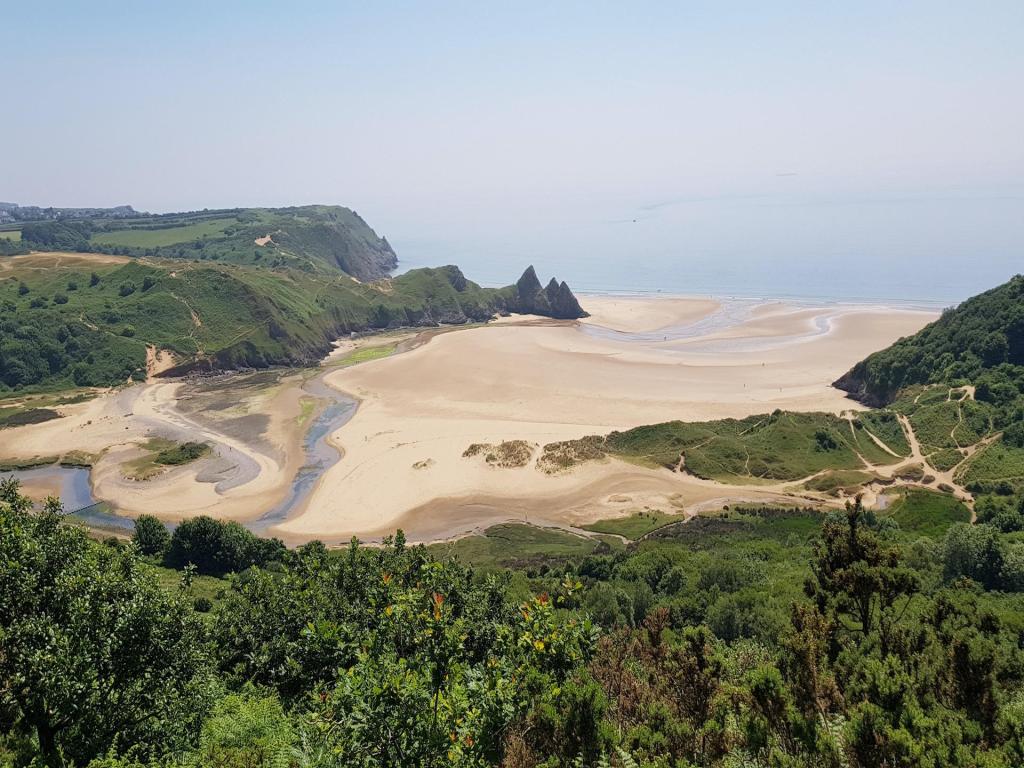
Three Cliffs Bay, Gower Peninsula – where we ended up by lucky chance, on our hitchhiking trip

Perhaps we were less sophisticated back then, but in more recent years I experienced a similar sense of the miraculous, when walking – or was it flying? – across the ravine on the new footbridge at Tintagel in Cornwall. The two sides of the cliff were connected by a land bridge in medieval times, but this collapsed centuries ago, and since then a steep scramble down and back up had been the only way to get across. But now, as one of the project managers says on this video: ‘It was just the most amazing moment, to be able to walk across that bridge and see a view that hasn’t been seen for five hundred years.’

Another captivating view at Tintagel, on the approach to the bridge, plus of course a meeting with King Arthur himself!

The River Exe

One story I’ve researched is that of the bridge over the River Exe, in the city of Exeter. I chose it as my special project during my training as an Exeter City Red Coat Guide.

The River Exe starts as a trickle in boggy upland Exmoor, near Simonsbath, winding its way down to the sea at Exmouth some 63 miles further away. The city of Exeter is just a few miles from the coast, and both the river and the nearby ocean have always been crucial to its history. In Roman times the city was known as Isca Dumnoniorum, the former territory of the Celtic Dumnonii tribe; the Romans made good use of river and sea for valuable import/export trading, and based their port about five miles downriver at Topsham – which happens to be where I currently live.

What’s in a name?

You’ll see from the map that the River Exe joins up with the River Barle just below Dulverton. So why should we take it for granted that the Exe swallows the Barle, rather than the other way round? As the Barle is a beautiful and major river in its own right, quite frankly it could have gone either way with the naming of the river! In which case we might now be talking about the city of Barleter. Not to mention Barlford, Barlminster and Barlmouth.

Below: some bridges upriver on the Exe, as it meanders across Exmoor; the bridge on the right is at Winsford
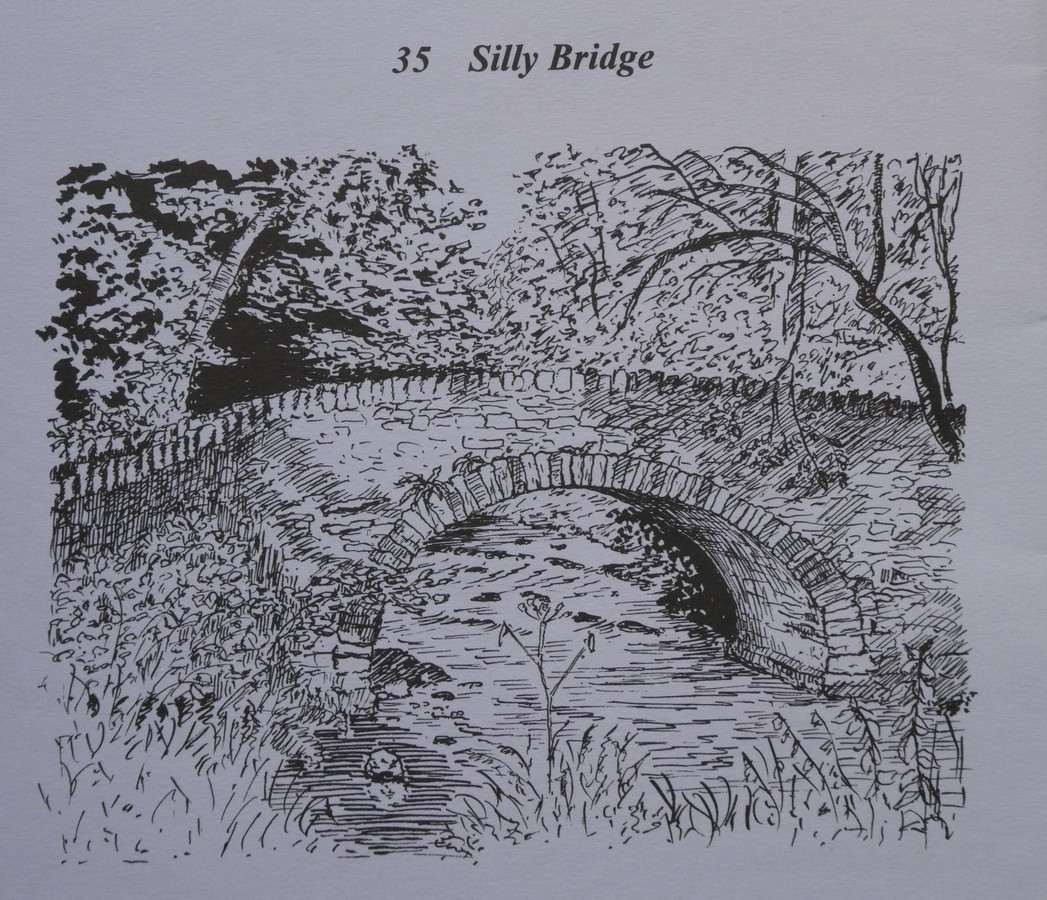
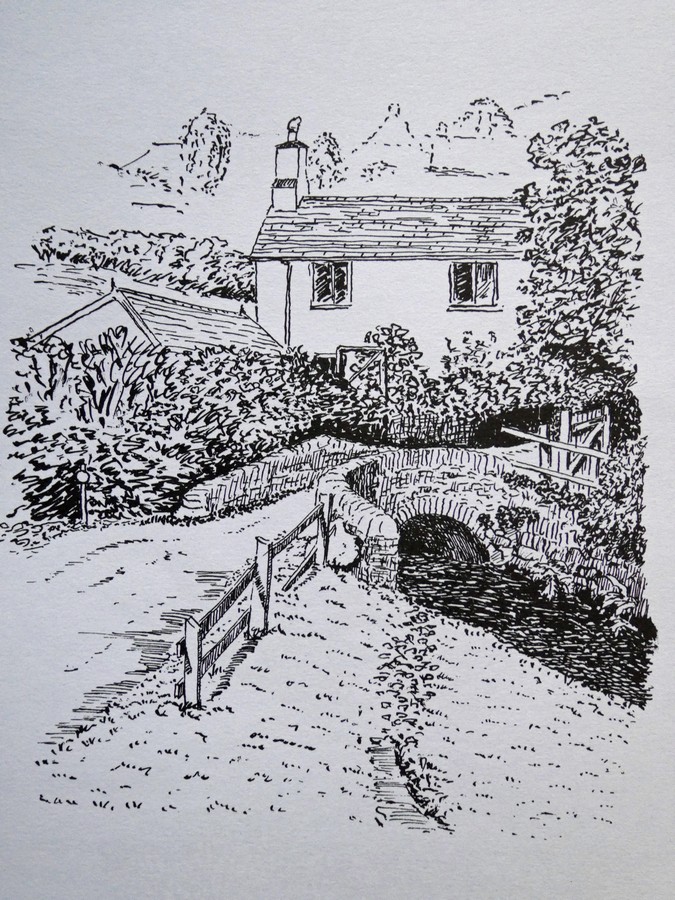
The  River Exe has charming wooden and stone bridges along its early lengths, but when it passes through Exeter itself, it has become broad, powerful, and often turbulent. Building a bridge here is fraught with difficulty. Flooding used to be common too, until modern flood relief schemes were implemented. So how might the Romans have managed, with travellers, animals and goods arriving at West bank of the new city?  There were probably ferries, and there was certainly a ford, but this was often dangerous to cross, even on horseback. A bridge would have been a necessity.

Mark Corney, a specialist Romano-British archaeologist, told me that the Romans may well have built a bridge of stone or stone and timber across the river at Isca Dumnoniorum, similar to others which they built in Europe, but no traces of it now remain. We can assume that this was eventually washed away, and that wooden bridges were probably built in Saxon and early medieval times, which were themselves destroyed even more quickly.  

The Roman bridge at Merida, Spain, which might be similar in construction to what the Romans built over the Exe

Building Exe Bridge

In about 1200, the first ‘modern’ stone bridge was built across the river, with some 17 or 18 arches. It was broad enough for the two-way traffic of horses, donkeys, cattle, carts, pedlars, and so on.  And it was imposing, at around 282 meters long – about two thirds the length of the old London Bridge. This medieval bridge served the city until the late 18th century. Part of it remains today, and the intrepid visitor can still walk across it, surrounded by a swirl of traffic racing around the new road system on the periphery. The river itself has been gradually channelled into narrower boundaries, so much of the old Exe Bridge passes over low-lying, but dry ground.
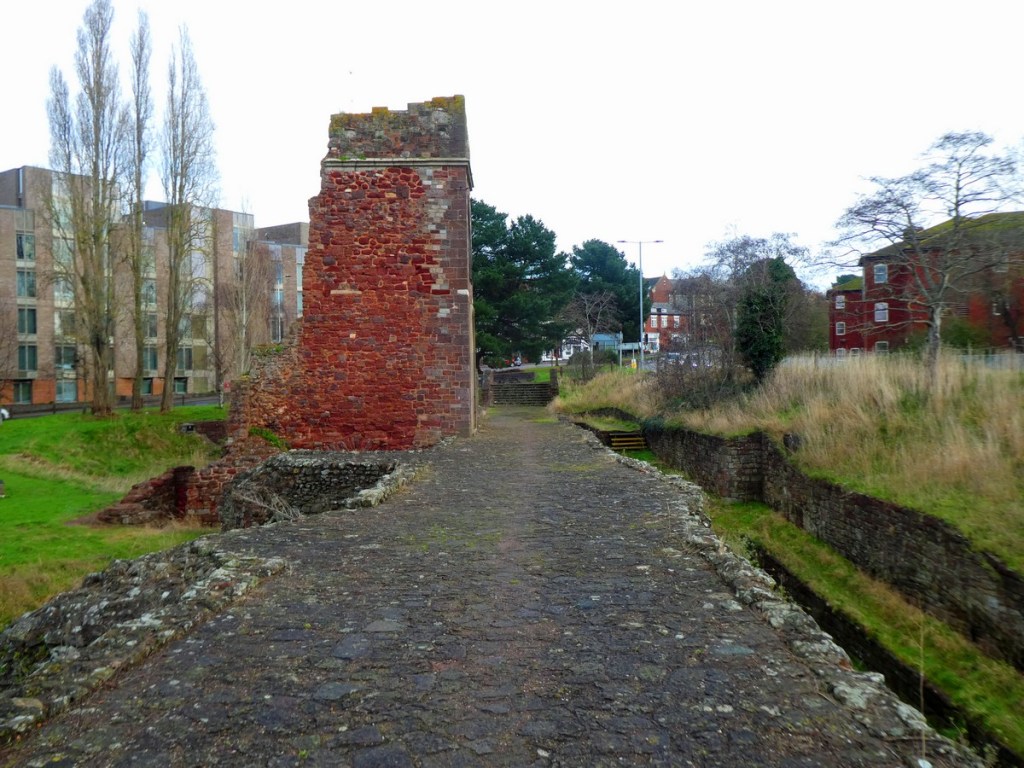
The medieval bridge over the river Exe in Exeter, allowing travellers from the West to enter the city. The river was shallower and wider then, and would have stretched right across where the grass is now. All that remains of St Edmund’s Chapel now is the tower, although it was in use up until the 1960s.

Building Bridges as a Virtue

The building of stone bridges in Britain during that medieval period was loaded with significance. It was a mark of charity for wealthy merchants to contribute towards bridge-building – in Exeter, the Gervase family, father Nicholas and son Walter, dug deep into their  well-stocked coffers to provide much of the money needed. It was probably a win-win situation for the merchant donors, as such a ‘modern’, safe bridge would encourage commerce, and flag up how well-equipped the city was to receive traders.

Above: The old Saxon pillar, probably once part of a cross located by the River Exe to offer spiritual protection for those trying to cross the river, in the days before there was an adequate bridge. Now in the Royal Albert Memorial Museum, Exeter

Praying for your soul – Chapels and Offerings

Crossing over water is always perilous; even with a relatively safe bridge in place, the gods or deity must be placated. It was common practice to throw offerings into the water before crossing a river, whether by ford, boat or bridge. Votive offerings such as coins have been found in the River Exe from different periods, along with an old Saxon cross, which might have marked the place where it was safest for travellers to cross the river. And sometimes, chapels were built on bridges themselves in the medieval period in Britain. There were originally three of these chapels on or by the Exe Bridge, of which only one, St Edmund’s Chapel, still remains, though it is now in ruins. St Edmund was rather an appropriate saint to choose, since he was a 9th century East Anglian king, who hid under a bridge to avoid capture by the invading Danes. In vain, alas, for he was caught and martyred for his faith.

Repair bills

The practical issue of funding bridges has loomed large throughout its history. (And still does – the 2nd Severn Bridge has only been free to cross since 2018, when the debt for building both bridges was finally paid off by toll fees.) Despite the relative stability of Exe Bridge, floods were still frequent, washing away stones and damaging the piers of the bridge. Tolls alone couldn’t pay for it all.  Just as it was an act of charity to pay for the building of a bridge, so too was it a worthy deed to leave money in your will for its upkeep. Even small donations were welcome – in his will of 1269 Adam de Collecotte, layman, left 6d to ‘the bridge of Exeter’.

Nevertheless, even on this well-maintained bridge, floods could still endanger life; in Tudor times a tanner called John Cove and his wife were swept away downriver on their bed when their house fell into the raging torrents! Apparently he managed to paddle the bed to safety, using  his hands and feet to steer it onto solid ground downstream. The servants, it’s reported, were not so lucky – they drowned in their beds.

Life on the Bridge

Living on the bridge: the last surviving houses which stood on Exe Bridge since the 1500s or so pictured in about the 1880s

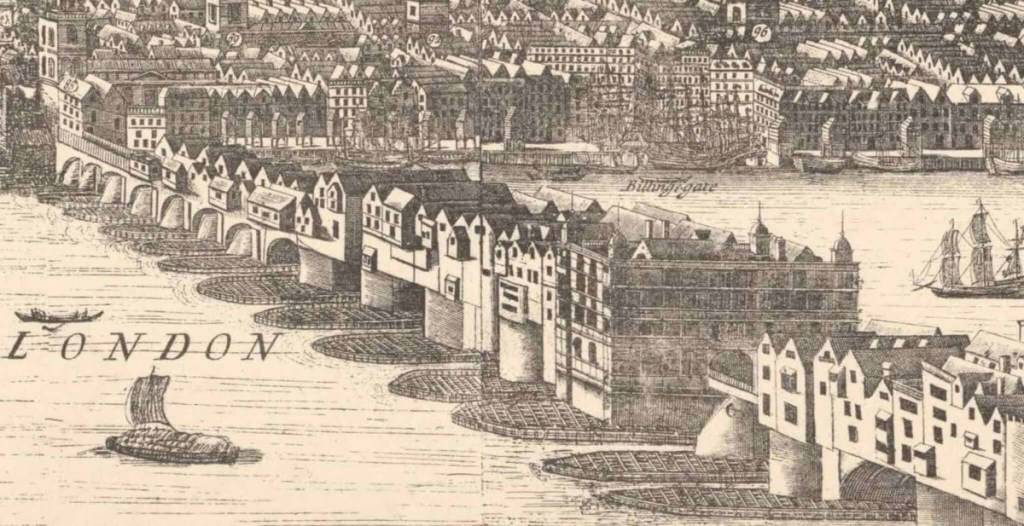
A bridge wasn’t just for crossing, either. No, it was for making the most of in daily life too! Exe Bridge became packed with houses, again rather similar to the buildings on the old London Bridge and on other bridges in the UK – bridges where you could shop, pray, drink, live, or store your goods. Some of these buildings on the Exe Bridge lasted right up until the 19th century, and some still remain on a few other bridges in the country. There are still shops, for instance, on the elegant Georgian Pultney Bridge in Bath.

Above: Pultney Bridge in Bath; the small shops which span the length of the bridge.
Below: London Bridge in its medieval form.
The Long Drop

On the Exe bridge one building was known by the enchanting name of ‘The Pixy House’. The reality was not so pretty – this was in fact the first public toilet on the bridge, presumably with ‘the long drop’ to the waters below.

There was even a pub on the Exe Bridge, but along with that goes a sad story of some vagrants, who used to lodge there before peddling their ‘sulphur’ matches by day on the streets of Exeter. One night, in 1775, they accidentally set fire to their room while illicitly boiling a pot of brimstone with which to coat their matches. Some died of fumes, others when the roof burst into flames and collapsed. The pub, ironically, was called ‘The Fortunes of War’.

Holy Toll Gatherers

The seal of the bridge keeper at Exe Bridge

The spiritual significance of a bridge carried through to its mundane finances too. Hermits were sometimes appointed to collect any tolls due – it was probably mutually beneficial, since the hermit could gain from having a fixed lodging, and a modest income, and the bridge authorities would get their revenue. Most probably travellers wouldn’t usually dare to refuse the holy man what they owed! Hermits could act in other capacities too in their role as bridgekeepers –supervising repairs for instance, or acting as wise counsellors to passers-by. In medieval times they were not necessarily recluses, but often had a hut or dwelling at a cross roads, where they dispensed wisdom and were handed alms.

A less orthodox kind hermit was found on Exe Bridge, however – a female anchoress. In 1249, records relate that ‘a certain female hermit had shut herself up on the bridge of Exe and was obstructing traffic. Carts could not get by, to the grave damage of the city’s trade.’ And there she remained, for several years. It seems that no one knew quite what to do about her.

I would love to be able to wander back in time, visiting the shops on the bridge, chatting with the folk who lived there, maybe asking a hermit for a bit of wise counsel…and if I visit ‘The Fortunes of War’, I might even pay a visit to the Pixy House…

‘The View from a Bridge’

How does today’s bridge keeper feel about their task? – for there are still some of this ancient and noble calling? Here’s what one has to say:

Having worked on drawbridges for over 12 years, I’ve come to know how strongly many people feel about bridges in general. Just publish your plans to demolish or replace one, and brace yourself for the public outcry. People love to walk and jog across bridges, and many’s the time I’ve witnessed marriage proposals. Fishermen often have their regular spots staked out, and people love to hop out of their cars during bridge openings to enjoy the weather.

(‘The View from a Drawbridge)

Bridging Worlds

A bridge may in some sense may transport us from one world to another. In myth, a rainbow bridge can lead us into the realm of the gods) or a fiery bridge to the land of demons. Or a magic bridge may be conjured up to help the hero or heroine to escape danger. There’s a sense of this in real life too, when a bridge leads us from one country to another, as with the Severn Bridge from England to Wales, or from island to mainland, as with Skye in Scotland where a bridge has been constructed in recent years. Even a tiny bridge can have major implications, such as the one from the airplane into terminal, as you leave the strange world of mid-air limbo, and prepare to step onto new and solid terrain. Bridges are ‘liminal’ places – and perhaps if we linger a little more, or at least become mindful when crossing bridges, we might sharpen our perceptions of changing from one state or place to another.

The Unwelcome Bridge

Not all bridges are benign, however. In Topsham, downriver from Exeter, there is no bridge across the river Exe. So just imagine what it would have been like in the Civil War of the 1640, when General Fairfax threw up a temporary bridge across the River Exe at Topsham, ready for marching his enemy troops over to capture the town. What fear that sight must have caused to the inhabitants! Yesterday, no bridge – today, no one is safe. Capture it he did, though not for very long…

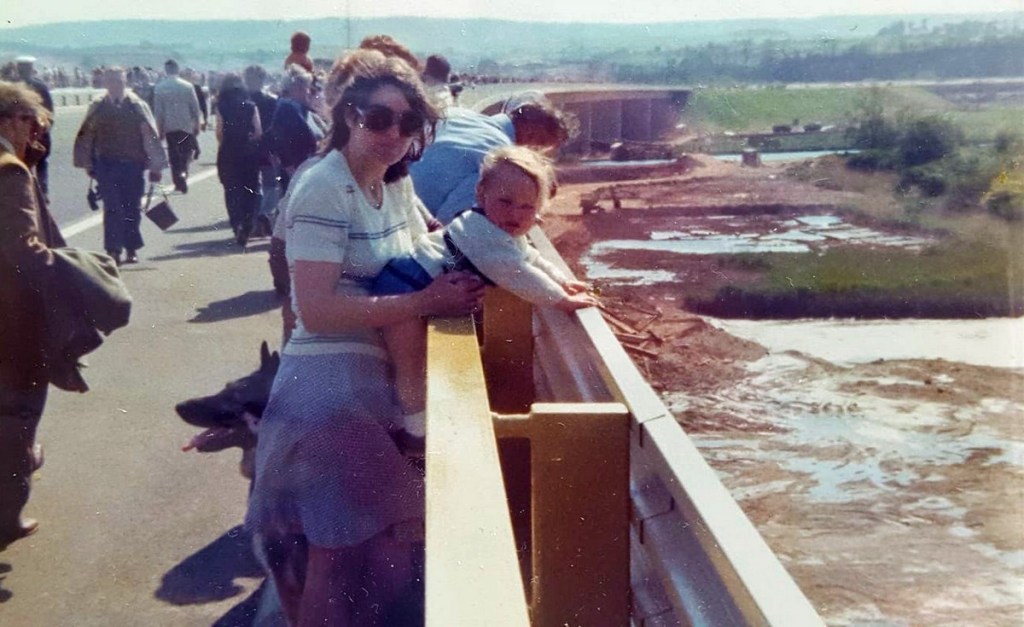
In the 1970s, a more permanent new bridge appeared across Exe upriver from Topsham – the M5 motorway bridge. Before vehicles was allowed on it, pedestrians were invited to walk over and admire the view. Today, the motorway brige, and the noise of traffic dominates the scene upriver from Topsham. Any new bridge certainly has an impact – in this case better for some, disruptive for others.
And another view – one from under the M5 bridge

Bridge awareness

Perhaps there’s no such thing as a bridge with no meaning or significance. And if we paid conscious attention every time we crossed a bridge we might experience this transition more intensely. Why not give it a try? Most of the time, it may be a relatively mundane experience, but sometimes it may be an intense challenge. It took me a huge attempt to overcome my fear to cross the Carrick-a-Rede rope bridge in Northern Ireland. I clung on for dear life – it didn’t matter how safe it might be in theory, it felt like dicing with ultimate danger!

I’m plainly hanging on, as I cross the Carrick-a-Rede rope bridge in a state of great trepidation!

Bridge Despair

Sadly, a bridge can sometimes be chosen as a place to end one’s life. The Exe Bridge of the 19th century (a replacement for the medieval one) was notorious in this respect, as we can see from various old newspaper reports. Mercifully, not all these suicide attempts were successful, though that in itself could be a serious problem. Until 1961, suicide used to be a crime in British law, so a failed attempt could lead to a jail sentence. However, judges often showed compassion:

1890 Edwin Cole aged 32, was arrested for trying to commit suicide. Witness said that at about half past nine in the morning he was standing on the Exe Bridge and saw the prisoner, suddenly throw his hat into the river, clap his hands, exclaiming, “The devil’s got hold of me.” He then threw himself into the river about fifty feet below. Cole was out of work, out of money, and rather drunk – when rescued by the witness and his friend, he said, ‘I did not want to swim ; I wanted to go to the bottom. I have had a lot of trouble, and I am tired of my life.” He was then referred to Sessions Court where he was discharged by a merciful judge after his ailing mother promised to look after him.

(A summary of the report in the Western Times).

Our modern-day Drawbridge keeper also sees the nature of bridges as a jumping off point, sometimes in a horribly literal way: 

Bridges also represent transitions. “Crossing over” is a euphemism for taking that journey from life to death. Perhaps that’s also why so many people use bridges when they’ve made the unfortunate decision to end their lives, a decision which, speaking from personal observation, is made far more frequently than is reported in the media, and is also a decision which they instantly regret, judging from their screams on the way down. (‘The View from a Drawbridge)

Occasionally, a woud-be-tragic story turns into comedy. In 1885, a young woman called Sarah leapt off the Bristol Suspension Bridge after a row with her fiancé, to what she imagined would be a suitably dramatic death . However, her billowing skirts acted like a parachute, and she landed relatively unharmed in soft mud, living to marry another and surviving to the age of  85 years.

One of the most famous bridges in the world, at Sydney harbour, Australia

Bridge of Hope

And finally, I return to the drawbridge keeper for this positive view of the bridge:

Perhaps my favourite bridge symbol, though, is that of hope. If you can just get over that bridge, you may find yourself in a better place on the other side…So in some ways bridges can represent a struggle, but one with the prospect of better things on the far shore. I find that inspiring. (‘The View from a Drawbridge)
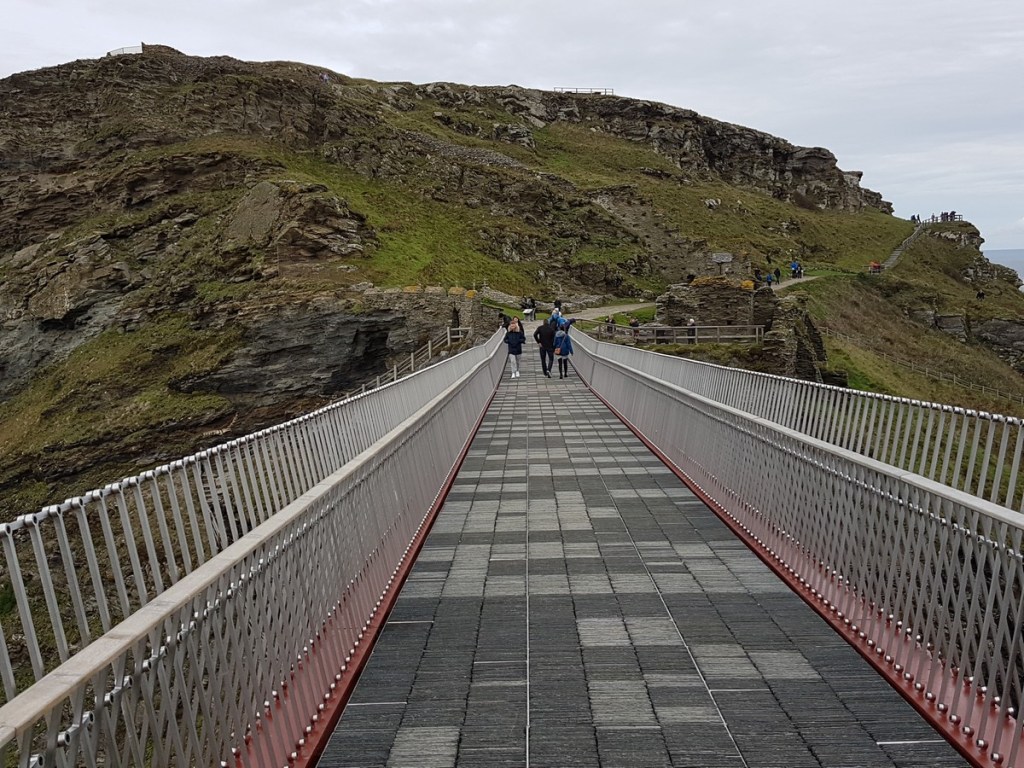
Crossing the bridge at Tintagel, into a magical world….perhaps!

Shamans, Lunatics and a White Glove – A Summer Bulletin

This is the first time during the summer period that I’ve posted on Cherry’s Cache. I’ve been very busy with other activities, and preparations for a house move to come. So it’s time I put up a Bulletin Blog, with updates and with snippets of stories which might interest you. Plus some hints of what might be coming along later!

100 today!

Celebrate…my 100th post on Cherry’s Cache! This is it. Little did I think when I started this blog, back in April 2020, that I’d reach this milestone. (216,826 words later…Oh, not quite halfway to War and Peace then.) Thank you, readers! I really appreciate your support. 100 and rising.

The Shamans

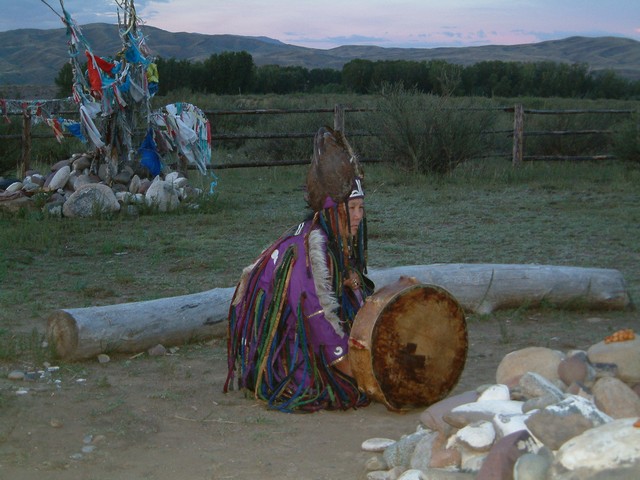
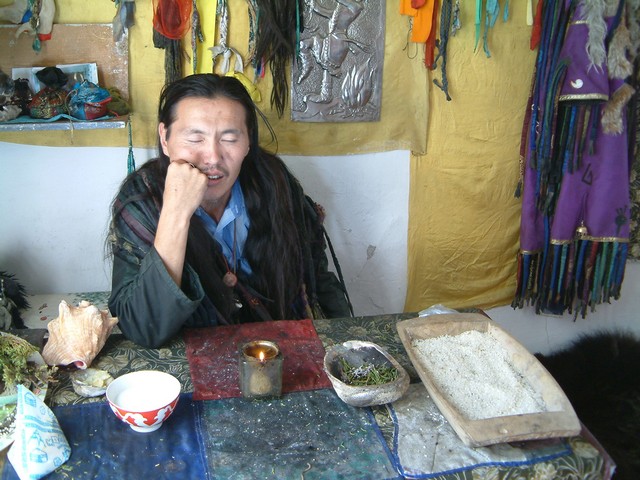
I will be giving a talk on ‘Siberian Shamanism in Person’ on Sun July 16th – ie very soon! This will be in audio internet format, and all are welcome to join. It’s hosted from the USA by R.J. Stewart and Anastacia Nutt, in their ‘Salon of the Western Mysteries’ series. Registration costs, timings (BST 6pm) and all other details can be found here . I’ll be speaking about my journey to Southern Siberia, where I met a practising shaman and discovered much about the local traditions – the relationship to nature, the power of the spirits of the land, and other fascinating elements of native culture and cosmology. You can find some aspects of this in an earlier blog which I posted about the encounter at . The talk itself will go further than this, and there will be opportunities for questions. The app used is ‘Go To Meeting’, which is easily accessed via a link sent to participants. I’ll say no more until the day!

The Lunatics

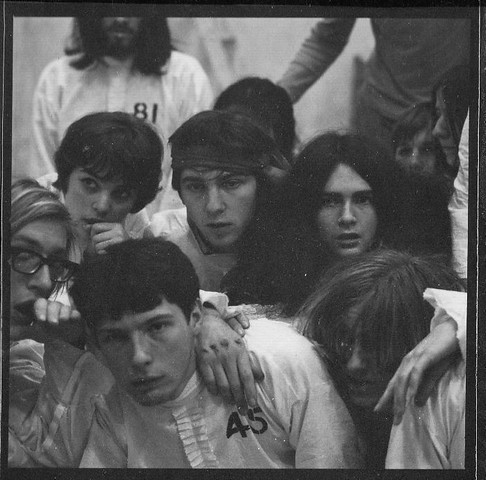
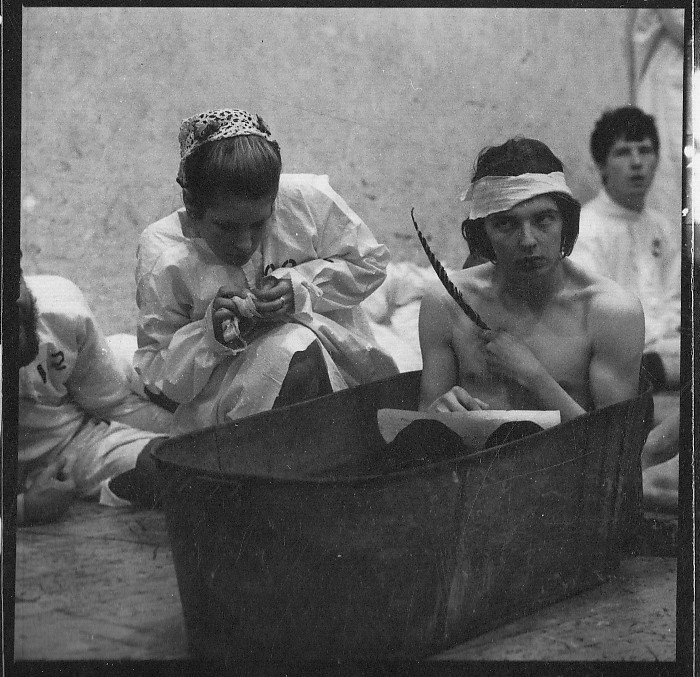
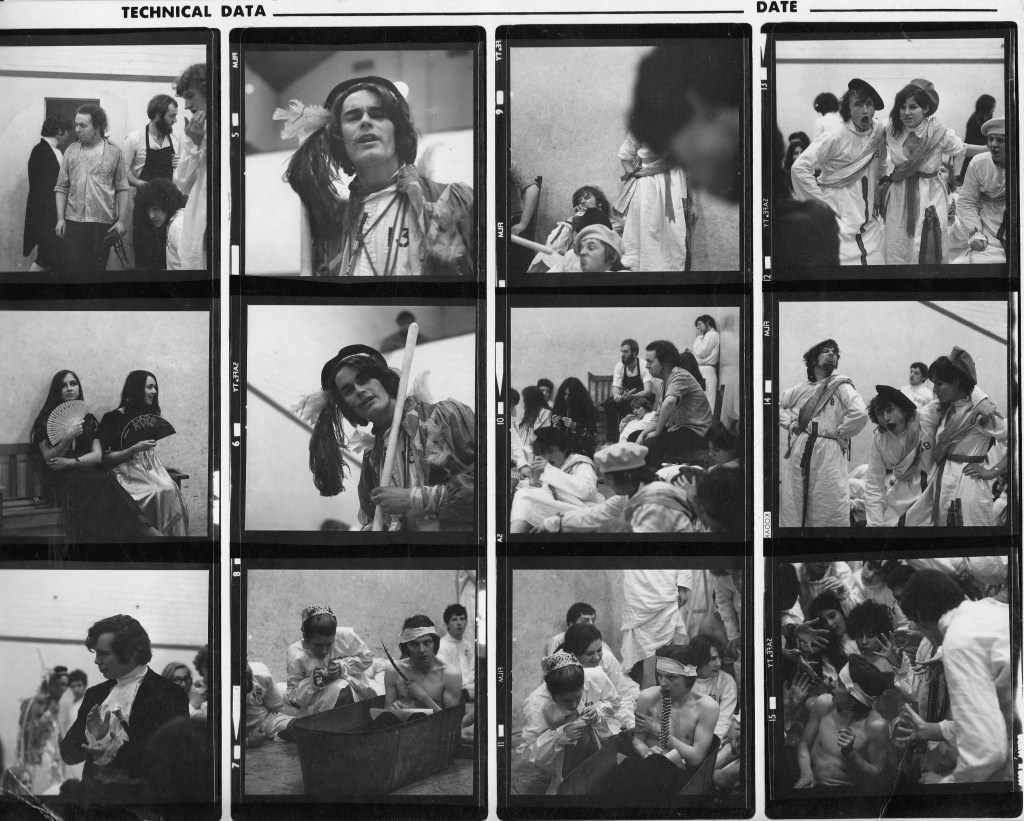
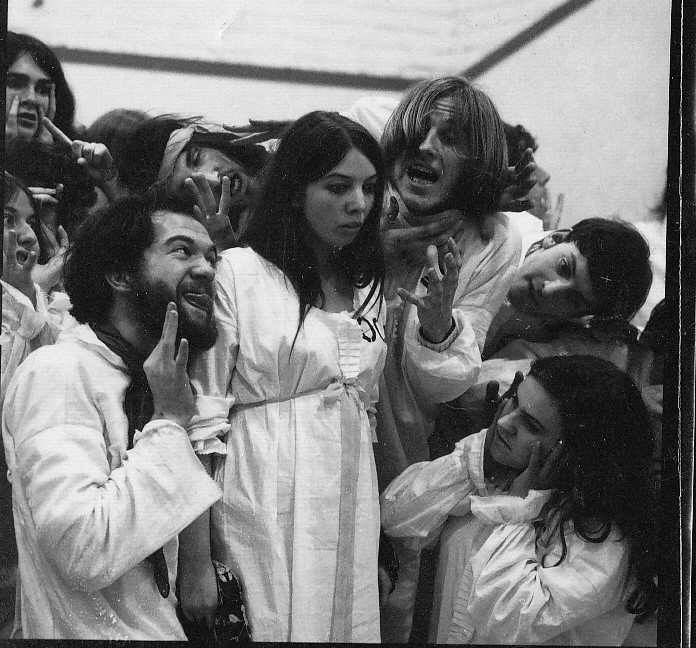
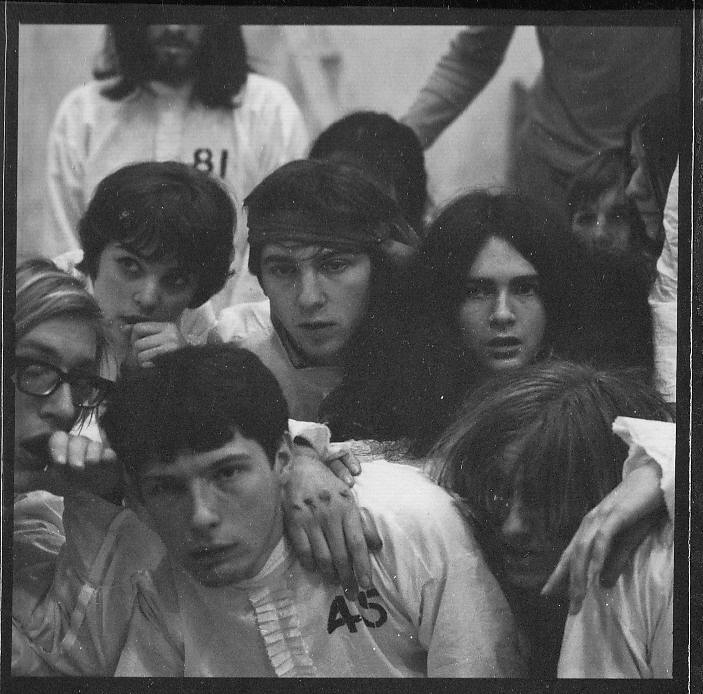
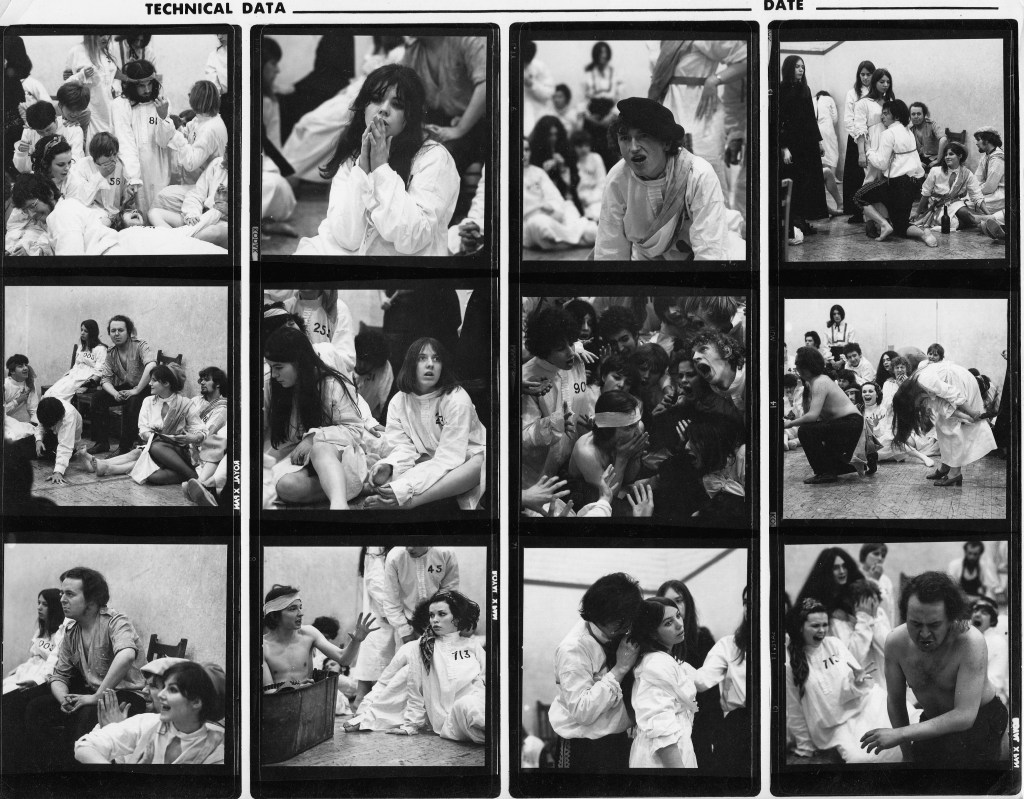
Then – here’s an update on Marat Sade, as it was acted in Cambridge by a bunch of students (including me) in 1969, with the innovative, somewhat controversial theatre director Bruce Birchall. See my previous blog about the occasion. . Many of those in the original cast have contacted me with their memories of the production – an iconic event in our days at university there. Finally, Briony Garety – formerly Janet Young – sent me the golden document that I was missing: the duplicated, typed cast list of Who was Who. Do you recognise yourself in the list?

I like the high-handed instruction that the Programme ‘should be read before or after the event, and should not be brought on the night, please.’ I wonder if there was full compliance? I daresay the director felt it should be more of a ‘happening’ than a conventional stage production. Wielding a programme would perhaps diminish the immediacy of the experience, which was meant to be immersive, as we lunatics leered at the audience. (I don’t think we actually molested them, though.)

It was a momentous event and Bruce was a hard act to follow.

I’m the one with the long dark hair, top right…

And then – The White Glove

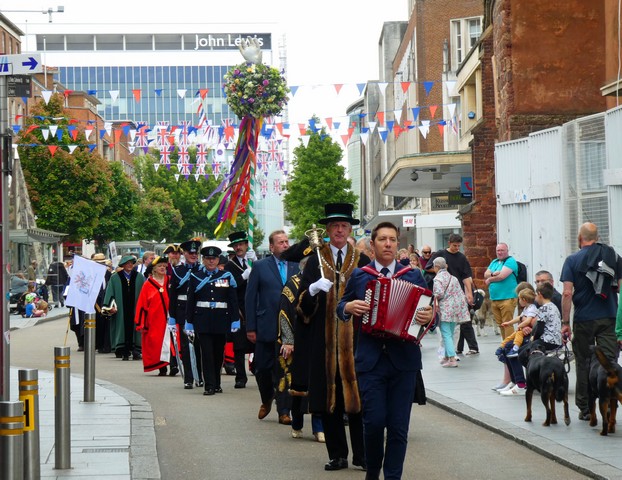
This week, I paraded with a contingent of the Exeter City Red Coat Guides in a procession which dates back 900 years – for the opening of the Lammas Fair. Last year, I visited with a fellow guide, and we decided to ask if we could join in. Our bright red jackets are born to march, after all! This year, the council invited us to do so.

Here’s the story of the Lammas Fair, taken from the Council’s own website.

And yes, I know that strictly speaking Lammas should be the 1st August (quartering the year with Halloween, Candlemas and May Day in the old Celtic and British traditions) but, well, Exeter decided to do it differently. Today’s parade marks the opening of the annual Craft Fair on Cathedral Green.

(The photos of the procession are mine, some from previous years; thanks to Red Coat Guide Susie Newton for the picture of us in action.)

From Exeter City Council:

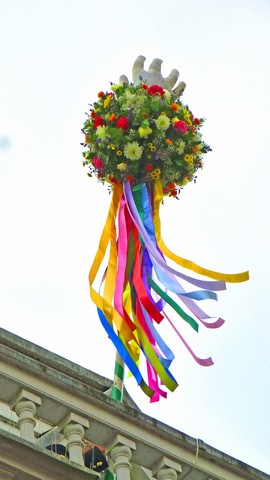
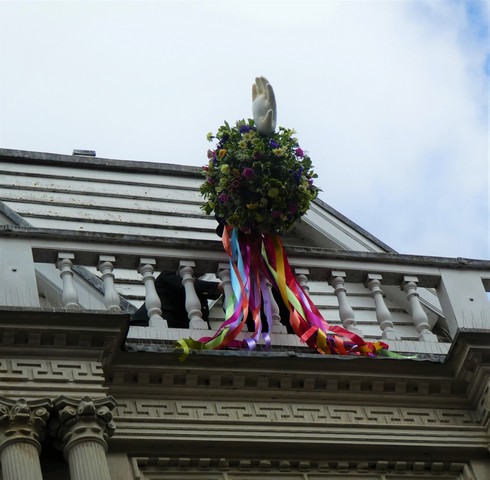
The wonderfully quirky tradition of parading a big white glove through city centre streets was today maintained in Exeter. Lammas Fair was celebrated in Exeter and at the end of the occasion, the big white glove was hoisted high above Exeter’s historic Guildhall, where it will remain for the next three days. Today’s Lammas Fair saw colourful pageantry in the heart of Exeter. The event got underway at 11am, with the Lord Mayor’s procession of the Lammas Glove, including civic dignitaries and Morris dancers departing from the Civic Centre.

The procession travelled down the High Street to the Guildhall, where the proclamation was read out and the glove hoisted above the balcony… The annual ceremony of the Proclamation of Lammas Fair dates back to before the Norman Conquest, more than 900 years ago. The word Lammas derives from the Anglo-Saxon Hlafmaesse or Loaf Mass. Lammas Day, the festival of St Peter ad Vincula, was when the first fruits of the harvest were offered to the Church in the form of a loaf…The Lammas Fair White Glove was displayed during the Fair and was a sign of Royal protection of the peace. The large leather, stuffed glove was attached to a long pole and was decorated with ribbons and a garland of flowers. Prior to the hoisting of the Glove, a Proclamation was made to declare the Fair open. The Proclamation was issued at the time of Edward III in 1330. A Court known as the “Pie Powder Court” was appointed for every fair to deal with any complaint or other matter arising within the Fair….

And so the Lord Mayor solemnly warned us not to commit any crimes as we moved on to enjoy the Craft Fair displays…

Creative Writing Courses

Another line of work I’m involved with is tutoring Creative Writing Courses for Oxford University Continuing Education. I began teaching for the department back in 2009, took several years’ break in the middle, then returned last year. Might you be interested in taking part? Take a look here. I can’t guarantee that you’ll be able to choose me as a tutor (or choose not to have me!) but I can say that the courses are very well run, have a student intake of all ages from locations across the world, and give you a chance to develop your writing skills in a friendly environment. They also involve lively discussion, which you can take part in more or less in your own time, rather than having to be on line at a specific moment. My own tutoring revolves around ‘Getting Started in Creative Writing’, ‘Writing Fiction’ and ‘Writing Lives’, but there are plenty more to choose from.

The House Move

Our plans have now crystallised, and if all goes well, we’ll be moving back to Gloucestershire in the early autumn. We’re heading to Minchinhampton, the area we lived in previously. Just over a year ago, I was drawn back to the beautiful hills and commons in the area, and since then we’ve been re-connecting with old friends and deciding that this is the place we’d like to return to. Here’s what I wrote at the time: ‘Sweet Chance on Minchinhampton Common‘.

The Future of Cherry’s Cache

…is still evolving! I have more subjects waiting in the wings, which will be developed as and when time permits. I promised more ‘Wild Women’ – there’s a radical revolutionary ancestor who’s story I want to tell – and a dip into the relationship between alchemy and music. Bear with me. My posts will emerge once we’re settled in our new home, if not before. In the meantime, I love to receive your comments and emails. It’s great to know that there are readers out there!

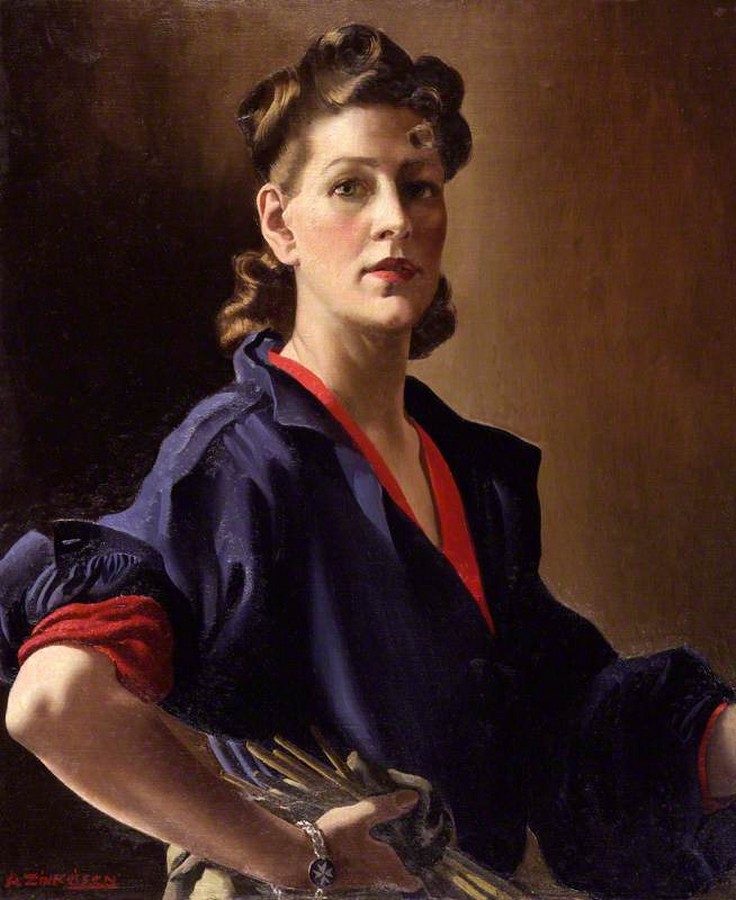
All posts remain available to access and read. I check the stats and am delighted when there’s a flare-up of interest, say, in Black Country humour, or the art of Anna Zinkeisen . The posts are there as resources for future readers. Pangur Ban and the Old Irish Cats remains the perennial favourite.

That’s it for now! See you again before too long. And you’ll find a selection of my books on the internet. Here’s a few of them, below.

Hope Bourne: A Wild Woman of Exmoor

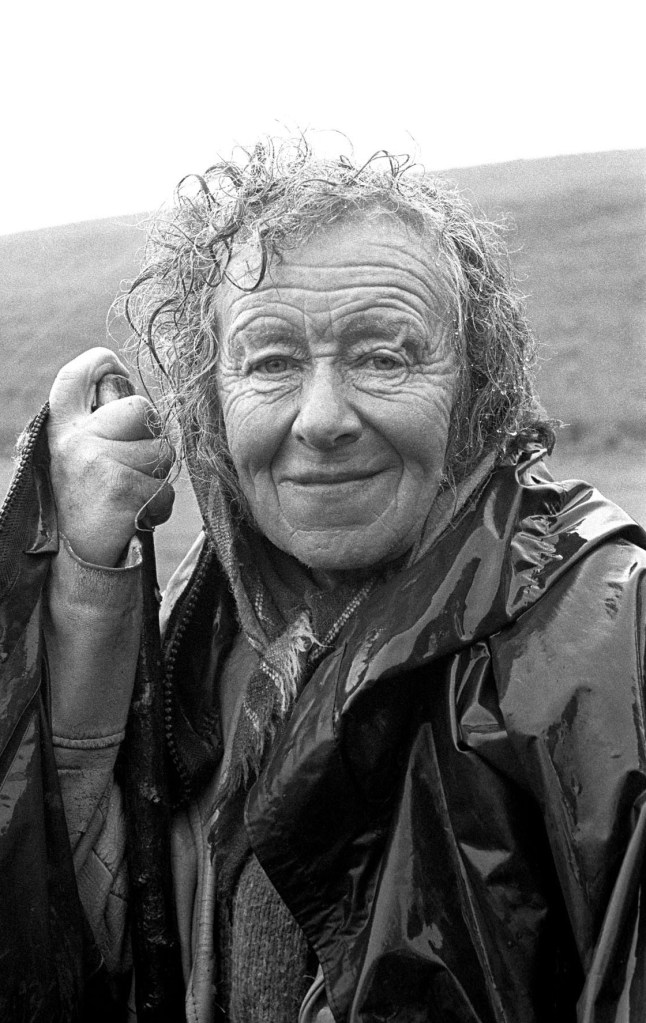
This is the first blog in which I’ll celebrate ‘Wild Women of Words’ – women who lived unconventionally, close to nature, and wrote about their own special pursuits. Here I’ll introduce you to Hope Bourne, whose writing was primarily about the wild landscape that she lived in.

Hope Bourne – reproduced by kind permission of Chris Chapman photography

A Personal Recollection

In the 1980s, when I was living near Dulverton on Exmoor, we used to buy the West Somerset Free Press newspaper. It was an all-purpose local newspaper, with the kind of headlines that didn’t shake the world. (The one which sticks in my mind was: ‘Rainfall breaks all records!’ Amazing, I thought – but reading on, I discovered that for the first time ever, it had been exactly ‘average’ for the last month. And ‘Hit and Run Driver’ was the villain who’d left a slight dent in another car and not left their details. But perhaps we should be thankful for such mild dramas in local life.


However, the newspaper also contained something unique – a column by one ‘Hope Bourne’. Was it a pseudonym, I wondered, as ‘Patience Strong’ had been a generation earlier, a pseudonym for Winifred Emma May who wrote morally uplifting, often cringeworthy poems for magazines. But I soon realised that Hope Bourne was indeed the genuine name of a woman who lived a very unusual life, immersed in the wild nature of Exmoor. At this time, Hope would already have been in her 60s. She lived remotely, more or less what we’d now call ‘off grid’, and walked miles over the wild moorland every day, sometimes shooting and fishing to catch her food. She was very knowledgeable about history and landscape, and not afraid to speak out from her own values, whether they were the popular ones or not.

Withypool, Hope’s nearest village


I learnt more specifically that she lived alone in a caravan on the site of a burnt-out farmhouse at Ferny Ball in the wilds of Exmoor. She had no transport, but would regularly walk the four miles to Withypool and back, to pick up essential shopping. She observed the changing seasons and the life of the moor in detail, writing and ruminating over the changes and sometimes painting or drawing what she saw – she was a skilled artist who had had professional commissions in her time. All this was the basis for her regular newspaper articles. And she shot rabbits for the pot, a firm believer in the old ways of the countryside. In this way, she was somewhat like the poet Ted Hughes, who hunted and fished as part of his immersion in the natural world, not backing away from the realities of where food comes from.

At this time, we lived in an old Devon longhouse, called Hawkwell Farm. It was no longer a complete farm with all its land, but we still had 10 acres – enough for me to fulfil a dream of owning a horse (or two), and keeping chickens, something which I’d loved as a child. Hope kept bantams around her caravan pitch in the abandoned farmyard. And according to her newspaper column, these bred freely and she often had more bantam chicks than she knew what to do with. So I plucked up courage and wrote to her. We could offer a home for one or two, if she liked?

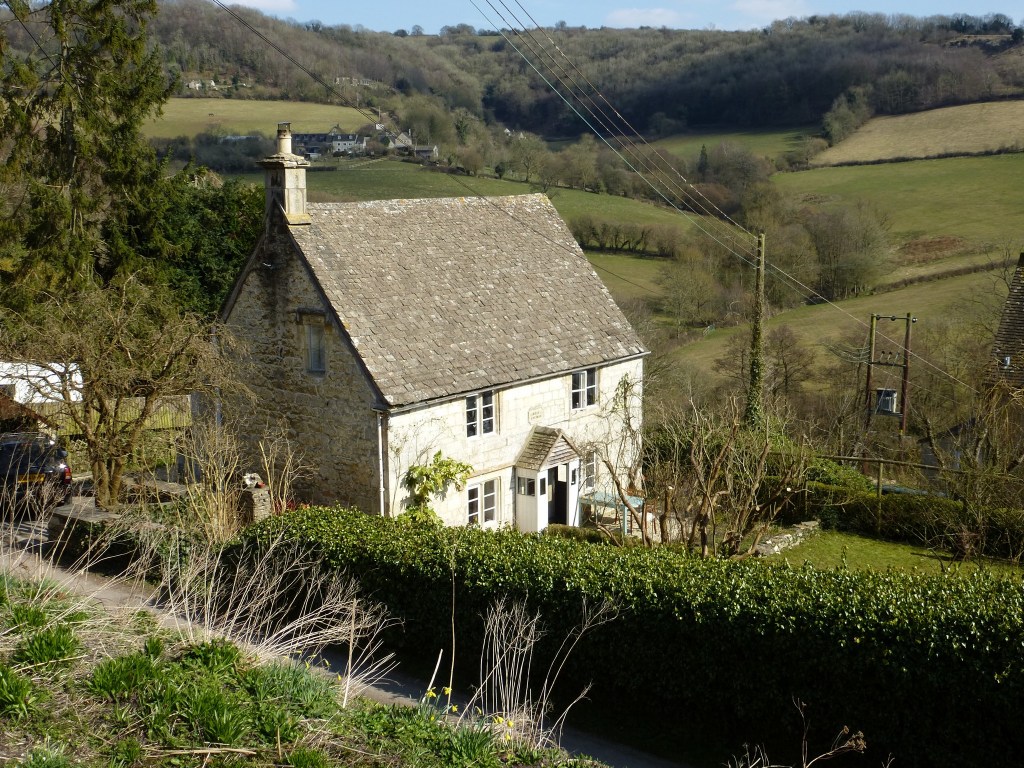
Hawkwell Farm, a more recent photo, looking rather more well-kept than in the days when we had it. Below are a picture map of its old field systems which was painted on our dining room wall at the time, and the nearby Hawkwell Cross.

Hope did indeed like the idea. She had a couple of spare bantams looking for a good home. She invited me over to visit her and I in turn invited her to come back in the Land Rover with me to lunch, and see where the two bantams would be living. She accepted with alacrity – she was keen to see corners of Exmoor that she hadn’t visited before.

All this happened forty years ago, so my memory is a little hazy, but I remember being somewhat shocked when I drove up to Ferny Ball, to see the ruinous state of the farm surrounding her caravan. And we chatted easily – I was left in no doubt that she was a sharp-minded, lively woman with strong views. I do remember in particular her opinion of the stag hunt on Exmoor, already contentious at that time, and later banned. ‘You see,’ she said, ‘I view it as one of the last remnants of medieval pageantry.’  I had never thought of it that way before, but I mused on her perspective. The deer do need culling, as they have no natural predators such as wolves in this man-managed landscape, and the debate is usually over whether it’s better to hunt or shoot them. There are many articles about deer on Exmoor, and their welfare, such as https://wildaboutexmoor.com/exmoor-deer/ and, in my old friend the West Somerset Free Press. But for Hope to see it as part of the old ways of the countryside, and its rich traditions, certainly gave food for thought.

Red deer, as I photographed them on Molland Common, at the full extent of my zoom lens
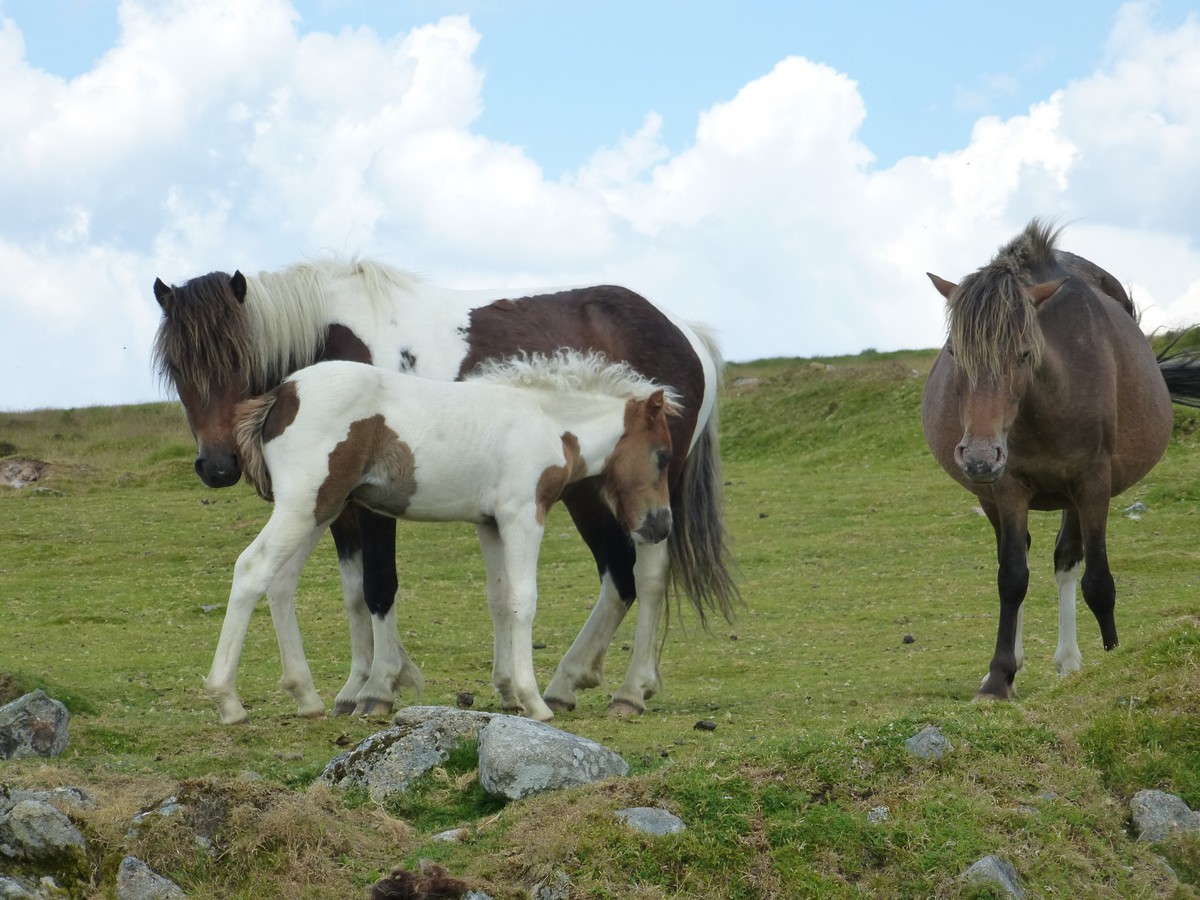
An Exmoor pony, on Anstey Common

Hope had arrived on Exmoor as a child. She was born in Oxford in 1918, the illegitimate daughter of a school teacher; her father was an Australian soldier, who she never met, but thought that she probably inherited her ‘love of guns and horses’ from him. Hope and her mother moved to Hartland in north Devon in 1927, and eventually in 1951 to a cottage on Exmoor. With just a short absence after her mother died in 1955 (when Hope tried out life in Australia on a sheep farm), Hope then lived on Exmoor for nearly fifty years. It was a singular life, but not a reclusive one. She loved her life alone, but also welcomed company – remembered by others as a kind, helpful woman. She often helped out on the farms where she was skilled with haymaking, harvest, and working with cattle and sheep. Horses were also her love, and she created beautiful paintings of the Exmoor ponies, who roam semi-wild there.


For many of these biographical details, I’m indebted to Chris Chapman for his video ‘How many people see the stars as I do?’ You can watch a trailer for the film (see below) and purchase it from Chris Chapman directly, an account of Hope’s life and his friendship with her. I’m also grateful to Chris for permission to use his stunning portrait of Hope to open this account.

The Bantams Arrive

Hope and the ‘banties’ thus arrived at Hawkwell, and we gave her lunch and chatted – I wish now that I’d recorded or noted down more of our conversation. Sprite, the female bantam, along with ‘Cocky’ (a male surplus to Hope’s own flock) settled down nicely with our assorted flock of free range hens, and a few more bantam companions. Then a little later, I received a further letter from her, offering me another growing bantam.

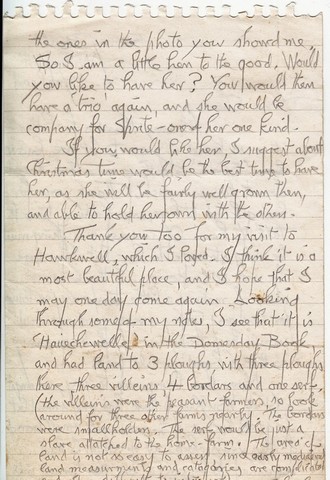
Dear Cherry,

Many thanks for letter – it is so kind of you to let me know how ‘Sprite’ is getting on – I’ve thought about her so much. Thank you for being kind to her, and finding time to talk to her. Of course, everything must be very strange to her, but I’m sure she will settle down. I think your idea of making a little temporary enclosure for her and Cocky a very good one – it would keep them in each other’s company so that a ‘bond’ would form.

Now this brings me to say, amongst a lot of troubles I have had one bit of good luck: of the youngest small brood of this year’s chicks, all of whom I had assumed to be cocks, one has turned into a pretty little lightish-coloured hen, like the ones in the photo you showed me. So I am a little hen to the good. Would you like to have her? You would then have a trio again, and she would be company for Sprite – one of her own kind.

If you would like her, I suggest about Christmas time would be the best time to have her, as she will be fairly well grown then, and able to hold her own with the others.

Thank you too for my visit to Hawkwell, which I loved. I think it is a most beautiful place, and I hope that I may one day come again. Looking through some of my notes, I see that it is ‘Hawechewelle’ (?) in the Domesday Book and had land to 3 ploughs, with three ploughs there, three villeins, 4 bordars [smallholders] and one serf, (the villeins were the peasant farmers, so look around for three other farms nearby. The bordars were smallholders. The serf would be just a slave attached to the home-farm. The area of land is not so easy to assess, since early medieval land measurements and categories are complicated and often difficult to interpret.

Hoping to hear from you again before too long,

Hope L. B.

The early days of our hens at Hawkwell, while still youngsters, before the bantams arrived.

After that, I didn’t meet Hope again, which is much to my regret now. Our own country dream (more romantic and less committed than Hope’s way of life) came to an end when we moved up to Bristol in 1987, and we re-homed our menagerie. Schooling for the children, work in London for my husband, my growing involvement in singing early music– all these prised us out of our Exmoor idyll. Plus it was very hard work. We were not made of the stern stuff that Hope was.

Her letter to me, below:


I kept up with news of Hope through mutual friends from time to time, and eventually heard that she had had to give up her ‘wild’ existence. She was getting older, less healthy, and no richer either – the Poll Tax imposed by Margaret Thatcher, money to pay simply for being alive, was one of the final straws. She had been a fierce resister in refusing all State aid for all those years, and now she was to be penalised for this. As we now know, this hugely unpopular tax was abolished a few short years later – but by then it was too late for Hope. She thus moved into sheltered accommodation with the financial assistance of kind friends.

Hope’s Legacy

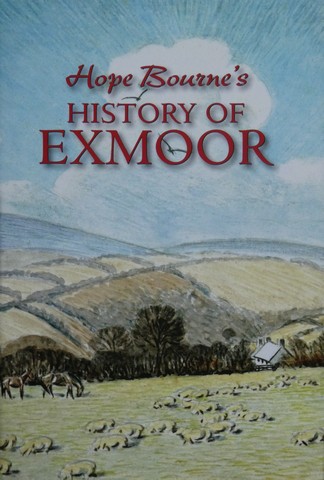
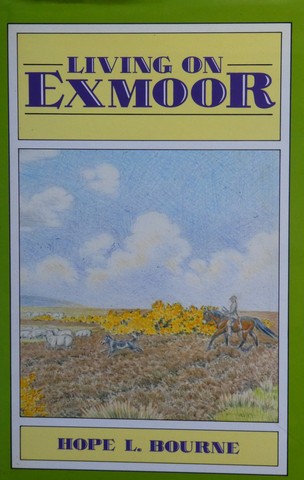
I have three of her books on my shelf: Living on Exmoor, Exmoor Village, and Hope Bourne’s History of Exmoor. Apparently Living on Exmoor was put together out of scraps of paper, packed up in a cow cake bag and sent on spec to the publishers! Luckily, they recognised it as something quite unique, and accepted it. Her writing can be a little on the effusive side, but I’m not surprised that it does sometimes go a little over the top – it is astonishing how she manages to sustain descriptions of nature and the landscape page after page. There are some truly beautiful passages, marked with sharp observations. From the chapter on May, therefore, in Living on Exmoor, which is particularly appropriate to the moment that I’m writing this, with the first of May in a couple of days’ time.

Everywhere the beech has burst into such a glory of living green as bewilders all the senses. Translucent, soft as silk, delicate as fluttering wings, holding the light in showers of pure green-gold – the beech leaves break over the harsh moorland landscape like a benediction, like a voice proclaiming life. Over hill and combe, all round the fields and about the grey-roofed farms the green tide flows and tosses, life from the brown shucked bud, life from the dead wood, life reaching out to the mounting summer sun. How lovely is the beech! No foliage is there more delicate in spring, no leaves so fiery in autumn, nor yet any tree stouter to face the winter gales….Now I walk home in the evening hours, with all the sky an ocean of endless radiant light…and see the hills dissolve in molten space, and all the leaves, each one a green translucent thing, a green light against the light. The sun sinks down and is gone. The horizon grows dark with a line of wind-twisted beech marching along its rim, far off and distant like a drawing. The sense of space and distance is enormous, infinite. It is like looking at a country far off in space and time…The dark sky-line against the light seems to draw one’s soul…Suddenly all things seem possible, for one feels a power that is more than mortal all around. It Is an awareness that is something beyond all human understanding.

The hollow drumming of a snipe comes strange and vibrant in the silence. I turn through the first field gate int the twilight, and the last sound of the night is the croaking of the frogs like inane laughter in the labyrinth of the bog below.

Hope became an esteemed figure in the landscape during her life on Exmoor. In 1978, Daniel Farson made a film about her. She thus became a ‘star of self-sufficiency’ for a while, but didn’t enjoy the attention – she didn’t want to be seen as a ‘back to the land’ hippy, but empasised that lived her way ‘out of necessity’. She never had much money; her grandfather’s will cut off any possible inheritance from her mother.

Since her death, her renown has grown year after year, and she is now a legend. Regular walks for visitors are conducted down the tracks that she walked, she features in Exmoor exhibitions, and has become part of the heritage of Exmoor itself. Our lives only touched each other for a short while, but I’m proud to have known her, and wish it had been for longer. Exmoor itself is imprinted on my soul, and now that we’re back living in Devon, I try to visit it regularly again.

The wild Exmoor uplands of Dunkery Beacon and the beauty of the beech trees in old Exmoor woodland.

For another illustrated article about Hope, with further details of her life, and emphasising her contribution to understanding nature and our place in it, see ‘How Many People see the Stars as I do?’ in The Return of the Native, a blog about Landscapes of Literature, Art and Song.

The Naming of Flowers: A spring musing

Our garden in spring

As I approach my 100th post on Cherry’s Cache, I’m taking a spring break. So I’m now posting one of my occasional ‘interludes’ which I hope will provide some gentle interest and amusement for a while. And meanwhile, behind the scenes, there are new posts in preparation. I never know exactly which ones will succeed and make the light of day, so I shan’t give away anything just yet! But I’m hopeful to have a few more to share with you through the changing seasons. To give a clue or two: a feisty lady whose invention was sought by royalty – an ancestral hero who was hanged for treason – and the story of a bridge which housed an illegal match factory. Let’s see how it goes!

The Magic of Common Names

For now, it’s the spring itself which prompts this post, about the names that we give to flowers. Those names which I learned in my childhood still cluster brightly in my mind. Meadowsweet, foxglove, deadly nightshade, celandine. Bluebell, speedwell, old man’s beard, and ragged robin. Scarlet pimpernel, Jack-go-to-bed-at-noon, and marsh marigold. All these are old familiar friends to me, and I have no trouble identifying them in fields, woods and hedgerows, in the way that my parents taught me on our country walks when I was a little girl. I imagine that in my mother’s case, they were handed down to her by her parents too –my grandfather, taught me that hawthorn leaf buds were called ‘bread and cheese’, and that they were tasty to eat. (They are, too!) He also said: ‘When the gorse is out of bloom, then kissing’s out of season’. Something I’ve trotted out regularly, to the boredom of my own family. A botanist later explained to me that they have identified two different species of gorse, which bloom at different times of year, hence the impression that they’re perennially in flower.

The gorse which proves that ‘Kissing’s never out of season.’

I loved leaning these names, and must admit that I haven’t progressed hugely beyond my childhood lists. (I have added though, for instance, Bog Asphodel, Yellow Rattle, and Star of Bethlehem. Plus Lousewort and Feverfew, Angelica and Yellow Archangel)

Left: Bog Asphodel, photographed on Woodbury Common, East Devon.

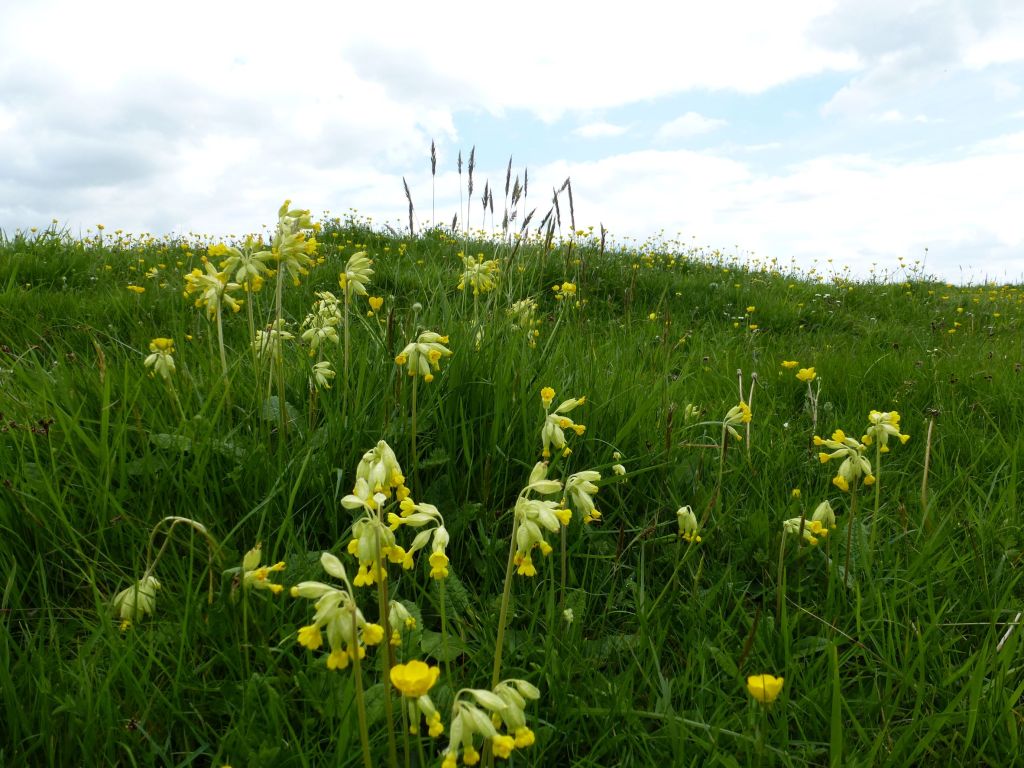
Right: Yellow Rattle and Star of Bethlehem, photographed on Minchinhampton Common, Gloucestershire

I will never be a proper wildflower specialist, because above all else, I love the ‘common’ names and resist learning the Latin ones. They may be far more accurate in differentiating species, but they lack the character of our common ones, which are often steeped in folklore, healing lore and bawdy jests. (see below, for Cuckoo Pint).  Last summer, in 2022, writer Michael Rosen broadcast a radio programme about these names, in his BBC series ‘Word of Mouth’. If you can access iPlayer, it’s available at https://www.bbc.co.uk/sounds/play/m0019m7c

The programme description reads:

Snotty Gogs and Moggie Nightgown may not immediately mean a lot to you but as common or folk names for the Yew berry and Wood anemone they reveal a fascinating social and cultural history of the countryside. Michael Rosen talks to the natural history broadcaster Brett Westwood about the informative, often funny sometimes bawdy names given to British plants and flowers.’

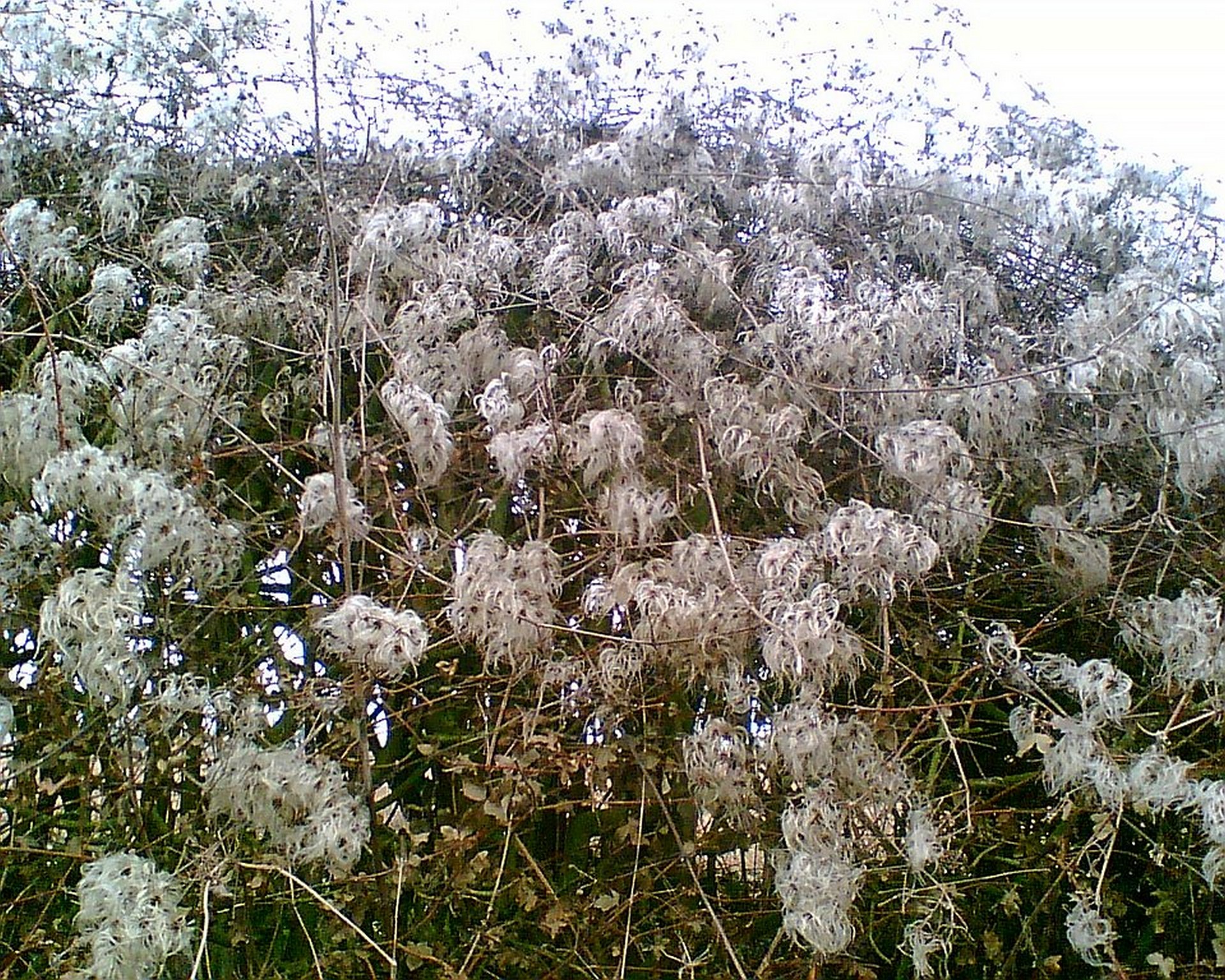
Some are a kaleidoscope of interchangeable names: Eggs And Bacon may also be called Birdsfoot Trefoil, Cuckoo Flower can be Lady’s Smock, that sticky grass which you threw at when you were little) can be referred to Cleavers, Goosegrass or Sticky Willie. And in my mind, Eyebright, Speedwell and Traveller’s Joy are all the same thing – small, bright blue flowers. Though either I telescoped them or was taught erroneously, as on further checking it seems that Traveller’s Joy should really be identified with Old Man’s Beard, growing in the hedgerows and seen most clearly in winter. Listening to Michael Rosen’s broadcast I was taken aback to hear that Cuckoo Pint, which is what we used interchangeably with Cuckoo Flower, actually relates to Lords and Ladies, ie Arum Lilies. However my shock is not at the casual transference of names, but the fact that apparently Cuckoo means Cuckold, and Pint is an old word for penis – you can work out the implications I am sure.

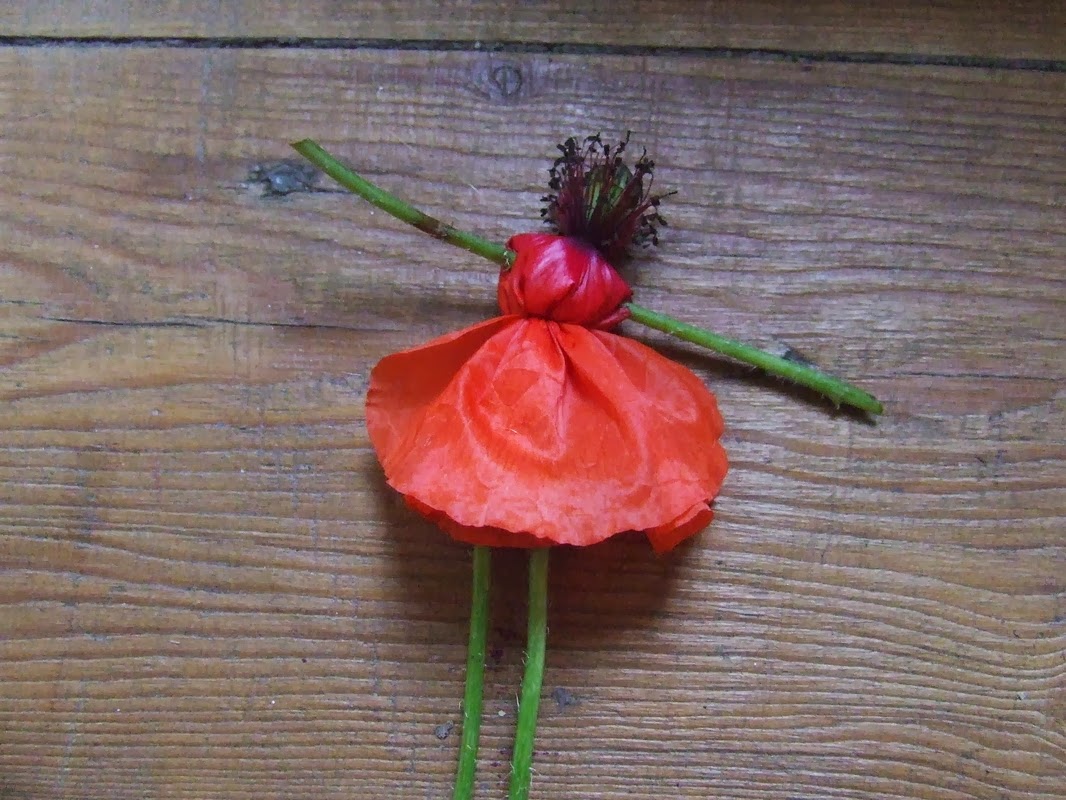
The same radio programme also mentions flower games, such as making daisy chains, which reminded me how my Auntie Maisie taught me to make Poppy Dolls. You carefully fold the scarlet petals back, exposing the black frilled seedhead at the centre, then tie the doll’s waist with a soft piece of grass, and poke a stiff piece of grass through the upper area of the petals to look like arms. Could I find an image of these on the internet? (It not being the poppy season to give me a chance to revive my skills.) Hooray, I could! These ones have two legs rather than our single stem ‘leg’. I wonder how they did that?

Old Man’s Beard or Traveller’s Joy, Marsh Woundwort, and Forget-me-not

The pandemic project: listing names

So to conclude, here’s a list of ‘common’ names which I copied out of a book of flowers. It was an afternoon-idling kind of activity that I turned to in lockdown, and now it can find a place here. I wrote out all that appealed to me for the ring of their names, the humour and the stories that must go with them. The book was ‘Field Guide to the Wild Flowers of Britain’, published by the Reader’s Digest in 1981, and as well as an identifier, it’s a treasure trove of information on plant names, uses and folklore.  Some are well-known, some unusual or regional. And rather than call them common, I’d use the word ‘magical’. See what you think.

Bullrush

Marsh Marigold

Stinking hellebore

Traveller’s Joy

Buttercup

Foxglove

Lady’s Smock –

Cuckoo Pint

Meadowsweet

Spearwort

Crowfoot

Treacle mustard

Gold-of-pleasure

Swine-cress

Shepherd’s purse –

Mother’s heart

Lords and Ladies

Ragged Robin

Bachelor’s Buttons

Chickweed

Sally-my-handsome

Hottentot fig

Good King Henry

Fairy flax

Herb Robert

Goat’s rue

Lady’s Mantle

Biting stonecrop

Jack-go-to-bed-at-noon

Sundew

Enchanter’s Nightshade

Rosebay Willowherb

Shepherd’s Needle

Sweet Cicely

Common dodder

Lady’s Slipper

Aaron’s Road

Toadflax

Monkey Flower

Red Rattle

Self-Heal

Marsh Woundwort

Yellow archangel

White Horehound

Skullcap

Lady’s bedstraw

Sheep’s fescue

Yorkshire fog

Creeping Bent

Snapdragon

Love-in-a-Mist

Hollyhock

Hound’s tongue

Corngromwell

Goosegrass

Honeysuckle

Devil’s bit Scabious

Butterburr

Colt’s foot

Fleabane

Common cudweed

Golden Rod

Mountain everlasting

Sneezewort

Nipplewort

Smooth hawk’s beard

Cat’s Ear

Frogbit

Solomon’s Seal

Butcher’s broom

Star of Bethlehem

Field Wood-rush

Stinking Iris

Dragon’s Tongue

Blue Devil

Autumn lady’s tresses

Bird’s nest orchid

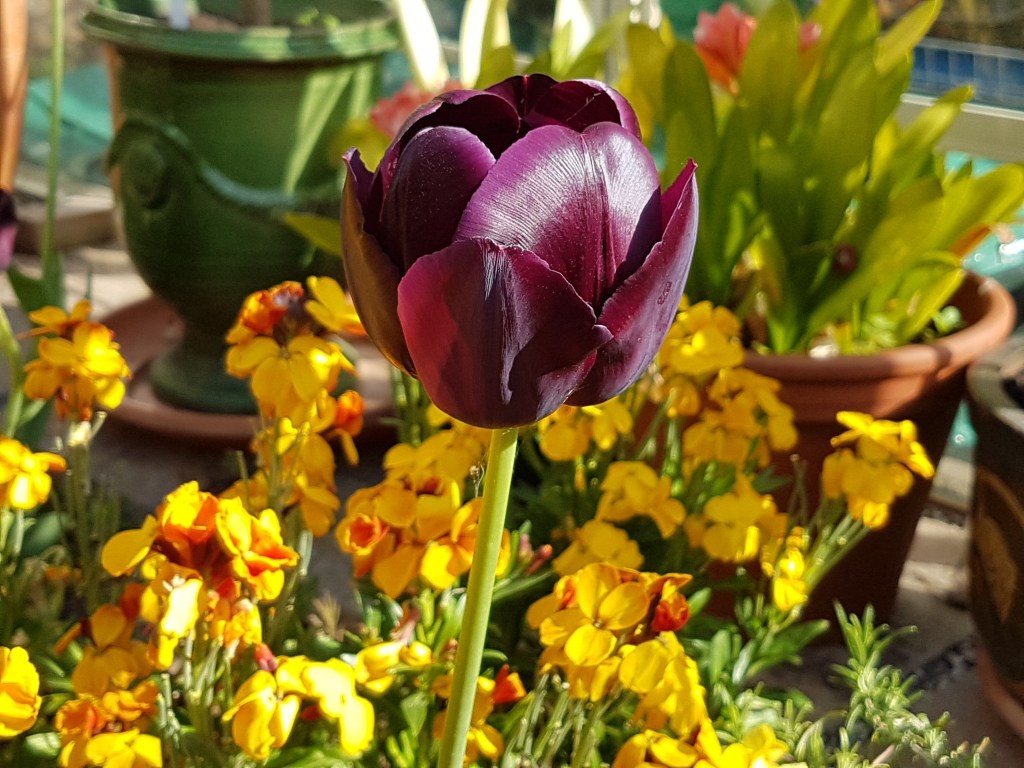
The Queen of the Night resides amongst Wallflowers: taken in our garden in a previous Spring, and appearing again soon

The Coming Coronation: Part Two


I introduced the first part of my ‘Coronation’ post with very few details about the author known as ‘Charles Tetworth’. So here are a few more: He was born at the end of the 1920s, came from a working class home in South Wales, and was brought up in Somerset and Wales. He left home young, at the age of 16, to join the RAF where he (surprisingly!) discovered the tradition of knowledge known as ‘Cabbala’, in its Tree of Life form. For the rest of his life, he dedicated himself to passing on this knowledge, and developing new forms of it which might serve in the future. In his professional life, he was versatile, working variously as an accountant, a babywear sales rep, and a jeweller among other things. He died in 2006. There is no great secret now as to who he was in ‘real’ life, but as he preferred to use this pseudonym for this particular book, I’m following his wishes.

So now the concluding section of Chapter Ten of Wielding Power by Charles Tetworth, on the subject of the British Coronation. As before, the transcription is exact but sub-headings may be mine, for ease of reading. Eithr I have supplied the illustration captions or the source for these is given.

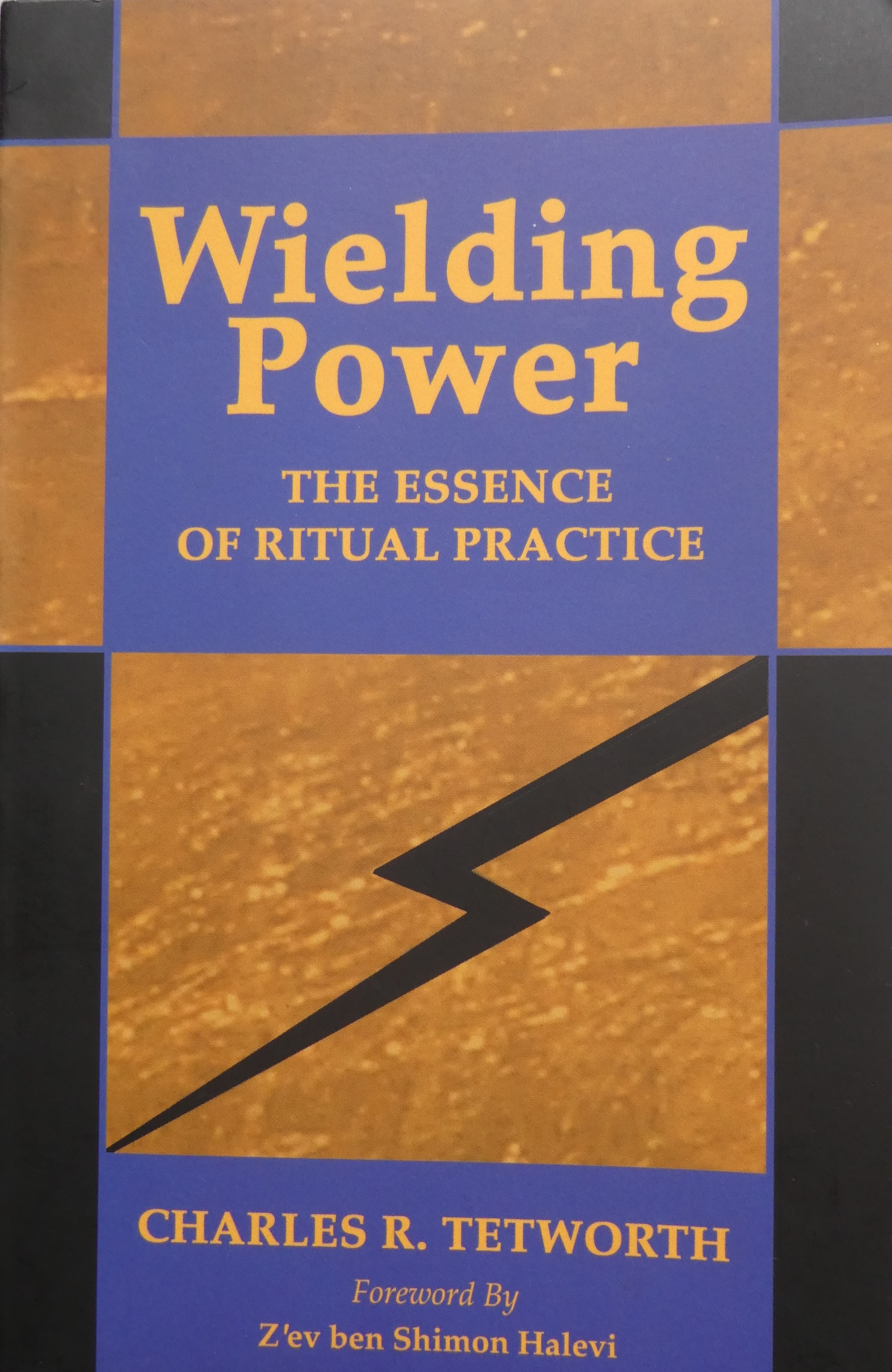
Extract from: Wielding Power: The Essence of Ritual Practice, by Charles R. Tetworth

Enter the Monarch Elect

All the regalia have been placed in the Abbey. Now the monarch enters the Abbey, clothed in the Crimson Robe and Cap of Maintenance and proceeds to pray privately. Then the Archbishop together with the Lord Chancellor, Lord Great Chamberlain, Lord High Constable and Earl Marshall present the monarch to the four quarters – east, south, west and north – asking all to recognise the true monarch and to pay homage. With trumpets and loud acclamations of “God save the King/Queen”, the ceremony proceeds to the Litany when all the regalia (except the swords of the nobles) are placed on the altar. We then start the communion service and after the homily the monarch takes the Coronation Oath. With Bible in hand he promises to govern the people, to execute law and justice in mercy and to maintain the laws of God.

Empowerment

The monarch is disrobed of the Crimson Robe and the Cap of Maintenance. While the Archbishop is blessing the oil, the monarch sits on the Chair of Edward. This is built around the Stone of Destiny from Scone Abbey in Scotland. The Scottish kings used to be crowned on it until Edward I took it from them in 1296. Ever since, it has been used for the crowning of English monarchs. The monarch sits on the Stone of Destiny, under a canopy of cloth-of-gold which is held by four Knights of the Garter. The Archbishop then proceeds to anoint the monarch with the Holy Oil taken from the Ampulla using the Spoon. The monarch is anointed first on the crown of the head “as kings, priests and prophets were anointed”, then on the breast and the palms of both hands. The palms represent the physical, the breast symbolises the heart, and the crown of the head represents the intellect. The oil is a symbol of grace and benevolence. It impresses the gift of the Holy Spirit.

(A Note on the The Anointing Spoon, which is described thus by the Royal Collection Trust and pictured above):

The silver gilt spoon has an oval bowl, divided into two lobes, engraved with acanthus scrolls. The bowl is joined to the stem by a stylised monster’s head, behind which the stem flattens into a roundel, flanked by four pearls, and a band of interlaced scrolling, with another monster’s head; the end of the tapering stem is spirally twisted, and terminates in a flattened knop.

The spoon is first recorded in 1349 as preserved among St Edward’s Regalia in Westminster Abbey. Already at this date it is described as a spoon of ‘antique forme’. Stylistically it seems to relate to the twelfth century and is therefore a remarkable survival – the only piece of royal goldsmiths’ work to survive from that century. It was possibly supplied to Henry II or Richard I.

In times past monarchs were also anointed in the middle of the shoulders, the shoulders themselves and the inside of the elbows. This was symbolic of the wings of the spirit. Unfortunately, this is no longer done. This part of the service is the actual empowering of the monarch, and is accompanied by the words: “And as Solomon was anointed King by Zadok the priest and Nathan the prophet, so be you anointed, blessed, and consecrated King/Queen over this People, whom the Lord your God hath given you to rule and govern, In the name of the Father, and of the Son, and of the Holy Ghost.”

This recording of Zadok the Priest is sung by the Choir of Westminster Abbey

Then the canopy is taken away and the monarch is dressed in the vestments of a bishop with the Colobium Sindonis, the Dalmatic, the Pall and a girdle. Thus robed, the Golden Spurs are presented. The custom now is to touch the king’s heel with the spurs, but they used to be buckled on. A queen only touches them. The spurs signify that the monarch is head of all orders of knighthood. The Jewelled Sword of State is next given to the monarch (a king will gird the sword, while a queen touches it only) and is described as a “kingly” sword with which to “restore, maintain, reform and confirm” order. The sword is then taken by a peer and redeemed for a “hundred shillings”, and drawn out of the scabbard and carried naked in front of the monarch for the rest of the ceremony. The monarch is then invested with the Bracelets of sincerity and wisdom and the Pall or Imperial Mantle. The monarch has now been established as the nation’s priest or priestess.

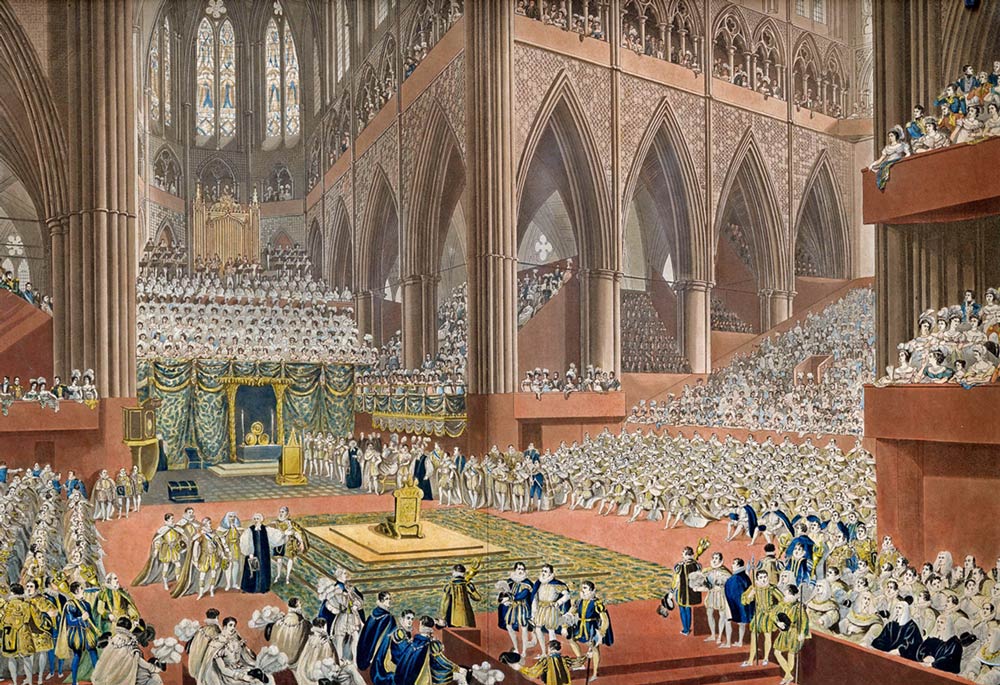
The Coronation of George IV in 1821

Confirmation

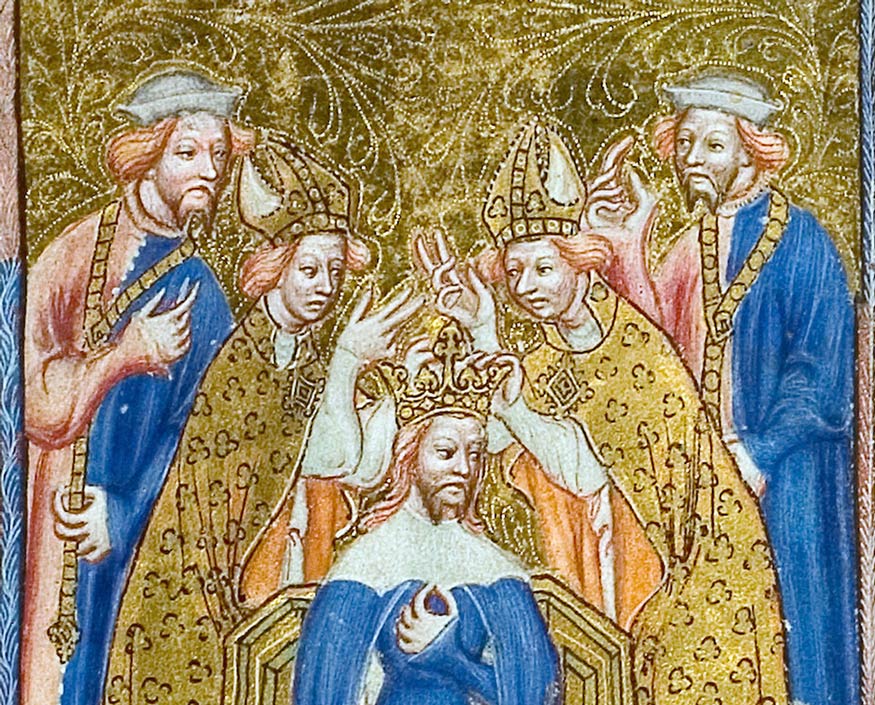
Now begins the investiture of the monarch, dressed in the “Robe of Righteousness”, with earthly power. He or she receives the Orb with these words: “And when you see this Orb thus set under the Cross, remember that the whole world is subject to the power and empire of Christ, our Redeemer.” Next, the monarch is wedded to the spirit of the land with a ring. The Orb is laid aside, and the monarch is given the Sceptre with the Cross, the ensign of royal power and justice, to hold in his right hand, and the Sceptre with the Dove, the Rod of equity and mercy, for the left hand. Now the monarch is crowned by the Archbishop with St Edward’s Crown and everybody shouts, “God save the Queen/King.” The Peers and Kings of Arms all put on their coronets, trumpets sound and the guns in the Tower of London fire their salute.

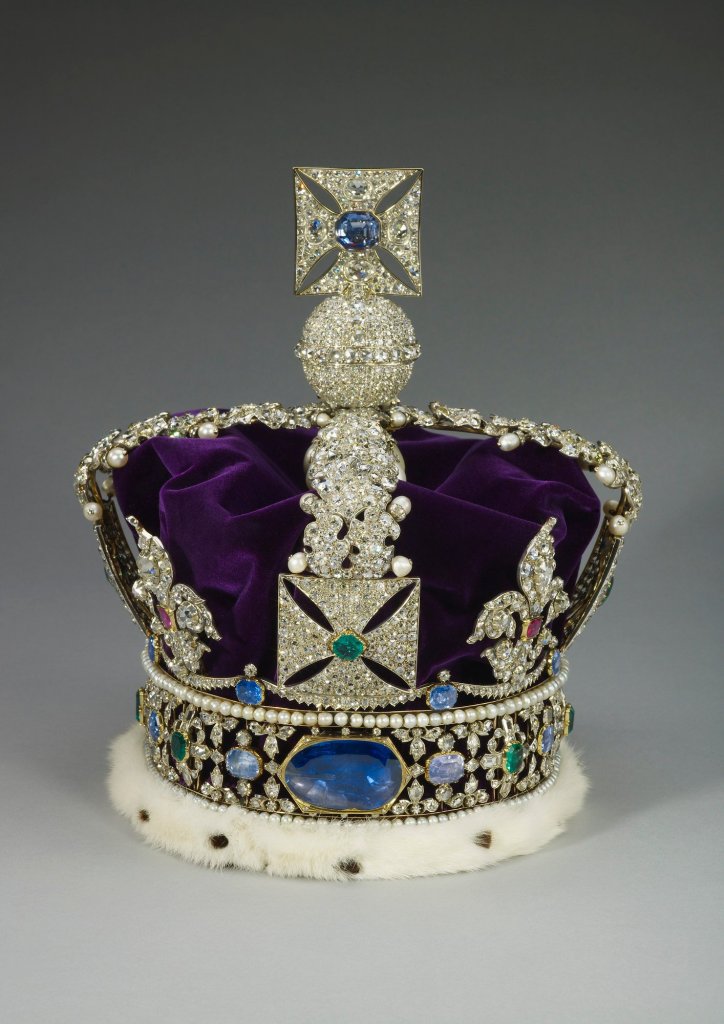
The Imperial State Crown is formed from an openwork gold frame, mounted with three very large stones, and set with 2868 diamonds in silver mounts, largely table-, rose- and brilliant-cut, and coloured stones in gold mounts, including 17 sapphires, 11 emeralds and 269 pearls.” (Royal Trust Collection)

The clergy then present the monarch with the Holy Bible, signifying wisdom, and bless him or her. The monarch leaves King Edward’s chair and goes to the Throne which is lifted up by the clergy and the peers, officers and nobles. This is a relic of the monarch being raised above the people on his shield so that all could see. All the relevant persons present pay homage to the monarch publicly. Individuals from the clergy, royals and peers come up to the monarch, swear fealty and allegiance, and kiss the monarch’s cheek. After this the monarch descends from the throne and goes to the altar where the Crown, Sceptre and Rod are delivered to the Lord Chamberlain. The monarch offers the bread and wine for communion to the Archbishop, and also makes an offering to the Abbey of an altar cloth and a gold ingot. The service continues, and when the bread and wine have been administered to the monarch, he or she puts on the Crown and takes up the Sceptre and Rod again. At the end of the service the monarch retires to be disrobed and puts on the Royal Robe of Purple Velvet, the Imperial Crown and takes the Orb in his left hand and the Sceptre with the Cross in his right hand for the long procession in the state coach back to the palace, through the waiting and cheering crowds. Once at the palace, the monarch must make a statutory appearance on the balcony to wave again to the crowds.

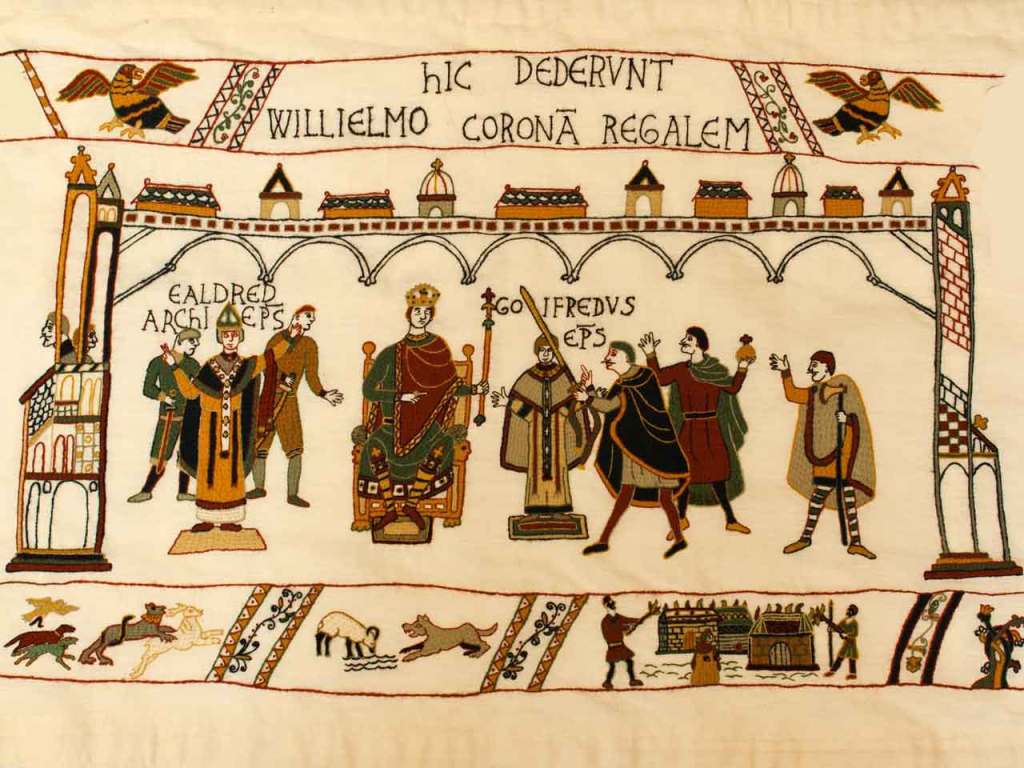
The crowning of King William I after the Battle of Hastings in 1066, as imagined by the Alderney Bayeux Tapestry Project, which set out to complete the missing sections of the original Bayeux Tapestrey.

The Author’s Conclusions

Since the overall aim of the book is to unfold the significance of ritual, whether everyday, of magical intent or national importance, Tetworth concludes here by taking a step back and suggesting that a combination of ‘order’ and ‘joy’ are both essential for effective ritual. At the other end of the spectrum, chaos does not channel the intention successfully and unmitigated solemnity can become oppressive.

Confirmation

When people assemble in procession in large numbers the spectators are affected by colours and by feeling. If the paraders are all dressed in different colours and clothing, there is plenty of stimulation for the eyes and ears, but, like Brownian movement, there is no order in it. When there is no order, there is excitement but no satisfaction. Each new stimulus starts off a train of associations in the perceiver and is replaced by another train, but there is no connection between the two. There is nothing for the feelings or the mind to rest upon. If there is order in the procession, with uniforms and bands and cavalry and coaches, robes and coronets, there is sufficient difference for the eye not to be bored. There is a theme running through the parade. The feelings can cohere, the mind perceives order, continuity is established. Unconsciously one is reassured – there is order in the world. The coronation is a drama where the order of the state is publicly enacted. Rightly or wrongly, the spectator feels that things are all right, that someone is looking after the state.

Although Hitler and all the fascist dictators ensured that their public rituals were massive, they did not imbue the rituals with enough fun and enjoyment. They impressed strangers with the danger of the situation, not with delight; they were not the summation of centuries of different experiences. All state displays are an enactment of the structure of the society. Those states who consider all their members as being basically the same tend towards mass displays of gymnastics, weaponry and sheer weight of uniformity. For me, the spectacle of 10,000 people all performing the same actions on some great celebration is terrifying. I feel that they, the people, have been reduced to the activity of worker ants. But so be it. No doubt, that is how that particular state is happy to perceive itself.

As for the coronation, the whole procedure evokes in the mind of the British people their history and the continuity of the nation. It invokes the aid of God and Christ, and the monarch, the clergy and peers, all the guests and the crowds participate in these events. The coronation itself provides a ritual of defence. The armed forces are represented by their senior officers. It commemorates the monarch by the historic allusions and the age of some of the items involved. It initiates a reign – that is, it recognises that a new beginning has been made. It empowers, in that the symbols of monarchy are bestowed; and the handing over of the weapons acknowledges mastery. The monarch is confirmed in status when he is placed on the throne and acclaimed by the clergy, the peers and the people. Becoming a monarch means giving up a private life. It may not have been so drastic in the days before television and radio, but now it certainly is so. Even Edward VIII found that he was forced to abdicate because of his private life.

It is not easy to relate and know with certainty the result or consequences of any one action. How can we possibly judge the consequences of the great ritual act of Queen Elizabeth II’s coronation? Was it a successful ritual? History will judge the political, philosophical and social results.

Queen Elizabeth II’s appearance on the balcony at Buckingham Palace after her coronation in 1953

And for my own conclusion…

Since these final words were written, we have of course said farewell to Queen Elizabeth. And at the time of writing this, we are awaiting the next coronation, of King Charles III on May 6th 2023. I’m grateful to historical novelist Deborah Swift, for pointing me to an article which reveals that there may be more to this choice of date than meets the eye – potentially,the date selected relates to both Islamic and Celtic traditions on this (hopefully) auspicious day. King Charles himself has been a keen student of different religious and spiritual tradiitons, and a patron of the Temenos Academy where he says:

The work of Temenos could not be more important. Its commitment to fostering a wider awareness of the great spiritual traditions we have inherited from the past is not a distraction from the concerns of every-day life. These traditions, which form the basis of mankind’s most civilised values and have been handed down to us over many centuries, are not just part of our inner religious life. They have an intensely practical relevance to the creation of real beauty in the arts, to an architecture which brings harmony and inspiration to people’s lives and to the development within the individual of a sense of balance which is, to my mind, the hallmark of a civilised person.You can read his full message by clicking on the link above. I myself was privileged to give a series of three lectures to the Temenos Academy on the significance of Russian mythology.

We don’t yet know how much the ceremony will be slimmed down, but it’s likely that most of the components of the ritual itself will be preserved. Once again, the import of his reign will emerge over time. I hope these two posts may be helpful and illuminating in understanding the prime rituals of this ‘Ancient Nation’, as Tetworth referred to it. Once again, I’m grateful to his family and editor for helping me to extract and post this chapter of his book.

The Coming Coronation: Part One


On May 6th, 2023, Charles III will be crowned King of Great Britain. To mark the coming event, I’m posting some extracts from an unusual book, passages which go deep into the symbolism of the event, and its ancient origins.

This is the first of the two posts whose main content is taken from Wielding Power by Charles Tetworth. Today’s post introduces the book and its author, and takes us through the tradition of monarchy and the coronation as far as the regalia used and costume donned. The second post, to be published in two weeks’ time, will then describe the rituals of anointing and crowning which fully establish the reign – in this case – of King Charles III.

A note on the text: I have cut out a short section from the chapter, and added comments of my own, but not altered any of the original text. The book itself, subtitled ‘The Essence of Ritual Practice’ can still be purchased, for example via Amazon.

A note on the content: I am assuming that the coming ceremony will be conducted in the way described here, but it’s possible that certain changes to procedure will be implemented. Please take the details here as guidelines to the ritual rather than necessarily exact in every detail.

Wielding Power was written by a late friend of mine, and published under a pseudonym. ‘Charles Tetworth’ was an expert in matters of ritual, and for many years was a mentor and a source of knowledge to me. The book itself focuses primarily on an individual approach to ritual, in a magical sense, and then in the last chapter opens out to explore the meaning of our state rituals. Perhaps one of the book’s main achievements is to show that there is really no division between the practice of ritual in a so-called esoteric context and in those embodying the history and aspirations of our nation. Charles Tetworth shows us how the ‘spirit of the nation’ dwells in the ancient customs of the land. In the case of the coronation, these rituals are based on common law and the people’s choice of a monarch.

The book was published in 2002, well before the death of Queen Elizabeth II. So it’s one of those delightful cosmic jokes that the author’s choice of ‘Charles’ as part of his pseudonym is also that of the King who will be crowned sovereign in 2023. At the time, twenty years ago, no future coronation was in sight. There were also uneasy rumbles about succession, and Mr Tetworth himself thought privately – as he told me himself – that Prince Charles would never come to the throne.

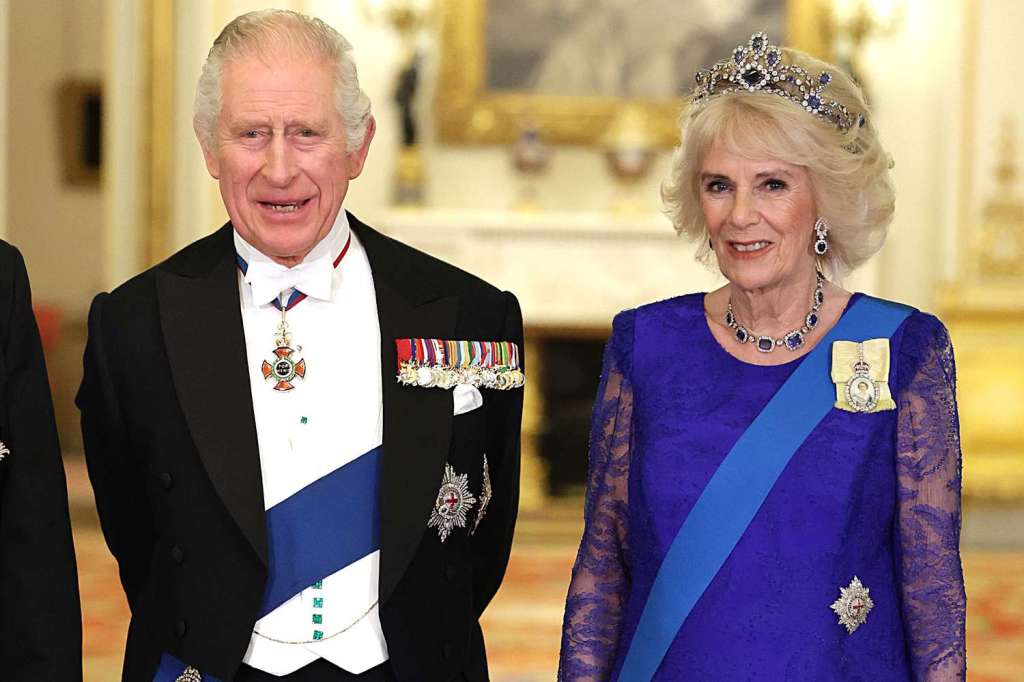
King Charles III and Camilla the future Queen

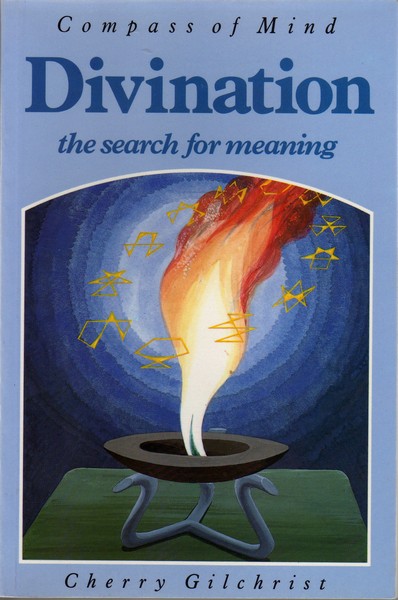
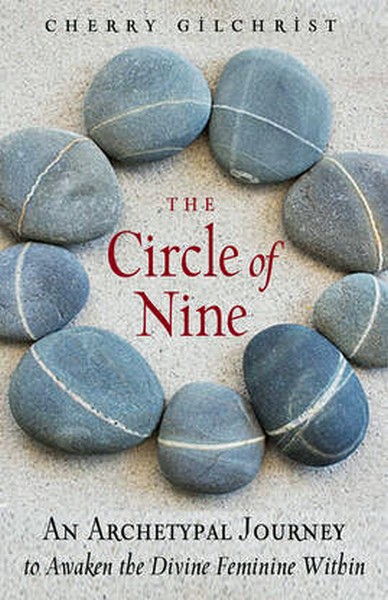
The publication of the book is a story in itself, and one in which I was involved. The text was first drafted back in the late 1980s. At that time, I was Commissioning Editor for a series of books called ‘The Compass of Mind’, to be published by Batsford as explorations of mind/body/spirit themes. Once the project was agreed, I set about finding suitable authors and topics. Out of this first batch of commissions, we gained ‘Dream-work’ by Lyn Webster-Wilde, ‘Astrology’ by Eve Jackson, ‘Genesis or Nemesis’ by Rev. Martin Palmer, and ‘Meditation’ by Lucy Oliver, ‘Divination‘, which I wrote, plus the first version of my book ‘The Circle of Nine’, about feminine archetypes. After these were launched, we then commissioned a book on ‘Performance’ by early music director Anthony Rooley, ‘Mind, Brain and Human Potential’ by psychologist Brian (Les) Lancaster, plus titles on the inner symbolism of music and – here it comes! – on the underlying meaning of ritual.

However, when the text on ritual came through, it was unacceptable for the series. Although the author was a well-established authority in the history of esoteric movements, in this case he unexpectedly veered away from the agreed synopsis to advocate his own specific religious beliefs. There was now a gap in the publishing schedule, which was well advanced – what should we do? And so I asked ‘Charles Tetworth’ if he could do an emergency job for us, writing a new text in time for the publication schedule. He agreed, and stayed up most nights that summer, scribbling a new version for us, based on his own deep insights after some forty years of esoteric study and practice. We were back on course.

But then disaster struck – Batsford, a long-established publisher, suddenly went out of business in its set-up of the time, taking our list with it. It was one of my worst jobs ever, telling the authors that their commissioned works could no longer be published, even if they had finished their manuscripts. I’m happy to say though that ‘Performance’ and ‘Mind, Brain and Human Potential’ subsequently found other publishers; the rest were simply cast adrift.

Below: some of the books which did make it into print from the ‘Compass of Mind’ series

Tetworth was sanguine and took it in his stride. We assumed that this was the end of the title – it was not an easy one to place with another publisher. However, some ten or fifteen years later, through another contact, he received an offer from Lindisfarne Books in the USA. ‘Another bite of the cherry,’ as Mr Tetworth put it cheerfully. Adapting and editing followed, and in 2002 it was finally published. Another close acquaintance, the well-known Kabbalist Warren Kenton aka Z’ev Ben Shimon Halevi, wrote a foreword:
‘…This work is full of riches clearly drawn from long and intimate experience with and practice of the subject.’

I was asked for a quote for the back cover, and wrote:
‘Tetworth is one of the few practitioners who have gone behind the scenes to ask what ritual is all about. He reveals the mystery of ritual, and proves it to be something basic to human society, a means by which we preserve mystery and promote magical interaction.’

Now, with permission of his family, as Mr Tetworth is no longer alive, and with assistance from his private editor, (a personal contact, rather than the in-house editor), I feel it’s an appropriate time to post the last chapter of his book, which is on the British Coronation. In order to keep it more accessible, especially since I’ve included some asides, I’m splitting my post into two; the second part will follow in two weeks.

Please note: All the details of the coronation, its customs and trappings, are accurate as far as I know, and many can be checked via the excellent Royal Trust Collection website. However, I can take no responsibility for any errors that may occur in the original text.

CHAPTER TEN – AN OLD NATION

From ‘Wielding Power’, by Charles Tetworth

Britain has a history of not having been invaded for a thousand years. So it has had the chance to grow in an organic fashion. Even the Normans in the eleventh century really only took over the upper echelons of society; the lower strata remained comparatively untouched. The Normans soon learnt that the force of custom and tradition and regard for common law was so strong that if they contravened it, they would have no one left to rule over. One could say that Britain gained the upper hand and conquered the conquerors. Even the Romans seem to have been content to control only central matters of government rather than interfering at every level. Common law was recognised by nearly everyone and there were still large tracts of common land. According to the Domesday Book, Britain at this time was mainly wooded and it was very easy for the disaffected to disappear into the forests. This is the origin of the Robin Hood stories.

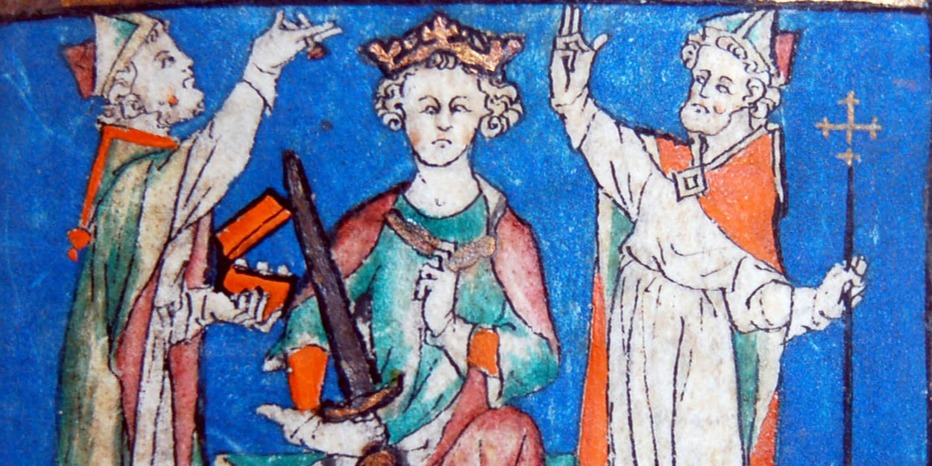
Such common law could not exist except by general agreement. Mechanisms existed already for dealing with problems, so Britain never went the way of France, with its monarchic despotism based on immutable law and the mystique of the Holy Blood. Since the Anglo-Saxon kingdoms came to power in about 850 AD, methods had been evolved for handing over the authority to someone acceptable by most of the ruled. Rulership was originally elective, or at least required the acceptance of the tribal leaders; there was less chance, therefore, of familial dynasties becoming entrenched. Kingship was established as the most practical form of rulership and became accepted in common law by the compliance of the populace. Even the Norman William the Conqueror had some claim to the crown (though he was a bit impatient to wear it), and in due course he was anointed and crowned King of England.

At that time there was cooperation between Church and state. The Church had the authority to anoint the king since that was a religious matter, and this anointing is still seen as the central act of coronation. Pagan customs were also assimilated into the process of the coronation, and some of the mystique monarchy still possesses is based on ancient rituals that lie too far back in British history to be traceable.

Coronation means “crowning”. To be crowned is one thing; to be accepted by the people is something else again. So one of the most important aspects of the coronation ritual is the procession through the crowds of ordinary people by the monarch both before and after the ceremony. The procession before the coronation is to confirm that the right person is being crowned. In fact, this was crucial in days when the king was elected and succession was not by right of primogeniture. The election ceremony (a formal acclamation or election by the bishops and nobles) usually took place the day before the actual coronation in Westminster Hall. The monarch would then process from there to Westminster Abbey for the rites. This held real meaning: it was the opportunity for the people to discover who had been chosen and to approve the choice. The new heir is formally acclaimed immediately on the death of the king or queen at St James’ Palace. The coronation ritual itself starts with the formal recognition of the new monarch. But the procession is still the means whereby the people offer their implicit recognition. The procession after the crowning is for the people to see for themselves that the right person has been duly appointed.

The monarch exercises power and authority in both the spiritual and temporal realms. If the people have given their consent to the new monarch before the ceremony, and within the ceremony their worldly and spiritual leaders have also given their consent and have handed over the symbols of authority to the new monarch, then they know who their ruler is and they tacitly accept his or her authority. In earlier times, the anointing of the monarch meant that the person of the monarch had been transformed into something sacred. Perhaps this belief had sprung up from an earlier past when the king was looked upon as magician, priest and god. In Christian times the act of king-making was a sacramental rite and it is interesting to note that it has to this day never been fundamentally altered. Whatever the fashionable climate may be, it is still a fact that England is a Christian state with a religious foundation and the ruler has to be inaugurated with Christian rites.

State ritual is the framework within which power is exercised. From the ritual of the dissolution of parliament to the election of a new government, from the state opening of parliament to the Lord Mayor’s Show, from budget day to the prime minister’s question time in the House of Commons, all is governed by ritual. The ritual of the Coronation is worth studying in some detail as it embodies many of the formal and informal relationships that have evolved among the peoples of Britain….

The Coronation of Charles’s mother, Queen Elizabeth II, in 1953
Toy coronation coach – very popular, in various versions, in the 1950s! I wonder what happened to mine? And also what souvenirs will be produced on the occasion of King Charles’s coronation.

THE ROBES AND REGALIA

The coronation robes are worn only on this occasion in the lifetime of a monarch. Both the robes and the regalia reflect the spiritual and temporal authority and power that the monarch is vested with. The robes that represent spiritual authority are very similar to a bishop’s garments, which suggests that their origin lies in the time when anointing was believed to confer priestly status on the monarch.

The Colobium Sindonis is a long white sleeveless linen robe (rather like the alb worn by a bishop when he is celebrating Mass); it is open at the side, edged all round with lace, and gathered in at the waist by a linen girdle. The Dalmatic is made of cloth-of-gold lined with rose-coloured silk; it has short wide sleeves and is decorated with palm leaves, pink roses, green shamrocks and purple thistles. The Stole is again made of cloth- of-gold lined with rose-coloured silk. At either end of its five-foot length is the red cross of St George on a silver background. In the Church it is worn as an emblem of authority and bishops wear it round the neck hanging down in front, uncrossed, whereas priests wear it crossed while celebrating Mass. At the coronation it is worn over the Dalmatic. The Pall or Imperial Mantle, made of cloth-of-gold (with rose-coloured silk lining), is worked in a pattern of silver coronets, fleur- de-lys, green leaves, shamrocks, purple thistles and silver eagles. It is very similar to a bishop’s cope except that it is not rounded at the bottom but has four corners to represent the four corners of empire. It is the final robe to be placed on the newly consecrated monarch.

The Imperial Robe of royal purple is worn after the coronation for the procession out of the Abbey; it is made of purple velvet, lined and edged with miniver and ermine tails; it is hooded and has a long gold embroidered train. The Crimson Robe of State is worn in the procession to the Abbey before the coronation. It is made of crimson velvet embellished with gold lace; it is lined and edged with miniver and has a long train. It is also the robe worn for state openings of Parliament. The Cap of Maintenance (see below for an example) is worn by a male sovereign on his progress to the Abbey, while it is carried before a queen regnant. It is made of crimson velvet lined and edged with miniver. This or another “cap of maintenance” is carried before a monarch by a peer on a short baton at the opening of Parliament.

The Cap of Maintenance for Queen Elizabeth II

Some notes from Cherry

Regalia – macro and microcosm

In the City of Exeter there is also carefully preserved royal regalia. I knew nothing about this until I undertook to train as a Red Coat Guide, and we were given in-depth information about this, plus a chance to be close up and personal with the items themselves. In 1497, King Henry VII came to Exeter to thank the citizens for fighting off an attack by Perkin Warbeck, a pretender to the throne. Exeter has mostly been very loyal to the crown, as its motto of ‘Semper Fidelis’ meaning ‘Always Faithful’ – possibly granted by Queen Elizabeth I – implies. It wavered towards the Parliamentarians in the Civil War but after the Restoration sent a fulsome apology to the Crown in the form of a giant and elaborate salt cellar: The Exeter Salt.

The Exeter Salt, a kind of apology to King Charles II for turning against his father. A very elaborate addition to the dinner table!

Anyway, King Henry thought well enough of Exeter to bestow his battle sword on the city. This is kept proudly in the Exeter Guildhall treasury, and brought out on parade for special occasions. Henry also gave the city his Cap of Maintenance, which likewise resides in the Guildhall or is carried on a cushion in procession. The Cap has had to be replaced after hundreds of years; the Sword is intact, but needs a new sheath every now and then. Both denote recognition of the city’s loyalty to the British monarchy.

The silver maces carried by the Mace Sergeants of Exeter – an ancient office dating back to medieval times – represent the authority of the Mayor and the Monarch. One of these maces must be placed on the bench for a Council Meeting to proceed in the Guildhall. This leads neatly back to the subject of the coming Coronation, since the Proclamation of Charles as King was read out in front of the Cathedral, with the Regalia and Mace Sergeants in attendance. In the photo below, you can see one of the Mace Sergeants, who are in black hats trimmed with green, holding his mace up, while to his right the furthest Mace Sergeant holds the battle sword of Henry VII upright. To his right, the Lady Mayor makes the Proclamation itself.

Now we return to the section from Wielding Power about Royal Regalia:

So much for the robes. The royal regalia consist of those emblems with which the sovereign is actually invested at the coronation. The ring is a sapphire and ruby cross of St George set in fine gold; this signifies the wedding of the monarch with the people and that the monarch is the “Defender of Christ’s Religion”. The Armills are two bracelets representing sincerity and wisdom; each is made of solid gold and together they symbolise the bonds that unite the monarch with the people. The Golden Spurs (also known as St George’s Spurs) are of solid gold with gold-embroidered crimson velvet straps. They represent knighthood and chivalry and in medieval times the bestowal of spurs formed an essential part of the making of a knight. The Jewelled Sword of State is the most magnificent of the swords carried at the coronation; both hilt and scabbard are elaborately decorated with gold tracing and precious stones.

Below: The Armills and the Golden Spurs

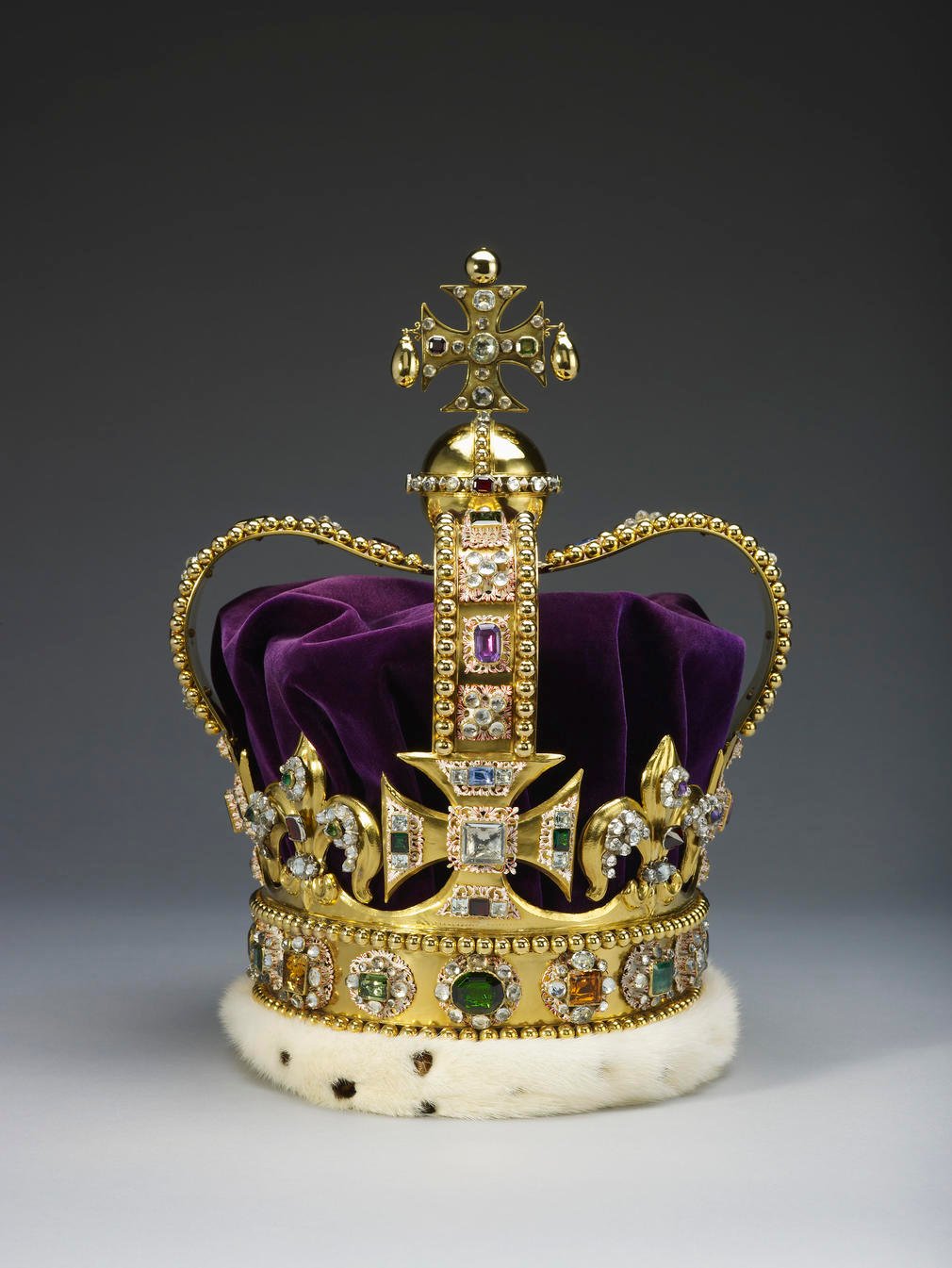
St Edward’s Crown, made of solid gold and set with precious stones, is worn only once in the lifetime of a monarch. It has four fleur-de-lys and four crosses around the rim; arches link the four crosses and there is an orb and a cross at the point of intersection. St Edward’s Staff is made of gold but has a steel tip; it is four feet, seven and a half inches long. It is carried before the monarch in the procession to the Abbey to guide his or her steps. The Royal Sceptre with Cross is the ultimate symbol of kingly authority. It is made of gold and has mounted beneath the cross the largest portion of the Cullinan diamond, weighing five hundred carats. The Sceptre or Rod with Dove is also made of gold but is surmounted by a gold and white enamel dove signifying the Holy Spirit. It is delivered as the rod of equity and mercy.

Below: St Edward’s Crown and the Royal Sceptre

The next two symbols – the Orb with Cross and the Second Crown – are highly significant, although strictly speaking they are not part of the actual regalia for the ritual of king-making. The Orb with Cross is a golden ball surmounted by a heavily jewelled metal band from which springs a jewelled arch with a cross at the apex. It became part of the coronation rite comparatively late. It is presented before the delivery of the Royal Sceptres and again for the procession out of the Abbey. The Second Crown was always worn by the monarchs on important occasions and is today worn at the state opening of Parliament. This crown, also called the Imperial State Crown, was made for Queen Victoria’s coronation and, set with many historic gems, is more splendidly jewelled than St Edward’s Crown.

The nobles and officers of the Church also have their own sets of regalia for a coronation. The symbols of coronation associated with the sacramental aspect of the rite are handled by the clergy alone. These include the special chalice and paten without which no Eucharist can be celebrated. Two of the most historically interesting items of the regalia are the Ampulla and the Anointing Spoon, which are thought to be the actual vessels used in medieval coronations. The Ampulla is a hollow vessel of solid gold in the form of an eagle; it holds six ounces of oil which is poured through the beak. The Spoon is of silver gilt and is probably older than the Ampulla. It is used by the archbishop to convey the sacred oil to the various parts of the monarch’s body.

There are four swords which are carried by the nobles and form part of their regalia. The largest of these is the two-handled Sword of State (picture below). It represents the power of the state itself and today is the only one of the four seen outside a coronation, since it is carried before the monarch at the state opening of Parliament. There are two Swords of Justice, one representing spiritual power and the other temporal justice. The fourth sword is called the Curtana because it has a blunted end: it is a symbol of mercy.

To be concluded: see The Coming Coronation part 2 (currently scheduled for release on Feb 26 2023)

Further Resources

The Royal Collection Trust

Sword of State and Cap of Maintenance

Forgotten Images from the Silk Road

Sitting on top of the world…en route from Pakistan to Uzbekistan

Just recently, I discovered a cache of photos taken from a second Silk Road trip that I made. The first trip, in 1995, lasted around a month as with a group I travelled from Bejing to Rawalpindi, across the West of China to Kashgar and Tashkurgan, then down the Karakorum Highway – a narrow road hewn out of the rock at great cost to the workers who built it, and replacing the old caravan trail barely big enough for pack horses. Around a year later, my(former) husband decided that he’d missed out, and would also like to see something of this ancient trade route, a branching network of roads traverses the terrain from East to West. The Silk Road network extends north and south into countries such as India and Pakistan, Russia and Syria. In the heyday of the Silk Road, from the early centuries AD until the 15th century (when new sea trading routes largely superceded it) it was the means by which exotic, innovative goods were traded from one part of the world to the other – silk of course, but also gunpowder, paper, rhubarb and exquisite carpets and ceramics. It was also the route for transmission of stories, art, and religious beliefs. You can read more about this in my previous blogs – Bazaars of the Silk Road and Suzani from the Silk Road.

My second trip – my husband’s first – was much shorter, and this time we began in Islamabad (next door to Rawalpindi in Pakistan), and flew up to Gilgit. From there we would travel up through Pakistan and onwards north to Kashgar in China, over the mountain pass into Kirghistan and to our final destination of Uzbekistan. The plane from Islamabad to Gilgit actually flies between the mountains, rather than over them, so if there’s a cloud in the sky, the flight doesn’t go. If it does go, you hope that a cloud or two doesn’t appear en route, and thicken into mist, since that could be a recipe for disaster. Our flight took off successfully – the alternative was something like a three day drive through unspectacular scenery. It also landed successfully, I’m pleased to say.

Arrival at Gilgit, at the time of a sombre religious festival. Some of the men standing on the rooftops were army snipers, on the lookout for any trouble

I had visited Gilgit before, and enjoyed its (then) fairly relaxed attitude, which welcomed foreigners. This time, however, there was a different atmosphere since it was just after the festival of Ashura when according to the BBC website:

For Shia Muslims, Ashura is a solemn day of mourning the martyrdom of Hussein in 680 AD at Karbala in modern-day Iraq. It is marked with mourning rituals and passion plays re-enacting the martyrdom. Shia men and women dressed in black also parade through the streets slapping their chests and chanting. Some Shia men seek to emulate the suffering of Hussein by flagellating themselves with chains or cutting their foreheads until blood streams from their bodies.

There had been lashing, and many men strode past, wild-eyed, with open wounds on their backs. A tense atmosphere prevailed and army snipers stood on the rooftops, alert to any outbreak of trouble. This was not a place for tourists, and we kept our heads bowed and scurried on, pleased when we could set out on the next stage of our journey, up the Karakorum Highway and up into Kashgar, a place dear to my heart, with its huge Sunday market. From there we’d travel over the Torugart Pass into Kirghistan – new territory for me.

These gloriously painted trucks and buses are the norm for transport in the area. Our minibus was a lot less colourful, however!

The Hunza valley, up the Karakorum Highway is truly beautiful, and a stopping off point for mountaineers. The fiendish Karakorum mountains lure those who seek the ultimate challenge – ultimate in the case of Alison Hargreaves, an accomplished mountaineer who sadly died there in 1995 as a young mother in her 30s. These mountains have jagged, threatening peaks which loom darkly above you, and its hard to imagine anyone scaling them. But in Hunza below, apricot trees are laden with fruit, wild cosmos flowers bloom in the grass, and the terraces on the lower slopes are bright green with crops and grass fodder, grown with care and great industry by the local inhabitants.

Here too are the ancient forts of Altit and Baltit, presiding over the lost Silk Road kingdom of Hunza – other such kingdoms which you may never have heard of include Kashgaria and Sogdiana. Whole dynasties have risen and fallen in these regions and modern maps are sadly inadequate for understanding the layout of old Silk Road territories.

Relaxing in the ancient fort of Altit – or was it Baltit? Part of the Hunza valley is spread out below, although you cannot see here the full extent of the imposing Karakorum mountains

As it was my second Silk Road trip, and a shorter one, I documented it in less detail than the first, when I was eager to write a complete travel journal. Thus the pictures I have of mountains and nomadic people are somewhat loosely defined geographically now in memory, and I’ll share them without attempting to be too precise about their location. And what I’ll miss out here is our visit to the fabled city of Kashgar, now sadly with its Uighur and Silk Road culture diluted in recent years by Chinese domination and suppression. I took many pictures on my previous trip there, and perhaps because of that, I focused entirely on enjoying the vast Sunday market the second time round. But you can see more of Kashgar in my previous blog Bazaars of the Silk Road

But first the border crossing, from the far West of China through the Torugart Pass into Kirghistan. This was a prolonged affair, leaving one country and travelling several miles before entering the next. On the Kirghiz side, it was still the border post of the old Soviet Union, and guarded with maximum formalities. Although, as I speak Russian, I was able to chat to the officers who were delighted that someone, at last, spoke their native tongue!

Making new friends at the Chinese border! Always as well to have the guards on your side.

The peoples of this area mingle too – Tajiks, Kirghiz, and Uzbekis, for instance.There are still nomadic tribes or families, using traditional yurts, and perhaps migrating to town houses in the winter months.

Ever curious children (these ones probably from Hunza) above, and below a nomadic family, probably Tajiks who often have rosy cheeks and flashing black eyes.

The family below were yurt dwellers, at least for the summer months when they can graze their animals on mountain grass. The white felt hat which the man on the left is wearing is the traditional Kirghiz headgear. In the second picture, you’ll see that I took the chance to try ‘kumis’ which is usually made from mare’s milk, and tastes like kefir. It was delicious! Some swear by it as a cure for chestiness and other respiratory ailments.

Tasting kumis – fermented mare’s milk! Note that it comes out of an old goatskin (?) bag.

The yurts are easy to transport and put up again; they’re constructed on a pattern representing the cosmos, with the central crossing symbolising the four directions. You must always walk round sunwise inside a yurt, starting from the left hand side, even if what you’re coming in for is close to the right hand side of the entrance. Inside, they are cosy, and infants sleep snugly wrapped in their cradles, which can also be transported intact.

The cross poles of the yurt in the centre of the yurt, the heart of the universe
A Kirghiz baby in his or her bed, strapped and wrapped for safety

It was also an opportunity to try my skills on a horse again. The Kirghiz particularly love their horses, and on my previous Silk Road trip I’d also managed to blag my way onto a steed! They specialise in decorated felt and embroidered saddle cloths.

In the higher regions of Central Asia and Western China, yaks are useful for their meat, milk and as beasts of burden. They are also known as the ‘Tartary ox’.

Yaks, domesticated and hardy in the kind of extreme terrain seen below

Kirghistan has its own national hero – Manas. He is perhaps what Genghis Khan is to the Mongolian civilisation, a warrior king who fought battles for his people. The Epic of Manas in its present form dates from the 18th century, but was passed down orally before that, and is believed by the Kirghiz to be much older – they celebrated its 1000th anniversary in 1995! Its provenance is complex, but it seems to be based on historical facts much mythologised to celebrate the prowess of the superhuman hero.

A vast statue of the Kirghiz warrior king, Manas, which stands in Bishkek

If you’d like to watch this short video, you can see marvellous shots of the Kirghiz way of life, along with listening to plangent Kirghiz music, hearing a clip from the epic of Manas, and watching those curious white felt hats.

Kirghiz Music and Culture

Descending eventually down into Uzbekistan, a hotter and flatter country, we visited the astonishing cities of Samarkand and Bukhara. Later, on a subsequent trip, I also reached Khiva, which is a renovated Silk Road city of magnificently tiled buildings. Buhkara has been a melting pot of different dynasties and peoples, and the Samanid mausoleum built in the 10th century includes influences from Byzantium, Persia along with Sogdian and Sassanian styles, plus, we were told, hints of the ancient Zoroastrian religion.

Here in Uzbekistan, the produce is lusher, the clothes made of lighter fabric. The famous ‘rainbow silk’ is still worn by the women. There’s a legend about how it came into being – it can be found in a blog from my original website: Images from the Silk Road – Rainbow Silk

The second girl from the left in the back row is wearing rainbow silk, a nationally-celebrated fabric

And so we rounded off the Silk Road trip in Samarkand and Bukhara, where I’ll round off this post with images, rather than a discourse. First of all, here is the Uzbeki style of building grand houses and palaces. Even smaller-scale, more domestic houses often have these charming decorated alcoves.

And then, the wonderful tiled mosques, perhaps even more magnificent than those I had already seen in Istanbul. Some have been restored to their full glory after becoming dilapidated in earlier years.

After the second silk road trip, I did follow up with separate visits to Syria, a more complete tour of Uzbekistan, and futher visits to Turkey, where I’d been travelling since I was a student. With images and source books, I looked further into the history of the Silk Road, its legends and its cultures, and from this came my children’s book Stories from the Silk Road, and illustrated lectures which I gave for NADFAS (now the Arts Society), and at various other venues including cruise ships. Some of the ports in the Black Sea, for instance, are old Silk Road ports, so it was more relevant to the passengers than you might think. And, of course, I can enjoy writing blogs such as this one, to share the images with you.

Thanks for joining me on my travels!

Blogs of further interest

Bazaars of the Silk Road

Suzani from the Silk Road

Cherry’s Cache – At the turn of the year

At the turn of the year – a photo taken at the winter solstice in Bath some years ago

I began this blog nearly three years ago, in April 2020. And before I go any further, I’d like to thank all of you who’ve been reading these blogs, whether regularly or occasionally. It’s a real privilege to know that they’re of interest. Whether Dartmoor or alchemy, Welsh fruit loaf or Huguenot refugees, there is, I hope, something for everyone. When I set up this website with the help of a professional web designer, we talked about drawing in an audience for this. However, when he heard the range of topics I’d be writing about, he was somewhat baffled. ‘If this blog appeals to one kind of reader, then the next might be for a different kind…’ And he didn’t quite know where to go from there. But as it reflects my own genuine range of interests, then we would just have to go with that, we agreed. I could hear the doubt in his voice!

A note about the images: Most of these are from the blog posts mentioned here – and it shouldn’t be too hard to work out which is which, if you’re so inclined!

Thank you, readers! I hope you’ll stay with the blog and I’ll just be running it month to month, seeing what comes up and what I might post. It may not be a ‘forever’ blog, as keeping up the quality is really important to me. But I hope that the posts will still have a presence on the net so that those interested in, say, embroidered samplers or Silk Road travellers or the goddess Kuan Yin or a recipe for a Twelfth Night cake, can still find my posts for these. And by the way, please do make use of the ‘Search Bar’ on the home page. You can enter any relevant keyword for the blog and it should show you the one(s) available.

A little later, I’ll be coming onto What the Stats Reveal – which posts are popular, and where do you all come from. In fact, if you’re going to be bored by the next section about my own writing history, skip on past….

The writing compulsion

I started writing books in my twenties (quite a long time ago!), and in the fifteen years prior to 2020, I was producing a book about every two years. I was caught up in a rhythm, of researching ideas followed by canvassing publishers and then writing the book itself. I was proud to have had a steady sequence of books published, but it was becoming exhausting. Starting Cherry’s Cache was a way of breaking the addiction. Yes, really –a blog, I thought, would be a harmless and rewarding way to channel the urge. No dependency on the whims of editors or the business (mis)fortunes of editors – and a chance to use pictures. Lots of lovely pictures! I’ve always relished matching images to words, which I could do in my talks and lectures, but rarely in books.

You may be sceptical as to a) the demanding nature of writing and b) its addictive qualities, so let me fill in the background.

The cycle of madness

Writing a book involves a cycle of madness. I say this a little tongue in cheek, but it’s not far from the truth. My book ‘Russian Magic’) includes this dedication to Robert:
I would like to thank my partner Robert [now my husband] for putting up with a writer who had her head buried deep in books while researching this project, and who went round muttering about Russian wizards and wolves, and frogs that were really princesses, whenever she came up for air. His loving support and kindness was a life-line to me!

The first phase of writing a book is not quite so extreme, since I relish the quest and seeing the identity of a book emerging from this. The research stage is exciting. Heady, full of promise and possibilities. I have a wide field of interests, and in the 2000s, the books I produced thus included family history, writing life stories, Russian folklore, feminine archetypes and traditional Tarot symbols. I was also tasked with updating my now classic history of alchemy.

But then reality bites, writing up of an outline, often chapter by chapter, and producing all the back up info without which the publisher won’t offer a contract. (Who are the potential readers? What other competing books are out there in the marketplace? Do I know, and do I care?) It can be a grind, but it’s also reassuring afterwards to know that there’s a solid framework for the book.

I usually write to a publisher’s contract. And I don’t mind deadlines – indeed, I love them. In my opinion they are a writer’s best friend, a great incentive to keep going, providing you’ve agreed a realistic delivery date, and you’ve a contracted commitment from a publisher. Nevertheless, the outcome isn’t always rosy. Several times during my career I’ve been badly let down when publishers go bust, leaving work unpaid, and a contract is suddenly no more than a useful fire lighter. Projects can also be cancelled after the months of preparation but before the signed deal. And once I had a script rejected, which is definitely a blow to an author’s pride. (It rankles, even now!) It happens, even with the best agents, which I’ve been fortunate enough to have. ‘You cannot force a publisher to publish,’ is the sum of it. I therefore advise all prospective writers to be philosophical, because there will be stones on your path as well as pretty flowers.

A somewhat relevant image, I think. Be philosophical if you want to be an author! That’s the essence of any advice I’d give an aspiring writer. Pilgrim’s Progress with its Slough of Despond and Doubting Castle is not so far off the mark – but maybe the Celestial City awaits?

The writing phase itself can both inspire and drain you. It’s like a slow wave building up that you must sustain, carrying its momentum forward. The book is always there in your mind, even on days off. And when the text is finally drafted, it’s time to turn to the editing stage. I try to have a short break between the two phases if I can, because it does help, to come back fresh to your deathless prose and see that it’s not quite so perfect as you thought. By the time my final draft has landed in the editor’s in-box (thank goodness for electronic submissions these days!) I often feel exhausted and empty, rather than exultant. It takes time for the well to fill up again, for energy to be restored.

But my final draft isn’t theirs, of course. Then follows what may be a long stage of working with a desk editor (the ‘ideas’ department) and a copy editor (the style and clarity monitor). Finally, with everything ready there’s usually a further waiting stage to get the book printed, unless you’re a celebrity author being fast-tracked for the Christmas list.

And now it’s out! But you’re still on the case, even if you’re longing to start on that next book or (probably better) lie down in a sunny place for several months. There’s promotion, social media posts (groan), and possibly talks and articles and book signings. The author is expected to be very actively involved now in marketing, and often the onus is on us to fix up events and create a social media whirl.

In the good old days of launch parties – though I seem to recall we fixed this up ourselves! R-L: Lyn Webster Wilde, Eve Jackson, myself and Lucy Oliver celebrate the launch of our books at Watkins Bookshop, London. These were for a series called ‘Compass of Mind’, published by Dryad, for which I was commissioning editor.

A new venture

This is not really an author’s moan, as I’ve loved the process overall, and the delivery of my book children into the world. Editors and agents have become close friends, and I’ve also been part of a couple of wonderful writers groups, in Stroud and in Exeter (link). But in the last few years, obviously older than I once was, I feel that I won’t embark lightly on that process again, of conceiving, preparing, writing and promoting a book. (Unless you want to make me a good offer, of course?)

And then the idea was born to start Cherry’s Cache, and fledged through attending a blog-writing course with ‘The Gentle Author’ in Spitalfields, in March 2020, something I’ve written about in an earlier post.

The occasion remains eerily clear in my mind because it was the last weekend we were all allowed out before the lockdown. Our course was a kind of safe space, whereas outside drinkers spilled onto the pavements in unusually warm weather, shoppers crowded the markets, with an eerie semblance of normality. In Cheshire Street market I picked up a Folio Edition of Daniel Defoe’s ‘Journal of the Plague Year’. It seemed fitting.

Back at home, totally at home for the duration, I was able to make contact with the Gentle Author’s recommended web designer. With his expert skills, we played with names and themes, and the blog itself was launched remarkably fast in April 2020. I put up three opening posts, so that readers would have something to delve into. And it became a constant delight for me to work on it during those long months of successive lockdowns, without the pressure of a given brief or the extended effort needed for a whole book.

Cherry’s Cache has thus been my main writing focus for a while, but instead of the once-a-week post of the pandemic, which I maintained for about two years, I’m now posting once every two or three weeks. It melds well with some of my other activities, such as volunteering as an Exeter city guide, working on esoteric subjects (see our Soho Tree blog), and rounding up memoirs and musings. In the last year, I’ve also returned to teaching creative writing online for Oxford University.

Below: so who am I really?

L-R: as painted by Robert Lee-Wade, in a floppy hat reading a book, ‘Grandma’ by Martha, or donning a gown for teaching at Oxford Summer School of Creative Writing?

All and none, perhaps.

Loving the Stats

One of the great things about running a WordPress blog is the ease of checking out your stats. I can prove that as of today, I’ve published 93 blogs – yes, really! I’m surprised too – and this is no. 94. And my word counts show that I’ve just hit the 200,000 word output for all of these. That could have made two whole novels. (But not quite ‘War and Peace’.) It seems that I haven’t switched from books to blogs to reduce my output.

I can also peer behind the scenes and find out who has read what blog and when. Well, not who exactly, but how many readers. And roughly where they came from. On the day my last blog went out (December 18th) I had over 100 from the UK and the USA, but also from Canada, Nicaragua, Ireland, Spain, New Zealand, Hong Kong, Kenya and Australia. Previous visitors were also from Bhutan, Japan, and Finland. Today is still young – but hello there, Sweden and Vietnam! (I hope that most of you do actually look at the blog, rather than harvest my info for future selling or scamming.) In June 2022, there were just under 2,000 visitors from the United States and 75 from Spain.

I can even see some of the search terms used, which luckily are mostly harmless, if often misspelt. One or two are incomprehensible: ‘south african jazz artist wearing zobra colours suit’ for instance. What did they find – and did they enjoy it? I can also work out which the winning themes are. As compiled recently, the all-time favourites have been ‘Pangur Ban and the Old Irish Cats’, (which seems to find favour especially over the Christmas period) followed by Enoch and Eli – Black Country Wit, and Mick Jagger and the Cigarette Butt. Other animals do well, since Dartmoor Ponies is in 8th place out of 90 posts, and I’m happy to see that my various blogs on our home town of Topsham are in the top twelve.

Sometimes, a tidal wave of views sweeps in, perhaps triggered by a referral from elsewhere. My account of the artist Anna Zinkeisen and her connection with the Whitbread Zodiac Calendar, something I researched at length and was proud to present, was little studied until suddenly, between March and May this year, she had nearly 1000 views. I’d love to know why. Perhaps it was a link on a study course? (Below: Anna Zinkeisen’s self-portratit and a page from her Zodiac Calendar)

And some posts – like Enoch and Eli, for instance, take a while to find their audience and then they seem to roll on merrily ever after.

Aynuk and Ayli were fishing in the canal:
‘Me mate’s fell in the canal !’
‘Owd it appen?’
‘I just took a bite ov me sanwich an me mate fell out.’


Gerrit?

However, some of my very early posts, while building a readership at first, have ebbed away out of sight.What indeed is wrong with ‘Seduction, Sin and Sidmouth – an Ancestor’s Scandal’? Nothing, in my view! I may bring wicked Gt Uncle Edwin back to feature again on a future date.

Until then, here’s thanking you all once again, and wishing you a very Happy New Year!

Laurie Lee – Stories and Serendipity

Laurie Lee at Sheepscombe, photographed by Chris Chapman, and reproduced here by his kind permission. (More about this occasion below)

Whenever I pick up a book of Laurie Lee’s poetry, I fall under its spell. This first happened when I was an impressionable teenager searching for something that would resonate with my own experience of the countryside. The pull of nature had been a part of my life since my early years, occupying a place in my heart which I couldn’t really express, but which Laurie Lee could. It touched me in a way both visceral and emotional. As a child, in an era when it was possible to roam safely, I would sit in a favourite tree for hours, or cross fields to reach a stream fringed with pink campion and bluebells. Sometimes on my own, sometimes with a friend or my older brother. (It was more powerful, I discovered, without the grown ups.)

But at the time I began to read his poetry, I sensed that this instinct for nature was something which might slip away from me as I moved into my mid-teens. Another great nature poet, Wordsworth, was able to express that potential loss:

There was a time when meadow, grove, and stream,
       The earth, and every common sight,
                          To me did seem
                      Apparelled in celestial light,
            The glory and the freshness of a dream.
It is not now as it hath been of yore;—
                      Turn wheresoe'er I may,
                          By night or day.
The things which I have seen I now can see no more.

(Ode to Immortality)

Laurie Lee’s verse played a different part, in that it took me right into the heart of that experience, rather than just ruminating on how it once was; it gave me a way of holding onto that instinctive bond with nature, and also brought a special poignancy with it.

If ever I saw blessing in the air
I see it now in this still early day
Where lemon-green the vaporous morning drips
Wet sunlight on the powder of my eye.

Blown bubble-film of blue, the sky wraps round 
Weeds of warm light whose every root and rod
Splutters with soapy green, and all the world
Sweats with the bead of summer in its bud.

If ever I heard blessing it is there
Where birds in trees that shoals and shadows are
Splash with their hidden wings and drops of sound
Break on my ears their crests of throbbing air….
(From ‘April Rise’)

A view across the Slad valley in Gloucestershire to the village which was Laurie’s home.
(Landscape and all other non-portrait photographs in this blog © Cherry Gilchrist)

I still have the edition of his work in the ‘Pocket Poets’series, which I bought when I was at school, complete with the marks I made to indicate my favourite verses.

In these poems, I found a deep understanding of the magnetic pull of the English landscape – the fields, woods, rivers and villages which have especially captivated me. I may be fond of Wales, Scotland and Ireland too – and have plenty of Celtic ancestry – but it’s the English countryside that I have been immersed in all my life. Even though I have always had the travel bug, roaming the world when I could, England is home, and I can’t give up the primroses smelling delicately of hazelnuts, the ancient hedgerows, and the village fetes enjoyed on a hot summer’s afternoon.

When I first encountered his poetry as a teenager, my travels abroad were limited to trips by boat and train to Europe. So when I read what Laurie Lee wrote about returning home across the Channel, I recognised what he was talking about. I, too, had fallen back in love with the English landscape on the boat train after what seemed like very exotic adventures abroad.

Cowslips on Minchinhampton Common, a few miles from Slad
Far-fetched with tales of other worlds and ways,
My skin well-oiled with wines of the Levant,
I set my face into a filial smile,
To greet the pale, domestic kiss of Kent.

But shall I never learn? That gawky girl,
Recalled so primly in my foreign thoughts,
Becomes again the green-haired queen of love
Whose wanton form dilates as it delights….

So do I breathe the hayblown airs of home,
And watch the sea-green elms drip birds and shadows,
And as the twilight nets the plunging sun
My heart’s keel slides to rest among the meadows.

 (From ‘Home from Abroad’)

‘Everyone has a Laurie Lee story’

I first wrote a blog about his poetry on my author’s website, at the time when we were living near Stroud, in Gloucestershire, from 2007-2014. It was barely a fifteen minutes’ drive from Slad Valley, Laurie’s old stomping ground, which he celebrated in his popular poetic memoir, Cider with Rosie. And talking to locals in the Stroud area, I was excited to find the living proof of his existence, even though he’d died over a decade ago in 1997. Here’s what I wrote at the time:

Laurie Lee’s old cottage

The First Laurie Lee Blog: written in Amberley, near Stroud

It often seems that he’s not quite gone from there. We are relative newcomers to the area, but practically everyone who’s been around Stroud for longer has a tale to tell about him. Just recently we watched the play of Cider with Rosie at the Everyman Theatre, Cheltenham. Two well-dressed middle-aged ladies behind us were discussing him.

‘So did you see Laurie Lee often, then?’

‘Oh yes! I used to meet him about twice a week, at the Imperial.’

(Hmm – interesting!)

My acupuncturist mentioned casually that he used to be her landlord, a musician friend related how he once gave performances with him, and a local, now well-established writer, revealed that she’d marched up to his front door when she was still a teenager, asking for advice on how to become a writer. Should she go to university or not? ‘You don’t need all that,’ he told her. And she didn’t, it seems.

So, as one who is often late to the party, metaphorically speaking, although I never met Laurie Lee, I can still revel in the legacy he left and the landscape he inhabited.

Yesterday, in brilliant sunshine, we walked up Swift’s Hill which lies on the other side of the steep Slad Valley. Ponies were basking in the sun, a buzzard or two soared overhead, and the primroses were out in the hedgerows.

Ponies enjoying the sun on Swifts Hill

We looked across to Slad, picking out the phone box, the pub, and the cottage we thought Laurie had lived in. There was woodsmoke – ‘having a bonnie’ as the garden owner told us later, when we chatted over the wall. The wonderful, steep-gabled grey stone cottages appeared along the route of our walk tracing the contours of the valley, ranging from charming but tiny abodes like something out of a folk tale to grander dwellings with many eaves.

When we drove back to Slad later, we paid a visit to the Laurie Lee bar at the Woolpack pub, Laurie’s local, hoping we wouldn’t get mistaken for tourists. Which in one way we were, of course – but maybe we were more pilgrims for an afternoon, on the L.L. trail.

We were not alone, but the atmosphere was relaxed, the bars uncrowded. We then visited at his tombstone in the churchyard, and later I looked up the poem ‘The Wild Trees’, which begins with the following lines:

O the wild trees of my home,
forests of blue dividing the pink moon,
the iron blue of those ancient branches
with their berries of vermilion stars

and ends:
‘Let me return at last….to sleep with the coiled fern leaves in your heart’s live stone.’

Present Memories of Christmas Past

Writing now, in December 2022, I recall with pleasure how when we lived in Gloucestershire, we often attended Johnny Coppin’s annual Christmas concert, ‘All on a Winter’s Night’, held in the Stroud Subscription Rooms, and always packed out. (Once it was so much of a ‘Winter’s Night’ that unfortunately we couldn’t even get there, down the icy hill from Amberley.) It was an evening of music and poetry from the ensemble, plus favourite readings from Laurie Lee, as Coppin had collaborated with the poet in the years before his death. I have a copy of their ‘Edge of Day’, a CD first released in 1989, which includes this poem, ‘Christmas Landscape’. It opens thus:

Tonight the wind gnaws
with teeth of glass,
the jackdaw shivers
in caged branches of iron,
the stars have talons.

There is hunger in the mouth
of vole and badger,
silver agonies of breath,
in the nostril of the fox,
ice on the rabbit’s paw.

Tonight has no moon,
no food for the pilgrim;
the fruit tree is bare,
the rose bush a thorn
and the ground is bitter with stones…

You can also find the full recording on You Tube – but please support Johnny Coppin’s albums if you can.

At Swift’s Hill, above Slad – a steep climb!

The Laurie Lee Journey

There is something about Lee which has inspired people to seek out his haunts, both in Gloucestershire and further afield. Adam Horovitz, poet and author, lived in the Slad Valley too, and found his own childhood entwined with that of the Lee family. He himself has been drawn back to live here later on in life. After Laurie’s death in 1997, he witnessed others taking their own Laurie Lee pilgrimage around the area, and even a ‘Night of a Thousand Laurie Lees’ when a bevvy of tipsy cyclists, dressed in Laurie-type gear, careered from Miserden down to Laurie’s pub, the Woolpack at Slad on the first anniversary of his death. ‘More Lauries enter, all signing books, adjusting their hats and husking out requests for beer, their tongues parched with the effort of song and cycling….’ And when Laurie’s widow, Kathy, enters the pub, ‘Laurie suddenly seems alive and well and living on in the valley’s dreaming, in the moths and minds of everyone who lives there or passes through…’ It seems that people not only want to honour the poet, they want to be Laurie Lee.

The opening of ‘As I walked out one Midsummer Morning’ has acted as a call to other young men to follow in Laurie’s footsteps:

The stooping figure of my mother, waist-deep in the grass and caught there like a piece of sheep’s wool, was the last I saw of my country home as I left it to discover the world. She stood old and bent at the top of the bank, silently watching me go, one gnarled red hand raised in farewell and blessing, not questioning why I went. At the bend of the road I looked back again and saw the gold light die behind her; then I turned the corner, passed the village school, and closed that part of my life for ever.

Then follows his epic journey on foot from his Slad valley home to Spain at the time of the Civil War. It has inspired others to tread that path too, and then write about it likewise. Benedict Allen – the well-known TV traveller – set out to explore Lee’s journey in a programme which can be seen via the link below:

And very recently, I watched a documentary – Laurie Lee: The Lost Interview, described later. The morning after, I sauntered across the road to a charity Christmas sale, and on the second-hand book stall found a copy of As I walked out through Spain in Search of Laurie Lee by P. D. Murphy – yet another young man setting out to repeat Laurie’s journey. What are the chances of me finding that book straight after viewing the film and deciding to write a new blog about Laurie Lee? But serendipity often occurs, when I’m writing these posts!

And today…

My own connection to the poet ebbs and flows, as the years proceed. As mentioned, the recent broadcast of ‘Laurie Lee: The Lost Interview’ has set me going again, and provided the direct inspiration for this current post. Here in the carefully compiled documentary, you can see Laurie himself, filmed in the late 1980s walking through the countryside, and coaxed into talking about his early life by David Parker, a BBC producer who’d gently persuaded Laurie to open up to a microphone and a camera, in a way that he usually avoided. (It may be accessible through Now TV, or try for other online options).

In this film too, the ‘Who is Rosie?’ mystery from his other well-loved memoir, Cider with Rosie, continues…was she a real person, who became Laurie’s first tentative girlfriend, with a foray into love and cider drinking under the hay cart? Or was she a composite character, the essence of those first awakenings he had with the cuddlesome village girls? We may never know for sure, but we find out a little more here.

A bonus for me is that this documentary also links our former Gloucestershire home with our current one in Devon, through the presence of photographer Chris Chapman. Chris is a Dartmoor-based photographer par excellence, but he spreads his net wider, and had an earlier career in television as a ‘reluctant presenter’, as he puts it. In this current film, he appears with some of his own iconic shots of Laurie Lee, having collaborated on the original project with David Parker. I am very grateful to him for giving me permission to use one of the most touching and interesting portraits of Laurie ever taken. When Chris sent Laurie a copy of the photo, he wrote back to Chris:

Girl looks at horse, horse looks at me, I look at you, You look at us. Perfect.

Indeed.

© Chris Chapman photography

How does he do it?

But before signing off, I can’t resist sharing Roger McGough’s question which many of us may ask – just how did Laurie Lee create his magic with words? Well, there might indeed be a spell involved…

I love the way he uses words.
Will they work as well for me?
Sorry, said the words.
We only do it for Laurie Lee.
But words are common property – 
They’re available and free
Said the words, ‘We’re very choosy,
And we’ve chosen Laurie Lee.’
I want to write like he does,
But the words did all agree,
‘Sorry, son, we’re spoken for,
We belong to Laurie Lee.’

(Roger McGough - Transcribed from Laurie Lee: The Lost Recordings )

Yes, well, some of my early poems were also influenced by Laurie's! But if Roger McGough can’t emulate him, what hope had I?
‘Living in our valley was like living with broad beans in a pod – it was so snug.’ – Laurie describes the connection with his landscape

Laurie’s poetry remains an inspiration for me – and helps me to reconnect with the landscape which I feel is in my blood, whether Gloucestershire, my childhood in Kent, or time spent in country lanes, bluebell woods, pasture, moorland, and river banks. The older I get, the more powerful I find the magic of our natural landscape again. What was discovered in childhood returns – and perhaps had never really gone away.

And if I am feeling a touch melancholy at the passing of time, then these words of his strike home:

Slow moves the acid breath of noon
over the copper-coated hill,
slow from the wild crab’s bearded breast
the palsied apples fall….

Slow moves the hour that sucks our life,
slow drops the late wasp from the pear,
the rose-tree’s thread of scent draws thin – 
and snaps upon the air.

(From 'Field of Autumn')
View from Painswick Beacon, further north from Slad – and a shot of Painswick village, also in Laurie’s area, as we arrive from an energetic walk with friends along the Beacon (they are the two closest to my camera). Perhaps the name ‘Golden Heart’ tells us something about this special part of Gloucestershire, and the poet it gave birth to.

Further Resources

Interviews with Laurie Lee can be downloaded on the BBC website

A description of the Lost Recordings project

An illustrated talk by Chris Chapman on the theme of his ‘Photographic Friendship’ with photographer James Ravilious.

Blogs from Cherry’s Cache on travel, landscape, and Gloucestershire

Travellers along the Silk Road

Bazaars of the Silk Road

Sweet Chance: Spring on Minchinhampton Common (which also celebrates the life of another local poet, W.H. Davies the ‘supertramp’. He famously wrote: ”What is this life if, full of care,/We have no time to stand and stare.’)

A Real Life ‘War Horse’

Dartmoor Ponies

‘The Three Hares: A Curiosity Worth Regarding’ by Tom Greeves, Sue Andrew and Chris Chapman (photography), a fascinating study of the Three Hares symbol, found from the Silk Road to the churches of Dartmoor. (no longer in print but copies may possibly be found second-hand).

Madness and Marat Sade

Crazy Times in Cambridge – Part Three

I’ve posted two blogs already about ‘Crazy Times in Cambridge’, but this third will deal with some seriously mad enactments, rather than just student exuberance and defiance.

In the early spring of 1969, a bunch of assorted students, friends and townies began to rehearse for a production of Marat Sade in Cambridge . Or, to give it its full title, The Persecution and Assassination of Jean-Paul Marat as Performed by the Inmates of the Asylum of Charenton Under the Direction of the Marquis de Sade, written by Peter Weiss. It’s a play within a play, set in 1808, and featuring the inmates of a French lunatic asylum fifteen years after the French Revolution.

I’m proud to say that I was one of the insane band. We gave our all to the madness and chaos. Bruce Birchall, our alternative-style theatre director extraordinaire, strode around in rehearsals, thwacking his tall boots with a whip, in a suitably de Sade manner.  It was a stirring, primeval experience, which took up a disproportionate amount of both our study and leisure time, but engaged us completely. When we performed at Peterhouse College, one friend in the audience reported, ‘At first I was just looking at students acting as lunatics. But then you really did become lunatics.’ Praise indeed.

The photos below are taken from the sheets of contact photos for the production, which I’ve managed to keep hold of all these years.

Bruce Birchall, director, top left in shirt, the herald John Barker with a feathered cap, Julian Fellowes, in charge of the lunatic asylum, bottom left. And Jo Morgan, as Marat himself, in the bath, bottom row.

One of the poignant aspects of looking at these photos now is to ruminate on what became of those who took part. I have followed some over the years, and caught up with others more recently, thanks to the ease of Internet searching. Here are some of our varied destinies: human rights lawyer, initiated as shaman in Siberia, financial journalist, expelled from Cambridge for drug dealing, local radio commentator, imprisoned as member of the Angry Brigade, advertising executive, writer, died young of natural causes, computer scientist. A mixed bag.

Isabelle Feder, whose recollections are posted below, featured in this photo which was made into a giant-sized poster to advertise the play, and placed prominently in the window of Bowes & Bowes bookshop.

However, while doing the original research for this blog researching for this blog, in 2012, I was sad to discover that Bruce Birchall had died the previous year before in 2011. But a conversation about Bruce’s demise was to be found here.

As David Robertson remarks there (another of our troupe at the time): He was an ‘interesting’ indeed extraordinary character; some would say ‘colourful’; others, ‘impossible to manage’. He was both generous with his time, and relentless with his views. In the time I knew him, he would pick an argument in an empty room. Yet beneath a personal presentation that owed no debts to genteel bourgeois conformity, or even hygiene, lay a sharp mind, albeit one distorted, some would feel, by an intimidating monomania.

I’m afraid the ‘poor personal hygiene’ comment really was true! You didn’t get too close. As Margaret, then the flatmate of Gill, David’s future wife, also confirms: We used to hide the hairbrush when he came round as he had chronic headlice and would pick up the brush, stand in front of the mirror and brush his nitty knotty locks. He would look for it, and we would have to say ‘Oh where can the hairbrush have got to?’  

Gill, whose hairbrush was abused, seen here as an inmate of the asylum playing Charlotte Corday, the peasant girl who (in real life) hd murdered Jean-Paul Marat in his bath. I think the girl top left is probably me.

Others have written up their accounts of Bruce during his post-Cambridge years, when he headed into urban radical theatre, squats, street events and the rest. He was also a grand master at chess, and some have remembered him almost solely for that. A brief resume remains here and another memoir can be explored here.

Spot me looming in the top row, third from the left – lots of long dark hair. The hand on the shoulder in the foreground belongs to Chris, my future husband (bottom right) – notable for the marks on the knuckles, where they had been stamped on by a policeman during the Denis Healey protests! (See Crazy Times in Cambridge Part Two)

Bruce and the Heir Hunters

Bruce Birchall was also the subject of an edition of ‘Heir Hunters’, a popular television programme chasing up inheritors of unclaimed estates. (Series 7, episode 6, aired July 14 2014), announced with the description: ‘The heir on another estate tries to learn more about her deceased cousin, a chess champion and radical playwright.’

From this I learnt that his mother was from an Austrian or German family, with the name of Wasservogel (‘Waterbird’), and his father was Sydney Birchall. Bruce was an only child. The estate he left was £100,000 – no one knows how he amassed this money. He certainly never seemed to have many worldly possessions, and was living in a Housing Association flat in West London when he died.

The heirs traced were his two first cousins on his father’s side, one of whom, Hilary, spoke about her childhood recollections of Bruce on the programme. He later became the ‘black sheep of the family’, chastised for not knuckling down to a proper job. A friend of Bruce’s from boyhood, Bill Hartstone, had come to see Marat Sade and said it seemed to be full of ‘dangerous-looking lunatics’. (Excellent! Just what we intended.) He also reminisced that Bruce had once played in a chess championship wearing a bathing costume – probably for practical reasons of heat in the competition room! Everyone interviewed, including the playwright David Edgar, agreed that Bruce was very clever.

Only two photos of him were shown, from boyhood -and if I try searching on Google images, the only ones which come up are the ones that I’ve already posted from the Marat Sade production.

Bruce watching his actors, while playing the role of Asylum Supervisor

Updating scenes of madness

My first post about Marat Sade appeared in 2012, on my former blog at www.cherrygilchrist.co.uk (my blog has since migrated to here to Cherry’s Cache, in a different and I hope enhanced format). It produced a goodly flow of responses from others who remembered the production as a stand-out event in their student years; it even led to some happy reunions, as well as a lot more reminiscing. I’ll continue here with some of these conversations.

Did I remember, asked Isabel, the beautiful blonde standing above the crowd of lunatics, that we were dressed in real shrouds? No, I did not.

Did I also know that it was Julian Fellowes, of Downton Abbey fame, who played the asylum’s director? Hah! I was vaguely aware that we were at Cambridge at the same time, and hadn’t been able to remember which one he was. Hello Julian – now Baron Fellowes of West Stafford – you were already practising the aristocratic role that would come your way later!

Julian Fellowes as M. Coulmier, with his ‘wife’ and ‘daughter’, watching the performance by the inmates of the asylum

Did I recall, asked Tim, that he had been crucified as Jesus in the production? Ah, yes…he had a splendid dark beard and long hair which made him a natural for the part.

And ‘she died young’, I was told by Margaret, pointing at the photo of the Dutch girl who had once described me as ‘very, very untidy’. As Else was some kind of anarchist, it seemed to me ridiculous then that she should notice or care about such things. Now I feel sad that she left us a long time ago. 

We were all, also according to Margaret: ‘So young! so pretty! so mad!’

In another photo, that features my own non-starring role, I can also see the hand of Chris, my future husband (bottom right), placed on the shoulder of the guy next to him. Note the black marks on its knuckles. This was the result of us joining in the student protest in March 1968, against Denis Healey – you’ll find the account in my earlier blog **** of how a policeman stomped on it

To crown this rather haunting experience of revisiting Marat Sade, I’ll add here some extracts which Isabel sent me from letters written to her mother at the time. (Included here with her kind permission.)

On 9 February 1968, she wrote:

Sunday morning dawned bright and clear and I ventured forth to audition for the part of a mad woman in Marat Sade. I went to a rehearsal on Wednesday and we had to do the most amazing things. Still it was huge fun and like the man said – “What’s the point of a revolution without general copulation?”  

On 14 March her mood was darker, but triumphant:

The production of the Marat Sade has been going like a bomb. However, it’s terribly scaring and I spent the whole of Tuesday night having the most vile nightmares. I’m very proud of the fact that a large blow-up of a mad-me is adorning the window of Bowes & Bowes – FAME at last.”

Crazy times indeed. 

See also:

Crazy Times in Cambridge Part One

Turbulante Times in Cambridge (part two of ‘Crazy Times’)