The Experience of Eclipse Viewing
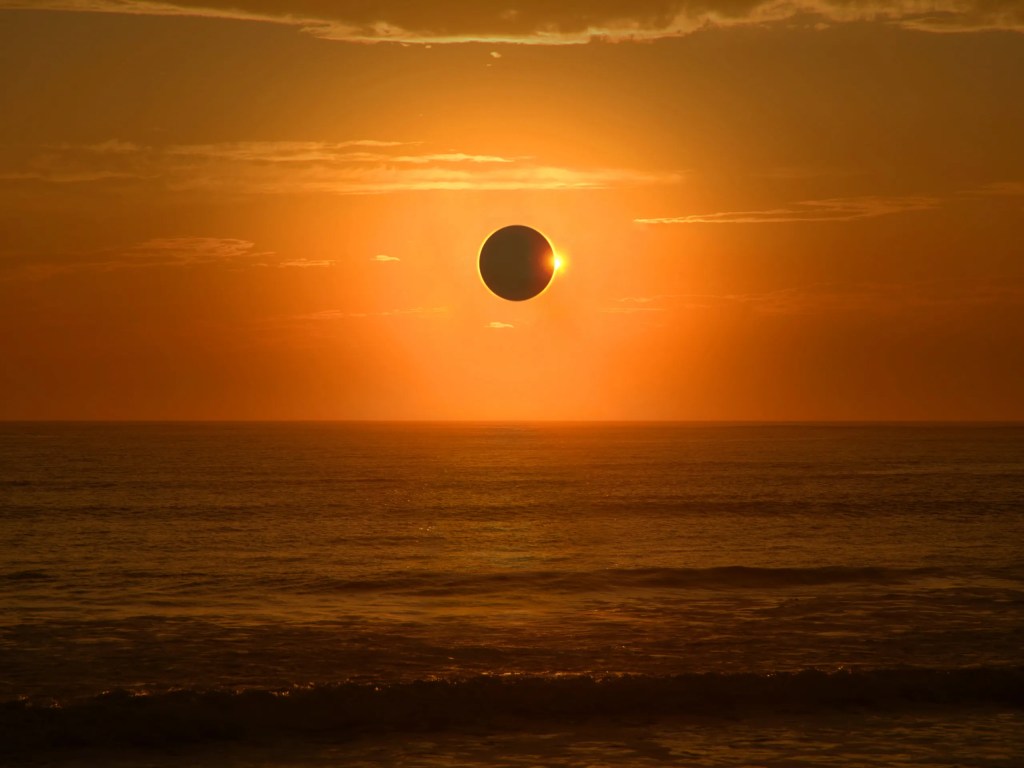
‘I mentally registered a vow, that, if a future opportunity ever presented itself for my observing a total eclipse, I would give up all idea of making astronomical observations, and devote myself to that full enjoyment of the spectacle which can only be obtained by a mere gazer.’
Warren de la Rue, written in 1860, after watching a total solar eclipse in Spain.
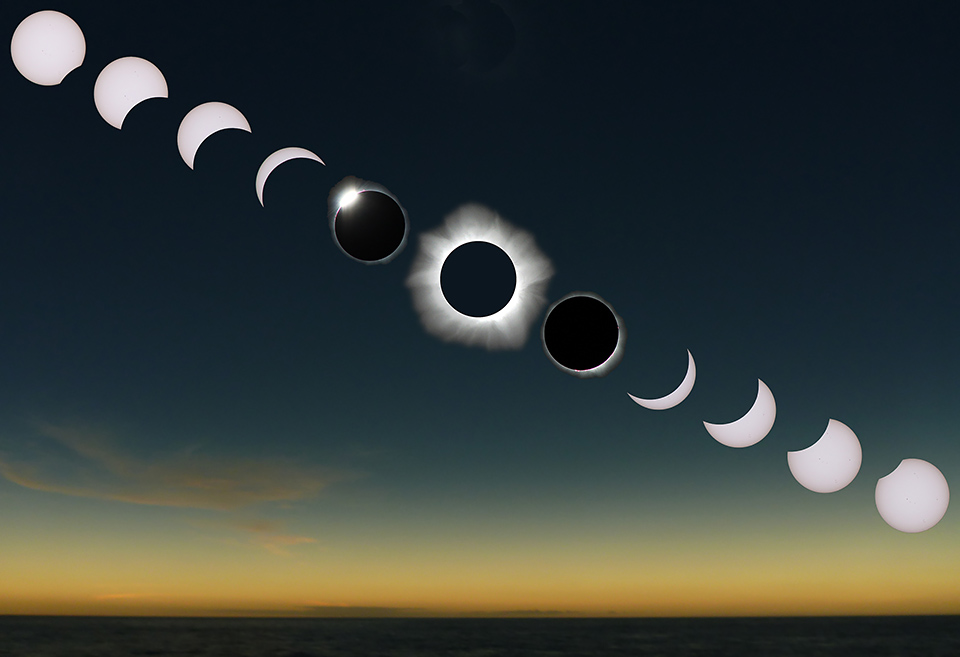
This is an account of eclipses, woven around people’s personal stories and my research into the experience of eclipse viewing. It’s drawn from an essay which I wrote in 2006, for my post-graduate diploma at the University of Bath Spa. I’m swiftly blogging this version, ahead of the 95% solar eclipse which is due to reach the British Isles on August 12th, 2026.
In August 1999, I missed the total solar eclipse which took place in the UK. I was staying in rural Russia at the time, and although I briefly watched a television report, showing a Russian commentator picturesquely framed against the background of St Michael’s Mount in Cornwall, I experienced nothing of it at first hand except for a faint, strange twilight for an hour or so. Local people were slightly surprised, as many of them weren’t aware of its occurrence. But once I returned home and heard people’s stories of seeing the eclipse, I began to wish that I too had witnessed it. And when I embarked on an MA study course in Cultural Astronomy and Astrology a few years later, I thought it might make a good subject for my preliminary dissertation.
I set about interviewing friends and acquaintances, both in person and by email, to learn about their experiences of eclipse viewing. And in early 2005, I was invited to join two British travel agents who were acquaintances of mine on their trip to Cappadocia in Turkey. They were preparing to lead a tour the following year in March 2006 for eclipse-chasers to view a total solar eclipse over the region. If I liked, I could go with them on their reccy. I did like, and learnt something about how such a tour might be organised – best viewing point, alternative one if bad weather intervened, and so on. (Eclipse tourism is a subject in its own right!)
What follows here is a selection from how people spoke and wrote about their experiences of eclipse viewing, both solar and lunar eclipses. I asked a variety of questions, which need not be listed here, as I think the responses speak for themselves. The original essay contains much about methodology, the selection process, and more about the history of eclipse expeditions and research. (A version of it was later published in the journal Correlation, guest editor Nicholas Campion, vol 24 2006-7). But I will here just list the range of places from which people had witnessed an eclipse, which was astonishingly varied: UK, Canada, USA, Turkey, Greece, Ireland, Australia, Germany, Sumatra, South Africa and France. And who they had witnessed it with, took on a deep significance for some of them – for instance, watching the eclipse with a group of fellow meditators on the edge of Dartmoor, gathering with crowds of viewers on Parliament Hill, London, and viewing with local inhabitants on a tropical island.

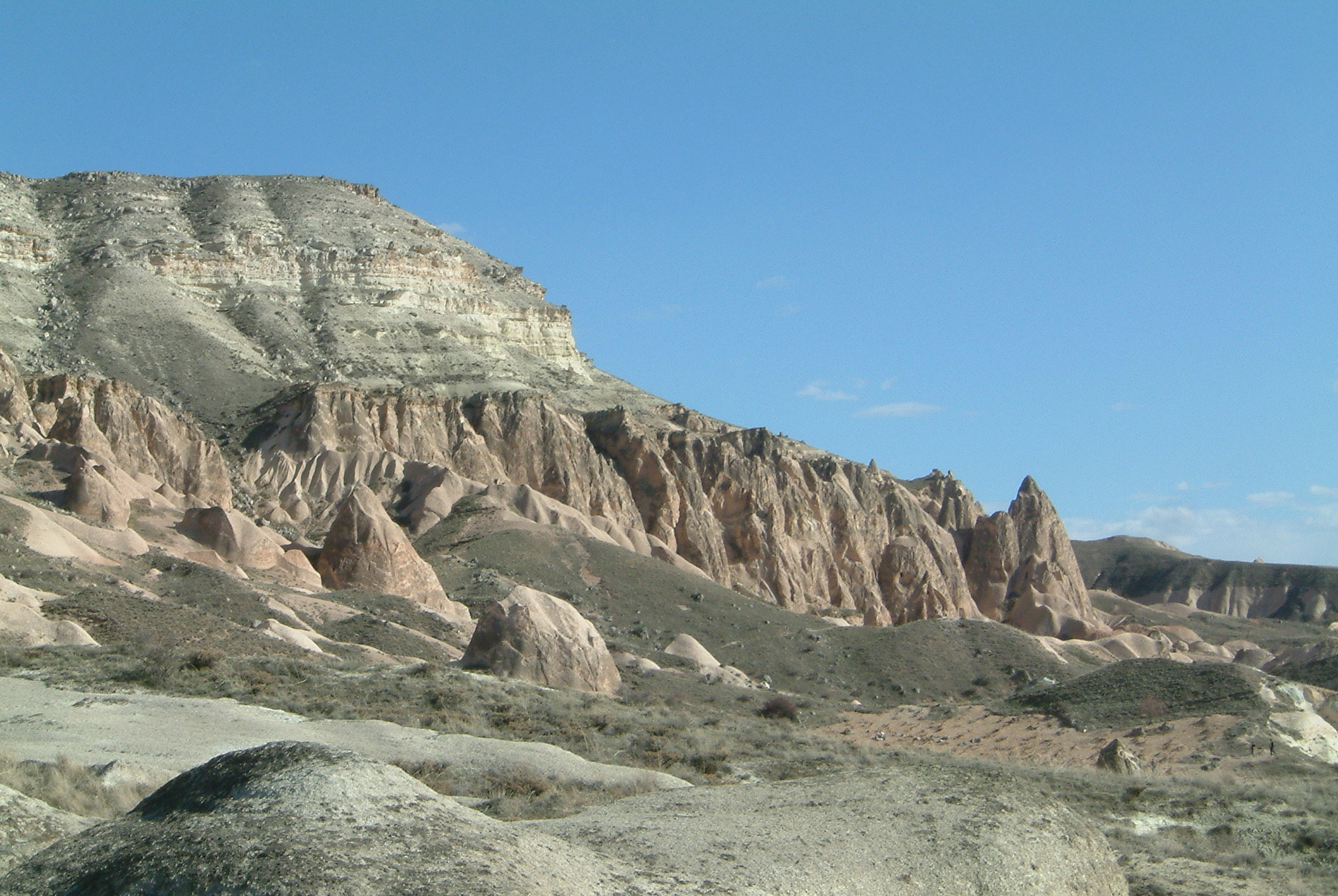
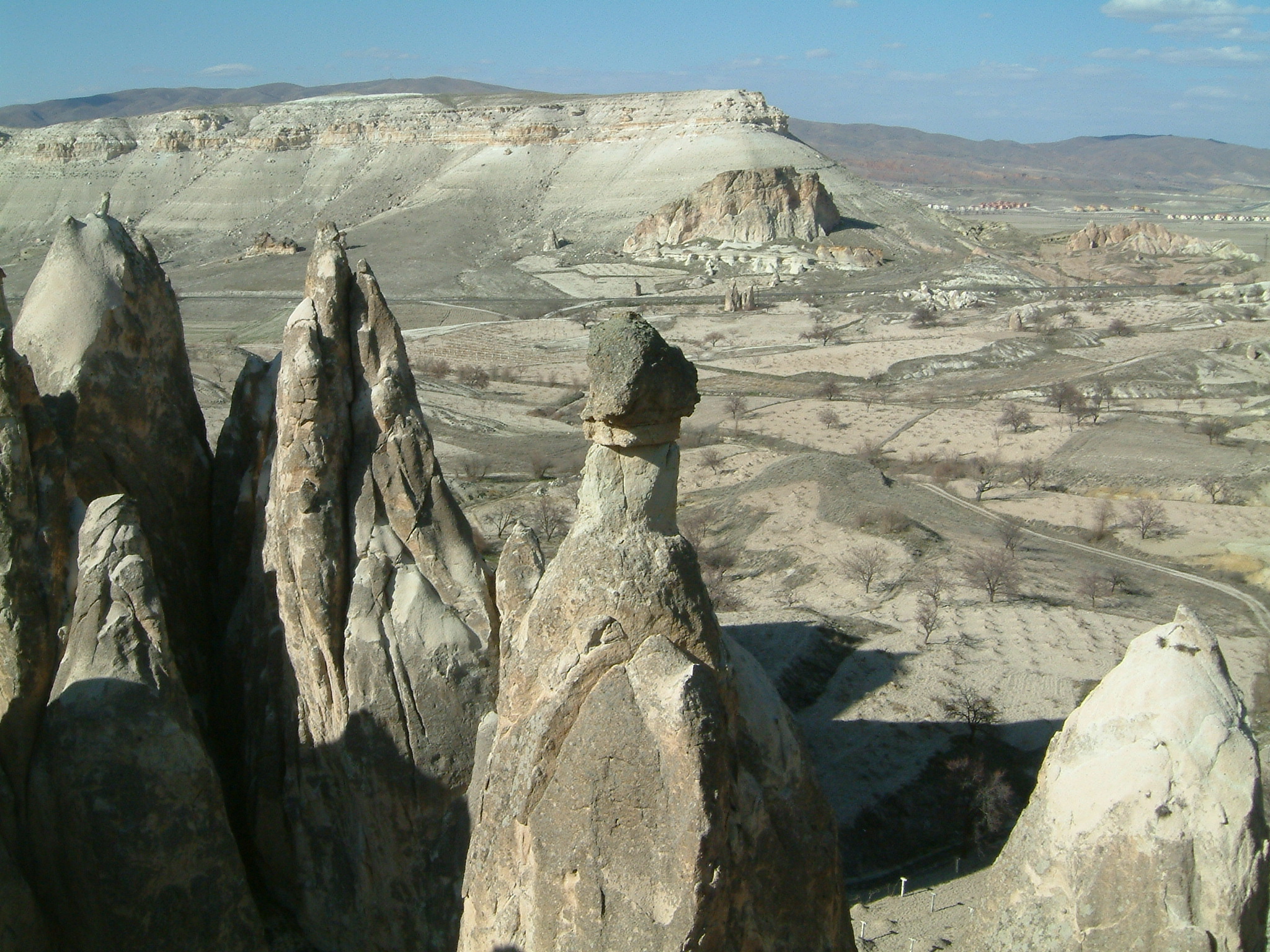
Mike and Karen, British tour operators surveying the best place to bring their eclipse chasers for a forthcoming solar eclipse in Cappadocia, Turkey. The terrain was wild and rugged.

Everyone who I spoke to or corresponded with had something to say about the experience. What follows are extracts from their accounts, which I hope will prove just what a significant occasion it can be. Also to add in here is the fact that the ‘missed eclipse’ can be surprisingly important. I’ve already mentioned my own missed opportunity in 1999, which left a kind of sadness in my memory. Two of my respondents bitterly regretted not taking themselves off to Cornwall for the totality, thereby missing the full sense of occasion. And one woman expressed her lifelong regret that her mother had refused to allow her to watch a solar eclipse as a child because she had measles and was told to rest her eyes: ‘I was desperate to see it, but she wouldn’t let me…I was in a darkened room, and she and the other children were out on the steps.’ There was also disappointment for those who tried but failed when conditions weren’t right. One person waited in vain for cloud to lift in the 1999 eclipse in Ireland: ‘Not being able to detect the last solar eclipse was incredibly disappointing, but I’m not quite sure why. A sense of bereavement almost.’
Only one person reported seeing an eclipse entirely by accident, which was Mike, the travel agent in Turkey who had just finished work at 3am in the morning. ‘I came out on my own and I was facing the Mediterranean and the moon was just right there over the…sea…looking very beautiful, and all of a sudden the shape of the moon started to change. And you could see the shadow just come right across the moon, until the moon completely disappeared, and it was gorgeous. Really gorgeous.’
Shadow of Moon and Earth
At the time of a solar eclipse, we are in fact standing in the shadow of the moon. The literal approach of the shadow impressed one of my informants:
‘I could see the shadow of the moon sweep over the mountain and across the valley, plunging us into a twilight darkness.’
But then, like most of those who recounted their experiences, it was the actual mood and nature of the event which impacted them most, rather than the purely visual observations. The person continues:
‘I felt a sort of psychic shock, it seemed that while the light of the sun was blocked, a dark sort of energy, that is always there, was radiating out and through me, as if I was mostly a skeleton in a dark light. This dark light seemed to be more warm and gentle than the noise of the bright sun light. In that quiet, it seemed one could see a little further beyond one’s personal situation, like a gentle warm future dark space beyond the claustrophobic teenage psychological space I was in at that time.’
Another report says something similar:
‘The speed of the shadow was unexpected. I realised that it represented the speed at which the earth was turning. I’d never felt that before. The depth of it: like falling off a cliff into deep cold water. The usual world I know taken away and replaced with something unknown.’
The shadow also seemed to have a mythic quality – the ‘heavy presence’ of a ‘giant bird’ which ‘had just flown over our heads’, or in another case: ‘The deep shadow rushed headlong across the fifteen miles of land…To my husband …it was like a huge black wing; to me, like the chariot of Dis.’ One person mused: ‘Strange to think that we were on the thing casting the shadow!’

Darkness and Light
The loss of the sun’s light has been considered as fearful over the course of history, and today’s modern, knowledgeable viewer is not entirely immune from the power of the eclipse to frighten us.
‘I did give myself a frisson of fear by imagining – for a dark moment – that the sun was being obscured as though a huge stone was being rolled into the entrance of a cave.’
‘Even I have felt a little childish uncertainty eating away at my mind, something which whispers, ‘Now you’ve seen the sun almost disappear in broad daylight, are you sure it won’t happen again?’
A woman who was watching the eclipse from the roof of her house, went back inside to fetch something, and felt: ‘The light was all wrong. It was not like a cloudy day – there was a very, very strong feeling in the house that something was not right…. It was scary.’
Solar eclipses have long been associated with myths of death and sacrifice, and one person who was watching the eclipse at the former concentration camp of Dachau had a strong sense that ‘down in the blackness was a victim being sacrificed on a slab of stone by the executioner.’ However, when pondering the meaning of the eclipse later, she decided that: ‘The sacrifice was symbolic and behind it lies the meaning of the eclipse. Death and life are intertwined. In life there is death and in death there is life.’
And in that context, as another observer remarked: ‘They [eclipses] always seemed to remind me of death. In that orange light, there seems to be a gentle reminder of the cycles of death, of its strong but gentle qualities….If our lives are like a spiral coil, then death are (sic) the alternating bands on that spiral coil’
Although respondents often found eclipses disturbing or unsettling, this was not the only response. One person found ‘a grace and benevolence’ there, and another noted: ‘I…rather enjoyed this extra twilight and felt very peaceful….The sun eclipse calmed me.’ Or, indeed, both reactions may be combined within one viewing; a report that the preliminary phase of a lunar eclipse was ‘dreamy but scary,’ but ‘when the eclipse totalled, the atmosphere changed. It became very calm, and I had the sense of being held in a firm comforting grip.’

Stillness and Silence: Nature Goes Awry
‘As it got darker and chillier, our two dogs were showing signs of anxiety, so we shut them up indoors. The chickens went doolally.’
For over 750 years, people have likewise been writing about the strange behaviour of animals during eclipses, as this correspondent did; according to an 18th century French astronomer visiting London to view an eclipse, horses simply ‘lay down’ on the road. The same person also noted that as the light started to return, ‘a sparrow hawk whizzed past at waist-height and grabbed a small bird…out of the air.’ Several other people observed that birds went quiet and roosted, but in some cases however, said that they started to feed in a frenzy, or to sing wildly at the beginning or end of the eclipse.
‘It was that sense that everything was stilled, and hushed, and the birds stopped singing, and it was like the animals that run away before an earthquake. It had that sort of magnitude, and impact.’
Indeed, the stillness and silence were a part of the ‘unnatural’ quality of the event: ‘It got darker, and went quiet, like death.’
Sometimes it was noted that other people watching the eclipse also fell silent, thus intensifying the experience. However, other respondents felt cheated of those precious moments of silence by crowds who were shouting, cheering, letting off fireworks or playing rock music. With the arrival of smart phones, too, the multitude of flashing lights as people try to take photos has proved a huge nuisance factor. Smart phones apart, though, this behaviour is probably rather traditional. As Weil, an earlier writer remarked: ‘Once, I saw people applaud the sky….The applause was not so much a welcome to the reappearing sun as a joyful thank-you to nature for putting on such a glorious show.’
Are we still grateful, in this so-called modern scientific world? It seems we are: gratefulness for the return of the sun is still a part of our own response to the passing of an eclipse. ‘The sun returning felt like a relief – all the birds woke up and it seemed like a new beginning.’
Time out of Joint
Previous commentators have noted how the sense of time may alter during eclipses:
Weil continues his report from Mexico:
‘Time did not flow. I have no way of comparing those three-and-a-half-minutes of clock time to any other three-and-a-half-minute interval I have experienced.’
Among my informants, one remarked that an eclipse is ‘stopped time’, and another suggested that the experience involves the ‘suspension of the normal laws of space and time’, resulting in ‘a sudden shift to a different state of being.’ Another commented that ‘the full eclipse was short, it seemed like seconds not minutes.’ It seems that the distortion of the sense of time can go either way.
The Physiological Impact of an Eclipse
In the questionnaire, I asked: ‘Do you think that eclipses….may influence us in physiological…ways?’
One informant made the ingenious suggestion that the darkness of an eclipse might increase the accident rate and another that the effect might be similar to that of the moon creating tides. Several considered that eclipses might affect our internal rhythms.
‘I do think (from my own experience) that they have a physiological/psychological effect to do with messing with the biological clocks.’
‘At one point in the evening after the eclipse, I found myself referring to “yesterday evening”, by which I meant the short period of darkness that day during the eclipse! So in that way I was confused like the birds were.’
And after watching the total solar eclipse of 1999 a third person said that it had been ‘disorientating’, saying: ‘I felt tired afterwards as if a night had passed in a few minutes….as if the clockwork of the normal course of things had slipped a gear.’

The Stories
Very few of my informants were unmoved by the eclipse. The overwhelming response was that of profound experience. Epithets used included ‘magical’, ‘miraculous’, ‘moving’, ‘wonderful’, ‘amazing’, ‘beautiful’ and ‘mysterious’ for the inspiring effects, as well as ‘eerie’, ‘disorientating’, ‘weird’ and ‘scary’ for the more disturbing aspects.
For many, the experience of viewing an eclipse was a story in its own right, an unforgettable experience sometimes linked to events of personal significance or moments of personal revelation. The first two stories have remarkable similarities, with their allusion to Adam and Eve, and the intensifying of the bond between husband and wife, one of whom stood on the brink of death.
In the summer of 1989, this woman’s husband was dying of cancer, and they decided to make one last trip out of the house together to see the lunar eclipse at 3am in the morning:
‘We set the alarm, and we walked up that little hill, the round hill…and he was…struggling to get there, because it was the last walk of any distance he managed, you know. And we were holding hands all the time, and struggling. And it was a great effort to get up there. But finally, we did, and we had it all to ourselves. And it was magnificent!…we saw a magnificent star panoply. But also this huge ball, bronze ball, rolling across the sky….And we also saw a meteor and…we felt we were the only people in the world, like Adam and Eve in the Garden of Eden. The whole show was just for us! Ah – so the wonder of …existence impacted on us powerfully, and we realised more than we had ever done before just how lucky we were to be given a chance of life.’
This correspondent watched the eclipse from her home in Cornwall. After the eclipse itself, she and her husband reviewed their lives:
‘We both had the same impulse, though I don’t remember who suggested it. It was an absolute compulsion to beat the bounds of our land; as it were to count, greet and name every living thing, like Adam & Eve. We had been reminded about how fragile life in the world is. We needed to reassure ourselves that we had come through.
‘The weather kept improving. With the dogs running round us, we walked round our three acres, the field, the little patch of woodland we planted, the cottage garden, orchard, hen-run, pond and willow brake. We paused at each of the burial places of our dogs and cats. Finally we went to the most enclosed patch of the vegetable garden….We sat there with mugs of tea, and made a kind of verbal inventory of the place, in thanks that everything was still here. Holding hands, we talked about our lives together….
‘My husband said it was like starting his life again. It had a wonderfully grounding and reassuring effect on me….After the eclipse, I was washed over by a wave of gratitude….I think all through our lives together, we shall try to recapture that still moment of grace.’
For one informant, an early experience of viewing an eclipse brought a significant degree of conflict into his life
‘When I saw the eclipse in 1978 I was a student at a fundamentalist Christian school. Our principal was an intense bigot who warned all the students not to stay at home and watch the eclipse. He said it was pagan and un-Christian to even acknowledge the passing of an eclipse. I knew he was once a science teacher and I asked him why not observe it as a natural science event? He said it would send the wrong impression to the younger students. During the eclipse he had all the students sit at their desks in the windowless room of the small private Christian school and pray against the evil of the event. I of course, and only one other student came to school late after viewing the eclipse and was scolded by the principle in front of all the other students for being a bad example; I replied I would do it again. I had all my recess and lunch privileges revoked and had to sit at my desk in detention for a week.’
Beginnings and Endings
Others found that the eclipse was a marking point in their lives, sometimes one at the end of a cycle.
‘I feel, though I did not realise it at the time, the eclipse I viewed pointed to the demise of my marriage.’
‘I had just that moment been given my redundancy notice from my job where I had worked for 9 years….This undoubtedly coloured my feeling which was of being cut off from the crowd on the roof and of cold.’
‘That summer it did seem to me that a phase in my life had concluded and come to a satisfactory end.’
One of the two women who watched the eclipse from Dachau found that her perspective shifted afterwards: ‘My earliest memories were of the war. I didn’t realise how deeply I still felt about the war until going to Munich and past Dachau etc. After the eclipse it was different and I was at ease with the Germans. It was CLOSURE. A door had closed and another one had opened.’
A beginning, rather than an end was also reported by, who watched three eclipses over a number of years, each of which ‘marked points where my personal understanding…deepened’ in relation to either science or astrology. He concluded that ‘…each event marked a point where a door was opening.’ Another respondent believes that eclipses are like the pause that marks the place between different musical movements.
Bonding with Others?
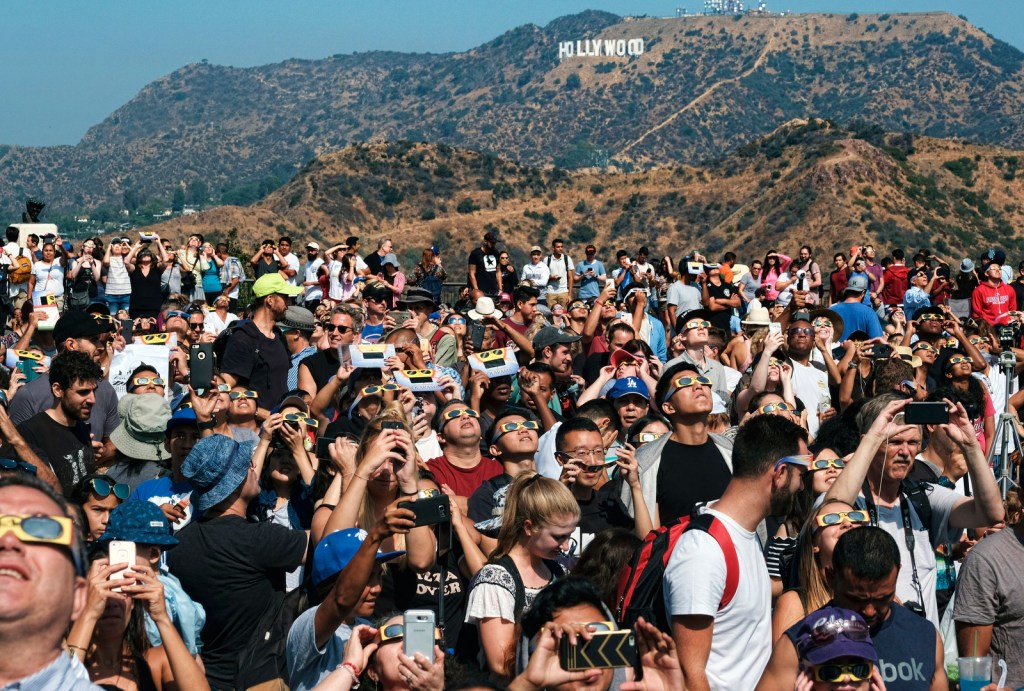
The duality of aloneness and togetherness was apparent in many of the accounts, rather in the same way as the interplay of light/dark. Eclipses seem to remind us of our ultimate aloneness, as well as our capacity to bond with others. A person who watched the solar eclipse alone nevertheless ‘liked to think of all the people all over England and Europe who were doing the same thing.’ Another shared a ‘unique moment of companionship with the person I was with,’ while a further person concluded that by watching the eclipse with a group of fellow meditators ‘we were probably open to experiencing it more deeply’. A number had actually watched eclipses in a crowd, and seemed to enjoy being a part of this, sharing a mood that was ‘expectant’, ‘friendly’ or ‘joyous’.
On the other hand, there could also be the sense of being singled out in eclipse viewing, because of its impact on the individual. There was ‘a feeling of it being very personal, as if no-one else was watching, that it was all set up for me.’ The different dimensions of being set apart from, and connected to others, are hauntingly described by a different viewer:
‘I remember in 2001 that whilst viewing a moon eclipse I was joined by another person, a stranger to me who noticed what I was doing and who decided to join me gazing. Then some other passer-by also joined us and then another couple too. We all stood there in silence watching the moon and I dare say there was a feeling of togetherness among us even though we were all strangers to one another. Even though it was freezing cold we enjoyed this novel gazing activity, each in their own way. Yet there were others who passed by, saw what we were up to, hardly glanced up to the sky, scoffed, and quickly went by their usual business as if afraid to look at the sky.’
A Sense of Scale
Eclipses, it was said in my survey, give us ‘a sense of scale’, reminding us ‘of our lowly place in nature’s scheme of things’. ‘We are part of a massive system’ in a ‘vast…cosmos’ it was observed, and the viewer can feel ‘very small, like a gnat on an orange.’ But this is not necessarily a bleak experience, since it can bring ‘a sense of mystery of the universe’, perceived as a ‘marvel’ which ‘has the ability to make one see more of the world around you’ and to ‘change perspective’ Perceptions arising from the eclipse experience can thus inspire new insights:
‘The way that there is a repeating pattern over such an enormous timescale, where the sun moon and earth come together as if in a formal dance, reminds me of those people who you meet once in your lifetime for a very short time to perform some sort of exchange, and then whiz off in your separate orbits again. It makes me think that there is a larger plan than just the one lifetime which a person seems to see.’
The Creative and the Sacred
The sense of awe or wonder described by a large majority of respondents may mean that for some, eclipse viewing is, or borders on being, a sacred experience. One correspondent had a sense that ‘the Holy of Holies’ was opening. Another likened the experience to ‘entering meditation’. A few felt the urge to turn the energy generated by an eclipse experience into creative expression. One woman, a poet, on concluding her questionnaire, wrote: ‘There must be some creative work in there somewhere, but where and what?’Another, a novelist, wrote a poem afterwards, and a third, a professional musician, composed a piece for guitar entitled ‘Eclipse 99.’
Eclipses and Prediction
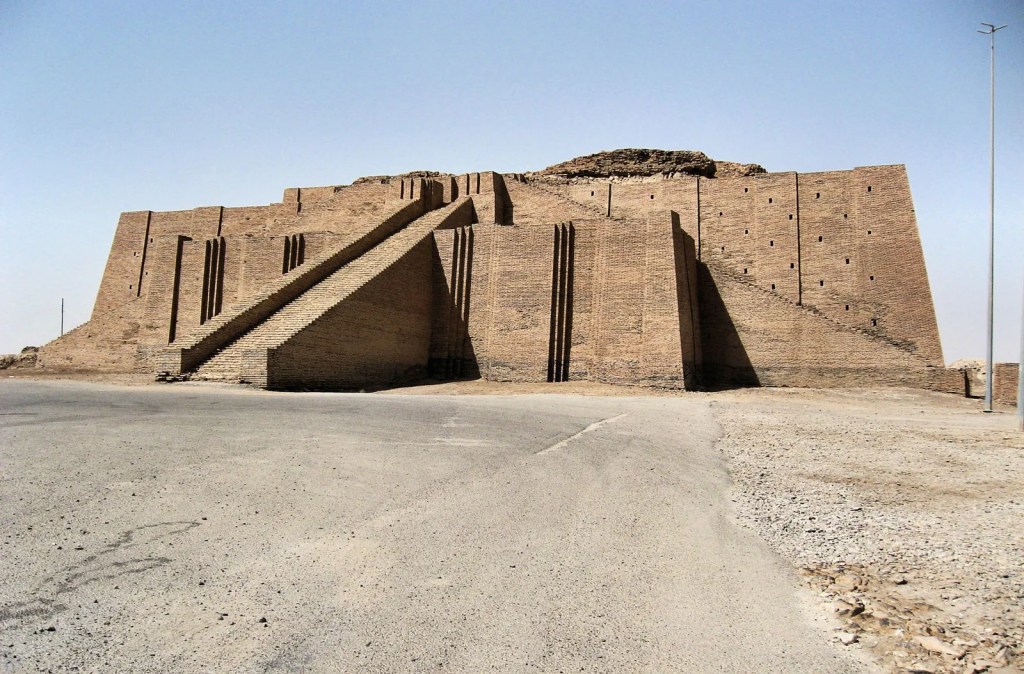
Prediction from eclipses has been a component of astrology since Babylonian times. In the last three hundred years, it has receded somewhat as a prominent element of Western astrology or horoscope interpretation, but I wanted to find out if any of the participants in my study held the belief that eclipses may be predictive. Of my informants, seven actively practised astrology, and another thirteen accepted it as a valid system; two were opposed to astrology, leaving seven whose views were not known with any certainty. Surprisingly, few did. The strongest negation was simply: ‘No. no.no.’ Even among the astrologers, none were prepared to validate the predictive qualities outright.
However one informant, who was not an astrologer, held to the age-old tradition: ‘I am convinced that there is a direct relation between the planetary movements, the movements of the heavenly bodies and what is happening on earth. In that sense they (eclipses) can be predictive.’
More eclipses?
I asked everyone: ‘Would you travel or make a special effort to see an eclipse again?’ All except three stated clearly that they would. Rather entertainingly, certain conditions were attached! One person would travel only up to two hundred miles, another would plan a viewing only if clear weather was guaranteed. However, several thought they might make a special effort, and another already had an expedition planned to an eclipse ten years ahead!
My eclipse project brought in surprising answers, and moving stories. The number of people surveyed was modest – 26 – but provided a goodly range of views and experiences. In these lie an affirmation that, however well we may understand the physical mechanisms of astronomy today, there is still a yearning to witness some of its most dramatic manifestations. These can affect our own outlook, our sense of collective awareness, and form a story to be woven into our life journey.
Adapted and edited on the eve of the solar eclipse to be witnessed in the UK on August 12th 2026.