A Coventry Quest: Finding a Grandfather

Family history is a quest, and the act of going out on site visits to do your research can be a story in itself. If you visit the places where your ancestors lived and worked, it can become a magical journey where surprises and discoveries abound. Savouring the atmosphere of ancestral haunts and walking the landscapes where they too walked can bring a kind of knowledge beyond that of hard facts.

In this post, I have written up one of my own quests on the trail of the ancestors – a trip to Coventry to discover more of my 3 x great grandfather, watchmaker Daniel Brown. I wrote it down a few years ago, in such a way that I could share the story with others, but it has never seen the light of day until now. I offer it here, after giving it the cold editorial eye, and a sprucing-up.

For those interested in doing something similar, I’ve added tips and suggestions about the process at the end. It’s worth making a special undertaking to do this. While teaching life writing and family history courses, I’ve often encouraged people to set up a ‘quest’ and write about their discoveries, and it’s always been exciting and moving to read their stories.
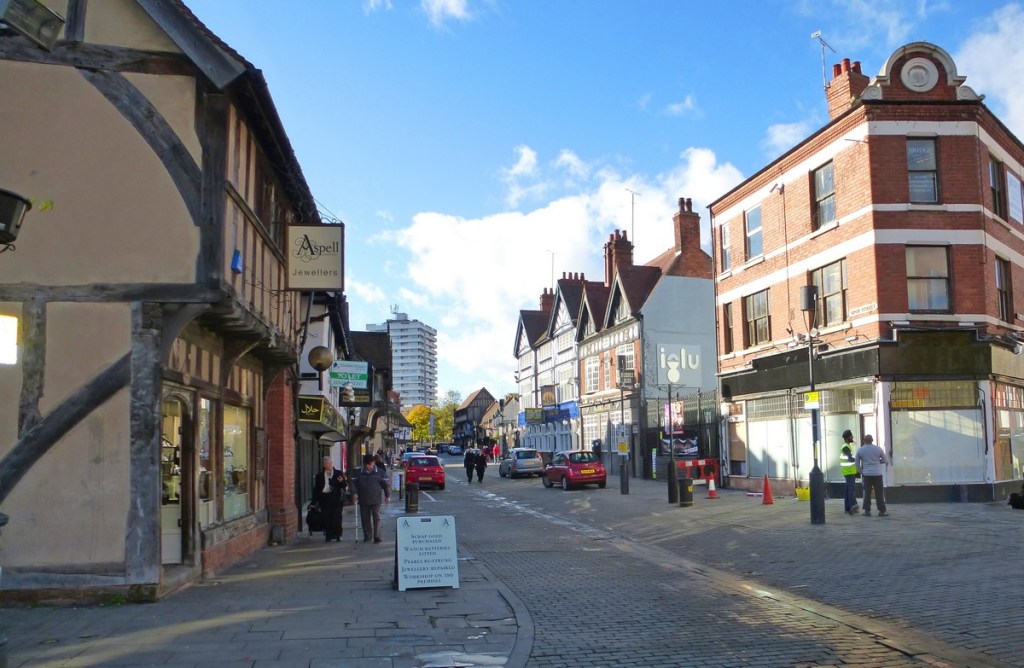
Spon Street, Coventry, photographed on the morning of our visit

Arrival in Spon Street

‘Is this Spon Street?’ asks my husband, in mild disbelief.

We gaze down the narrow city street, studded with a mixture of nightclubs and kebab takeaways, bridalwear shops and ‘the last proper butcher’s in Coventry’. It’s a wet, cold Saturday morning, and the street is deserted. Is this really the historic quarter, the street once filled by hundreds of craftsmen: dyers and weavers, shoemakers and watchmakers? The Coventry websites call it ‘the town’s finest renovation project’, but it seems a little sad right now. The photos they show, a real dream of an ancient street, obviously must depend on where you point the camera. Historical in part, we concede, noticing some exquisite groups of half-timbered houses dotted along the street, among the Victorian and ‘60s infill. We are here to follow up one of those former inhabitants, my 3 x great grandfather, Daniel Brown, watchmaker of Spon Street in the late 18th century. And even though first impressions are not quite as expected, we’re ready to take what the city can offer us.

I was last in Coventry when I was at school in Birmingham. Coventry wasn’t a place you came to then except to see the new cathedral, or, in my case, to listen to the Rolling Stones. It’s not familiar, although I can still recognise the ‘modern’ shopping precinct of the late 1960s where I looked in vain for trendy clothes, now smartened up with a glass roof. We aren’t here to cover my old trails, though, but rather to find new ones. When you’re hunting ancestors, even in a place you know well, you inevitably see your surroundings in a different light, and explore nooks and crannies which wouldn’t have attracted your attention before. Even the air smells different when you’re on the trail; often, a strange magic creeps in, and such days remain glowing in the memory.
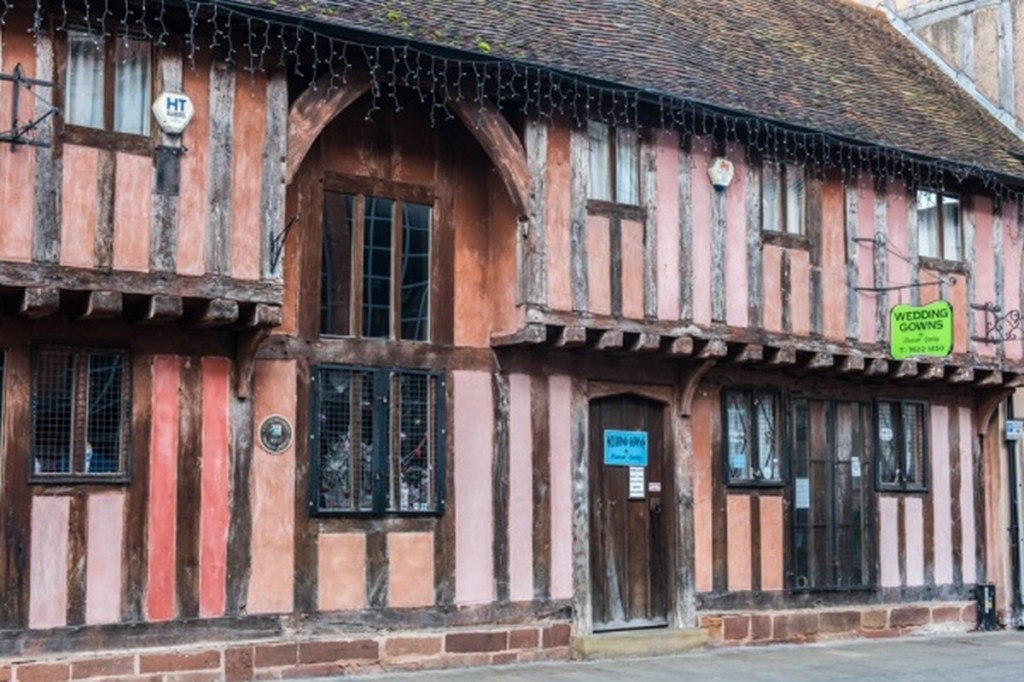
One of the truly old houses in Spon Street

So here is the background to this particular quest. Daniel Brown was born around 1768, and lived in the labyrinth of workshops in Spon Street for most of his life, practising his skills as a watchmaker. He married a woman called Anne –surname possibly Fulford – and they produced a family of some five children. One of these children, James, became my 2 x great grandfather. It seems that Daniel’s own father, Isaac, was a weaver, and since James reverted to the weaving trade, Daniel is the only watchmaker in my line, and of great interest as such. What can Coventry tell me about him?

He must have done well at his trade, since at his death at the age of 81 in 1849, he had money and property to leave in his will, an estate worth about £25,000 in today’s terms. Daniel’s first will had me fooled, though: it was a draft prepared less than ten years before his death, written in an almost indecipherable hand. I assumed it was his final will, but when I’d finally transcribed it, I thought it might be prudent to check for a proven will. There was one – much more legible this time, but oh, what had the old so-and-so done? He’d gone and got married again, in 1844, at the age of 76, to one Sarah Stone. Both their ages are coyly concealed on the marriage certificate, which declares simply that they are ‘of full age’. Well, it must have been obvious in Daniel’s case, but I’d like to know if Sarah was a tempting young wench, or a shrewd elderly widow? At any rate, Sarah comes in for the sum of 10 shillings to be paid to her ‘at the end of every week’ until it reaches a total of £300. This surely shows an astuteness in Daniel’s control of his money – if she was a gold digger, she would only be in line for a share of his assets and if she died soon after him, the residue of the bequest would pass back to his own family. Other bequests are to his children and grandchildren, who each receive a decent legacy. All, that is, except for my 2 x gt. grandfather James, who obviously owed his father a packet already, since Daniel’s will offers to write off James’s debts, but little else.

St John’s Church, Coventry, where my 3 x gt grandfather married twice, the second time in his late 70s. Below is the carving of the Green Man, which might have given him pause for thought then.

In the city centre itself, we admire Lady Godiva’s statue, a legend which is a tribute to the independence and feistiness of the inhabitants.

Robert is casting an artist’s eye over the sculpture of Lady Godiva who rode naked through the town in order to save the townspeople from punitive taxes. You can read the story and see another striking image of her here.

Discovering the city

We pay the steep entrance fee into the Cathedral to see not only the famous Graham Sutherland tapestry, but the Piper Baptistry window, the Whistler angels etched on glass, and the Frink choir stalls. The more we gaze, the more I appreciate this incredible building and its art, far more than I did in my restless teenage years. Yet I’m assailed by a sharp sense of the sadness and anger embedded here, in the juxtaposition of the new Cathedral and the ruins of the old, following the horrendous destruction of the Blitz. Witnessing this contrast, though, helps me to get a perspective on the longer history of the city. Although my direct-line descendants moved out to the nearby town of Bedworth, Coventry must still have been imprinted in the family story. My sense of the old Coventry as a productive, busy place, fostering independent craftspeople and small businesses, has now been heightened by the contrast with its post-war trauma. Indeed, almost anything you see and experience on a family history quest is likely to feed your knowledge, and fire up your imagination. You can never achieve this in quite the same way from research carried out at a distance.
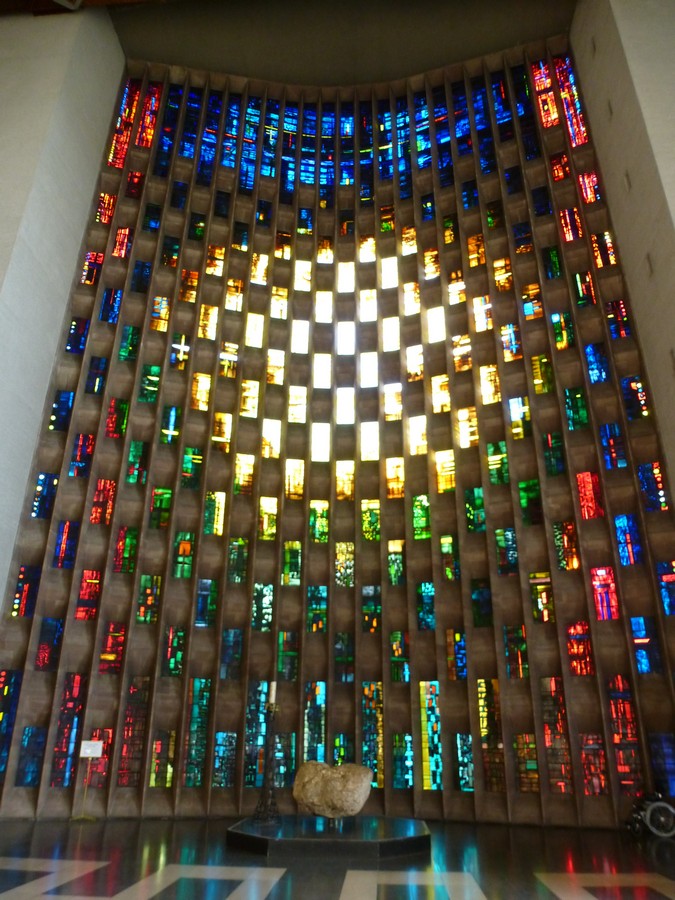
The wonderful Baptistry window by John Piper, in Coventry Cathedral

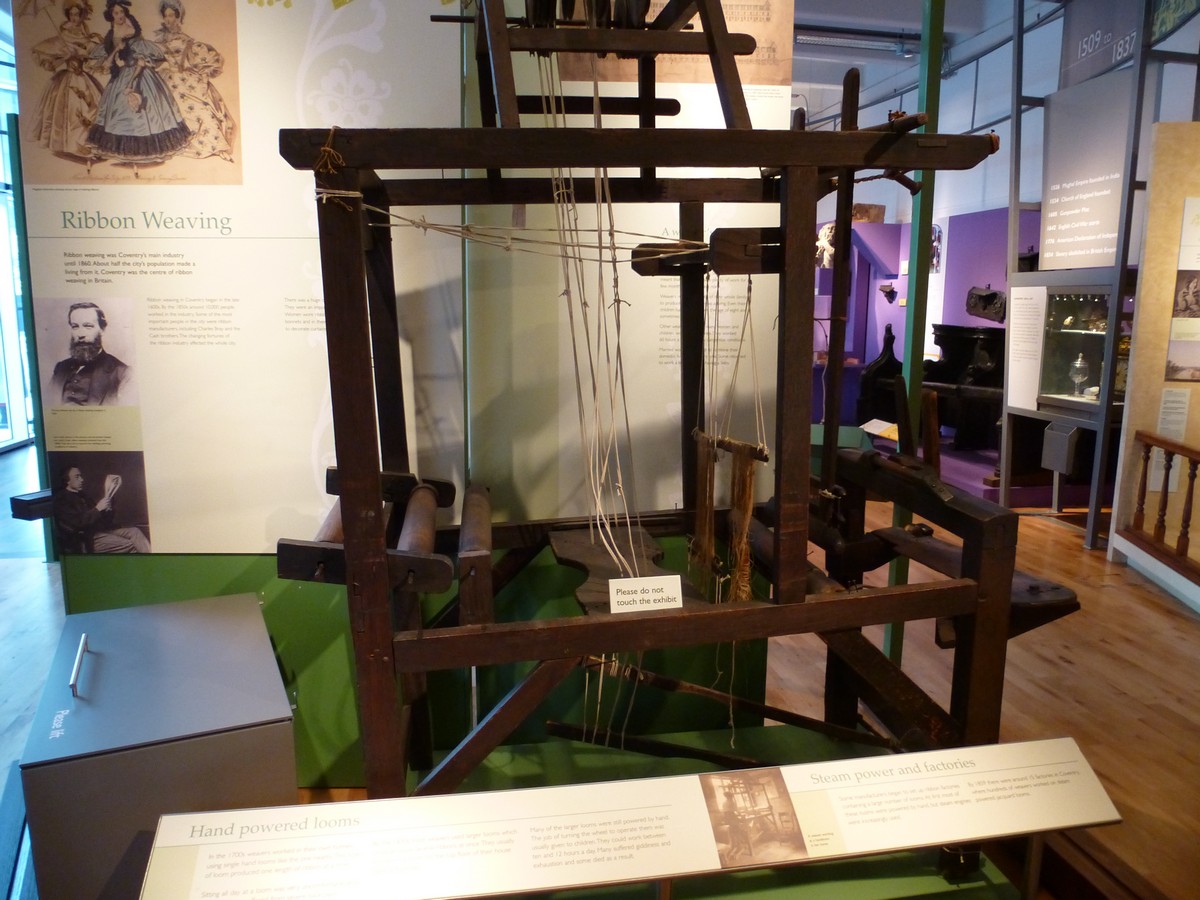
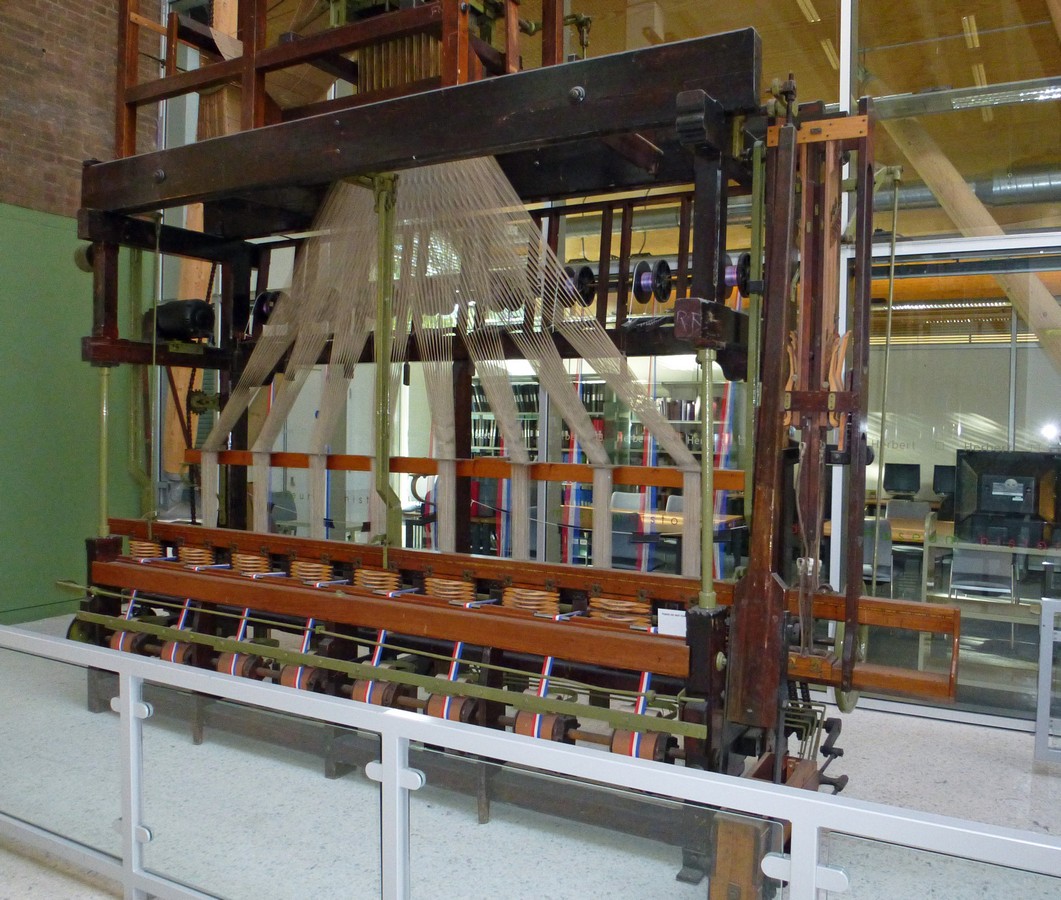
I am eager to visit the ribbon weaving display at the Herbert Museum and City Art Gallery. Many of Daniel’s relatives and descendants, including my great grandmother, worked in this industry, often from as young as ten years old. In the 19th century, beautiful and intricate silk ribbons were woven to adorn ladies’ costumes, and both Coventry and Bedworth depended economically upon this trade. The industry continued through the era of hand loom weaving into that of machine weaving and jacquard looms, which were capable of reproducing complex patterns. The Museum has a stunning example of a jacquard loom, and a video of the monster at work. (You can see below an example of an earlier hand loom on the left, and a jacquard on the right.)
The images below show the types of decorative silk ribbon that were being woven in Coventry and the surrounding areas in the 18th and early 19th centuries. These are in pattern books, preserved at the Herbert Museum.
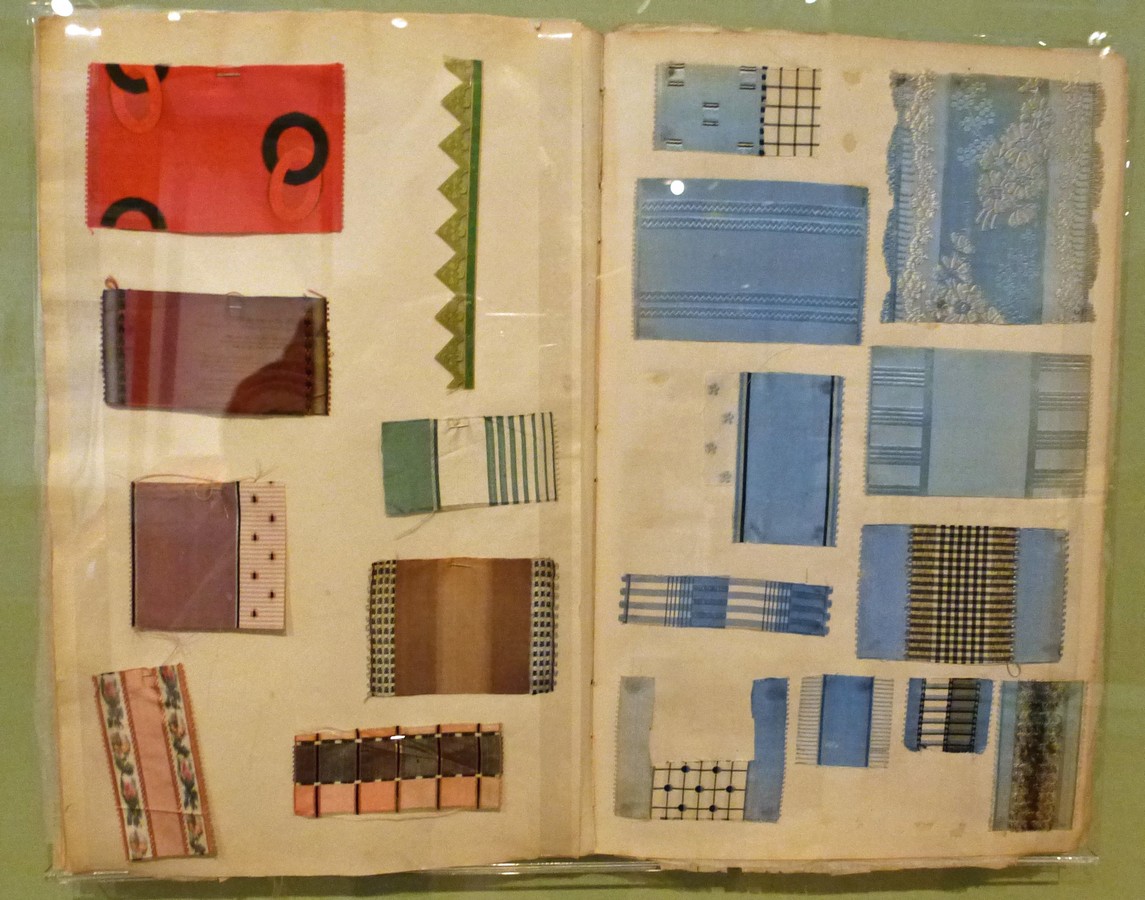
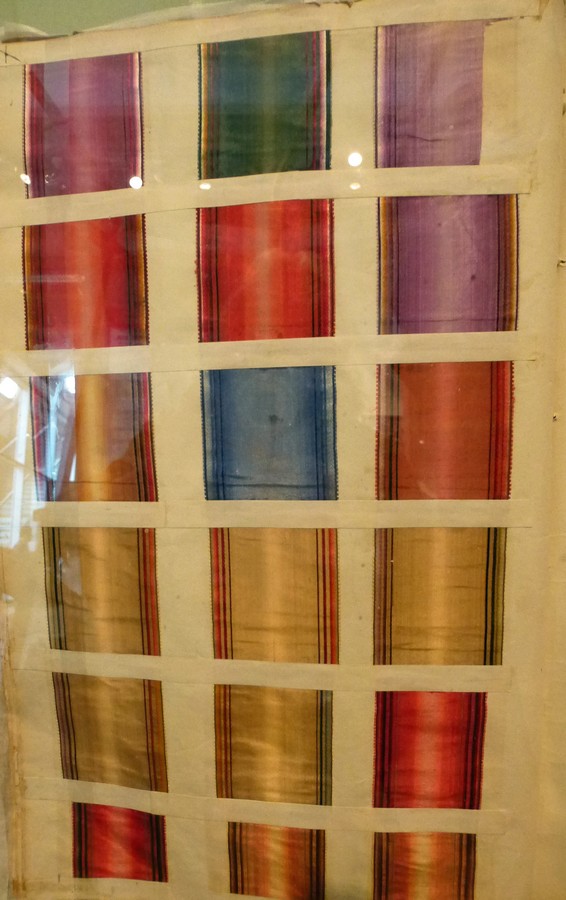
Ribbon weaving was often done from family workshops, sometimes situated on the top floor of their cottages for maximum light, but later subsumed into fully-industrialised factories which swallowed up their children for the workforce. Cash’s (of school nametapes fame) is probably the most famous of these old Coventry firms. At the Tourist Information Office – another source of local wisdom – the woman at the desk told me wryly that most of the Cash’s name tapes are now woven in Turkey, although some decorative bookmarks are still made locally as souvenirs. Now, in the Museum, we admire the sample ribbon pattern books dating from the 1840s, the time when my Bedworth ancestors were in the trade. There’s also an account of the terrible times of hardship that hit the ribbon weavers after the tariffs were lifted on the import of French silk, causing a major slump in home production. Famine struck both Coventry and Bedworth, soup kitchens were set up, and charitable funds were used to send whole families abroad to the Colonies. My great grandfather was fortunate in that he spotted the opportunity to work on the railways, which gave the chance for a family to move, something very difficult at the time. (He ended his career as signalman at Althorp Park Station, known these days as the stately house where Princess Diana lived.)
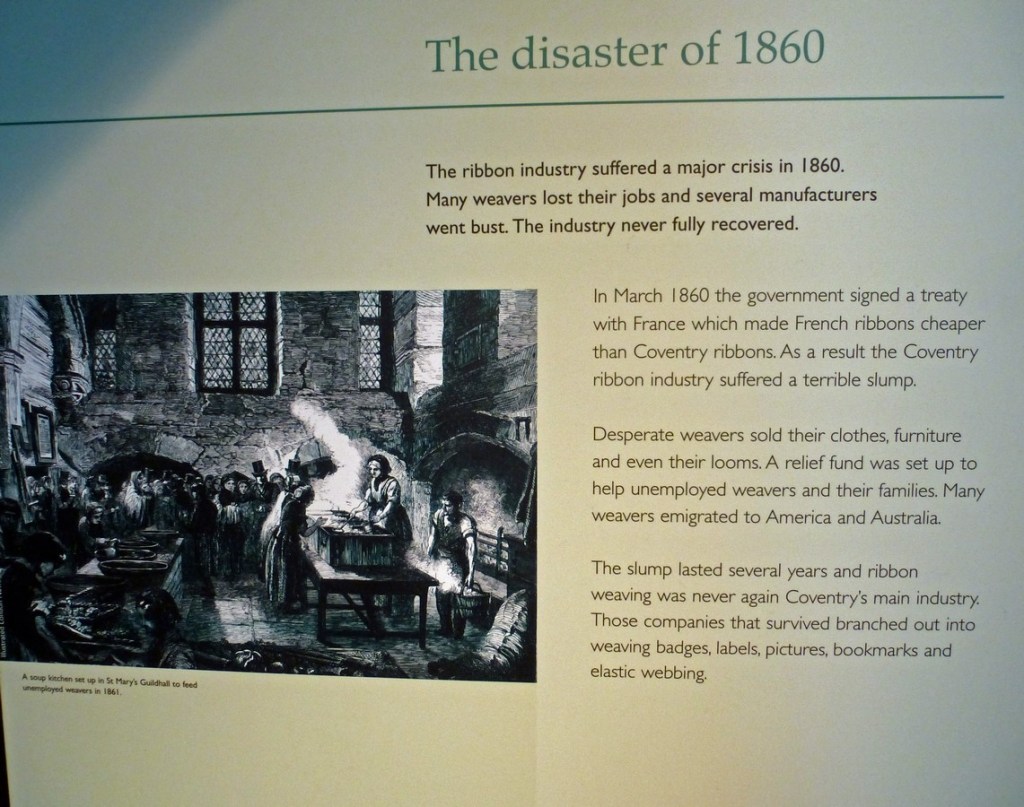
The plight of the ribbon weavers, from an information board in the Herbert Museum

Winners and Losers

On these quests, not every plan may prove possible. It seems that I can’t make the special visit that I’d been promised earlier, to see the rest of the ribbon weaving samples in store. It’s Saturday, and curators only work Monday to Friday, I’m told. Another time, perhaps. Indeed, I’ve learned from past experience, that it’s more rewarding to stay with what can be done, than to fret about what can’t. Perhaps I can take this enticing option on a future visit.

But, to balance this up, contrary to what the website says, the History Centre is open on Saturdays. An inviting, glass-walled library on the ground floor of the Museum, it is available for any walk-in visitors who’d like to consult shelves of local material, with the assistance of knowledgeable volunteers. We only have a short time, but some quick browsing produces a possible match for Daniel in the apprenticeship records and a plot number for him in the London Road Cemetery. This will at least give us a chance to see his gravestone; I discovered a picture of his memorial stone on a website a couple of nights ago.

A map of the London Road cemetery area. I wish I’d taken one of these with us! The location on the left hand side, with the Non-Conformist Chapel, is the area we needed.

We return to Spon Street, which is now looking a little brighter, with a few visitors in its shops and cafes. This was once a major highway into the city, and has been an important part of Coventry’s trading quarter since medieval times. But apart from the recent historic reconstruction at the inner end, little now remains of the cottages and bustling workshops which once flanked it for the best part of a mile. The city ring road has cut through it, and the two parts are severed, and only accessible on foot. The move to the era of ‘Car is God’ has created some truly terrible town planning in the Midlands, as I’ve written about in ‘Finding Brummagem’. The outer stretch is quiet now, leading us past blocks of flats, deserted open grassland, community centres and an occasional old cottage. But the sense of space is opened up, and it’s possible to project the imagination even further back in history, to a time when the area was rural. The river Sherbourne, which the dyers once used, is still racing along behind a row of houses, and on the old stone bridge which crosses it, you can stand and dream of life gone by.

The River Sherbourne, once semi-rural and passing weavers’ and watchmakers’ cottages. Now it passes through new housing estates.

Two o’clock, and we haven’t had lunch yet. (Food is always important on my quests. Fuel is definitely needed.) Oh, and the Watch Museum is open in Spon Street as well. Another piece of good fortune, as it only opens for a few hours twice a week. Can’t miss that. So shall we try the cemetery too? I steal a sideways glance at my husband. He doesn’t look too jaded, so maybe something to eat will strengthen us enough to complete the quest. We go for coffee and sandwiches in a bistro operating in one of the reconstructed 17th century houses, then stroll over to the Watch Museum. This consists of a very decrepit block of cottages, which lead back from the street into a courtyard.

‘Come out to the back!’

A museum guide beckons us eagerly. He throws open the door to one of three privies, lovingly restored. A hundred and eleven people once lived and worked here, and they had to share the facilities.

He scratched his head. ‘Some tourists have borrowed our bowler hats,’ he says, and shows us to where a couple of visitors are posing bowler-hatted for their photos against the back wall of the final cottage, which has a gaping crack running from top to bottom.

The inside rooms on show are incredibly dilapidated too, with flaking, distempered doors and bare floors, but they give me a sense of the old way of life more vividly than an artistic reconstruction. Was Daniel’s life this hard? Did he have to squirrel away his money to improve his lot?
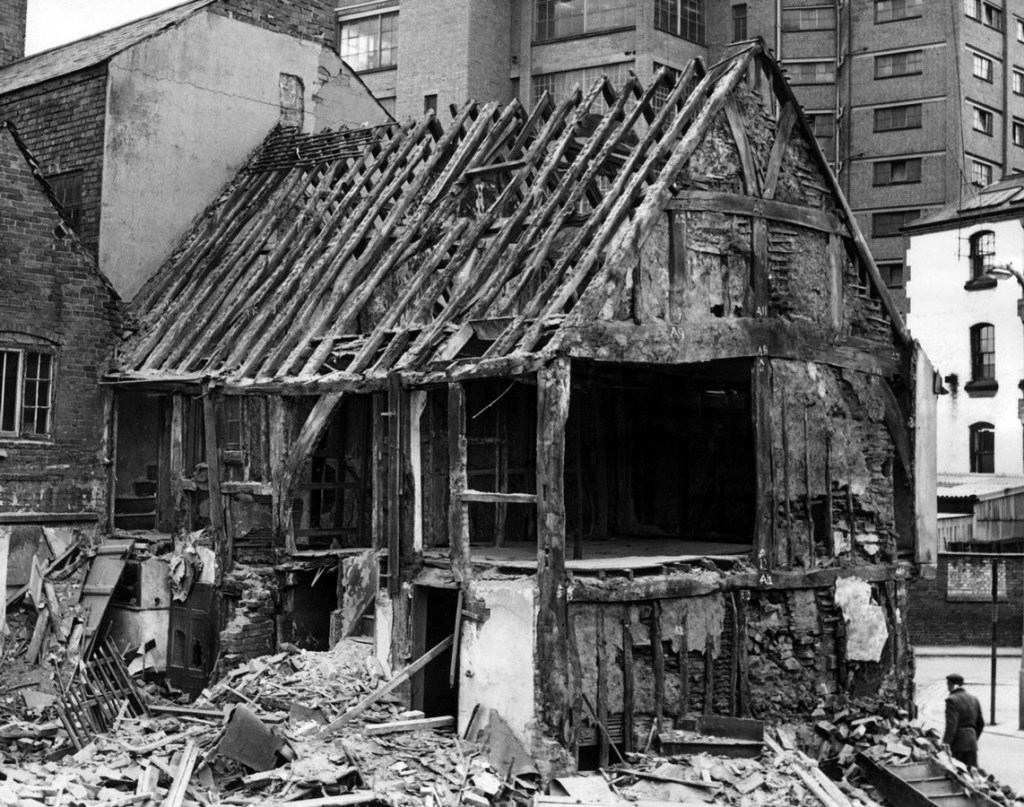
‘Spon Street, Coventry, West Midlands. The Spon Street building, now almost a skeleton stripped of its fabric, was built as a pair of semi-detached houses, probably in the 14th century. Markings on the end truss indicate that the timber framework is to be taken to pieces carefully and possibly re-erected. June 1963.’ From a newspaper article about the re-construction of Coventry, which also included the photo of the River Sherbourne above

We admire the selection of Coventry watches on display, and I wonder about Daniel’s status. I’ve found him listed in the watchmakers’ records for the town, but I don’t know if he worked entirely on his own account, or as a piece-worker for one of the local firms? I’m told by the guide that watchmakers could do either, or both, but that individual watches were rarely signed as many watches were composite productions. I’ve already seen in my research that the censuses of the period reveal many dial-makers and watch-finishers, as well as watchmakers proper. So finding a ‘Daniel Brown’ watch remains a dream for me.

‘Most watchmakers were apprenticed, and the first thing they got when they’d served the apprenticeship was the sack,’ the guide informs us. ‘They had to make shift for themselves, then. But they were also freer to do what they wanted. Look out for a marriage at around the age of twenty-one. They weren’t allowed to marry before that. It can help you with knowing the age of your ancestor.’

I check my dossier. ‘Twenty-four,’ I say.

He nods sagely. ‘Sounds about right. They tended to marry as soon as they could.’

A restored weaver’s house in Spon Street

I buy a booklet produced by the Museum, describing a historic watchmakers’ trail around the city, and then we’re off to our final stop: the London Road Cemetery. We are back in the car, and snarled up on the Coventry Ring Road, which was probably devised by planners when they were in a sadistic mood. Poor old Jane, our Sat Nav voice, can’t cope with all their loops and kinks. We circle around the city in the wrong direction. Eventually, as navigator I tell Robert to take the next road off the demonic ring.

‘Where’s it going?’ he asks.

‘I don’t know. I don’t care. Anywhere is better than this.’

There were plenty of watering holes around Spon Street and Spon End. This one was apparently called ‘The Old Windmill’, but known at one time as ‘Ma Brown’s’. Could Ma Brown or Sydney Brown have been a relation, I wonder?

Jane recovers her sanity and coolly directs us to the post code for the cemetery. And that’s where she can help no further. We only have a vague memory of the plan we consulted at the History Centre, with its numbered section and grave. We drive all around it, finally choose one of the unmarked entrances, and drive the car a little way in. It’s late afternoon now, and the place is practically deserted. We wander through the vast graveyard, looking for older stones that will show us we’re in the right area. But only modern graves catch our eye, some vividly decorated with pink flowers and teddies. Who can we ask? There’s one mourner by a grave, but he is truly mourning, wiping away tears. I decide to go through an iron gate in the wall – shades of The Secret Garden – to see if the old area is beyond there. It’s getting dusky, and I hesitate when I see three lads who look as though they might be drug dealing. Ah no, here comes a safe-looking middle-aged couple with their shopping. They tell me, rather vaguely, that there’s another complete section of the cemetery we need to find.

‘Where the Rolls Royce factory was. You know,’ she says helpfully.

‘No, I’m sorry, I don’t,’ I reply. ‘Do you know what road the entrance is on?’

‘No, haven’t a clue,’ answers her husband.

We decide to try again. This time, we find a friendly Irish lady tidying up a grave. She’s driven her car right up to the graveside. ‘Have to be careful. People have been robbed here.’ She tells us that there is a Chapel, and an older graveyard around it. ‘Just up there.’ She waves her hand vaguely.

Thank you, thank you. By now, Robert is using his visual skills as a professional artist and is consulting the photo of the gravestone.

‘Look at the shape of it,’ he says, tracing the indentations and angles cut into the top of the stone. He also has stonemason ancestors, so I’m trusting his instincts to spot the right one.

But we can’t find anything. We ask another man, also Irish as it happens, who shakes his head. As we head towards the exit, we see a very organised-looking lady tending a grave. I say it’s not worth asking, but Robert says we should give it one last shot.

‘Of course,’ she says. ‘You need to go out of here, and then find the other entrance, the original one. It’s just down the road.’

The old Non-Conformist Chapel, in the section of the cemetery where Daniel Brown was buried. This family line is mainly Baptist, so it’s possible that Daniel was as well. (Non-Conformists often married in Anglican churches, and were sometimes required to do so by law.)

Ah, it’s in a different place altogether! The cemetery was opened in 1847 and since then, the railway line has sliced it in half. We pick up the car which is languishing near a cedar tree, and drive out, round, down – and there it is – the older, grander entrance to the original cemetery. Daniel Brown was one of the first to be buried there in 1849.

Four magpies bounce across the path.

‘A boy!’ we say excitedly, in line with the old children’s rhyme. But will we find our man?

We search the first area without any luck, and I am thinking that it’s nearly time to go home. The air is darker, the mood is eerie, and we’re in a place where the dead are thick in number and the living very scarce. We are the only ones, in fact.

Then we spot the Chapel, further along. It’s a kind of strange, mausoleum type of building and with it comes a whiff of the Victorian cult of death. We move towards it, through the obelisks and the forest of stones, both plain and elaborate, some now leaning at an angle or almost swallowed up by the trees.

‘I’ll take this side, you take the other,’ I suggest.

Five minutes later, Robert calls out: ‘Found it!’

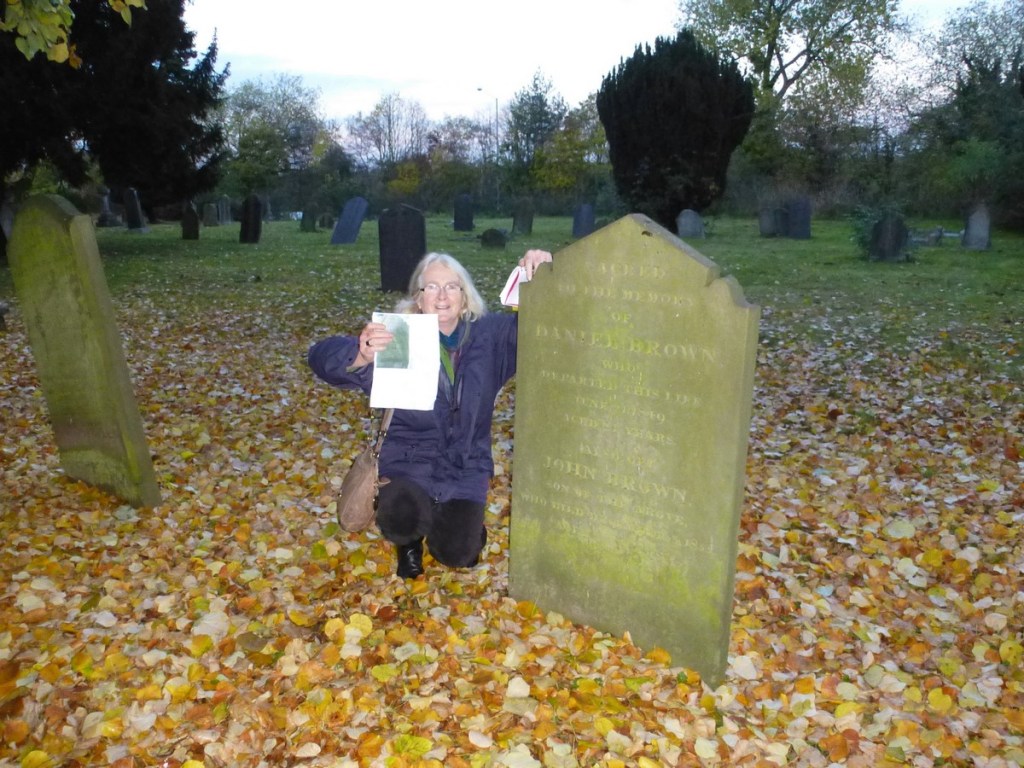
And there he is. ‘Daniel Brown, departed this life June 21st 1849 aged 81 years. And of John Brown, son of the above, who died Dec 5th 1855, aged 58 years.’

‘Hello, grandpa,’ I say softly.
Websites for Coventry history
Cash’s weaving, Coventry
Coventry Watch Museum
Herbert Art Gallery and Museum
Spon Street, Coventry – Coventry Walks website , Historic Coventry
Article on the changing face of Coventry, with photos of historic buildings in Spon End

Tips for a Family History Quest

Planning and carrying out the quest
Plan out your day, but allow for the unexpected as well. Following up new leads is half the fun!
Think about your route in advance, especially if it involves finding car parks in towns. It can save you time and frustration.
It can be more fun and give support to have someone with you, but be up front about the fact that you’ll be focused full-time on following the trail. Don’t plan extra side trips.

Suggestions for what to take
A small dossier of relevant material, eg local information and notes on family records. (Keep it light and compact – it can be difficult to find something quickly from a big sheaf of papers.)
Recording materials, such as a notebook, camera and a voice recorder, which can be on your phone.
A relevant map if possible. Ordinance Survey maps are useful for detailed navigation in the countryside (or the equivalent outside the UK); for a city, you can probably download a visitor’s map from the internet.

While on the trail
Ask for help from locals – anyone from a farmer to a museum attendant may have valuable clues for you. If you tell them you have family connections they may open up, and give you much more detailed information.
Buy local leaflets or booklets, on anything from folklore to churches. If you don’t have time to look at them while you’re on your quest, they may be really useful later. It’s much harder to track them down when out of the area.
Follow your nose – it may be the best guide that you have!
Be philosophical: you may be thwarted on some counts, but find wonderful new avenues to explore too.

Afterwards
Do write up your quest within a few days. If you’re short of time, just make notes, but make them as full as possible. It’s extraordinary how quickly we forget details.

Set yourself a reasonable length to write to – about 1500-5000 words is usually plenty. If you make it much longer, it may be too much of a project and never get completed. It’s better to make the first account precise, and expand it later, if you wish.

There’s always scope for editing! Sometimes the story comes out in a rush, which is great for conveying energy, but be ready to check and prune it later.

Share it with others – it makes a wonderful bulletin to circulate to other family members. Everyone loves to read a story.

Reflect on what questions have arisen out of your quest. You may end up with more questions than answers, but they may stimulate further research, and might even pave the way for the next quest.
You may also be interested in these other family history posts:

The Abduction of Mary Max

Following the Female Line

Seduction, Sin and Sidmouth: An Ancestor’s Scandal

A Poem in the Albert Hall

Part Four of A Writer’s Life

I became intoxicated by poetry in my teenage years. At school, we plunged deep into the Metaphysical Poets, were thrilled by D.H. Lawrence, and learnt to love Wordsworth. I also craved more recent poets untouched by the exam syllabus. I managed to put together enough money to buy paperbacks of poetry with titles such as Beat Poets and Jazz Poems, and by authors such as e.e.cummings and Laurie Lee, and Liverpool Poets like Roger McGough. Diving into these chimed in with our growing sense of the new freedom of the 1960s.

Some of my poetry collection from that period; I loved this innovative series of anthologies, which were – just about! – within my budget

This is, I admit, a prelude to talking about my own poetry. Of course, writing heartfelt poems is what teenagers do, and of course I was influenced by all the above poets, leading to some cringe-making lines. But nevertheless, some of those poems did come good, and two have stories attached to them, which I am about to tell. I still have my ‘Poems’ notebook with its marbled hardback cover and I find I can bear to read most of those written down there. And the earliest poem I have on record is far distant enough to be entertaining – we were instructed at school to write something epic about the legend of Theseus and the Minotaur. Here’s my effort, aged about twelve – the only thing I’ve ever preserved from my school exercise books.

Those of you who’ve read my blog before may remember how I began writing for Jackie magazine while I was still in the Sixth Form at school. That was in October 1966, and emboldened by this moderate success, I decided to try my luck with poems. Not to Jackie, of course, but to the prestigious ‘Poetry Review’. I’m afraid I don’t remember how or why I came to choose that august publication, but it was certainly a daring move. I had the naivety to give anything a shot, and – I suppose – thought I might as well aim high. My diary of Jan 7th, 1967, records: ‘The other day I sent off some poetry to Poetry Review for criticism (took great courage!!)’.

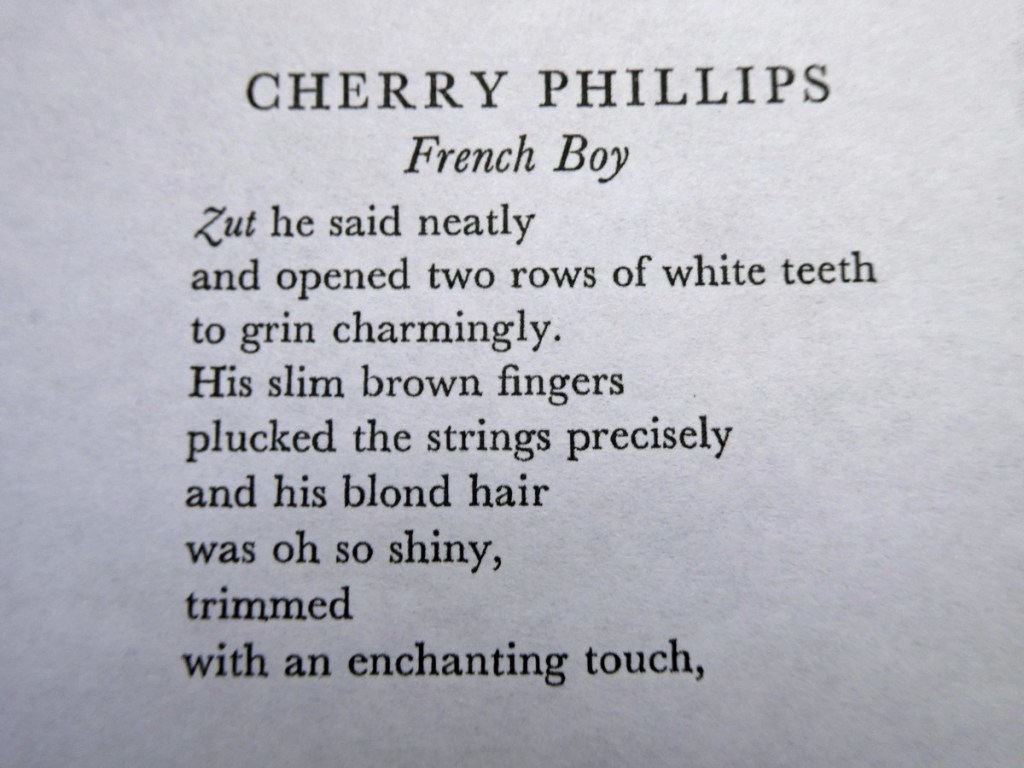
To my astonishment, I had an encouraging letter back from the editor – which, sadly, I haven’t kept – saying he’d like to publish the one called French Boy, for a fee. I think it was around two guineas. And so it was duly included, in Autumn 1967 issue. He also asked if I could send him further poems in future. But, with the carelessness of youth, I didn’t get round to doing that. Life was opening up at a rapid pace – I was at Cambridge university by the time it was published that autumn, and was distracted by a myriad of other exciting possibilities. I even lost or threw out the edition of Poetry Review containing the poem. (Here are a couple of others from around the same era, which I discovered on the internet.)

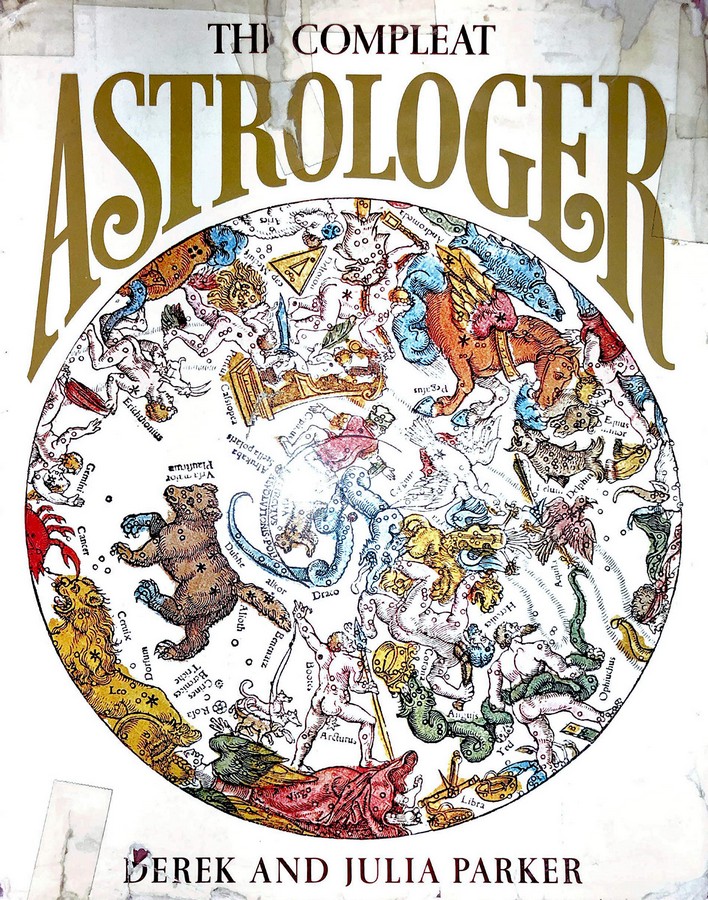
Fast forward to 2005, when I visited my daughter in Australia, while she and her boyfriend were living in Sydney for a few years. I’d rented a studio flat nearby, but as it wasn’t available for the first few days, I had to look elsewhere for a bed. Two old friends of mine from astrology circles, Derek and Julia Parker, had emigrated to Sydney not long beforehand, and when I contacted them, they said they’d be delighted to put me up for the interim. Julia is an astrologer of repute, and Derek a man of broad literary accomplishments; together they’d written the best-selling ‘The Compleat Astrologer’.

Below: Derek and Julia Parker during my visit to Australia, and their best-selling treatise on astrology

Somehow, during one of our delightful catch-up conversations, I mentioned the Poetry Review and how I’d had a poem published there as a teenager.

‘But I was the editor at the time!’ said Derek.

I had completely forgotten the name of the kind editor but, yes of course – it came back to me now! ‘I don’t suppose you have a copy of that issue, do you? I no longer have mine.’

‘Of course,’ he said, and pulled it down from the shelf.

I took the photocopy he made me, and vowed never to lose sight of it again. Yes, I can criticise it – but it did make the pages of a worthy poetry journal. And how foolish I was not to take that further. I still occasionally write poetry, but the chance to really build it as a craft has passed now.

The poem is one of a group I wrote about a rather miserable French exchange with an uptight family whose holiday home was in an uninteresting area of sand dunes and summer villas, full of moderately wealthy bourgeoisie and their offspring. Appearances and conformity were the rule of the day. The visit inspired a number of complaining poems on my part – which I won’t bore anyone with – and this one was about a lad who was a little too good to be true in appearance, and a little too vain to be likeable.

French Boy
 Zut he said neatly
 And opened two rows of white teeth
 to grin charmingly.
 His slim brown fingers
 plucked the strings precisely
 and his blond hair
 was oh so shiny,
 trimmed
 with an enchanting touch,
 a casual touch.
 The golden Apollo muscles
 Rippled
 beneath his blue shirt.
 The careful notes
 flickered and broke.
 Zut
 because this, too,
 was part of the flawless
 brown shell
 Poetry Review – Edited by Derek Parker
 Vol LVIII, no. 3, Autumn 1967.

The Albert Hall
At the same time that I submitted the poem for Derek’s attention, I also sent one off elsewhere. The diary tells the tale – here’s the full entry:

Diary entry for Jan 7th 1967
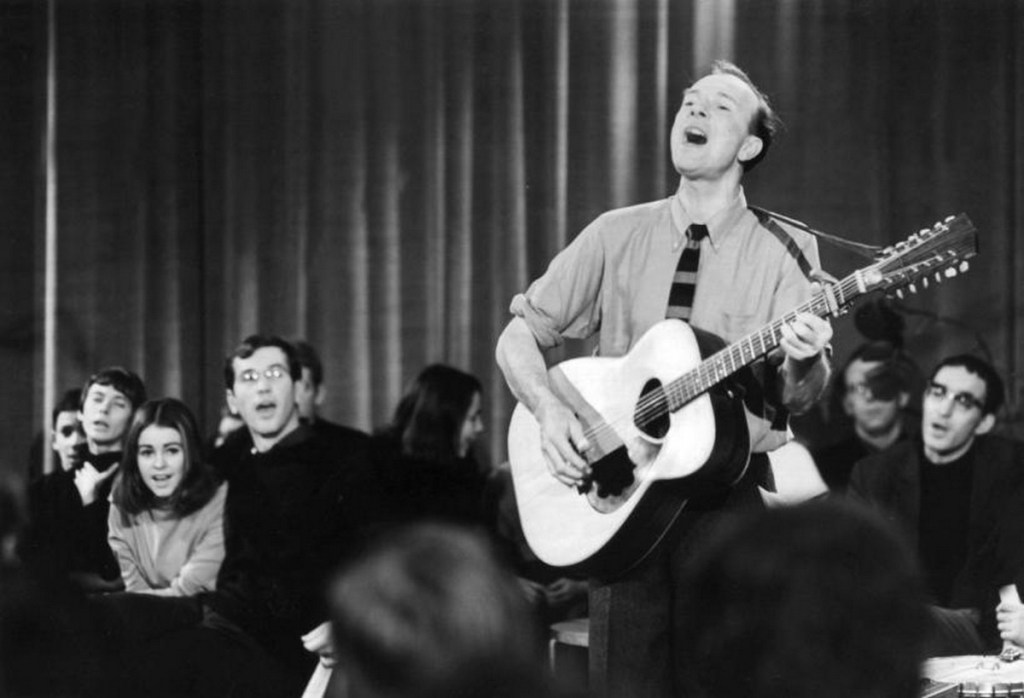
Most extraordinary thing happened today. Yes actually HAPPENED!!! Well the other day I sent off some poetry to Poetry Review for criticism (took great courage!!) I was typing some poems out and came across the ‘Folk Club’ one which is rather frivolous to put it mildly. Typed it out then thought I’d better not send it with the rest cos it wasn’t really the same kind of thing. So I sent it off to ‘Sing’, one of the folk song magazines – didn’t even know if it was still in print. Expected it back with a note saying ‘What the hell did you send us this for?’ Well today the phone went for me, and a voice said, ‘This is Eric Winter, Editor of ‘Sing’’. He said how much he liked my poem and said they would print it next issue, and also he showed it to Pete Seeger last night who also liked it, and gave a recital of it at his concert in the Royal Albert Hall! Complete with actions – and apparently the audience loved it! Then E. Winter wanted to know if I’d written any more poems, prose, songs etc and if I’d send him some, and come and see him if I was in London at all. V. Flattering! Great – it’s a big laff, but that’s made my day.

Pete Seeger performing in the same year, 1967, at a TV show in East Berlin. (Photo by: Zentralbild/picture-alliance/dpa/AP Images)

Eh? What? Pete Seeger read out my poem? I had almost forgotten about it, or assumed it was a distorted memory – but the diary doesn’t lie. (Truly, it doesn’t!) Again, I can only blame the casualness of youth. And perhaps an element of not enough self-belief. As I’ve said since to other budding writers, you have to take your achievements seriously. Surprisingly, it is too easy to assume that a success – maybe in a competition, or in getting a story published – was a fluke. That anyone could have done it, and that it doesn’t indicate any real value. But this shrugging off of success is as much of a trap for a writer as is being too conceited about one’s chances. So, please take a lesson from me in this respect. Cherish what you achieve, and build on little successes.

The Royal Albert Hall – Eek! Did my poem really get heard by an audience there? Does anyone remember, I wonder?

Here’s the poem – it’s based on the folk club in Birmingham, which I’ve written about in ‘Singing at the Holy Ground’.

Folk Club (March 1966)
 Fred plays the guitar
 brrm brrm brrm brrm
 and we all say
 well done Fred
 what was that you played?
 and drink our beer.
 And Fred says
 this song is called and it comes from well
 actually I learnt it off a fellah named
 sorry if I forget the words I only
 worked it out last well here goes – 
 brrm brrm brrm brrm
 clap clap clap
 well done Fred
 because everyone likes Fred
 and we drink more beer
 and say o look here comes Clive,
 but which Clive is it?
 well tonight it is big Clive
 and he has had all his long black curls
 CUT OFF.
 Gasps.
 Well they were an institution
 you could laugh or rave or scream
 or maybe even tell the time by them
 if you tried hard enough.
 you please yourself.
 but now he looks like a new shorn sheep
 well I suppose he is in a way.
 brrm brrm brrm brrm
 sssh - tell me later.
 he’s out of tune and i don’t like his voice and
 brrm brrm brrm brrm brrm
 ALL JOIN IN THE CHORUS
 tOOralay tOOralay tOOralay o!
 and haul away Joe
 cos we’ll all kill Paddy Doyle for his boots
 would you all take your glasses downstairs please. 
 singing whackfoldedaddyo and we’ll all go together
 Brrm brrm brrm.

At the Holy Ground folk club with the Munstermen, 1965.

And no, I didn’t keep a copy of ‘Sing’ magazine where it was published. And no, I didn’t follow up by sending Eric Winter other contributions. Sigh. As I said, please don’t take a lesson from me.

But if you’d like to read one of my more recent offerings, here’s a selection:

The Ancestors of Easter Island


We may think of ancestor cults as belonging to earlier forms of society, but this isn’t entirely true. Anyone who starts researching family history knows how finding the ancestors can create what feels like a living connection with those of our blood line who passed away long ago. I should know – I’ve done it! It came as something of a shock to me, but as with other avenues I’ve explored, I eventually decided to put both my research tips and something of my experience into a book. The result is Growing Your Family Tree: Tracing your roots and discovering who you are (Piatkus 2011; e-book with Lume Books 2019)

In order to write the book, I wanted to hear how other people had experienced the family history trail, so I set up a survey. Some wonderful material came up through this, which I’ve quoted liberally in the book, and which I hope to include in a future post for Cherry’s Cache. Also on the agenda is a further post about taking up ‘The Quest’ in family history, making expeditions to explore the terrain where ancestors lived, and hunt for new information.

But for this current post, I’d like to share two experiences which I had, of witnessing what ancestors mean in cultures other than a modern Western one. These are included in my book, but I’m bringing them together here for the first time, and with photographs which tell as much of the story as the words.

At the temple complex of Goa Lawah in Bali, where funerals and special ancestor ceremonies are conducted

Sailing to the far side of the world – Bali and Easter Island

My husband Robert and I used to go on cruises as guest lecturer and artist-in-residence. We made some fascinating voyages, mostly on smaller ships, which allowed us to travel to smaller ports than is possible on giant liners. One of the most extraordinary journeys was to Easter Island, as I’ll recount shortly. First though, I’ll relate how a trip to Bali allowed us to see, quite by chance, a ceremony for drawing back the spirit of an ancestor to dwell in the family home:

From Chapter Two
In modern Western culture, it may seem odd to assert that the ancestors can make their presence felt, but in many other cultures it is a natural assumption. Ancestor veneration is, or has been, important in practically any society that we might care to study. African, South American and Aboriginal Australian cultures all have strong beliefs in the significance of the ancestors, and practise customs which acknowledge the part they play in family life. They are variously thought, for instance, to guide their descendants, govern the local landscape and assist in divining the future. In shamanic practice, still found in countries such as Mongolia and Siberia, magician healers enter a trance and depart on a journey to the spirit realms to encounter the ancestors of the villagers, who will then give them counsel for the wellbeing of the community.

Ancestors in such cultures may be seen as deities, spirits or souls of the departed – there is no one definition, and often the boundaries are hazy – but their existence at some level is taken as a given. On the whole, they are not deified in the sense of worship, and therefore scholars nowadays prefer to use the term ‘ancestor veneration’, as this reflects more accurately the broad sweep of customs associated with the ancestors.

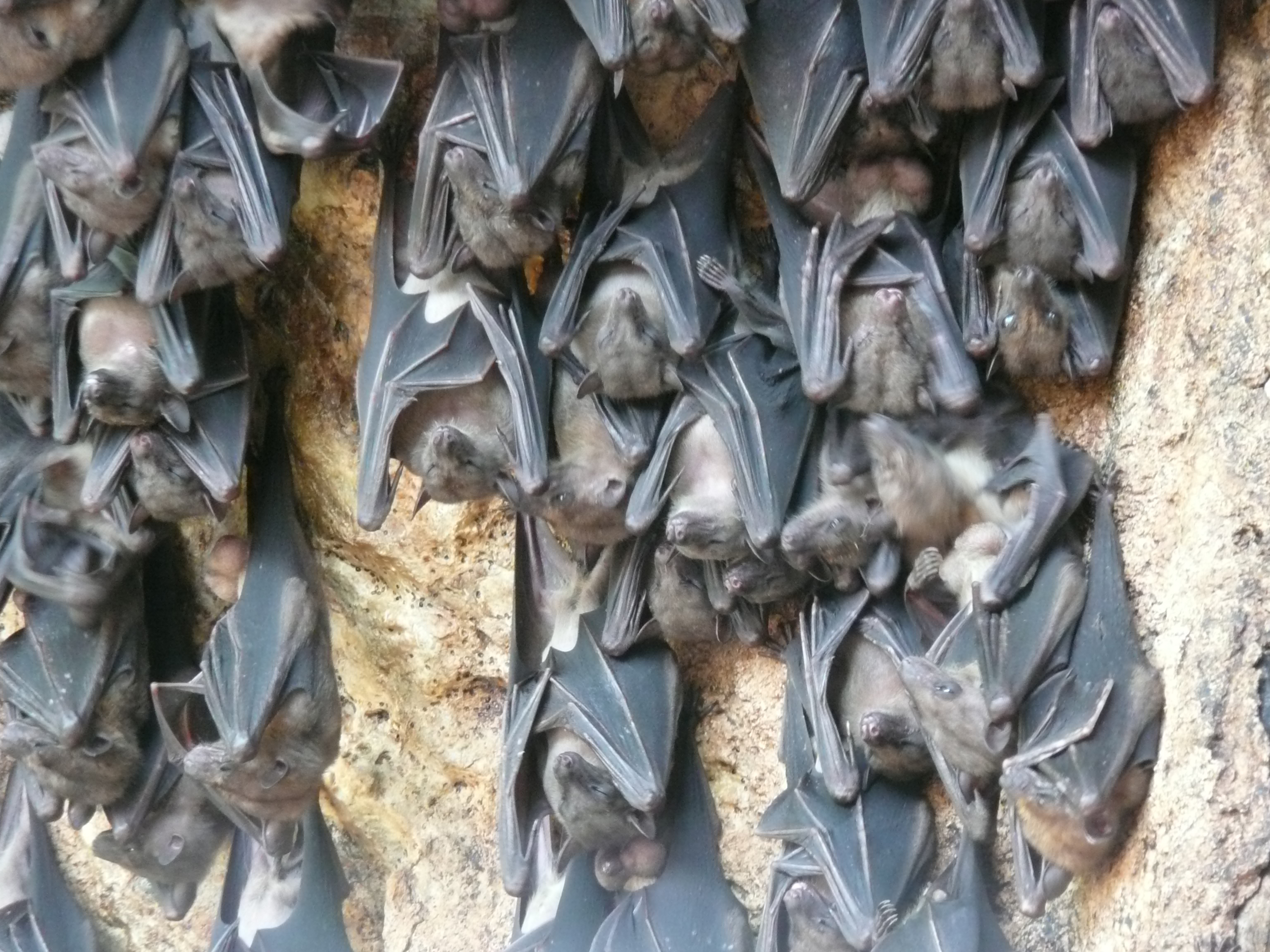
Below: the different shrines and ceremonies of Goa Lawah, which is also celebrated for its sacred ‘bat cave’! (Photo of procession from a website showing further images of the temples; other images © Robert Lee-Wade, Cherry Gilchrist)

When my husband and I visited Bali early in 2010, by great good fortune we hired a taxi driver who was keen to show us some of these customs. He drove us to a temple built into the rocky hillside, known as Goa Lawah. It is a popular venue for funeral ceremonies, and renowned for its colony of sacred bats, which reside in a cave at the back of the temple. Situated at a place where sea and land meet (symbolising the border between the present life and the afterlife, our driver told us), the temple acts as the mediator for the soul that must take its journey from one to the other. The body is first cremated, and then the ashes are placed in a coconut shell and taken down to the shore close by, where they are thrown into the ocean. A line or rope, with up to 2500 ceremonial coins tied to it, is cast into the waters as well, and the mourners cry out for the dead person to return to them as they draw it back to shore again. Two times more, the line is cast and the call goes up for the deceased to come home.

The ceremony of drawing back the spirit of the deceased from the ocean, which we witnessed from a distance in Bali

After twelve days have passed, the family members return to the same spot, and collect some kind of object (our driver was vague on this point – perhaps a stone from the shore, or something left over from the ceremony) which they carry reverently back to their home. This object is then placed in the domestic shrine, where it is believed to embody the spirit of the relative, now an honoured ancestor. From this time on, this ancestor will watch over the family, and protect and bless its members.’

It might seem as though Western society is far removed from such practices, but we too have our graveyards, where flowers are renewed, and relatives go to remember their loved ones. On Remembrance Sunday in Britain, we honour the dead of the two World Wars, and in Russia, practically every newly married couple has a photo taken in front of the local war memorial, where the eternal flame burns to commemorate the fallen soldiers. There are traces of interaction with the departed too, in Western customs, such as the feast of Samhain or Halloween in Irish tradition, when food and drink was and perhaps still is left out for the dead. We mark roadside casualties with shrines of flowers and symbolic objects. In Russian Orthodoxy, the first forty days after the death of a person are thought to be a journey during which the soul suffers various trials and temptations before reaching a more blessed state; at the end of these forty days, families may hold a ‘remembering feast’ to honour the departed and the arrival of the soul in heaven.

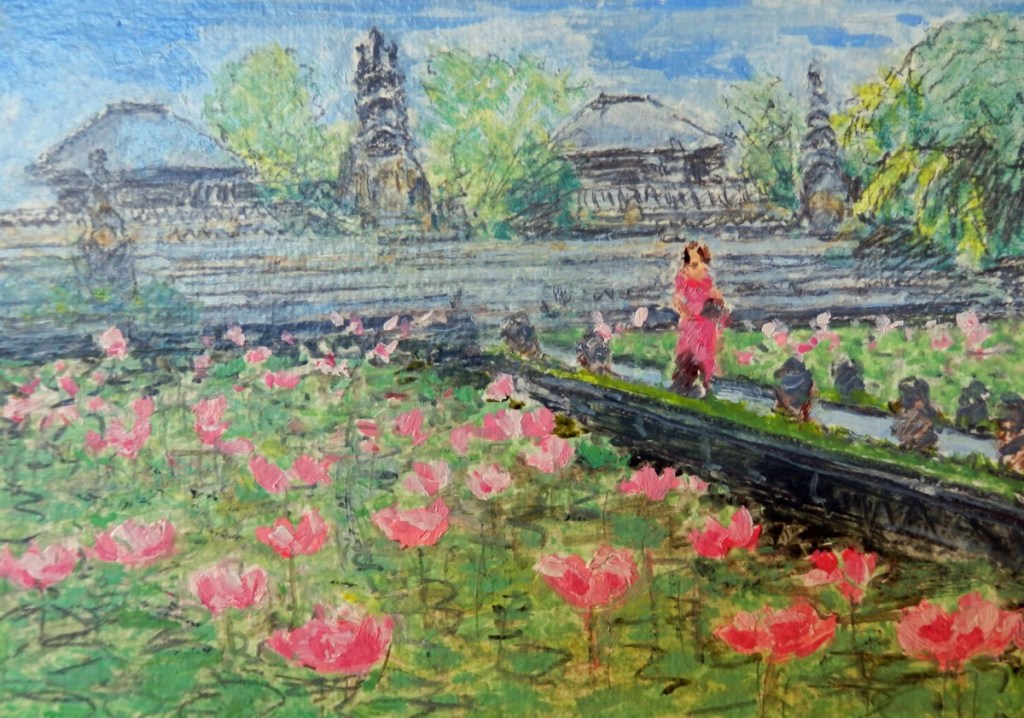
‘At the Lotus Cafe, Bali’ – a painting by Robert Lee-Wade. (I’m in the pink dress!)

The mother at the centre of the world

Discovering the part that ancestors can play in human life may come about in unexpected ways. When I visited one of the remotest islands in the world, I had no idea that it would lead me into an intense experience of this kind. Here’s how it happened:

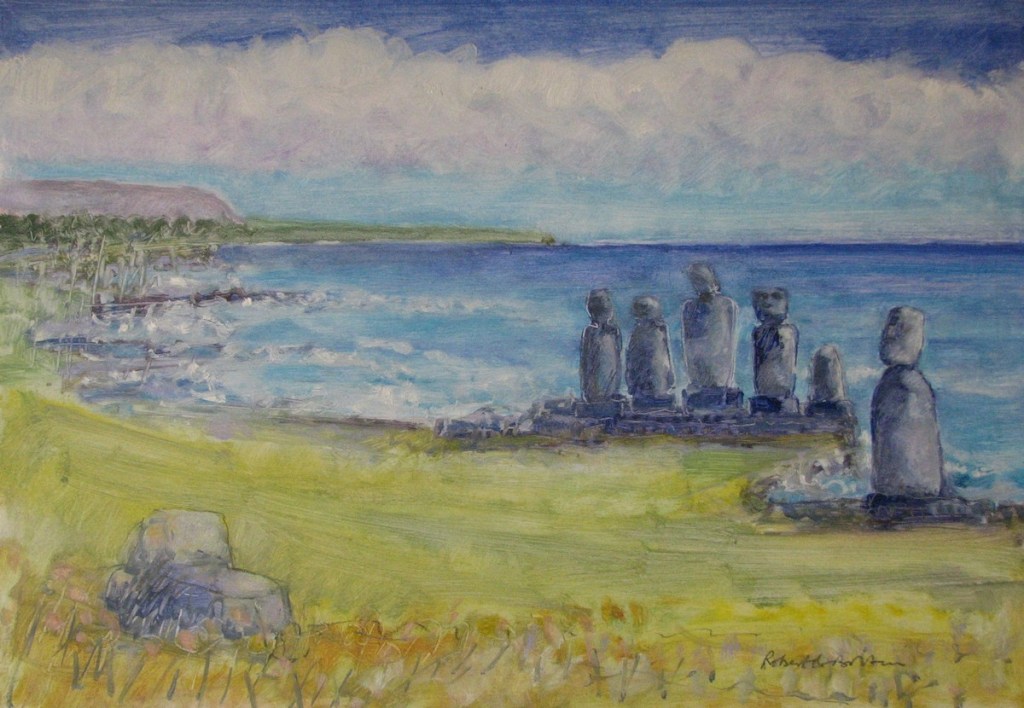
The island of the Moai – painting by Robert Lee-Wade, RUA

From Chapter Eight
It’s 2 March 2008. Mother’s Day in the UK, but we are spending it in the South Pacific, far away from gifts of flowers and chocolates, and restaurants packed with families taking Mum out to lunch. In fact, we are in a completely different civilisation altogether, visiting Rapa Nui, otherwise known as Easter Island. Robert and I have been transported here as lecturers on board a cruise ship, and today is our second and final day in this extraordinary place. We catch the tender boat from our ship and ride the fierce waves to the shore. The captain has warned us all that we might not even be able to land, after six days of sailing from the Chilean port of Valparaiso. All in the lap of the gods, he says.

And gods are what they have here. Yesterday, we watched the island emerge from the haze with growing excitement – a rounded volcanic scoop of land dressed in soft greens and greys. We began to make out cliffs and swathes of grassland, then, finally, the first of the giant statues for which the island is famous: the Moai. Nearly a thousand of these stone statues, with their huge heads and staring gaze, are placed around the island, many at the edge of the land, facing inwards towards the people they protect and command. Each face has its own character. When we landed, I made straight for the first Moai I could see, standing on the rim of the harbour, and was seized with a spine-tingling sense of awe as I gazed up at him. In fact, I felt overwhelmed. This was a place I had known of since I was a child, but had never dreamed I might be able to visit. Now we were stepping into its mythical world.

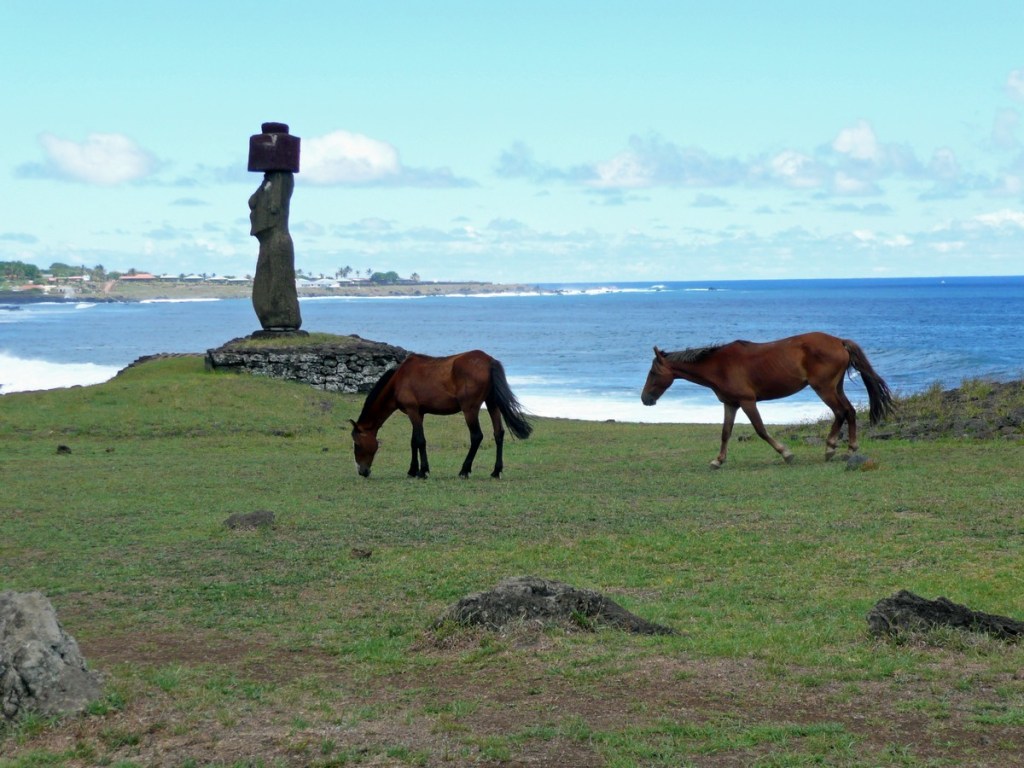
An imposing Moai or ancestor statue on Rapa Nui. Most are about three times human size.

There are still many questions and mysteries surrounding the old culture of Easter Island, but it’s known that the statues were carved between five and eight hundred years ago, and it is thought that they represent the deified male ancestors. Certainly, today’s inhabitants treat them as such, and asked us to respect the Moai by never treading upon the ahu, the sacred stone platforms upon which they are set. On the first day, then, we became acquainted with these ancestors, along with the herds of bright bay horses that roam the island freely, the green-sided volcano with its extraordinary internal lake and the exquisite beaches fringed with palm trees. The island, once stripped of its trees, is back to a better natural balance again, planted also with stately groves of eucalyptus. All through the centuries of change, the Moai have presided as immortals over the landscape.

Almost as strange as the Moai is the unexpected sight of horses roaming freely among them. They are much prized by the islanders and we saw many during our stay.

Now it’s day two of our visit, and we have barely a morning to see whatever else we can of this magical island. Something has tickled my imagination in a guidebook that I browsed on board the ship: a mention of an ancient round stone representing ‘the navel of the world’. Te Pito Te Henua is one of the other names for Easter Island and that in itself means the navel and uterus of the world, so this stone would therefore be the navel of the navel. Robert agrees: we should try to find it.

Friends on board recommended that we seek out the woman taxi driver on the quayside, probably the island’s one and only female cabbie among the ranks of beaming and burly male drivers. We spot her easily, and though they’d mentioned her simply because of her general helpfulness, hiring her cab for the morning turns out to be crucial to what we discover.

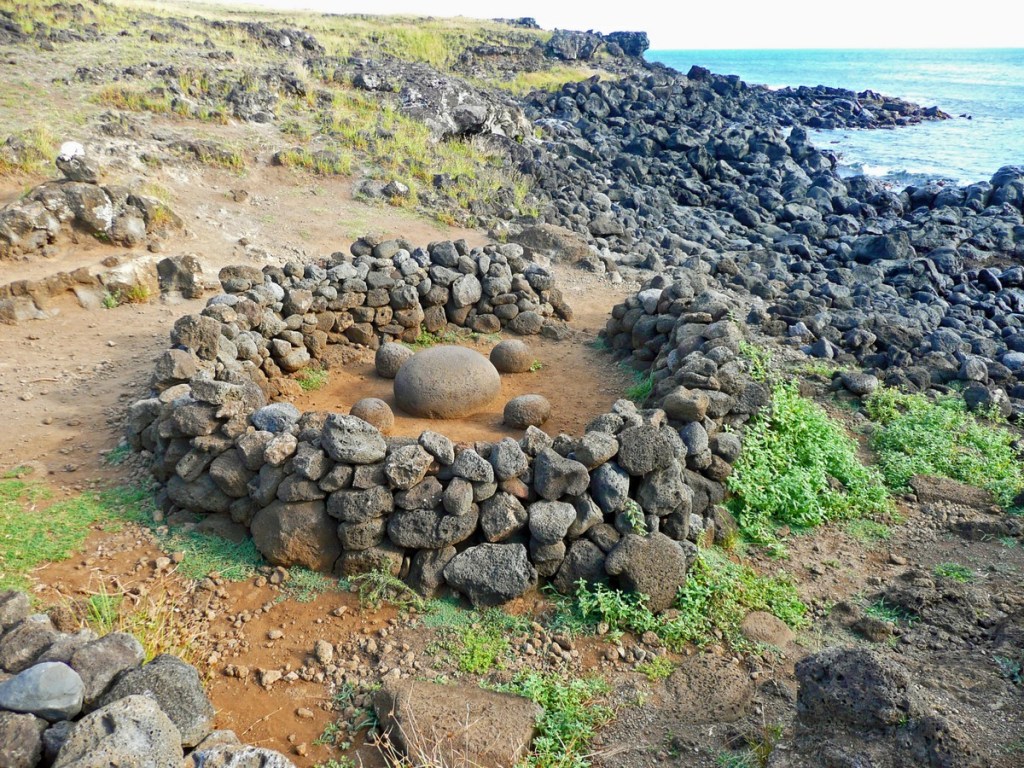
‘Ah, so you want to go to the place that we visit for energy,’ she says, when we ask her about the site, for which we have only rough directions. She takes us over to the north coast of the island, veering away from a well-frequented beach (though that, in Easter Island terms, may mean only a handful of people) to turn down an unpaved road which emerges by another small and completely empty beach. Among the rocks above the sea line, a round wall of stones and boulders has been created, about three feet high and eight feet in diameter. Within the circle it encloses, a huge and beautifully smooth ovoid stone has been placed, like a giant egg. Four similar but smaller stones are set around it at regular intervals, forming a square. It has a Celtic feel about it – we could almost be on the West Coast of Ireland or in the Hebrides – but here we are, over two thousand miles from any mainland and over eight thousand away from home.

The stone enclosure, reminiscent of Scotland or Ireland, rather than a remote island in the Pacific ocean

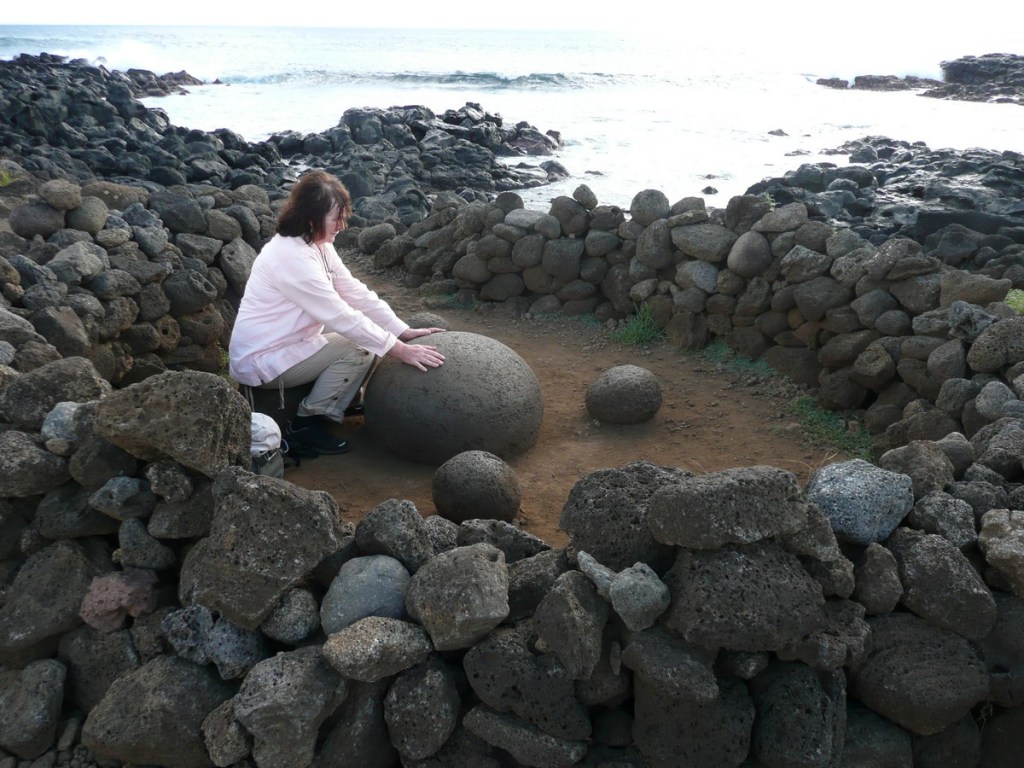
It is first and foremost a place for women, our driver tells us. She invites me alone to accompany her into the circle, and seats me on one of the smaller stones, encouraging me to place my hands on the great stone egg in front of me. She sits opposite and does likewise. ‘Put your hands on it gently,’ she says. ‘Relax.’

Women of the island have been coming here for hundreds of years, she explains. They come to pray for help, for safe childbirth and even for the delivery of their babies. The stone is the mother, their mother, and the island’s mother. ‘What do you feel?’ she asks me.

Sensing the energy of the stone

I feel as though the stone is not a stone at all, but an egg with the shell stripped away, and the delicate but all-powerful pulse of life moving within its membrane. I sense the women who have laid their hands here, and the ancestral mothers whose spirit is contained within the stone itself. Currents of energy seem to be running up my arms.

I tell her some of this, and she is satisfied. She then steps outside the circle and invites Robert to come and join me. Now I can suggest to him how to sit and place his hands and, rather to his surprise, he too experiences waves of energy.

We leave the enclosure. It’s time to get back to the harbour and board our ship for another six-day voyage, back to the coast of South America. Both of us are reflective after the experience, and feel privileged that one of the islanders trusted us enough to teach us about her sacred site. We first met the father of the island in the myriad forms of male ancestors, but now we have also met its mother – the one stone representing all the female ancestors.

This is a Mother’s Day that I won’t forget.

The mysterious Moai stones face inland, not out to sea. It’s as if they’ve arisen from the ocean, rather like the spirit of the deceased in Bali, and are gazing at us with news from another world.

I hope you’ve enjoyed these descriptions, and please remember that you’re welcome to add comments or recount your experiences too. If you are making a comment on the blog for the first time, this will be submitted to me first to activate it, so it could take a day or two before you see it posted.

You may also be interested in:

Following the Female Line

Sin, Seduction and Sidmouth

The Abduction of Mary Max

Singing at the Holy Ground

My guitar went everywhere with me. This photo was taken in Austria in 1965 – I had lugged it onto the boat and train with me en route to my German exchange with a family in Villach. They seemed to enjoy my playing, but frequently called on me to ‘Sing uns etwas lustig, Cherry!’ In other words, how about a cheerful song, instead of all those mournful ones?

Life within the Holy Ground

‘…There’s whisky in the jar!’ – A tuneful roar of voices giving out the last line of the chorus…a moment’s hush…a thunder of clapping – laughter – chairs scraping on the floor – feet rushing, coming my way, downstairs. I make my way up, cradling my guitar carefully, against the flow. Smell of cigarette smoke, faint wash of stale beer, touch of rough jackets, knobbly jumpers as I push my way up and through into the warm fug of the club room. ‘You singing tonight?’ asks the girl with long dark hair on the door. I nod, a small frisson of fear shooting through my stomach. She nods back, and waves me in: no charge for floor singers. I am in the Holy Ground.

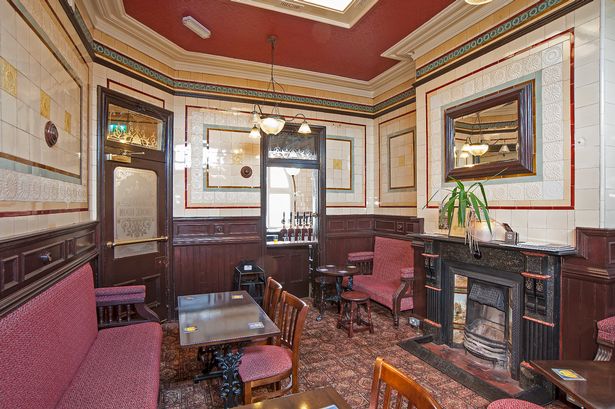
In the mid-sixties, while still at school in Birmingham, I discovered folk song, and fell headlong in love with it. I lived for the nights when I could turn up at folk clubs with a bunch of friends, order a daring half pint of shandy, and wedge ourselves in among the crowd. Then we would settle in for an evening of songs ranging from the bawdy to the tragic, accompanied by guitars, penny whistles, concertinas, dulcimers, spoons, or anything else that came to hand. We didn’t know it then, but many of these old Birmingham pubs only had a short life left before demolition razed them from existence (see my earlier post ‘Finding Brummagem’). Many of those wonderful etched glass panels and wrought iron Victorian tables would soon become a thing of the past. (I see that a single original table can now sell for over a thousand pounds on the internet.) The images below come from an article about a few that escaped demolition and makeovers, which you can read here.

The Folk Song Revival

There was a major folk song revival at the time, following on from the earlier jazz club phase of the 50s and indeed slightly overlapping with it. To put it simply, American folk singers held sway from the 1940s, and ran alongside skiffle, jazz and blues in the 50s, but in the 60s the British and Irish folk traditions rose up in popularity. Key figures such as Ewan McColl, Shirley Collins and Bert Lloyd promoted ‘the voice of the people’, and moved the folk song movement on from the polite drawing room where collectors and composers such as Cecil Sharp and Ralph Vaughan Williams had left it at the turn of the century. It opened the door to more energetic, earthy performances – and was very good for business in the pubs too.

It also generated a new wave of song-writing in a folk style, as in this famous one, ‘The First Time Ever I Saw your Face‘ by Scotsman Ewan McColl, and sung by American folk singer Peggy Seeger. The pair formed a lasting duo.

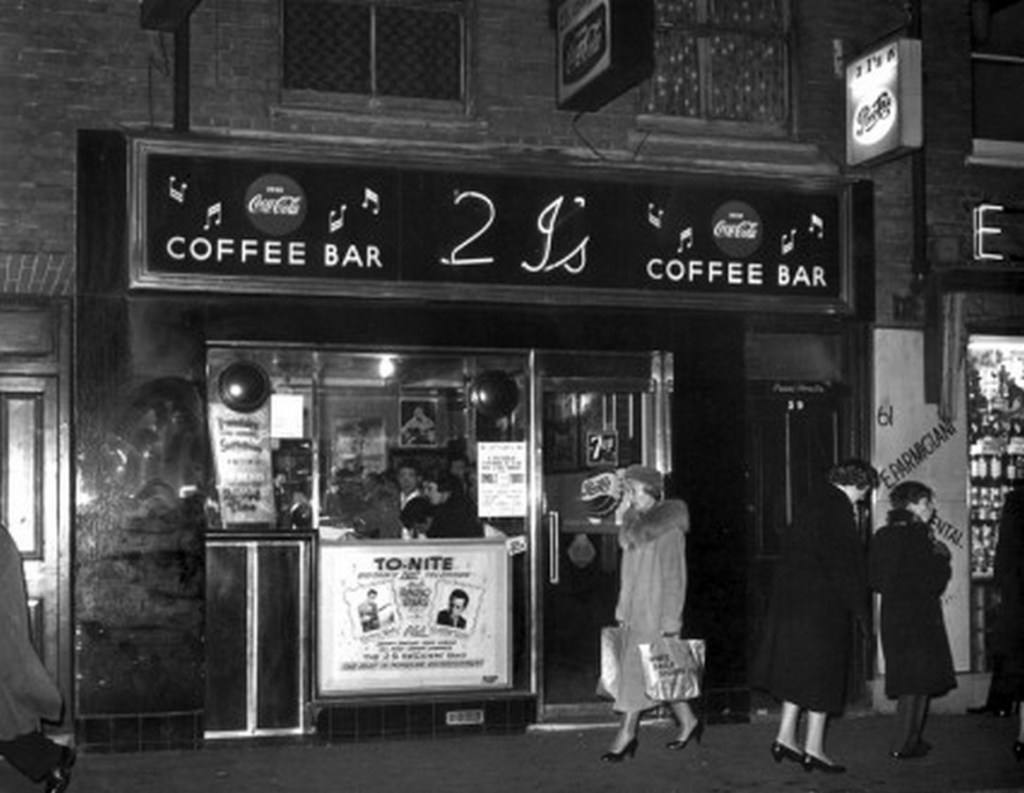
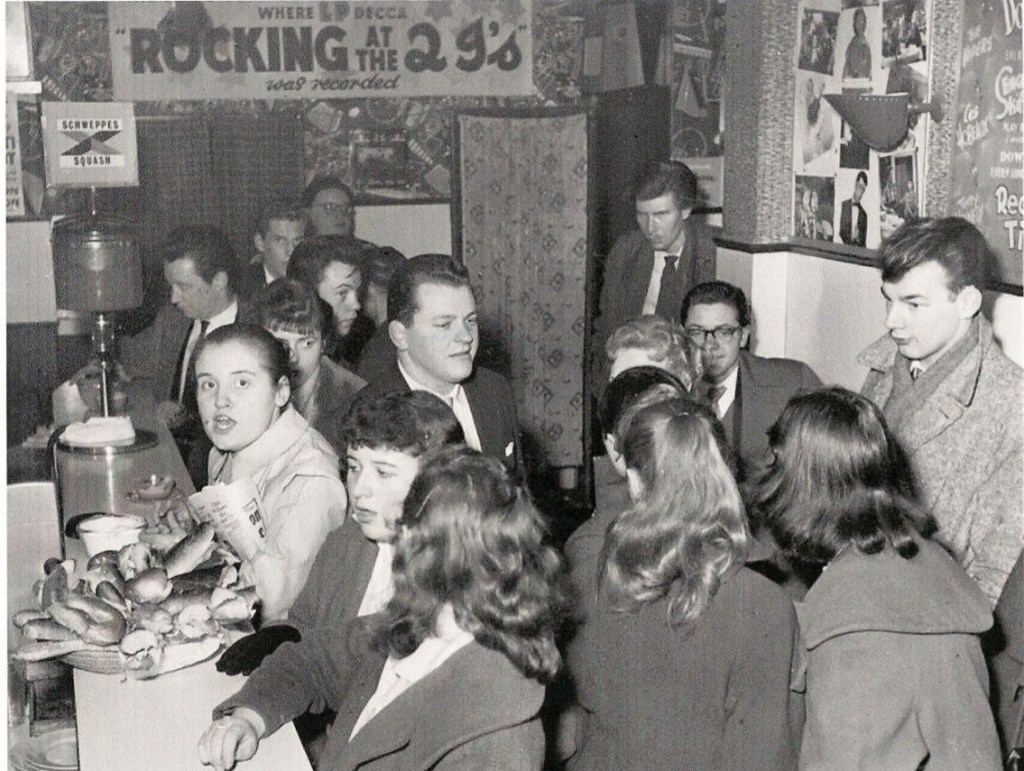
Folk music may have hit Soho earlier, as I’ve mentioned in my blog on the Soho Coffee Bar, but for a more general population in the provinces, it was only just beginning in the 1960s. The nation woke up to its heritage, and folk clubs sprang up like mushrooms throughout the land; Birmingham was especially enthusiastic in this respect Anyone could have a go – all you needed to do was to get hold of a guitar, learn a few basic chords, and then you could take it to parties and clubs, and trot out a few songs. Even Youth Hostels and Greek beaches ‘benefited’ from the wandering minstrels of the folk revival. Such music often had a broad base, too. Wherever you went in the world, you were never too far away from someone intoning ‘We Shall Overcome,’ crooning ‘Will ye go, Lassie, go?’ or giving a rendering of Davy Graham’s ‘Angie’. (I hasten to say, I love all of those!) And many performers took it to a much higher level, working hard on their singing and playing. Just as a side note, I think it’s been work in progress to this very day, since the standard of instrumental playing among folk musicians now is phenomenally good, at a level which was only reached by a few exceptional professionals back then.

Here’s a version of the famous ‘Whisky in the Jar’, sung by the Dubliners. As my own photos for this post are all black and white, I’ll spice it up a bit with some music! This recording has some delightful pictures of Irish scenes. And I particularly liked a recent comment: ‘Even in Ukraine me, and my friends love to sing this while we drinking. Cheers to the Ireland and lovely Irish people from far Ukraine!’ Yes, Irish music travels well.

It was the traditional British and Irish music that enchanted me. Even though I began by learning all kinds of songs, I focused more and more on the true traditional repertoire. If I heard a song that took my fancy, I delighted in copying it out into my own notebook. The oral tradition, in the sense of collectors trudging to remote farmhouses in search of a song, was almost past and gone. (I did try it as a teenager, on my pushbike, panting up Shropshire hills with a heavy, low quality tape recorder in a rucksack on my back, but soon gave up.) But we had a way of sharing songs between ourselves, which was in its own way just as exciting. Scribble down the words, and a few chords, and do your best to remember the tune. And if it did come out a little differently, well, that was part of the tradition too. There was still a sense of songs being passed from singer to singer.

I could afford to buy a few songbooks, some of which I still have, including The Penguin Book of Folk Songs, minus its cover and in fragile condition now, and Marrowbones edited by Frank Purslow. A friend’s brother made a guitar for me – most kind of him, and it did work, sort of, but when I managed to scrape enough money together, I bought my own Spanish guitar. I was never very dextrous though, so my instrumental playing, including piano, remained at a basic level. Pages from my own song books here show ‘Bridgwater Fair’ in my handwriting – something I was proud to have dug out of an archive – and in another hand, the sea shanty ‘Sally Free and Easy’, which was often sung by Cyril Tawney. This was followed by ‘The Nightvisiting Song’ which I expect one of the Munstermen wrote out for me (see below). There’s a version of it sung by Luke Kelly on the YouTube link below.

The Birmingham Folk Scene

It’s on record that The Holy Ground Folk Club opened on Saturday April 24th 1965 at 7.45pm at the Cambridge Inn. . And according to my old diaries, I was there with a friend the following week, May 1st.
Went to the Holy Ground in the Cambridge Inn. Club itself was pretty good – Bloke with a lute singing May day songs – we both enjoyed him best.

Sat May 8 – ‘Later, when it was very full, they said the ladies had got to sit on the gents knees.’
Sat May 15th – ‘…Sang ‘Flowers & weeds’ and ‘The Dear Companion.’ Not too bad. Not v. good though…

Sat May 22 – They had a wild Irishman as the guest singer tonight – Joe Heaney. He said he’d teach me Gaelic, but I don’t think he quite meant what I meant.

Below are some tiny, blurred and rare relics from that period, garnered from the ‘History of Brum Folk Clubs’ website (see below).

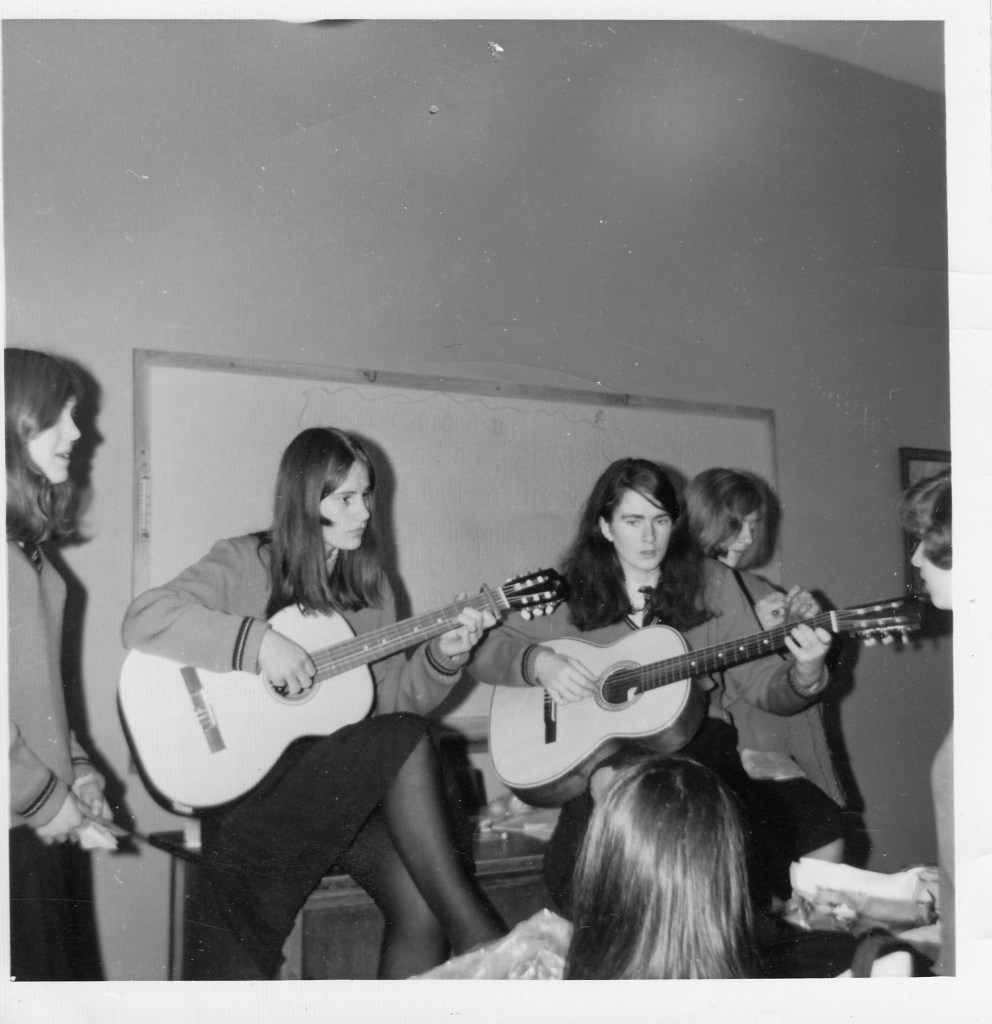
The Holy Ground became the favourite venue for a bunch of us to spend a lively Saturday night out. It was run by the Munstermen, who were somewhat similar to the Dubliners, full of energy and good humour, and vibrant playing and singing. There were guest singers such as the incorrigible Joe Heaney, mentioned above, and frequently Diz Disley, who had been more famous as a jazz player, and overlapped with those Soho cafes which I wrote about. There were also regulars such as singer-songwriter Harvey Andrews, and Jon Swift who unusually played a lute, and was the man I mentioned in my diary write-up. I suppose male singers were more prominent at that time, but female ones were certainly present and welcomed. I did a duo act with another schoolfriend for a while – there’s a photo of us practising a little further on.

Other clubs which I gravitated to included the Partisan, the Peanuts and the Camp, all listed in an astonishing compilation of the history of Birmingham Folk Clubs (the link formerly inserted is no longer active, but I’ll retain it just in case it pops up again here . Likewise, at Grey Cock, Precursor you could once see my name listed as a regular singer, misspelt as Cherrie Phillips.) The folk clubs were a melting pot at the time of different tastes and interests. However unified our bellowing of Musha rain dum a doo, dum a da, there were diverse views as to whether folk singing was all about having a good time, or should be approached with a missionary zeal and a purist creed. Diversity ran through the audiences too, which were a great mix of younger and older people, and from all backgrounds. It was also an ideal place to meet up with my own friends, and to eye up the slightly older and preferably handsome male folkies there. But, surprisingly, I never really took up with a boyfriend in the folk clubs, though there were a few serious pangs of the heart and more than a few casual kisses. It was mostly about fun and friendships. And I was genuinely serious about the music.

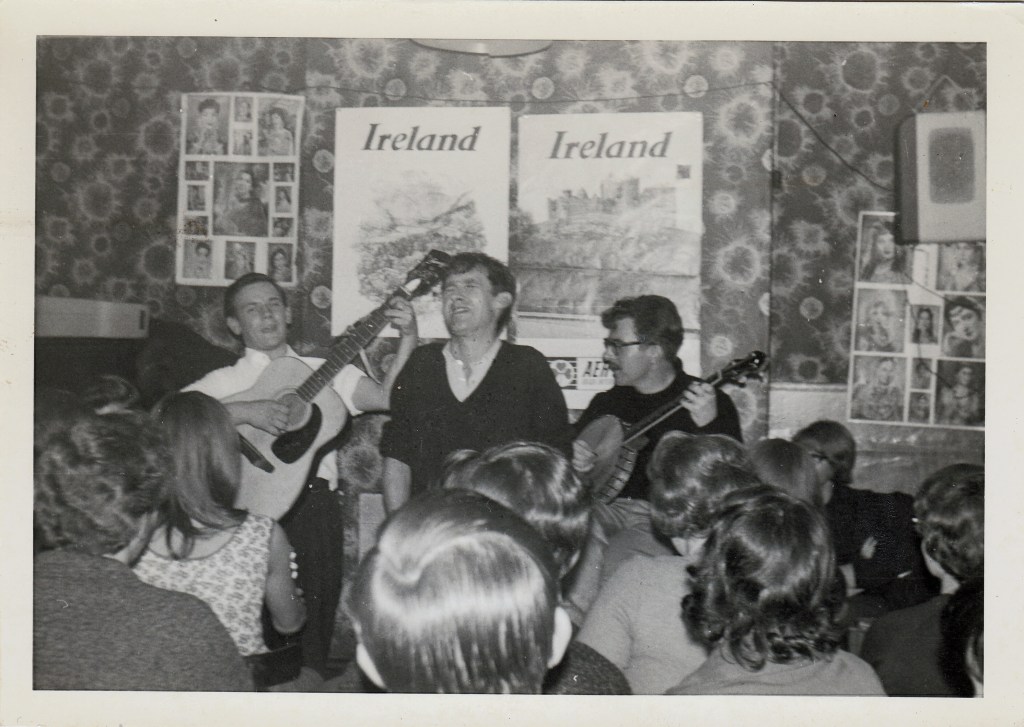
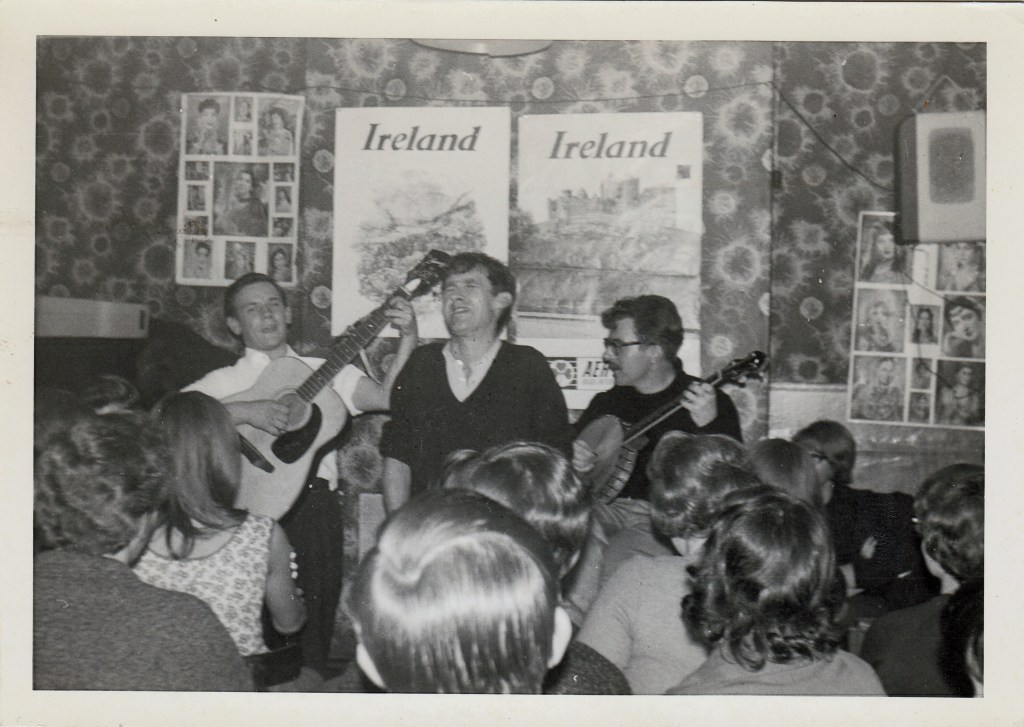
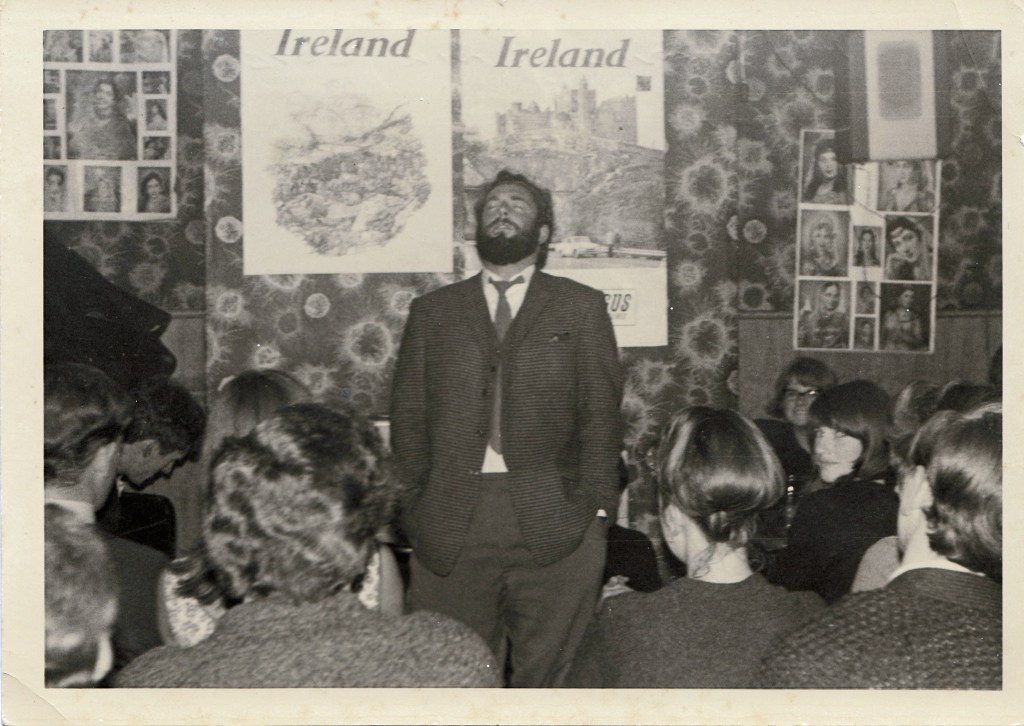
Mick Treacy (centre), Mick Lillis (right) and Eamon Lowe (left) of the Munstermen, singing at the Holy Ground. Another folksinger, ‘George’ below. Note the travel posters for Ireland behind him! And two of my school friends, Sue and Rosi are turning round for the camera from a coveted corner of front seats.

Going professional?

It got to the stage where I was actually getting paid a modest amount to appear in some of the clubs. My diary entry for the Holy Ground of July 17th, 1965, relates: Mick says that in a couple of weeks, instead of one proper guest, they’re going to have John Swift, Peter Moggs and me!! Wow! (getting paid too!)

But one day at school, I was summoned to the head mistress’s office. She was holding up an advertisement – a very tiny advertisement – from the Birmingham Mail. It announced that Cherry Phillips would be singing at the Grotto Club in Deritend. Yes, it did sound a bit dubious.

Do your parents know you’re doing this?’ she asked sternly.

Yes, they do,’ I told her, which was indeed true. They were rather pleased, as I recall.

She tried another tack. ‘But this – Grotto – club – it’s not in a very nice area of town.’

I shrugged. No it wasn’t, but it was in no way dangerous, and I wasn’t there late at night.

She had one more try. ‘I do know that it’s not illegal for you to be on licensed premises at 16, because I’ve checked the laws. But only if you don’t drink.’

I nodded in what I hoped was a mature and understanding manner.

And can you honestly say that you would never get tempted into – drinking alcohol – there? Perhaps if – if a man offered to buy you a drink?

Now was the time to look shocked and mildly offended. ‘Oh no, Miss Wilkes.’ I added a touch of bewildered innocence to give it greater authenticity.

I was dismissed, under caution, with severe warnings about compromising my homework and academic standards. I calculated that the occasional bitter shandy would harm no one, though my diary records that I did accept the odd extra tipple from MEN.

Practising a folk duo in the lunch break at school, with Chris Bradley. Our ‘Johnny has gone for a Soldier’ was most heart-rending!

During this period, I made very good friends among the other singers, some of whom I am back in touch with today:

Pam Bishop – who with her husband Alan Bishop, formed the Birmingham and Midland Folk Centre, which I’m about to mention. Pam has remained a singer, story-teller and archiver of folk music recordings all her life. See my blog on Black Country Humour for a closer look at their performances of the time.

Pam and Alan Bishop singing in the early 70s

Laurie Green – who has since led another life as an Anglican bishop, involving much charity work in India, (details here) and who still finds time to sing and play his guitar. He, Doug and Spike had a brilliant trio, with a repertoire of saucy songs and comic monologues. Below are Spike and Laurie performing ‘The Battle of Hastings’ (left) and a song with Doug on banjo (right). Both photos taken by me on club nights. You can hear some of Laurie’s current recordings on his website.

Mick Treacy – There were three Micks in the Munstermen – Mick Hipkiss, Mick Lillis and Mick Treacy, who were all Irish as you might expect. They were the liveliest folk band in town, and could get everyone tapping their feet and singing along with gusto. Mick returned to his old hometown of Mitchelstown and we plan to meet up and reminisce when travel is possible again. He is still playing and performing to great acclaim, as you can see from this recent notice about a concert in Cork (under Spanish Civil War songs). (Sadly, since writing this blog, Mick has passed away, but his memory and music lives on.)

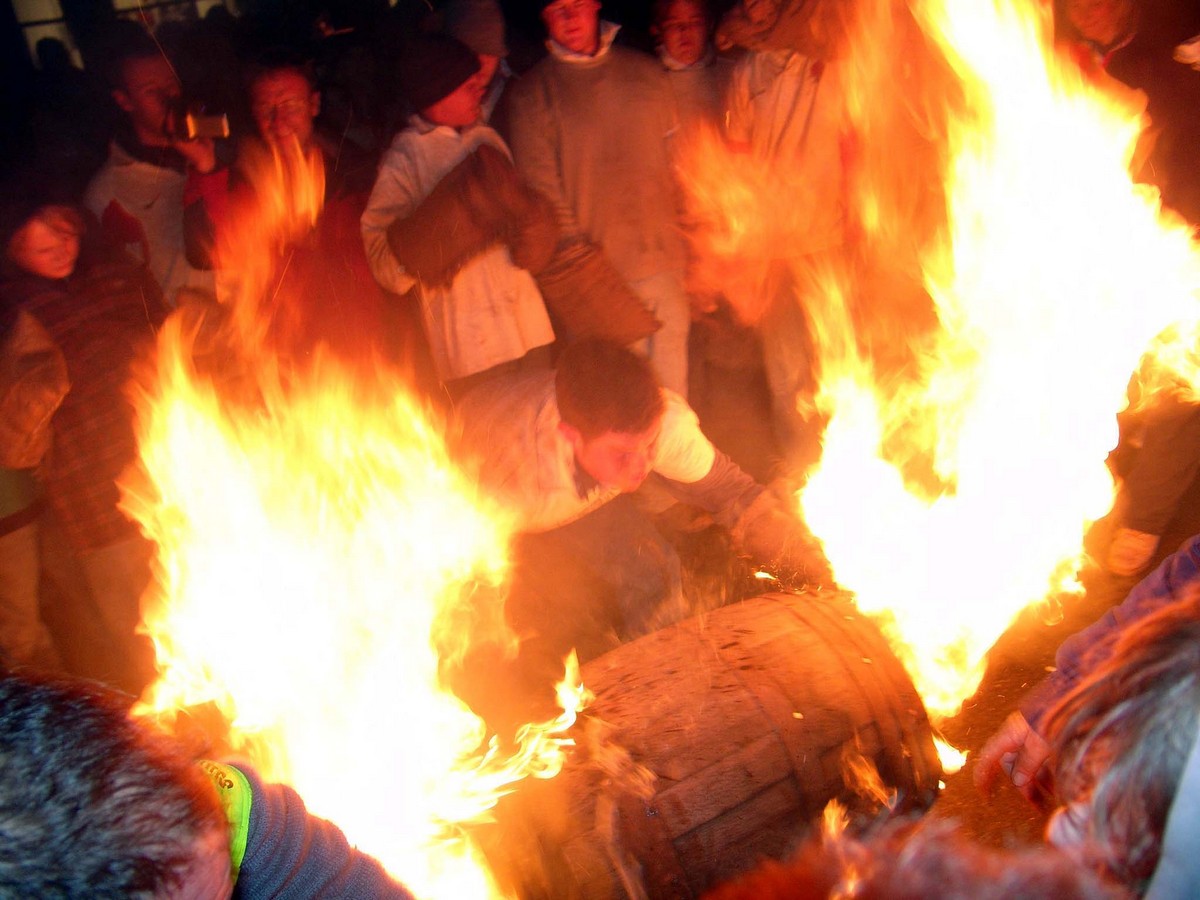
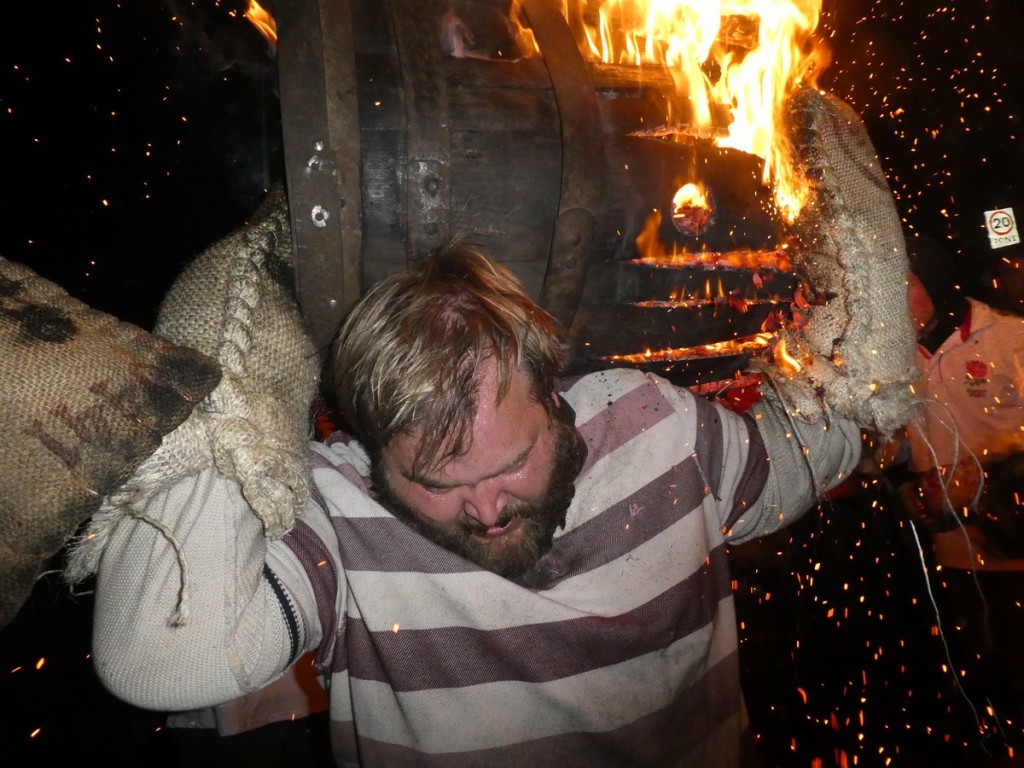
Doc Rowe – now an esteemed folklorist, who has attended traditional folk customs for more than 50 years now, and created a unique archive of recordings. You can see him with part of his collection in the photo below, and read an interview with Doc here conducted by John Wilks. Doc has supplied marvellous photos of Tar Barrel Rolling for my recent blog Topsham Celebrates. He was one of those I knew as ‘the Devon crowd’; there were always links between the Birmingham folk and the Torquay folk, and visits were paid between the two places. My summer just before going up to university was spent in Devon, working in a hotel kitchen by day, and singing in folk clubs there by night. It’s probably part of the reason I’m living in the county today!

The end of ‘Careless Love’ and the beginning of ‘Strictly Pure’

But my carefree approach to clubs and singing was about to change, when I came across an entirely different type of person:

Charles Parker
Charles was a red-haired and radical BBC radio producer. He and folk singer Ewan McColl were responsible for the innovative series of Radio Ballads, which are the stuff of legend today – Singing the Fishing, The Travelling People and The Big Hewer.

I first saw Charles eating cornflakes at breakfast during the Keele Folk Festival, where I had persuaded my parents to let me go for the weekend. It was long before huge and noisy festivals were invented, and was a concentrated, well-programmed series of workshops, talks and performances by the likes of A. L. Lloyd, Anne Briggs and even Arlo Guthrie, who was in his late teens at the time, but already a very able musician following in the footsteps of his father, Woody. I took against Charles, however, when I overheard him criticising the ‘warm bath of sentimentality’, which he claimed that many folk singers were immersed in. How dare he! I was having a really good time, thank you.

Possibly this photo of Charles was taken at that Keele Festival, judging by its tag (source Charles Parker Trust)

But a little later that year, I grudgingly admitted that Charles might have a point. He ran a weekly folk song workshop in Birmingham, hosted by Pam and Alan Bishop, and I trotted along to this to learn from my elders and betters. This workshop was formally known as the Birmingham and Midland Folk Centre, though it mostly took place in the Bishops’ living room in Mosely. Charles cared intensely about the music and the voices, songs and lives of the people he recorded – the Radio Ballads were innovative because they allowed working people and those on the margins of society to speak for themselves, something rare at the time. As I came to know him better, I developed a great respect for him, even if I didn’t always agree with what he said. His passion was genuine. He wanted everything to have the same veracity; he would tell you if your song moved him to tears, or if it just reeked of artificiality. Charles and Ewan were intensely political, but whereas Ewan was too dogmatic for my taste, Charles was imaginative and compassionate.

Sometimes a group of us met at the Parkers’ flat in Harborne, where he would pull down piles of books off his shelves to make a point, complaining that he needed to have a mild incapacitating illness in order to read everything he wanted to. He would hand out copies he didn’t need any more – I still have his Halliwell’s Dictionary of Archaic and Provincial English, J-Z. (It’s a great book, and recently I sourced A-I to make up the pair!) I invited him to my wedding a few years later, and he gave us a signed set of the Radio Ballad records as a gift, which of course I have kept, though with nothing to play vinyl on these days. I was saddened to read of his early death not so long after that. A trust has been set up in his name, to keep the spirit of his work alive.

You can listen to an excellent account of his life and work here

Field work at last!

Charles Parker, Cherry Phillips and Cecilia Costello, Birmingham 1967

The photo you see here is one that has only come to light recently. In July 1967, when it was taken, I was doing a post A-Levels project on folk song collecting. The tradition wasn’t quite dead, even in industrial Birmingham, and in the old Jewellery Quarter, Charles introduced me to Mrs Cecilia Costello. She was the child of Irish immigrants, but had grown up as a Brummie in hard circumstances in the old back-to-back streets of houses.

She adored her repertoire of songs and stories, and had already been discovered and recorded in 1951 by earlier collectors.

The Grey Cock – printed in my 1960s copy of ‘The Penguin Book of English Folk Songs’

Her very beautiful version of the ‘Grey Cock’ appears in the Penguin Book of English Folk Songs. (You can now hear the original recording of her song on YouTube below). But she had since been forgotten, and presumed dead. And it was only when some public mention was made of ‘the late Cecilia Costello’ in the late 60s, that she re-surfaced and declared herself still fully alive. In her humble terraced home, she sang and talked, while we listened and recorded. Later, I was allowed to ‘borrow’ (strictly against the BBC rules, I gathered!) some of Charles’s equipment and I went on a visit of my own to record her stories and music. (There is now a collection of all the Costello recordings which I acquired a couple of years ago, and I can hear my laugh on it in one or two places. Mine was very minor input, however, and Rod Stradling took on most of the hard work of collating and editing all the recordings later on.)

At some point in my sessions with Charles, this photo and the one above must have been taken. I had no knowledge of it until it was used at a recent Charles Parker Study Day as their background image for the conference. Apparently the question was going round: ‘Who is that woman?’ Only one person in the audience knew. And that’s how I came to have it, very late in the day, thanks to Doc Rowe!

Very serious about my task of note-taking while Charles interviewed Cecilia. Later, I was allowed to conduct my own recording session.

I have never forgotten Cecilia Costello or Charles. In fact, I would say that they have helped to shape my approach as a writer. I learned how powerful the voice of an individual human being can be, to sing songs, conjure up the past, and convey messages from the heart. I put much of what I learned, indirectly, into my book, ‘Your Life, Your Story’, and included a dedication to Charles Parker.

Singing has remained a part of my life, and I went on to train as an early and Baroque music singer in my twenties, performing as a concert singer in my thirties, and as a chorus member of the Academy of St Martin in the Fields a little later. My love of folk music remains, though, I still prick up my ears like an old war horse, when I hear those Irish choruses!

You may also be interested in:

Summer is a’ coming Today: May Day in Padstow

Enoch and Eli: The Heroes of Black Country Wit

Finding Brummagem

The Soho Coffee Bar

Checking in for the New Year

Sunrise from the top floor of our house in Topsham on January 1st, 2021

Happy New Year, dear readers!

This is the 42nd post I’ve written for Cherry’s Cache. The site was launched in April with three posts already in place, and new posts have gone up at weekly intervals since. So, I’ve been kept busy through lockdown and through a very mixed year – a year of challenges for all of us.

The idea had been brewing for a while; my author’s website had an intermittent blog, but I felt it was time to strike out again in a more purposeful way. I also needed to get my teeth into a project which wasn’t writing a book every two years, which I’ve been doing for a long time now. It wasn’t the right moment either in terms of my own ideas or the publishing market for that. But I needed to write, all the same!

And then an email popped up in my inbox, a notification from The Gentle Author, of Spitalfields Life blog, that he was preparing to give his last ever courses on blog writing. I’ve long been a subscriber to the G.A.’s blog, which is an incredible compendium of articles about London life, so I decided that this was my one and only chance. I signed up for the advanced course in early March, for those who already had experience of blogging and writing. I felt it would hone my skills and perhaps help me to discover a format for the new blog.

The old houses of Spitalfields, with Christ Church built by Nicholas Hawksmoor in the early 18th c

It was a magical weekend, staying in an old weaver’s house in Spitalfields, right opposite the Hawksmoor church. A small but committed group of us gathered to talk about our aspirations, and to check out ways of presenting material, designing a website and keeping ourselves on track with the writing. I’m bound by group confidentiality not to discuss exactly what we did, or said, but I’m proud to include give links below to some of the blogs that others are writing, with their kind permission.

The bedroom I stayed in, in the old weaver’s house in Fournier St, for the weekend of the blogging course. We met in the sitting room downstairs.

The weekend was intensified for me because of the sense of a looming crisis, as the Covid virus epidemic gathered pace. There were no actual restrictions in place then; the general advice was to be cautious, but the crowds I saw gathering in and around Spitalfields pubs in the evenings made a mockery of that. I made a few careful expeditions. A friend and I visited the Dennis Severs house by candlelight on the Friday evening before the course – magical! And I spent a blissful early Sunday morning rediscovering my (very) old haunts of Sclater and Cheshire Street, at the end of Brick Lane, where I had once ‘fossicked’ for vintage clothes for my shop Tigerlily. (We’re talking Cambridge, 1970s, here.) I plan to write something more about Tigerlily later on.

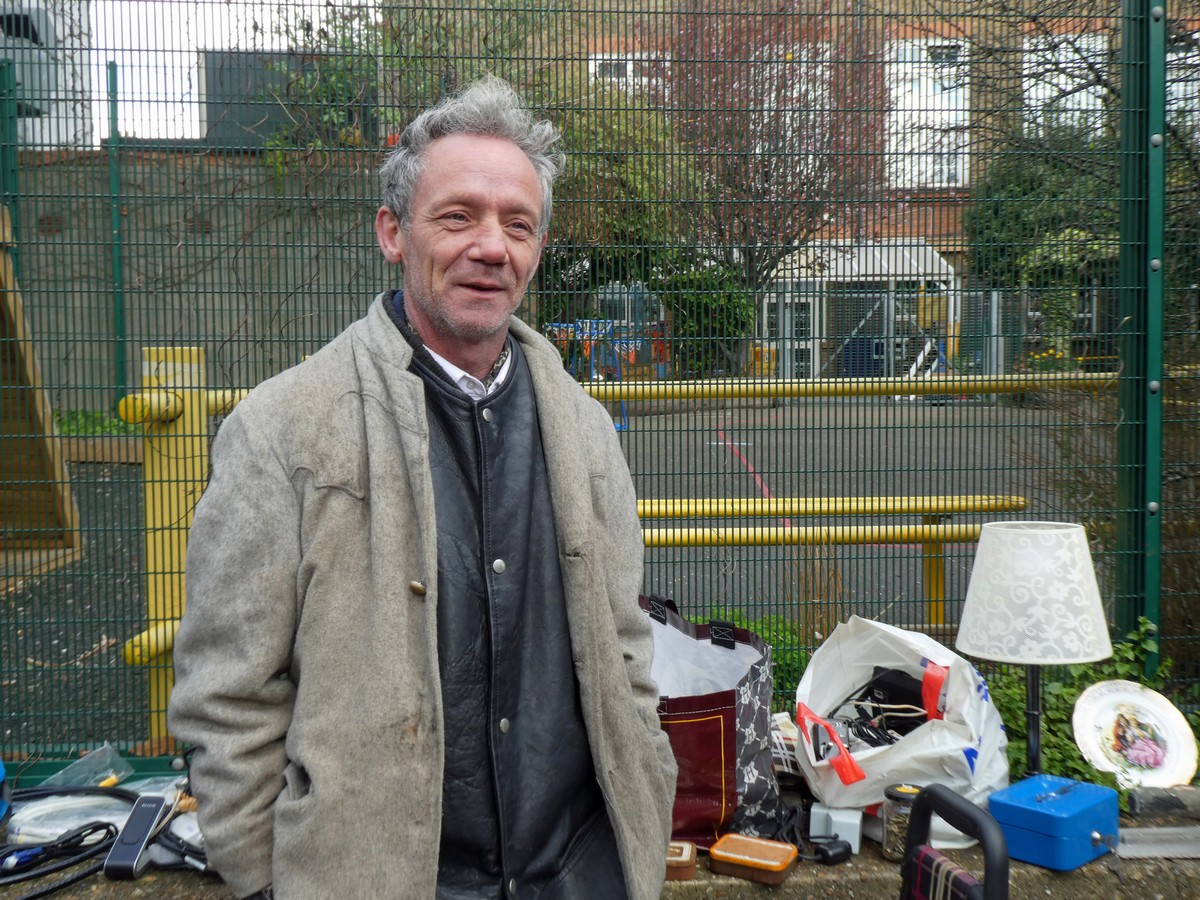
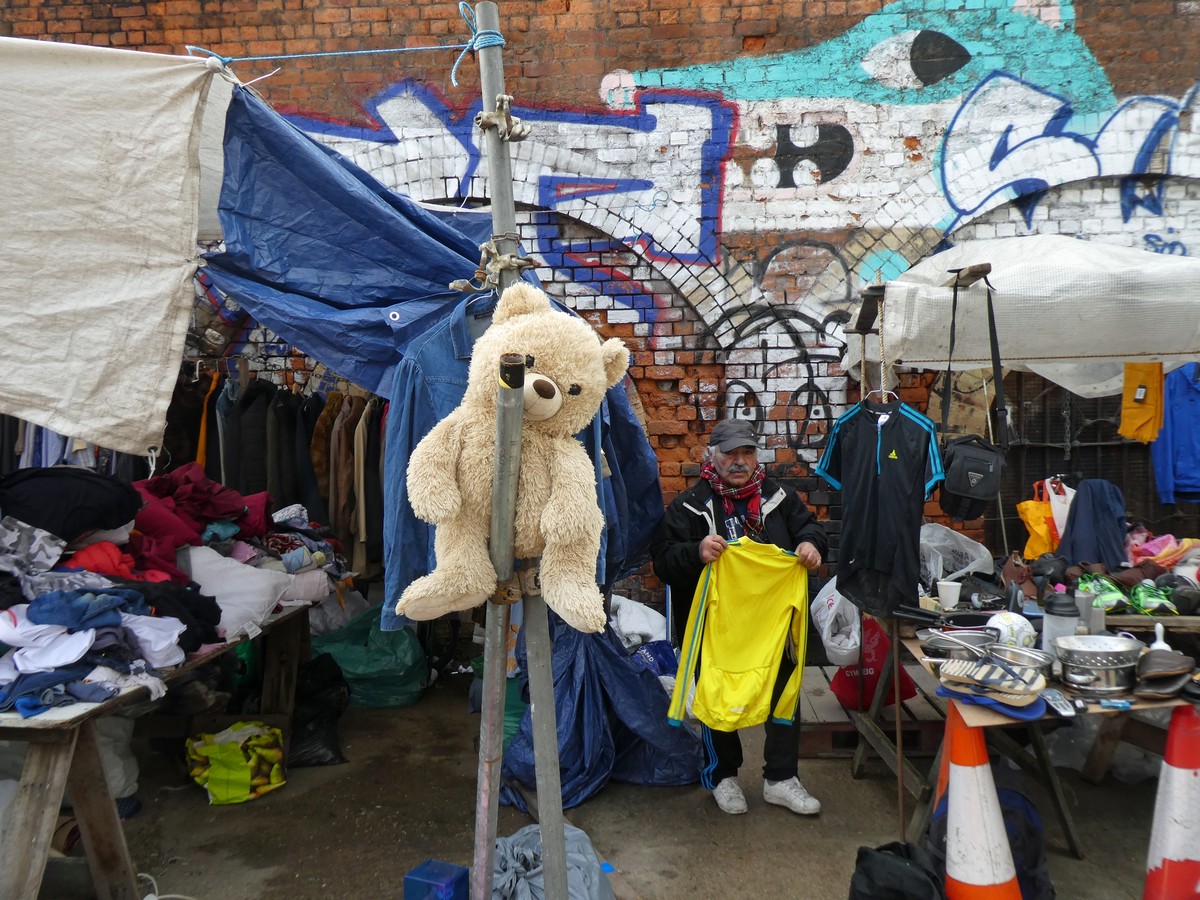
Below: Signs of the old rag markets in the Cheshire St area. I spent some time reminiscing with the stall holder on the left, who remembers coming down to his Dad’s stall there when he was a boy. From the bookstall I bought a copy of Daniel Defoe’s ‘Journal of the Plague Year’ – an ironic touch in the situation.

But I decided to cut short my visit after the course, as it was plain matters were getting worse, and I had to get back to Devon by train. I cancelled a follow-on stay with my son in Stockwell, and a planned visit to the Tate, and left the course a couple of hours early. As I jumped on the train at Paddington, I felt as though I was fleeing before a tidal wave.

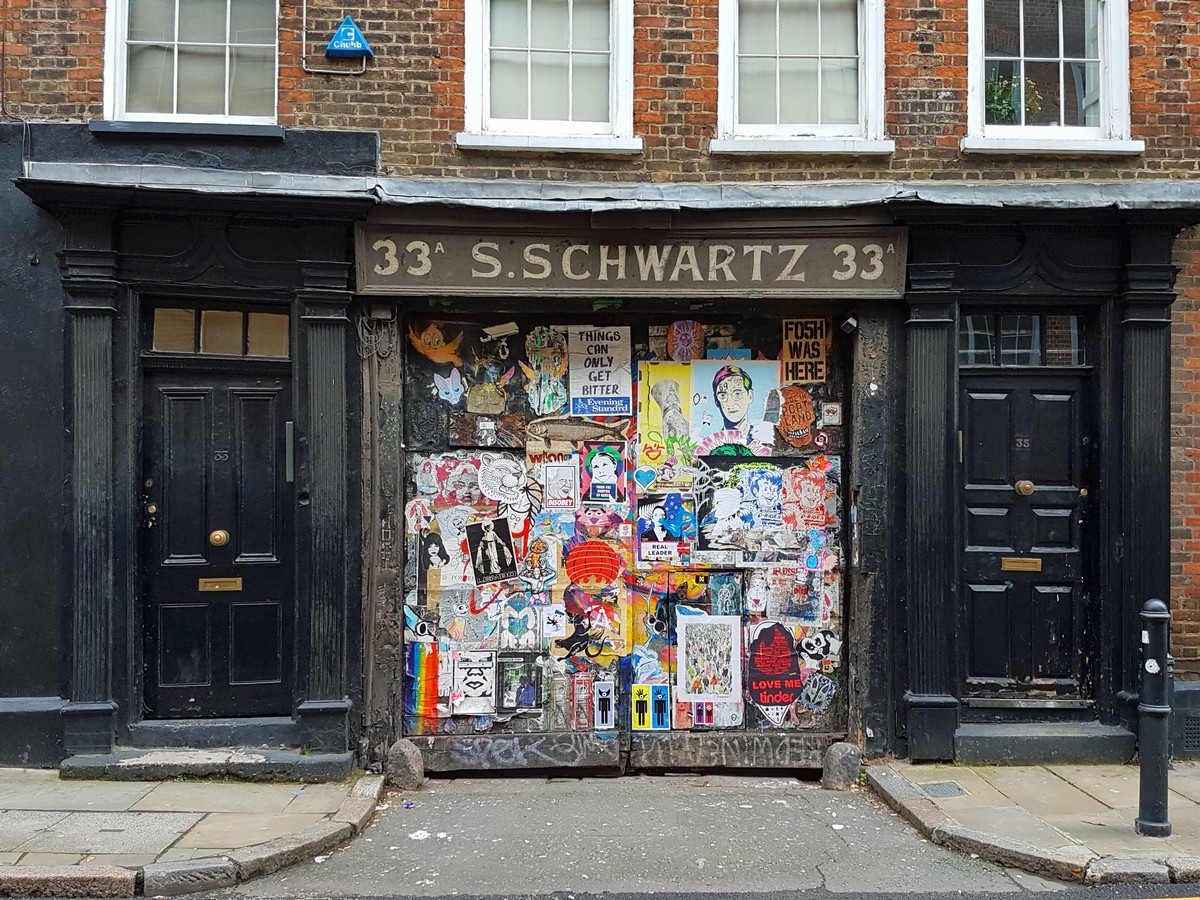
Spitalfields, March 2020 – Note the poster in the centre: ‘It can only get better’ – another touch of unintentional irony.

However, I had reaped huge benefits from the course. I pounced on a suggestion from The Gentle Author, that I should celebrate the diversity of my writing – I’ve never fitted easily into one category – and tend to write about a variety of subjects that fascinate me, and which I research enthusiastically. On the journey home, the name ‘Cherry’s Cache’ came to me, and I also jotted down a wealth of topics that I might cover. In the weeks that followed, with the friendly but ‘remote’ help of designer Jason, who handles the Spitalfields Life website, I became the possessor of a smart new website. The G. A. had advised me not to try and do it myself – time wasted, for a writer, he said! And although I had already learnt how to construct a basic site through one of the blogging platforms, Jason’s work gave me something far more sophisticated and user-friendly than I would have been able to create.

So here I am. I decided to put up one post a week, and I aim to hold to that until the 12 month year is up, in April. Then I may slow it down a little, perhapsposting once every two weeks. Although it’s exciting and stimulating, getting a weekly blog into place, it’s also a great deal of work! I enjoy research enormously, and probably for that very reason, it always takes me further than I expect into new areas. Some blogs, like those on Anna Zinkeisen and the Zodiac Calendar and cinematographer Walter Lassally require a considerable amount of background preparation, and I try and ensure that the facts are as solid as I can make them. Others I revisit from existing material, but I nearly always want to re-craft blogs or articles which I’ve written before. So my aim is that everything on this site, whether written from scratch or discovered in my ‘trove’, has a freshness to it, and a guarantee that I’ve put my spirit and energy into it.

A glass pendant, perhaps from Venice, which I bought at the Cheshire St market at the time of the blog writing course, which I count as a talisman of Cherry’s Cache

With that aim of refreshing the spirit, for any and all of us, I made a decision at the start that I wouldn’t usually reflect current events in my posts. I’d like some of the stories to be relevant in the future, not tied to the circumstances in which I wrote them. Also, I reckoned that readers were getting enough of the news and the prevailing pandemic anxieties, and that it would be better to tackle topics which could interest and cheer people. My Gentle Author coach was kind enough to say: ‘I am so pleased that you are writing your blog, these things take on a greater meaning when people are searching hungrily for stories beyond the news.’ Indeed. And it’s not my task to write as an activist, or agitate for particular kinds of change – others do that better. Once, I was asked in a visualisation exercise what my job was, I spontaneously replied, ‘I bring the fire from the mountain.’ Make of that what you will.

I’ve had enormous fun too, for instance consulting with my old schoolfriends Helen Leadbeater and Mary Cutler about how we all got involved with writing for Jackie magazine. Reliving the ‘unusual exhibition’ my husband and I put on in France, with the assistance of actors Bill Homewood and Estelle Kohler. Foraging for Black Country jokes, and writing about the adventures of my runaway 4x great grandmother, Mary Max. Just recently, my post on Pangur Ban and the Old Irish Cats was taken up by readers of the Facebook page, British Medieval History, and resulted in an explosion of reader numbers, for which I am truly grateful and honoured!

For these 42 posts, I’ve written a staggering 90,835 words, give or take a thousand or two. I am staggered because this is actually longer than any book I’ve ever written. Perhaps I shall be able to turn these posts into a book one day?

Some of the many images which I compiled for the last nine months of posts. I find that creating and choosing pictures is incredibly rewarding; I’ve always been fascinated by the juxtaposition of images and text, as in slide lectures, which I gave for many years as a NADFAS (Arts Society) speaker.

The game’s not over yet. I hope I can continue at least for another year, even if with fewer posts. And here’s a big THANK YOU for reading my posts, and for subscribing to the email list, if that’s how you get the alerts. There have been some lovely comments. I quote a few here as they help motivate me to keep going!

Hi Cherry – It wouldn’t be Sunday with your blog. Many thanks! (KC)
Love your cache writings. (JP)
I really enjoyed this. What a fascinating and profound experience. (MC responding to On ‘Meeting the Shaman’))
Absolutely fascinating Cherry! I love your researched and interesting blogs.(JW)
I just loved all your Russian content – especially the red corner etc. Thank you! (BM)
Hope you can keep up your Cache which I have been enjoying very much. Laughed out loud at the masterly Sign collection, and enjoyed another journey to Topsham. You write so entertainingly! (LO)

The adventure continues! Happy New Year again – please keep reading, and do share the link with anyone who might enjoy Cherry’s Cache.


Blog updates


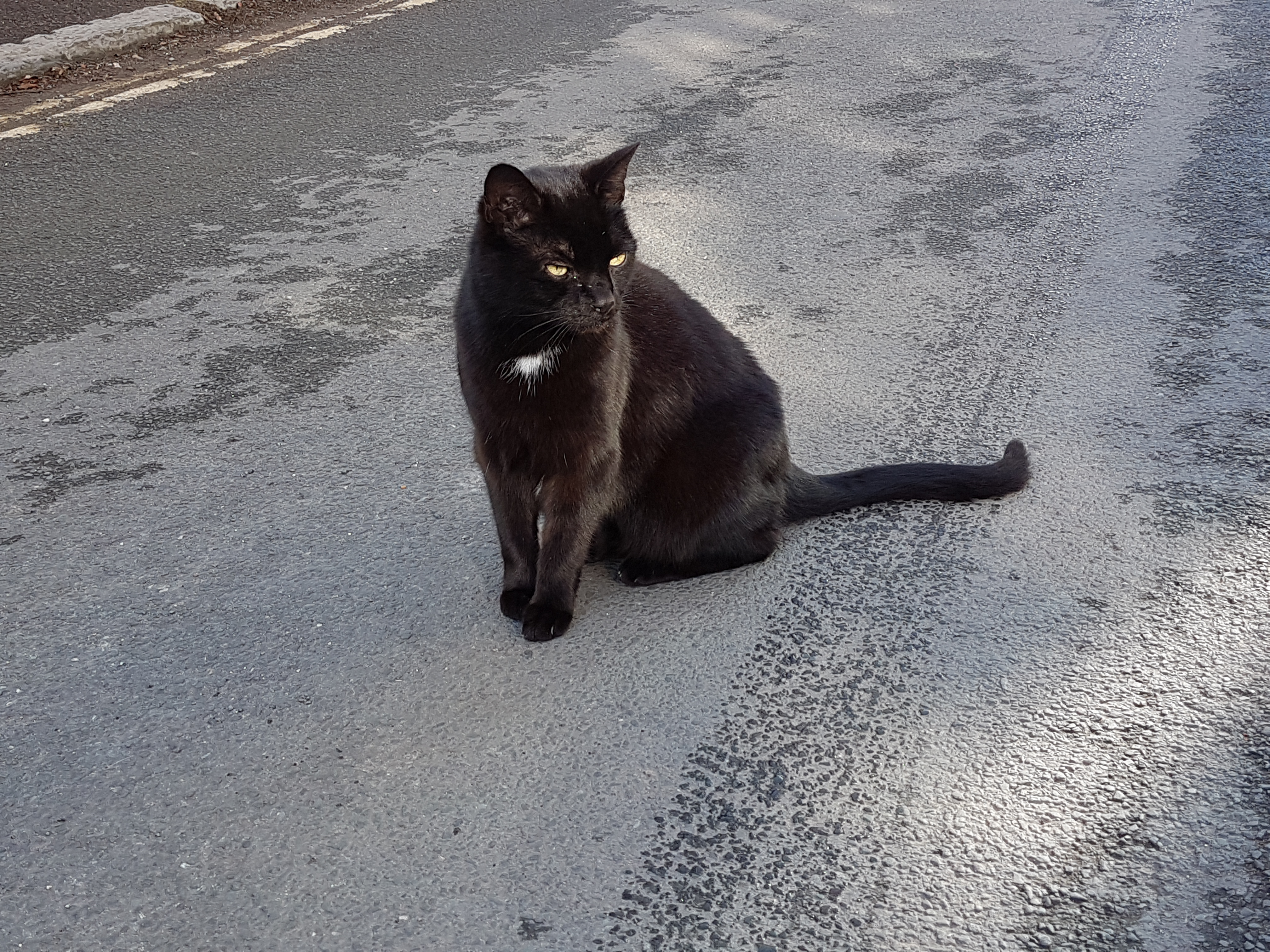
Cosmo, a cat of Hidden Topsham
Do you remember Cosmo, the ‘six dinner Sid’ cat of Topsham? He’s still around, as you can see from a more recent photograph. One morning, I found him lurking on the corner of Monmouth Street, standing guard over something. As I got closer, I could see that it was a dead fish. And moreover, it wasn’t something washed up on the riverbank, but a splendid fancy koi-carp type of fish, with elegant wavy fins. Or it had been. Oh, Cosmo! Did you go fishing in someone’s pond? Or should we give you the benefit of the doubt, and suppose that a passing heron dropped its catch right in your path? It’s possible, after all. Just.

Golden Quinces – I used the last of this year’s crop of quinces to make Quince Chutney. Chutney needs to be left for 4-6 weeks before it’s ready to eat, to reduce the vinegariness and meld the flavours. We’ve now just tried the first pot, and it’s pretty good! It has quite a tart flavour, but rounded out in a lovely Christmassy spice way. The Quince jelly, which was ready to eat straight away is superb. Last year, I don’t think I boiled it long enough and the resulting jelly was light both in colour and texture. This year’s is much stronger in both senses, and especially delicious eaten with soft cheese on an oatcake!

Venetia, the Woman who named Pluto – The Stats which I can look up for this website are a fascinating collection of information as to whereabouts in the world readers come from, what links they’ve clicked, and what pages they’ve looked at. My post on Venetia Phair was published back in October, describing how I met Venetia, and the story of how she named a newly-discovered planet back in 1930. This week, the post suddenly had 24 hits from China. Was it a class of Chinese students learning about space exploration? I will probably never know.

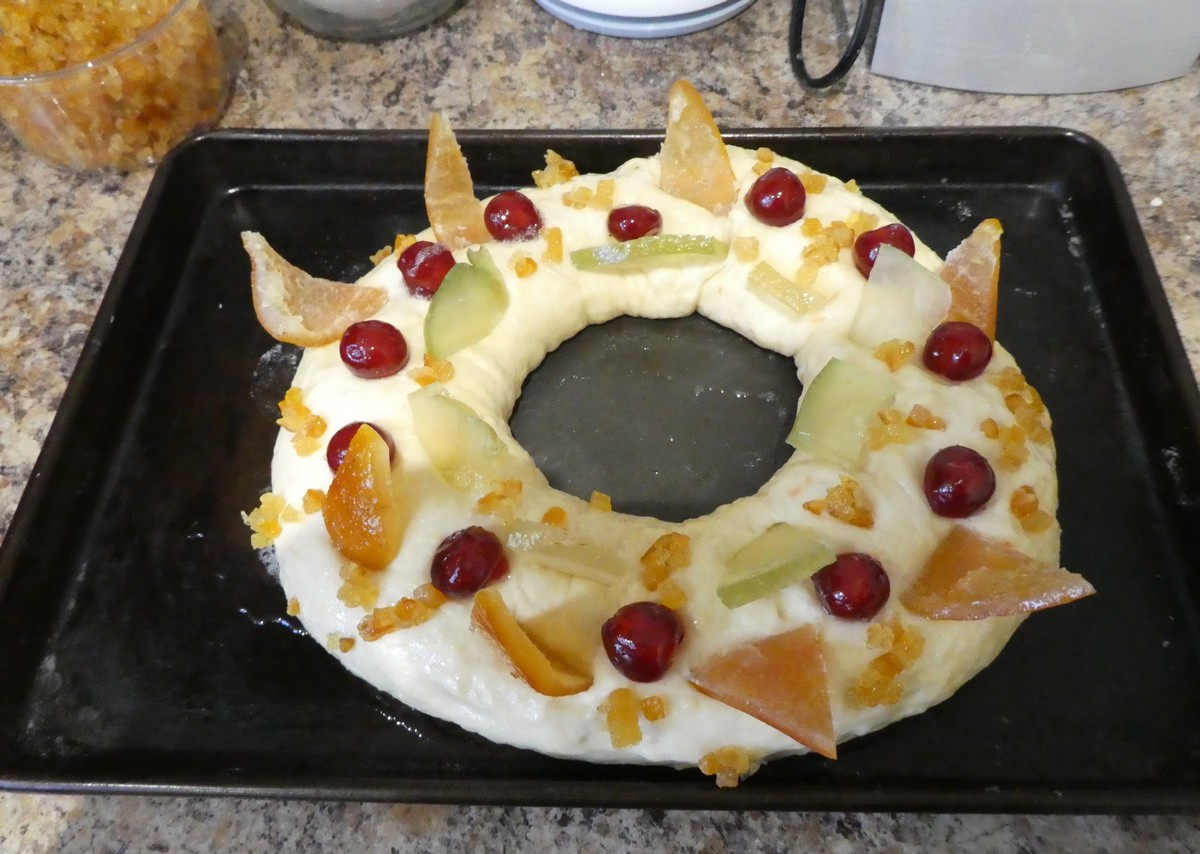
And the final update – the Twelfth Night cake!

In my post about The Twelve Days of Christmas I gave a Spanish recipe for a Twelfth Night cake/loaf celebrating the arrival of the Three Kings at the Christian festival of Epiphany and what used to be ‘party night’ in the last of the Twelve Days. It’s in a circular shape, rather like the crown of one of the kings. I felt that I was duty bound to have a go at making it, so this morning, shortly after 6am I got cracking, like a good baker. It is a kind of enriched dough, rather like a brioche, and needs up to 3 hours proving in two stages. I nearly gave up at the first hurdle, when I realised that the 25gm of yeast must refer to fresh yeast, which I didn’t have, and the method described might not suit the small packets of instant yeast which most of us use these days. However, I did have a tin of granular yeast (bought during the lockdown when nothing else was available) and I decided to try that. And I’m happy to say that it worked! I’d already stocked up with some candied fruit, the best I could find locally. But because it’s baked on the outside of the loaf rather than in the dough, it gets very hard, and in future I’d only use the softest types, like glace cherries.

At 10am I wondered if I could finish it in time before a Zoom call with friends at 11. But I wasn’t going to stint on the decorating – I placed 12 cherries for the 12 months of the year, and added various artistic touches with glace citron peel. (Yes I know, I’m not a potential Bake-Off winner.) It was out of the over before 11, and when it had cooled a little, I brought it upstairs to show my friends triumphantly. Robert and I tried it at lunch – it’s quite like brioche as I mentioned, or an old-fashioned sweet bun, with a delicate flavour of orange and lemon rind (grated into the dough) and a touch of brandy. I ate my slice with a little quince jelly. Then a couple of hours later, I wrapped several chunks in silver foil and took them to friends in the town, so that they could share in what I hope is Twelfth Night good luck for the year ahead. Here’s the cake, from its dough ring stage to the finished ‘crown’. By the time you read this, I will have also added a few notes to the recipe that I posted earlier.

My Fellow Bloggers

Last, but most definitely not least, I’d like to point you to some of the fascinating blogs by other members of our Spitalfields Life blogging course. Please take a look! The diversity of what we write is fascinating.

From left to right: Carolyn Skelton, Jo Rogers (in earlier years!), Bertie the Bear, and Shula Rich

Carolyn Skelton: ‘A London Family is the story of my quest to find out more about the elusive paternal side of my family. It starts with my job as an ‘heir hunter’ in London in the 1980s and describes how an old photograph found in a wallet years later sent me on a search which encompasses two hundred years of social history…’ https://alondonfamily.com

Bob Ball:  Mindfully Bertie – These are tales told from the viewpoint of a bear – well, not just any bear, but Bertie! ‘My blog Mindfully Bertie has, over four years, carried me through bereavement to being told in Spitalfields that I am “ a proper writer”.’
www.mindfullybertie.org.uk

Amanda Root: The Coastal Pilgrim – ‘This is a blog about one woman, surrounded by an interested and helpful community, starting a seaweed farm, which may or may not morph into a social enterprise and which is hopefully going to get us all eating more seaweed!’ https://thecoastalpilgrim.com/

Jo Rogers: – ‘Huguenot Jo is a blog exploring the effect of Huguenot ancestry on Jo’s family, with a lineage going back to the 1680s. It looks at the historical context of Huguenot persecution, and the contribution of these French refugees to the societies which took them in. ‘www.huguenotjo.co.uk

Shula Rich: Natural Beauty Brains – ‘I wanted my blog to reflect that I’m many things and egged on by the tuts of ‘you can’t do that’ put everything I do together. Lease advice – natural beauty brains – waking beauty.’ https://www.naturalbeautybrains.org/

Linda : Letters from Linda – Letters of life, snippets and snapshots, a history. Linda says: ‘So far I’ve started to write about my family and some of the mementos I’ve collected in my flat that give me happy memories.’ http://lettersfromlinda.com/

Images from ‘The Coastal Pilgrim’ (left) and ‘Letters from Linda’ (right)

Contacting Cherry

If you’d like to get in touch, on the ‘About’ page you will find a ‘Contact’ link which you can click on to bring up a Contact Form. A message from there will reach me by email. Or else visit http://www.cherrygilchrist.co.uk and select the Contact tab there.

The view from our kitchen window, in Topsham

Topsham Celebrates

Topsham knows how to celebrate! Even though our feasts and festivals couldn’t be the same this year, due to the pandemic, the customs of dressing up the town and dressing up ourselves are firmly embedded in the calendar. We’ll do it again next year, if we can.

This post is based on the Topsham celebrations that I’ve witnessed over the last few years, with a few historical occasions thrown in for good measure. It’s not a comprehensive Topsham Calendar, and it will be more picture-dense and text-light than usual. But I’m including a link to a full account of the illicit Tar Barrel rolling event!

Let’s enjoy some celebrations here virtually, and despite all the restrictions, I’m sure that we’ll still have a festive spirit and display in the town. As I write this, in early November, the town is making itself ready for Christmas as cheerfully as possible. And as I come to make the final tweaks on December 5th, everything is up and twinkling! More photos further on.

Getting the street lights up, and a test switch-on
From a previous Christmas in Topsham

Charter Day
Since 2016, Topsham Charter Day has been held each August, to celebrate the day when King Edward I granted the charter which turned Topsham into a town, back in 1300. (Woe betide anyone who dares refer to it now as ‘a village’!)

On the first of our modern Charter Day celebrations, Charles Courtenay, the current Earl of Devon, arrived by boat from Powderham Castle to receive the charter from ‘the King’. According to the schedule for the festivities:

1.45pm: The king and his entourage and townsfolk will process along Fore Street, lined with “medieval” market stalls, to St Margaret’s Church green. Here, he will present a replica town charter to the present Earl of Devon, Charles Courtenay.

In case of any confusion, the Earl was real, while the king was ably acted by one of our townspeople. You can read the complete order of ceremony here:

The Earl of Devon waiting to receive the charter from ‘the King’, accompanied by junior knights and pirates who sailed with him from Powderham Castle
Jousting in the churchyard
Mustn’t be late for the Charter handover!

The Town Criers’ competition has staunchly remained a popular feature of Charter Day. They arrive from all over the country, to process down the main street in splendid array, then make a speech from the balcony at the Globe Inn, in the old coaching yard. It’s the speech that decides who will be crowned the best Crier in the land.

Charter Day Procession, with the Town Criers marching too

Christmas
Well, Christmas in Topsham wouldn’t be the same without the Carols at the Bridge Inn, which always takes place just before lunchtime on Christmas Day, to the rousing accompaniment of our local celebrated folk group Show of Hands. I hope we can still manage it in some form in 2020.

Carols at the Bridge, the oldest public house in Topsham – squeeze room only! Steve Knightley, Phil Beer, Miranda Sykes and Chris Hoban are regular stars of the band.
Here’s Show of Hands performing inside at the Bridge Inn, as part of their ‘Tour of Topsham’ in 2011

Topsham shop windows are beautifully decorated, house doors likewise.

This was my personal favourite in Topsham, though alas the accountancy firm has left the premises, and it’s now just a fond memory. Skaters that skated, carousel horses that went up and down….
Buying some Christmas cheer on a bicycle made for two

Nello’s Longest Table
Once every two years, in June or July, over two thousand people gather for lunch together in Topsham. The line of tables stretches down Fore St, winds around to the Quayside, then snakes back again alongside the river to Ferry Road. Over 350 tables are laid out, so that families, friends and visitors can feast together, and create one ‘Longest Table’.

This lunch was set up in memory of Nello Ghezzo, a local restaurateur who dreamed of a feast which the whole town could take part in. Nello died in 1999 and in 2008 the first such meal took place, named in his honour. The event is also a fabulous fundraiser. In 2018 the organisers posted on Facebook: We are absolutely delighted to hand over the proceeds from this year’s Nello’s Longest Table and Topsham Food Festival: £2500 to Force Cancer Charity, £2500 to the Brain Tumour Charity (in memory of Geoff), and £1500 to Estuary League of Friends for the new and fabulous Nancy Potter House. We furthermore were able to fund the new Love Topsham web site as well as give a donation to Love Topsham for admin for new Topsham traders initiatives.

Louis Ravenscroft, the former Town Crier, announcing the start of Nello’s Longest Table, 2016

There’s always a rush to secure tables in favourite spots when the booking opens, and the food is generally more banquet than picnic, with delicious creations and exotic specialities.

A pavlova for our family table, produced by my daughter Jess

Dressing up may be either to a theme or on the whim of the individual groups. The second Longest Table in 2010 reported: Tables were decorated beautifully with colourful cloths, china, table decorations, flowers and even chandeliers. Others had based themselves on a theme – there was a Mexican table complete with sombreros and giant moustaches, a Sicilian men (and women) in black table, a Mad Hatter’s Tea Party, a gardening table, walkers’ table, and more.

An American themed year, which also featured some fierce looking American Indians

As the day goes on, groups mingle, children play games (racing each other around the churchyard is a favourite) and wine flows freely. We missed it happening this year, in 2020! Here’s hoping we can go ahead in 2021.

And what celebrations happened in days of old? The Museum archives tell a tale or two.

VE Day party, Topsham 1945
Coronation street party, Monmouth Avenue 1953
Topsham traders dress Victorian in 1984, occasion unknown – unless you can tell us?

(With thanks to Catriona Batty and the Topsham Museum for supplying these images.)

Other festivals pop up throughout the summer, like various Music Festivals, Beer and Bacon, ‘Secret Gardens’ (which I’ve written about here…). Plus ‘Jazz in the Garden’, a Dog Show, and a Flower and Produce Competition. I’m sure I’ve missed some out! Ah, yes, the Food Festival at the Quayside, which produced an excellent talk on salmon fishing from Ed Williams-Hawkes, and a demonstration of making the acclaimed ‘Smokie’ dish which used to be the top favourite at the Globe Inn. Here’s how a member of the Hodges family who ran the Globe explains it:

The Topsham Smokie
Basically it’s smoked haddock poached in milk with bay leaves. Make some lovely white sauce – you can put some cheese in there & use some of the milk that has poached the fish. Mix up the fish, white sauce and stir in some mashed potato. Put in a pot, top with tasty grated cheddar cheese and bake xxx simples !!!

From Liz Hodges of Route Two Bikes – formerly landlady of the Globe

Demonstrated by a chef from the Globe Inn, who hasn’t forgotten how to make this scrumptious dish.

Guy Fawkes Night
But what about November 5th? There may be a mega-display at the Rugby Club most years, but individual fireworks are a matter of past glory, according to long-term resident Roy Wheeler. Recording his memories back in 1988, he remembered how, decades earlier, the local lads would pitch a firework battle on Chapel Platt, just outside the Methodist Church.

One thing I remember vividly was fifth of November, firework time. A chap used to keep what is Meg’s Restaurant now was a man called Gilders – we used to call Putty Gilders – and he used to sell everything. And we used to buy our fireworks there and then it was a case of ‘Top Town’ versus ‘Bottom of the Town’. The bottom of the town boys used to come up to there and we used to come down to this side and we used to throw fireworks at each other. It was a battle-royal. That was always something to look forward to! Ha ha ha ha! But yes, this was always a very busy spot and it wasn’t so long ago that the City Council in their wisdom, or otherwise, planted a tree there. Thought it would enhance the beauty but it didn’t last very long. The Topsham people weren’t going to have that. They weren’t going to have their Platt desecrated. Hee hee! So, the tree was knocked over. (Account supplied by Topsham Museum)

Still earlier, in the 19th century, there was a rip-roaring tradition of celebrating Bonfire Night in Topsham and Exeter, with processions, battles and exotic guys. This account reveals that a recreation of the Armada provided plenty of entertainment for Topsham folk:

Western Times – Saturday 08 November 1890
Had the weather been favourable no doubt the carnival held on Thursday by Young Topsham” would have surpassed any previous attempt. But unfortunately rain fell heavily and a strong wind blew continually during the night. The procession did not start until close upon eight o’clock. The order was follows:—The local band, banner, Topsham guys, Young Exeter, the local fire brigade, Captain on horse, back, Committee, Topsham Cyclist Guys, tar barrel brigade, and a representation of the Armada fleet, under the command of Ally Sloper.” The latter was the most striking feature of the carnival. After the procession had broken up, the two model ships, representing the British and Spanish fleets, were formed for action the ” battlefield” in Fore-street, and after a warm encounter the Spanish vessel was ” bombarded “by Roman candles. A large number of excellent rockets were let off, and the celebration, which was witnessed by a large number of persons, including many from Exeter, continued up to a late hour.

Bonfire nights were an excuse for lynching unpopular members of society in earlier centuries in Exeter, as described in this article , and as Todd Gray also records in his book ‘Not One of Us

Indeed, it wasn’t all fun and happy outcomes:

Exeter and Plymouth Gazette – Saturday 13 November 1847
Accidents. —Since Friday last, upwards of 27 individuals, who have received serious injury from accidents, have been taken into the Devon and Exeter Hospital. Of these accidents 18 or 19 were occasioned by the unexpected explosion of rockets and other fireworks in the hands, or near the persons, of the sufferers; one of whom, a lad, was brought from Topsham, so injured the lower part of his person, that life is despaired of. Another young person had his skull fractured by a kick, or a blow from a bludgeon, as he was engaged with others in the fun of rolling tar-barrel.”

All photos of Ottery Tar Barrels here are supplied by kind permission of folkorist Doc Rowe, who has attended the occasion and numerous other folk customs for many years

Did someone say Tar Barrel?
What’s that about? – surely the only Tar Barrel Rolling round here is in Ottery St Mary? But no – Topsham used to have its own tradition of Tar Barrels, until it was made illegal in the town, probably in the early 19th century. As a sport it can be thrilling, but the dangers are obvious, and especially so in narrow streets with old timber-framed cottages.

And in 1847, the Rev. Frederick Isop Cocke,, assistant curate of Topsham, was convicted of Unlawfully Rolling a Tar Barrel. The Rev. Cocke appealed – he had only been doing his duty, he said, and trying to keep the barrel away from the crowd. In January 1848 he was acquitted. ‘Decision of the Bench was received with loud cheering outside the court.’ Western Times – Saturday 08 January 1848 – you can read the whole story here:

But be warned, if you decide to persue this account, that the ‘he said’, ‘she said’, ‘No I didn’t’, ‘Yes you did,’ runs to over 3000 words . Nevertheless, it’s a mine of information about local people and the streets of Topsham at the time. The story proved immensely popular around the country, and appeared in briefer versions in various provincial newspapers. After all, a parson with a flaming tar barrel, who ends up in court, makes a good story!

Finally, I’ll end with a custom which has only recently been introduced, but which is based on a very old tradition which certainly took place in the area, if not in the town itself. This is the now annual Wassail. Wassails are usually held in January, an old farming custom intended to drive evil spirits out of the orchards and produce a healthy crop of apples. (Very important in cider making districts!)

Topsham’s Wassail is now going strong, with songs especially written by Adrian Wynn, and a merry band of folk club followers, children and townspeople. We gather at Matthews Hall, serenade the apple tree there……, then move onto Victoria Road and a noble old apple tree in a garden there, thought to be a survivor of a former cider orchard. Further stops occur at other venerable apple trees, including the Old Vicarage, and the procession eventually celebrates the final tree at the Allotments . To make the magic work, a robin must be placed in the branches, and a piece of bread dipped in cider then stuck in the tree itself. Possibly a few cups of cider and slices of apple cake may also be consumed en route. And perhaps I should mention that we’re usually accompanied by a farmer with his shotgun; traditional Wassails aren’t complete without a loud blasts fired through the branches, to send the devils packing! You can see him lurking with gun at the ready in the picture on the right.

Topsham Wassail
In the orchard dark we muster,
North wind whistles through the North wood Tree;
Prosper Greasy, Soldier prosper,
In our orchard and soils of old,
Gather Topsham, sing and rattle,
We’ll bring cider back to thee!
Gather round and old Tom Putt
Will flow and fill our wassail bowl.

Adrian Wynn

Hanging the robin in the tree and placing some bread soaked in cider in the branches is of course essential for a proper Wassail. Children are usually keen to help.

Christmas 2020 – So here we are, in the run-up to Christmas, with shop windows beautifully decorated, lights twinkling and everything as normal and cheerful as it can be in this extraordinary and difficult year. As a small town with a busy High Street (actually called Fore Street!) it has a particular sense of community and the feeling that everyone is doing their best to create the spirit of Christmas here. I’m thankful to be living in Topsham!

You may also be interested in:

The Tidal Town of Topsham

Hidden Topsham Part One

Hidden Topsham Part Two

Hidden Topsham Part Three

Hidden Topsham Part Four

Acknowledgements

With thanks to Doc Rowe, for his stunning photographs of the Ottery Tar Barrels

Catriona Batty and the Topsham Museum, for photos of historic Topsham celebrations and the memories of Roy Wheeler

All other photographs by Cherry Gilchrist, with thanks to Love Topsham for help both in the town with masterminding various projects, such as the Christmas lights and other festivities, and for supporting this blog.

The Abduction of Mary Max

A runaway bride at the age of 13

Gaile House, co. Tipperary today, where Mary Max was born

I first posted a version of this story on my author’s blog at in Dec 2019. Various other Phillips descendants got in touch as a result, so I’m delighted to have expanded the current family network! In autumn 2019, my husband and I had planned to visit Gaile House (the first time for me), staying in the house where Mary Max was born, and visiting the graveyard nearby where she is buried. We would have been joined too by one of my ‘new’ cousins who I’ve discovered through sharing her story. Sadly, the owners of Gaile House cancelled our booking due to a bereavement in their own family, so we’ve had to postpone our trip. At present, in late 2020, it’s impossible to say when we may be able to travel to Ireland again, but I hope that 2021 will bring better opportunities to use my new Irish passport, and that I can see for myself both where Mary Max lived, and where my own grandfather was born. My father who was a regular visitor there during his life, while his elderly cousin was still in residence, always had a dream of buying back Gaile and living there in his retirement, but as is so often the case, life got in the way. It was sold, and is now beautifully renovated and operating as a working stud and horse training centre, so it has certainly come into good hands.

Note to other Phillips descendants: if you are connected to this line, and would like to be put in touch with others researching the Phillips family, please contact me either via this website or my author’s site at http://www.cherrygilchrist.co.uk. (use the Contact Form)

Mary Max

This is the story of my 4 x Irish great grandmother, Mary Max, who was abducted and forced into marriage in1777, at the age of thirteen. She lived in the Max family home at Gaile House, County Tipperary, and was an heiress to a £40,000 estate, which was worth over £6,000,000 in today’s terms. Her father and brothers had all died in quick succession, so in 1777, as a young teenager, Mary was set to inherit the family fortune when she turned eighteen. Her only close relative was her mother and guardian, Joan Max.

At the time, abduction was rife in the heartlands of Ireland, and Mary was a tempting candidate. Bride-snatching had become almost acceptable as a way of securing a bride, and although it was a capital offence, the risk of conviction was low. The target was usually a girl who the prospective bridegroom thought would better his position, preferably with money or property, and of good social standing. He would then gather a band of supporters, often including friends and family members, and they would plot to seize her by force. Plans were audacious, with ambushes and even armed hold-ups. One episode on record involved locking the priest and the congregation in church while the raiding party singled out their chosen target from the worshippers!

Mary Max was abducted by Samuel Phillips of Kilkenny in August 1777. He was her first cousin-once-removed, who lived about forty miles away in the Phillips home of Foyle. The Phillips family had arrived in Ireland before 1600, possibly as Welsh immigrants, and as merchants they then rose through the ranks to produce a couple of Mayors of Kilkenny, marrying into moneyed or landed families such as the Despards along the way.

By the 18th century, the family had some land and money of their own, but not enough to satisfy them, it seems. And so a secret plan was made to grab the family fortune of the Maxes, their kinsmen, to add to their own. A raiding party was put together: Samuel Phillip, groom was then 21, and his supporters included his father Richard Phillips, who was a Magistrate and Justice of the Peace, his sister Frances, and, surprisingly, Dennis Meagher who was Mary’s uncle on her mother’s side.

Mary was snatched late one evening, as she was returning home from a ball. Samuel’s sister acted as the decoy, pretending to offer Mary a safe lift in her carriage back to her mother’s home. Instead, the coach sped away to Waterford, where the conspirators and prospective bridegroom were waiting. It sounds the stuff of a period drama movie, and it certainly caught the public attention at the time. Reports spread through the press like wildfire as the story unfolded.

The lands of Gaile, at the time when the estate still had hundreds of acres

One newspaper gossip column reported:

Letter from Dublin, dated Sept. 20: As I make no doubt but you will be curious to know in what manner Miss Max was carried off, I have collected such particulars as I could, and have sent them for your entertainment. Miss Max was at a ball, at which also was Mr. Philips, with whom she danced the evening. —The husband intended by her guardian was also one of the company; after the ball, Mr. Phillips’s sister walked with Miss Max towards the carriages, and prevailed her to accept of the use of theirs to set her down. All things having been previously concerted, Miss Max stepped into the post-chaise, and was drove directly to Waterford, where Philips, the young Lady, and assistants, embarked, and arrived safely in England, from whence they crossed over to France. Miss Max not being missed for above two hours, full time was given for eluding a search, which was afterwards made to no purpose. She is first cousin to her adventurous lover.

The current driveway to Gaile House, through what look like very old trees from the days of its estate

Newspapers around Britain went crazy for the story, and this particular ‘letter’ was republished in local papers from Kent to Newcastle.

From Waterford, the ‘wedding party’ went by boat to Wales, and then by road to Scotland. (All land transport was, of course, by horse and carriage in this era). A hue and cry was raised, and a magistrate’s militia was sent off in hot pursuit. At this point, the Phillips family’s first aim was to get Mary married off to Samuel, before the pursuers could intervene. Many such forced marriages were conducted in all sorts of shady ways, with little regard for the legitimacy of the priest. In Edinburgh, as we’re told by subsequent legal documents, Samuel procured a so-called clergyman, ‘a man of very indifferent character’. (In later years, he came to regret not finding a priest with better credentials, but only because he was worried that it might otherwise undermine his claim on Mary’s fortune!)

Mr and Mrs Phillips then hastened to travel south with their ‘wedding party’. But by then, there was a price on their heads: Mary’s mother offered a handsome reward for Mary’s safe return, and a bounty price to anyone who could hand over Samuel Phillips or his father to the law. Knowing little of the geography, Samuel’s troupe made a strenuous journey by side roads down to Brighton, at the time a small fishing village known as Brighthelmstone. En route, they stopped at Kingston, and asked if the sea was nearby! When they finally made it to Brighton, they then set sail for France. All but one of the party – Mary’s uncle- escaped across the Channel. He however was arrested and clapped in jail in Dublin. It was a close-run thing: according to one newspaper report the abduction party was chased right to the edge of the water.

Before the packet in which they sailed was lost out of sight, two of Sir John Fielding’s men arrived at Brighthelmstone, in pursuit of them, and offered any of the fishermen a large reward, that would give chase to the packet, and prevail on the Captain to steer back; but not one of them would attempt it.
(Hampshire Chronicle, 15 Sep 1777)

Print of Brighthelmstone in 1785, around the same time that Mary and Samuel sailed from here to France

It was reported that they made a successful landing at Dieppe and then headed for Paris. It was time to draw breath, perhaps. Within the space of a month, a thirteen-year-old girl had gone from living quietly with her widowed mother in rural Ireland, to being forcibly married to a cousin, and chased across four countries. But even in France they were not entirely out of reach of British law. As the Freeman’s Journal reported on Sep 25th 1777: ‘Application has been made by the English Ambassador at Paris to have the Phillipses who ran away with Miss Max delivered up if they could be found in the French dominions, and liberty given to have them transmitted to this kingdom to be tried for the felony.’

But before the law could finally catch up with them, Mary’s mother Joan made them an offer. She was desperate to get her daughter back, having lost her husband and both sons in quick succession. According to later legal reports, they stayed in Paris for some time, until the new year of 1778, when Samuel finally decided to bring his ‘bride’ home. On Dec 31st, 1777, Joan Max had formally withdrawn her offer of rewards for capturing the kidnappers. She withdrew her threat of prosecution too, and allowed Samuel to bring his under-age bride back to Gaile House, the Max family home.

Gaile House in 1913, which became the home of the Phillips family after Samuel married heiress Mary Max in 1777

Samuel Phillips now became head of the household in a dwelling that was most definitely superior to his father’s home at Foyle, Kilkenny, and he lost no time in using Mary’s money to make it even grander. He still however had to stand trial at Kilkenny Assizes for a hanging offence of abducting a minor, but as Joan Max refused to offer any evidence, he walked free. Though Samuel didn’t win hands down. Mary’s money and property was put in trust for her heirs, so he never had complete control of it. He did however secure Gaile house, which then became the Phillips’ family home for over 150 years after this. My grandfather, Richard Phillips, was born there, before emigrating to England, where my father was born. (Thanks to having an Irish-born grandparent, though, I have recently been able to obtain Irish citizenship and an Irish passport!)

The photos below, from my father’s colleciton, show the glory days of Gaile in the late 19th and early twentieth century – the hunt meeting, garden parties and bicycle races!

The hunt meeting at Gaile, 1885
Tea parties and what looks like a ‘doubles’ bicycle race on the lawn
Pets were popular, as we can see from this long lost Pet Cemetery in the grounds of the house.

Samuel Phillips and Mary Max, now Phillips, had three children: Richard, Joanna and Frances. (Richard and Samuel were names which were chosen in almost every Phillips generation). Then Mary died, aged only 26. Who knows what a toll the early marriage and childbirth had taken from her? She had her first child, Richard, when she was only sixteen years old.

The graveyard with view towards Gaile House, taken by my cousin Rebecca Ditchburn. Photo below from my late cousin Robin Phillips, who also appears in the photo below on his ancestor-hunting journey in 2004, before the house was restored

But despite family papers and newspaper reports, we still don’t have the whole story. Was it a forced abduction, that ripped a young girl away from her mother, her only protector, and laid claim to Mary’s fortune? Or could it be that Mary and Samuel were indeed in love? Or, again, perhaps she was a headstrong young teenager with a thirst for an exciting adventure. The idea of running away might have seemed very romantic. They were not strangers; the families lived only forty miles apart and already knew each other well. At that period in history, thirteen was considered nearly ripe for marriage. But even for those times, she was still very young: although most Irish abductees were under the age of 21, very few indeed were as young as that. And it seems that Sam and Mary started sexual activity straightaway. One newspaper reports: ‘It appeared that when they left Ireland they sailed for and landed in Wales, that they crossed all England and made the best of their route to Scotland, where it is supposed young Phillips and Miss Max were married, as it also appeared they slept together at Kingston, and at Brighthelmstone.

As her direct descendant, I’d like to think that Mary and Samuel married for love. Or at least, that there was some romance, or sense of adventure on her side. Perhaps she was a catch in more ways than one – a couple of newspapers described Mary as ‘exceedingly beautiful’, though we have no surviving pictures of her to check this. One gossip column of the day suggested that the couple already had an ‘understanding’ and that when Mary’s relatives began to arrange a marriage for her to ‘a young Gentleman of a distinguished Family in Dublin’, Mary and Sam decided to secure their own marriage first. Nevertheless, would a thirteen-year old girl really understand what was in store for her?

More Phillips descendants visiting Gaile House, before it was renovated. Family lore has it that the Phillipses are tall and lean, that they love horses and are very untidy! My father always said that this fitted me very well.

My father was a keen genealogist, and he uncovered this story and pieced it together. I’ve added to it with the advantage of excellent internet tools now, and a rich trove of old newspaper reports available for searching online. And thus a tantalising, dramatic, but still mysterious story has unfolded, to which we will probably never have all the answers. One question is why Mary’s mother Joan dropped the prosecution, and accepted that her young daughter’s marriage? For that, there is a historical answer: studies from the period reveal that a girl was often regarded as ‘damaged goods’ once she had even been alone with a young man, let alone travelled abroad with him, and that she would henceforth be rejected as marriage material. Once a daughter had been abducted and married off, it was a fait accompli, and parents usually decided that a forced marriage was better than no marriage. And later reports do indicate that Mary and Sam did settle together quite happily, for the thirteen year period of their marriage.

Below are three of my direct-line grandfathers, all named Richard Phillips, and all of Gaile House.

The family lore which was passed down through the generations, doesn’t seem to include a strong sense of outrage or pity for Mary. My father, Ormonde Phillips, often talked to his ‘kinsman’ Jack Max, who still held some of the Max family papers about the legal side of the abduction, and he didn’t glean any indication from Jack that it was a blot on the family landscape. This isn’t conclusive, but does at least give a window of hope that Mary was not completely devastated by the event. The Max family, rather than the Phillipses, would surely be the ones to hold onto a grievance.

This Facebook video is a delightful sequence of a Connemara pony being put through its paces at Gaile today, which is now an equestrian centre for training and supplying sportshorses.

I’d like to honour my 4 x great grandmother by telling her story, and keeping its memory alive. Researching it has led me into a fascinating area of history, when the law in central Ireland was largely disregarded, and old clan ways still prevailed. I cannot help be somewhat uncomfortable, however, about the way my Phillips ancestors acquired their ‘forever’ home of Gaile House, Tipperary. Eventually, there was no one in the family suitable to take it on any more, and so it was sold. But from falling nearly derelict, it’s now under new ownership, and beautifully restored as an equestrian centre. The wheel of Fortune turns again.

Gaile House today

To the memories of Mary Max 17763-1789 and Samuel Phillips 1756-1816. I wish you could see how the family has grown today, and how splendid Gaile House looks once again!

Related Reading

The Pursuit of the Heiress: Aristocratic Marriage in Ireland 1740-1840 – A. P. W. Malcomson (Ulster Historical Foundation, 2006)

Forcibly without Her Consent: Abductions in Ireland, 1700-1850 – Thomas P. Power (Universe, no date). My father contributed his Mary Max research to this book, which also contains a very good Bibliography

You may also be interested in other family history posts on Cherry’s Cache:

Seduction, Sin and Sidmouth: An Ancestor’s Scandal

A Tale of Two Samplers

Relevant books by Cherry Gilchrist

Following the Female Line

The three women in my immediate female line: my mother Kathleen Phillips (centre), grandmother Hannah Brown (right), and great grandmother Sarah Lee (left).

‘As I watched a tallow candle burn in a seashell, I tried to sense the ancient life of the cavern and its early inhabitants. And something strange happened; a connection opened between the caves and my own deep layers of memory. Their shadowy depths seemed to generate wisps of recall, floating streams of impressions that came from a realm beyond my conscious grasp. The Great Mother had stored the memories of her former children here and, even though I could not capture them distinctly, I received fleeting glimpses of the manifold life she had contained in her rocky womb, of the times when both beasts and humans lived within her shelter. The memories of the lives she nourished are still alive there.’

I was visiting Kents Cavern, an extraordinary set of caves entered through a clifftop, near Torquay in Devon. Passing through the unassuming door in the visitor centre, I stepped from the everyday world back into ancient times, entering the darkness of Stone Age, where humans and wild beasts lived in uneasy proximity. I was writing my book The Circle of Nine, about feminine archetypes, and what could have been more symbolic for my chapter on the Great Mother? The opening quote of this blog is taken from this. And, in a more general sense, the experience also linked into my long-term quest to explore my mother’s line of ancestors.

A rock formation in Kents Cavern, which looks rather like the head of a woman. And visiting the caves at a later date with my granddaughters Martha and Eva.

Discovering your female line
For women, and very possibly for men too, reconnecting with the female line can be an empowering experience. We emerge from our mother’s body, as she emerged from her mother, and so on, back to our earliest female direct-line ancestor. We can find ways to sense this lineage with only a few facts at our disposal, but through the excellent family history research tools available now, we may be able to get acquainted in more detail with individual grandmothers back through the generations, whose existence we knew nothing of before.

My research into the female line was triggered by my mother’s death, in the year 2000. She was 87, and although I knew that she couldn’t last much longer, I hadn’t take the chances that those last few years offered. Suddenly, I had no living link to my mother’s line of ancestors, and I longed to know more. Following family history research up the mother’s line, sometimes called rather condescendingly ‘the distaff side’, is a quest with a particular challenge. Most modern societies are patrilineal, which means that it’s the father’s surname which is usually passed down through the family, and thus women often change their surname in every generation. Once the oral history link is broken, the female line can all too easily slip into the shadows.

My mother Kathleen as a little girl (centre) with her parents Hannah and Bernard, sister Maisie and brother Neville

Maria and the Army
But nevertheless, approaching family history through historical records can reveal things that our mothers and other close relatives may never have known. My first great thrill, when I took up the research, came when I discovered that my 3 x gt grandmother, Maria Owens, had travelled with the army. It’s on record that she accompanied her soldier husband Edward to Sicily in the Napoleonic wars of the early 19th century, and gave birth to a daughter there in 1812. Possibly she was with him earlier, in 1809, at the battle of Corunna too. I was inspired to read up about ‘camp followers’, a disparaging term for the wives who were often desperate to stay with their army husbands, and might indeed become destitute if they didn’t. There was a cruel system on some campaigns, where the wives had to travel to the ports of embarkation to take part in a lottery, in order to become official followers. Although I don’t think my grandmother had to do this, just as an example in her case this would have meant travelling from mid-Wales to Plymouth, a huge distance on difficult roads. Those who failed to win a place had to make their way home, sometimes hundreds of miles, with no travel or living expenses awarded to them. Some women jumped into the sea, rather than face this.

But Maria made it one way or another – many women ‘followed’ unofficially, and often had a hard, if adventurous time, unless they were officers’ wives. Maria was married to a foot soldier, so no luxury would have come her way. Female camp followers struggled to find food to eat, and worked as unpaid cooks and laundresses. It must have tested her courage to the full.

Female camp followers of the period, travelling with children in tow.

The Travelling Urge – I visited the ruins of the little stone cottage in mid-Wales, to which they returned when soldiering days were done, and imagined her leaving this remote, rural environment for the army life in faraway foreign lands. Did this influence the family line ever after? Her grandson, David Owen, my mother’s grandfather, definitely had a roaming urge. His calling as a Baptist minister took him from Wales to Devon to the USA and back to the English Midlands. It’s said in the family that he sought a more open mindset than he could find in rural backwaters. One of his daughters, my Auntie Blanche, wrote to me that she had an adventurous turn of spirit which she attributed to growing up in America. And I’ll confess to a restlessness in my own moves around the country, and to a strong urge to visit many far-flung places abroad, such as the Silk Road, Siberia, and Easter Island. Perhaps if Maria had never decided to go with Edward, that spirit would not have been embedded in the family, on my mother’s side.

The remote hillside where Maria and Edward Owens lived after their return from the army, in Bwlch-y-Sarnau, in mid-Wales. This is the site where their cottage once stood.

Seeking a better life
A very different 3 x great grandmother of mine, who is the earliest known grandmother in my direct female line (ie mother’s mother’s mother etc), is another Maria but in this case a Maria Adie, born into a different kind of life at the end of the 18th century. She came from a family, who were silk weavers and miners in the Midlands town of Bedworth. They were poor, as all such workers were, and lived in the humblest terraced cottages in the town. Her daughter Jane, my 2 x great grandmother, started work as a ribbon weaver when she was a child, though she was at least able to learn how to read and write. The Bedworth trade of weaving decorative silk ribbons for ladies’ gowns and bonnets sounded glamorous, but the weavers themselves and their families worked long hours for a pittance. The Adies, and the Lee and Brown families which succeeded them, must have struggled desperately to stay afloat when the bottom fell out of the silk trade around 1840. (This was due to ill-advised import duty changes by the government.) Their town became known as ‘Black Bedworth’, rife with famine and violence. Many families were offered charity places on boats travelling to the USA and Canada, and emigrated from the area.

The images show patterns for the ribbons that were woven from silk, and how they might be used on ladies’ attire

But Jane’s own daughter Sarah (my great-grandmother) found a means of escape with her miner husband Henry. He made a shrewd sideways step, and took a job on the railways. This was a passport to moving elsewhere, something very difficult to do for working people at the time. In their case, it took them to a more secure way of life in Northamptonshire. Here Henry became first a porter and then a signalman at Althorp station, the train halt for Althorp Park, later the home of Princess Diana. Not all the traumas of their previous life were left behind, however, as two of their children died of a diphtheria outbreak due to a polluted water supply.

Below you can see my gt grandmother Sarah Lee, standing with her daughter Sophie who kept the Post Office at Great Brington, near Althorp in Northamptonshire. And here am I, sitting in exactly the same place about 100 years later!

Following down the female line, from Althorp my own grandmother went into service in ‘the big house’ as a lady’s maid. She told her children tales of her time there which, sadly, have never come down to me. I know that she worked at either Althorp itself or Holden House, but the rest is a mystery. My mother, eventually, did what her grandmothers could never dream of, by training at Homerton College, Cambridge, to become a teacher. Here she met my father, as an undergraduate.

My parents on my father’s graduation day in Cambridge (early 1930s)

Connecting with the grandmothers
So much for family history, and the pictures that it can paint of your grandmothers. But what about those grandmothers who you cannot trace this way? In my book The Circle of Nine, I’ve suggested some exercises, as other ways of re-connecting with the grandmothers of your line. An imaginative approach can be rewarding, as we discovered at a women’s camping weekend on the theme of ‘Generations’.

The outdoor site was on a gentle slope. We took a rope roughly sixty feet long and tied it securely to a tree trunk at the top of the slope, leaving the bottom end loose. The rope, representing the matrilineal line, was knotted at six points. The first knot, at the bottom of the slope, represented the maternal grandmother. Moving up the rope, the second represented the great-grandmother, and so on up to the knot representing the five-times great-grandmother closest to the tree. One by one, each woman was blindfolded and handed the free end of the rope. From there, she worked her way up the slope, hand over hand on the rope with a helper each side to support her. As each woman pulled her way up the rope, she paused at each knot and greeted the grandmother of that generation. By the close of the exercise, she had travelled roughly 200 years back in time, “meet¬ing” maternal ancestors, most of whom she had previously known nothing about. When we shared our impressions, however, most of us felt that we had had real communication with these unknown grandmothers.

If you don’t have the facilities to try this exercise – and it does indeed take some setting up! – you could create a much simpler version. Simply substitute a length of cord that will stretch across the room, with enough to spare for knot-tying as above, and a loose end for holding. Secure one end of the cord to an anchor point such as a door handle. Ensure that you have a clear passage across the room, and with your eyes closed, hold the end of the cord and make your way from one knot or ‘grandmother’ to another, as just described. Keep the action gentle, without too much physical force. This could be done alone or with other women in turn.

And you can even do a completely internalised version: imagine yourself holding that knotted rope, and feeling your way along it to pay tribute to each grandmother. Find a way that works best for you, for instance by just invoking a tactile sense of the rope, rather than seeing it as an image. Or you can picture the rope as it was in our outdoor exercise, stretching up a grassy hill to an old, ancient tree beyond, to which it is safely tethered. Feel free to experiment and see which is the most evocative way for you to connect with the grandmothers.

Washing clothes in the 18th century: Remembering the everyday activities which both we and our great grandmothers carried out can also be a way to connect to their line – even if methods have changed!

There are simple everyday activities which can also connect a woman to her female ancestry. Just bring your grandmothers to mind as you do the same simple things that they would have done – picking blackberries, washing clothes, stirring a pot on the stove. Our lives have expanded greatly now in terms of professions and occupations, but there are core tasks that we still do, which haven’t changed so very much. Pick up ordinary objects, such as baskets, combs, saucepans, spoons, and spades – let your mind run back up that female line, and enjoy the moment of sharing activities passed down from mother to daughter.

Picking blackberries – something that never goes out of fashion! Painting by Myles Birket Foster

The grandmothers who surprise us
Returning to family history research, you may stumble across female ancestors whose lives were just that bit different. As well as my globe-trotting grandmother Maria, I’ve also discovered a 4 x grandmother in Ireland who was abducted by her cousin at the age of 13. She was carried off by an ‘raiding party’ from Waterford to Wales, from Wales to Scotland where they got married, then from Scotland to Brighton and thence to Paris, with the magistrate’s men hot on their heels. I’ll be telling her story in my blog next week, so catch the next episode here!

So at last my mind could now run up and down the storylines, feeling both compassion and admiration for my grandmothers who struggled to provide a better future for their granddaughters-to-be. I relish knowing that some of my grandmothers had adventures, probably facing more challenges than I have ever had to, in our much-expanded way of life today. I’m thankful that they persisted, sometimes against the odds, and kept their line going.

My own family group – myself as a baby with my brother Richard and parents Kathleen and Ormonde, taken in about 1950

Related books by Cherry Gilchrist

You may also be interested in:

A Tale of Two Samplers

Seduction, Sin and Sidmouth: An Ancestor’s Scandal

The Moon Meditation of Kuan Yin

Keeping it Simple with Princess Diana

The third in my ‘Writer’s Life’ series

We were passing through the gates of Prague Castle when I heard the news. ‘Have you heard?’ said an American from our group. ‘Princess Diana’s been killed in a car accident!’

I was visiting the castle with a bunch of delegates from a conference on alchemy, where I was giving a lecture. Prague itself has a rich history of. alchemy, astrology and Rosicrucianism, so it was a magical venue. But now the city had acquired another layer of meaning for me, with the news of Diana’s death, on August 31st 1997.

‘Golden Lane’, the street of the alchemists in Prague

When I called my husband before the flight home a couple of days later, he said, ‘Oh, there’s a fax for you from the publishers. They want you to write a book on Princess Diana.’ I was taken aback. The poor woman hadn’t even been buried yet. However, the journey home gave me time to adjust my sensitivities, and I realised that if I didn’t take up the offer, someone else would.

What they were requesting was not a scholarly biography – which I’d be ill-qualified to write – but a short ‘reader’, a brief life story of Diana for students of English Language Teaching (ELT). I’d been writing these readers for Penguin for a few years now, encouraged by an author friend who’d been doing rather well out of them. Most of the titles that I tackled were adaptations of existing books, but Princess Diana was to be an ‘original’, my own creation.

I got into ELT writing to start with because this friend had put my name forward to the editor, who was short of a few writers for a series of adaptations which needed a quick turnaround. The editor, hearing that I was a ‘writer’ rather than a teacher of ELT, demurred. ‘Oh we don’t want real writers,’ he said. ‘They don’t follow the rules, and they only write what they want to write.’ Somehow, my friend persuaded him that I was not a ‘real writer’ in that sense. Hmm. But it’s true that the ELT work is specialised, and very strict in its discipline and syllabus, as I’ll explain.

From the film ‘Out of Africa’, with Meryl Streep and Robert Redford; the image was also used on the cover of my book

In and Out of Africa – My first title for adaptation was for Out of Africa by Karen Blixen, and I took it very seriously. The book itself is full length, but had to be boiled down to a short re-telling of 70 pages, with limited vocabulary and grammar. Every adaptation means reading the book several times, jotting down the plot line, and deciding how to reconstruct the narrative for a very much simplified version. Where there was a related film I watched that too, as in this case, since it could be a good guide to selecting strong plot lines.

Turning the Screw – As well as sticking to the linguistic guidelines for these projects, I felt that it was important try and replicate the author’s voice even to a small degree. Mostly that meant using the right tone, but still within severe constraints of language. Imagine having to do that for Sense and Sensibility by Jane Austen, or The Turn of the Screw, by Henry James! I tackled both of those, and whereas Jane and I got on fairly well, I think, The Turn of the Screw was the only book I adapted which really annoyed me. The storyline is ambiguous, and an ELT grammar and word syllabus doesn’t allow for ambiguity. Things either have to happen, or they don’t happen. Who did what to who in this tale? I had to try and decide:

‘Mrs Grose and I talked a lot about Quint’s ghost.

I have never seen anything,’ she said. But she knew my story was true. ‘Who was he looking for?’ she asked me.

‘He was looking for little Miles,’ I said, because I suddenly knew that it was true. Mrs Grose looked frightened. ‘The child?’ she asked.

‘His ghost wants to find the children.’

‘How do you know?’

‘I know, I know! And you know too, don’t you?’ She did not answer…

Yes, well, that’s about as good as it got in my homage to H. J. But I adored re-writing Jane Austen, sacrilege though that might seem to some, and had great fun with Saki short stories. For Presumed Innocent by Scott Turow, I had to study American court and jury set-ups in order to keep veracity – very complicated, and no online resources in the mid-90s, so I went off to the Britsol university library to dig out a relevant tome. The only book which truly saddened and depressed me as I worked on it, was The Diary of a Young Girl by Anne Frank. A casual first read of the diary itself is sobering but if you live with that book day and night for several weeks, including extra background reading, it begins to haunt you. But I hope I did it well.

The entrance to the secret annexe, where Anne Frank and her family hid during the war

Grading the Readers – The ELT readers ranged from Grade 1-Beginner to Grade 6-Advanced, from the simplest level of English to a more sophisticated grasp of the language. The choice of titles and allocation of a grade was decided in house. The majority I worked on were in the middle grades. The Diary of a Young Girl and Boys from Brazil were 4s, but Presumed Innocent was a 6, and The Turn of the Screw was surprisingly and frustratingly -, only a 3. The simplest was Saki, as a Level 1. I quote from my text:

‘One day, Dora sold Jane a very exciting hen. Jane gave Dora a lot of money for the hen…But Jane’s best hen did not give her any eggs. Not one egg! Now Jane writes angry letters to Dora, and Dora writes angrily back to Jane.’

You get the idea. There was a list of authorised vocabulary for each grade, (1200 words for Diana, 300 for Saki). A few extra words were also allowed for each title, at the adaptor’s discretion, to cover the specific needs of the story. Sometimes I tripped myself up. With The Turn of the Screw, for instance, I was delighted to find the word ‘entrance’, in the sense of ‘enchant’, was included in the vocabulary list. What a good idea, I thought – it fits the storyline so well. I used it with gusto, although I did think it unusually advanced for a Grade 3. When my editor rang me up to go through the corrections, he asked, ‘Cherry, what is this word ‘entrance’ that you’ve used?’ ‘Well, it’s there, in the list.’ ‘The word is entrance, Cherry. As in a door.’ ‘Ah….’

The grammar list increased in complexity of permitted constructions up through the grades, which also implied a development of meaning too. This limits expression: for instance, if you can’t say something is like something else, then your power of description is limited. My love cannot be like a red, red rose. She either has to be a rose, or I must say that she’s ‘lovely’, or whatever other simple adjectives of praise are available to me. I would then have to tackle the whole story with that in mind. Or, if according to restricted verb forms, you can’t say ‘we might go’ or ‘you could see,’ let alone ‘could have seen’, then speculation is out of the window. This was one of the issues with The Turn of the Screw. However, I was very proud of being able to get round one whole section of metaphor and conditional tenses in a story about Krishna, re-told in The Waters of Life, in the ‘young reader’ level.

Kaliya’s snake wife wanted to save him. She swam to Krishna, and said, ‘Please don’t kill Kaliya! He’s a snake! All snakes make the waters bad!’

Krishna thought about this.

It was true. A cow is a cow, a snake is a snake. Snakes have to live in the world too.

’Well,’ said Krishna. ‘I won’t kill you, Kaliya. But go away from here. We must have clean, sweet water for our cows and fishes!’

Making subtle writing un-subtle requires a level of skill too…

But there was also a great sense of achievement in turning existing writing into simple English. Most of the time, I found the task very rewarding and indeed, well-paid. (Unlike the measly financial returns for the books I’ve poured my heart into!)

Writing Originals – So, back to Princess Diana. My work leading up to that point had satisfied my editor, by and large, and I’d already written a reasonably successful original called The Streets of London about a homeless young woman who was saved by her artistic talent. I’d now been chosen to write Diana’s story at Level 3, in about 36 pages which amounted to about 8000 words. I read the major biographies about her, studied news reports, and tried to get to know Diana better before I committed her life to paper. I owed her that much, at least.

Her life story was a minefield, of course, and opinions ranged wildly between those who thought her a beautiful heroine or wronged saint, and those who saw her as an unbalanced, manipulative woman. I tried not to judge, but to give the facts and a fair indication of differences of opinion. Again, this wasn’t easy with the restrictions of language, but in a way it was a relief, as I am not an expert in the field and didn’t want to pretend that I was.

I’d forgotten how I ended the book, so I had a look while writing this post:

Diana’s life is over, but her story is not. The way that she lived and died will change many things. Her life showed a new road for the Royal Family to take. She showed them a way to be nearer to the British people and to help with real problems in the modern world. When she died, we all remembered that life can be very short. Every one of us has to do our best with the time that we have.

‘It’s important to show love,’ said Diana.
We need to remember this too.

And then the Royal Family
Princess Diana was doing well, and so a request came in from the publishers to write a similar kind of title about the Royal Family, who were now having something of a resurgence in interest following Diana’s death. I applied myself to untangling the complicated royal genealogy and getting my Edwards and Georges sorted out. The result was an acceptable but dull book, which has long since fallen by the wayside, although it did bring in some requests from radio presenters and newspapers who were looking for ‘a monarchist’ to interview. I had to explain that although I have nothing against the Royal Family, I am not exactly a spokeswoman for them either.

Diana continued to sell. Judy Parfitt who plays Shula on the Archers radio series read the audiobook version, and the book itself took off in the Far East, as Diana became an icon for young girls in Japan and Malaysia in particular, in the years after her death. This was financially rewarding as well, since while writers were paid a one-off fee for adaptations, originals at that time were commissioned on a royalty basis. I have never become rich as a writer, but I have done better from Diana – God rest her soul – than from any other book I’ve written, either for ELT or in my own subject range. Even now, 22 years on, there’s still an occasional dribble of royalties coming my way.

An Unexpected Windfall – However, the greatest financial surprise came from my EFL adaptation of the film script for Four Weddings and a Funeral, which I had turned into a short narrative story. As the film was such a favourite with the public, I was nervous about my responsibility. I lived with the script for weeks, and the more I worked with it, the more impressed I became with the skill and conciseness of the original dialogue. Apparently Richard Curtis re-wrote it seventeen times! I now have huge respect for the script-writing profession.

My ELT version of Four Weddings and a Funeral was published in 1998, and some fifteen years or so after that, I got a statement from ALCS, the body that collects royalties from photo-copying and the like for authors who’ve registered with them. Usually I earn a hundred pounds or so each year, which is always very welcome, but nothing special. This time, they sent a statement informing me that I was due a substantial four figure payment for the copying rights on Four Weddings and a Funeral. No, I thought, better not get too excited here, since I didn’t write the original script. It must be a mistake. But when I dug into the ALCS rules, I discovered that an adaptor is entitled to 50% of these royalties! They had all been earned in Denmark, and I can only think that the head of education there ordered every secondary school in Denmark to make copies of the book.

The Millennium is coming! – Writing for the ELT list, I relished the rigour of being conscious of every word and every grammatical construction. The editor would double check for any breaches of the syllabus, which was reassuring. There were a few pitfalls, however, one of which I managed to spot before the editor got there. I was writing another original, entitled Millennium – The Year 2000. (Oh yes – that’s going to have a long shelf life – not,’ I thought when asked to tackle it.) It was to be magazine style in content, with facts, horoscopes, quizzes, and a short story or two. First of all, the editor and I had to learn to spell Millennium, which we both stumbled over. Then, when I’d submitted the text, he told me that the characters in the main picture story, set in London on New Year’s Eve, 1999, needed to be more international. ‘Ben’ for one of my main protagonists was too English. We settled on ‘Alex’, which is widely used across different cultures, and I decided to make the changes through the ‘Find and replace’ command. All well and good – except that at the final read-through, I discovered that the text now read, ‘And then Big Alex struck midnight…’

Big Ben – or should I say Big Alex? – at a New Year’s Eve celebrations (BBC image)

Moving on – I thoroughly enjoyed my run with ELT books. But, as is often the way with publishing, things changed eventually. My editor left (I’m told he didn’t need to work any more, after the success of his own ELT titles and textbooks), and then the imprint was sold to another publisher, with their own stable of writers who worked with a different approach. This was the beginning of the end. After about ten years, I’d written or or contributed to about 19 titles. More would have felt tedious, and put a brake on my own natural style of writing.

It was a great learning process, and for any writer prepared to take on the discipline and exercise tight control, it can be beneficial to work in this intensely observant way, scrutinising every word, phrase and sentence. I’m sure it’s improved my editing skills and my ability to make my own writing more concise. It also updated my grammar skills, too, although as grammar rules seem to change frequently, that was only a temporary triumph.

Thanks, Princess Di, I aimed to honour you – apologies Jane Austen – and I’ll shake my fist at you one more time, Henry James! But I’ve loved working with you all – even if you don’t know it.

You may also be interested in my other ‘Writer’s Life’ posts:
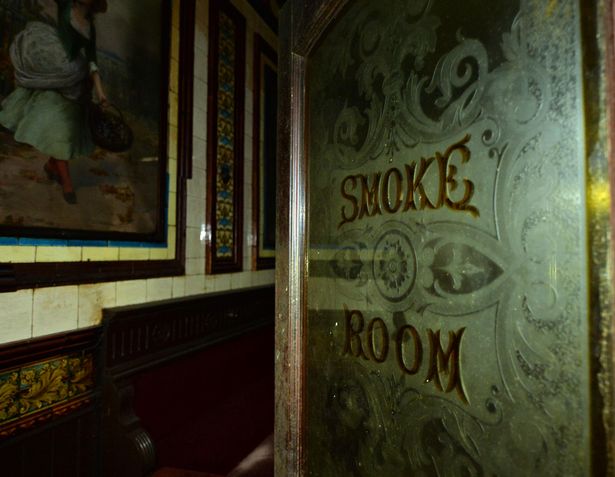
‘Writing for Jackie Magazine’

The Perils of Publishing

The Soho Coffee Bar

Over the last few years, I’ve been looking into the history of the Soho coffee bar – a fascinating phenomenon in its own right. This post is adapted from one that I’ve written for Soho Tree, and here I’ve combined stories from two circles of people who frequented Soho at that time – the aspiring musicians, including the renowned folk singer Peggy Seeger, who I interviewed earlier this year, and the ‘seekers’ who became members of a Cabbala group, studying the mystical Tree of Life.

Soho in the Fifties
While most of Britain struggled through the dreary post-war years in the 1950s, Soho was a fermenting cauldron, a pageant of unusual characters, exotic food stores and exciting new art and music.

The fifties were a time of austerity, of punitive conventions, of a grey uniformity….Soho was the only area in London where the rules didn’t apply,’ (George Melly, critic and musician).

The cafes of the 1950s helped to define Soho itself. Tucked into the very heart of London, Soho had already been a melting pot of nationalities and cultures for a hundred years or more. But the arrival of the espresso bars there in the 1950s opened up a whole new phase of possibilities for meeting up, making music, and finding soulmates and allies.

Coffee itself had been in Soho for a long time – this company began in 1887 – but it was the Gaggia coffee machines, as above, which revolutionised how it was served up.

In keeping with various other Soho memoirs, I’m stretching the geographical boundaries a little. The café habitués of the time didn’t draw a hard line where Soho officially ended: people spilled across the Strand towards Charing Cross and up towards Covent Garden market when staking out their favourite haunts.

Music and Cabbala
Folksinger Peggy Seeger recalls fondly: ‘It was my playground. You could meet people there, get to know them in the street.’ In the 1950s, Peggy was a young woman who had recently arrived from America, a member of a prominent musical family – her brother was Pete Seeger – and was now in both a relationship and a performing duo with the Scottish folk singer Ewan McColl.

Peggy Seeger and Ewan McColl, a song-writing and performing duo who were key figures in the British folk song revival, in the ’50s and ’60s

Peggy’s route through Soho took her mainly into the music clubs of the day, and the coffee bars which offered music. The Cabbala group, on the other hand, met primarily in cafes where you could focus on long discussions, while spinning out a cup of coffee. Although several members of this group were themselves musicians, and there was plenty of overlap between the two circles, you needed a somewhat quieter environment to tackle ‘the big questions’ of life. These were informal gatherings, the gateway to more intense, private group meetings for those who were interested in taking it further.

The 2 I’s was so-called because its original owners were brothers Freddy & Sammy Irani. Its tiny, 18″ stage was used by enthusiastic bands, and plenty of soon-to-be-famous musicians played there, including Cliff Richard and Joe Brown.

The Coffee revolution
Coffee was a prime mover in the Soho scene. Its influence began in the early ‘50s, when an Italian dentist came to the UK to sell revolutionary Gaggia coffee machines:

The coffee bar and espresso culture of the fifties…began in Soho, partly because of the large Italian community, and partly because Gaggia had their first British premises in Dean Street. Achille Gaggia invented the espresso machine…in Milan in 1946. Pino Riservato, an Italian dental technician, set up Riservato and Partners to import the machines to England, and in 1953 got Gina Lollobrigida to open the Moka Bar at 29 Frith Street, England’s first coffee bar, to show off his wares….’

Mr Gaggia’s shining machines transformed many traditional ‘caffs’ and Italian ‘greasy spoons’, which cut the grease and stodge from their menus and acquired a set of toughened glass cups and saucers (which not only looked modern, but also made sure that drinks soon got cold, discouraging those who wanted to linger all night over a single cup).

(Up West: Voices from the Streets of Post-War London, Pip Granger)

This was probably the first taste of decent real coffee that anyone had enjoyed in the UK

Life in the Soho coffee bars – the first shot is ‘real’, the one below staged for the film ‘Beat Girl’. But in one sense, everyone visitng the cafes was ‘on stage’.

The Soho Crowd
For many, entering the Soho scene was primarily a chance to break free of stuffy rules and live on the wild side. Some had run away from home to be there, or it was their first taste of freedom after National Service, or an escape from a tedious job in a dull post-war town. It offered both the opportunity to seek out those who shared your interests, and also the chance to mix more widely with a fascinating variety of people, of all artistic, philosophical and sexual persuasions.

Soho was a wonderful mix of artists, writers, sculptors, many of whom had studios nearby,’ Peggy told me. ‘It was also sleazy – the prostitutes would stand in doorways, the phone booths were full of cards, which were often rather ‘poetic’ in their descriptions of what they offered. I would often go in and take the cards down!’ (Peggy was, and still is, a passionate feminist.)

Even when you had found your crowd, or your tribe, there was scope for making new friendships through a common interest in music; live rock and roll, skiffle, folk and blues were a key feature of many Soho coffee bars. Often a performing space was kept free for this, even though a band might have to squeeze in tightly!

How the film ‘Beat Girl’ portrayed the Soho cafe of the era

The Coffee Bar Scene
To set the scene for the Soho coffee bars, here is an extract from an internet memoir by ‘Goosey Anne’, (real name unknown):

I was living and working in London in the early 1950s and most of my leisure time was spent in the newly-opened coffee houses in and around Soho. These were the haunt of the bohemians – artists, writers, resting actors, musicians and characters closely followed by students, nurses and people like me who had a good day job but enjoyed their company in the evenings. It was a mainly harmless pursuit – we would meet at one given coffee bar and during the course of the evening make our way onto a couple of others. The new Gaggia coffee machines were installed in most of the places – huge, glistening chrome affairs that hissed steam into the air to mingle with the cigarette smoke, for nearly everyone smoked and the atmosphere was pretty fetid. Coffee cost 9d (old pence) and usually we would all make one cup each last all evening.

We would sit and talk and talk and talk – putting the world to rights. No drugs ever came my way and indeed had that happened I would have refused. I only knew two of the circle who took drugs – we actually felt sorry for them. Most evenings someone would bring a guitar along and another person bongo drums and a sing-song of mainly Folk Songs would begin. One particular coffee bar – The Gyre & Gimble had a resident guitarist – Dorian – who would play softly in the background and compose witty ditties about the customers which he would almost speak in his educated drawl as he played. In one place – Bunjies – one of our group composed a song which went something like this:

Sitting in Bunjies my heart began to throb – for one cappuccino would set me back a bob. And for a sandwich I’d have to sell my soul – for six weeks I’ve saved up to buy a sausage-roll‘.

The owner didn`t like that tune much and would threaten to throw us out. But it was mainly Folk Music with the odd Rugby song thrown in if the University students were about.’

It didn’t take long before the espresso bar began to find a place in popular culture

Why Coffee Bars?
One of the great advantages which coffee bars had over pubs – apart from serving good coffee!  – is that they could stay open later, as they weren’t subject to licensing laws. And anyone could go into a café, whereas there was a minimum age of 18 for drinking in pubs, and women often felt intimidated going into male-dominated pubs at the time. It also chimed in with the birth of the teenager, the time when this age group began to have opinions, fashions and music of its own. ‘The colourful informality of trattorias and the all-important coffee bars made Soho the Mecca of the newly discovered teenager.’ (Pip Granger)

The ‘50s coffee bars were not just a teenage haunt, however – members of the Cabbala Group were mostly in their mid to late twenties, for instance – and they appealed to a very wide cross-section of clientele, from shoppers and beatniks, to office workers and film crew.  Cinematographer Walter Lassally, for instance, whose story you can read here, found his way into this circle because he had to be in Soho on film business – most of the film companies had offices there.


No doubt the vices of Soho were feared by parents of teenage children, and by those who never dared to set foot in such a disreputable area. But, as Goosey-Anne says, drugs were not often on the agenda, and those who preferred strong drink chose the pubs instead. In fact, according to the film ‘Beat Girl’, the message among the teens themselves was that ‘drinking is for squares!’ (Beat Girl starred Adam Faith, the soon-to-be pop star, and its cinematographer was Walter Lassally.) The clip below features the theme tune by John Barry and shows the opening sequence, with a very young Oliver Reed jiving in a plaid shirt.

Nothing was really policed in Soho though – it wasn’t at all dangerous. And the prostitutes were cheerful – I had a lot of respect for them,’ Peggy told me. Keith Barnes, a ‘Group’ member, recollects that two of the ‘ladies of the streets’ once bought him a meal when he had no money to eat.

Despite the lurid posters, ‘Beat Girl’ is a rather charming film about the young cafe-goers of the day and mild encounters with strippers and gangsters.

Opening a Coffee Bar
Property was cheap to rent in Soho in the post-war period, so opening a coffee bar was a great little start-up business. In 1956, the humorous magazine Punch declared: ‘We have reached the stage where virtually the entire population of these islands goes in hourly danger of opening a coffee-bar.

Tony Hancock, one of Britain’s best-loved comedians, took this further. In one of his sketches, he and his mate cast around for a scheme which will make them a bit of money:

Hancocks Halfhour – The Espresso Bar (1956)
Tony: ‘When actors are not working, where do they hang around?…We are going to provide them with such a place! We are going to open an Espresso Coffee Bar!

Mate: ‘Oh no! We’re not the type

Tony: ‘No, but we can soon remedy that. Buy a couple of duffle coats, a pair of corduroys, rope sandals, grow our hair long – we’ll be a sensation!

Mate: ‘You don’t only get the layabouts in, you know. You get the youngsters, and the intellectual bohemians.

Tony: ‘Intellectual bohemians – I’ve watched ‘em. They’re all broke. They don’t buy anything.

Mate: ‘No, but the people who come in to look at them do!

So the coffee bar crowd not only drew the beatniks and the intellectuals, but also generated its own kind of tourist trade. Hancock goes on to envisage how the Guards officers would bring their debutante girlfriends to gawp and giggle, on a racy night out on the town!

Choosing the Image
Creating the right image for your coffee bar was of prime importance. A funky name went down well – perhaps something Italian or Spanish like Il Toro, or arty like The Picasso, or musical like Freight Train, or melodramatic like Heaven and Hell. (All these were successful Soho cafes.) Décor was important, but could be done cheaply. Popular finishes were murals (plenty of young hopeful artists to paint them for next to nothing), brick-patterned wallpaper– or just the real thing, bare bricks. Bamboo furniture and plastic tables were inexpensive, and imaginative recycled lighting helped to create atmosphere. Some cafes went further. As one blog comment put it: ‘At Le Macabre you could have your coffee on a coffin in a cobweb festooned house of horrors, wearing sunglasses at night whilst having earnest discussions about the difference between Jean Paul Sartre and Dizzy Gillespie.

Affirming your identity
Choosing your coffee bars went along with choosing your circle and affirming your identity. Keith Barnes, a core member of the early Cabbala Group, recalled that there were different circles in Soho. He was, as he put it, at the bottom in the beat circle, wearing his duffle coat and a sweater, and sporting a dirty beard. The musicians, he said, were a rung higher up the ladder as they were paid for what they did.

The Musicians of Soho
Keith himself played in the musicians’ cafes, and a number of his friends in the Cabbala Group did likewise – group leader Alan Bain busked with his piano accordion, and another group member called Fritz Felstone was in demand for his banjo playing, for instance. Because Soho overlapped with the theatres and cinemas of the Leicester Square area, there were plenty of queues outside these for the musicians to serenade. And the Musician’s Union had its offices nearby, where jobbing musicians could pick up work, perhaps in nightclubs or for session recordings. Soho was the nucleus of the music industry at the time, giving birth to British skiffle and rock and roll, and so it’s perhaps no coincidence that one of the prime musicians’ cafes was called the Nucleus, generally known as ‘the Nuke’. ‘The 2 Gs’, in John Adam Street was another, and a favourite of the Group. Its full name was the Gyre and Gimble, but according to Keith, ‘only the tourists called it that’.

Goosey Anne recounts: ‘Of course this music played in the coffee houses was the beginning of the Skiffle and later Rock `n Roll era which I just missed. Apparently Tommy Steele used to come into the Gyre & Gimble and play his guitar rather tunelessly and people would ask him to stop!

She is not the only one to refer to Tommy Steele’s first and rather awful efforts – one account witnesses somebody hitting Tommy to try and shut him up. But, like Tommy Steele (born Thomas Hicks – recently knighted as Sir Thomas Hicks!) a number of other musicians began their rise to fame from these early sessions in the clubs and cafes of the Soho area – Seeger and McColl, Diz Disley, Red Sullivan and Wiz Jones, for instance, along with members of the future Incredible String Band. A couple of years ago, when Rod Thorn (my co-author of Soho Tree) and I visited the Mexican basement café which once housed the 2 Gs, the waiter we encountered was astonished to learn that it had once been a famous café, where Tommy Steele had played!

Peggy Seeger’s musical relationship with Soho evolved too, and in the 1960s she and Ewan were principle members of The Ballad and Blues Club, near Soho Square. No doubt today’s Health and Safety would have clamped down: ‘It was an absolute fire trap,’ she told me. ‘The room was on the third floor with stairs so narrow that they had to have ‘going up’ times and ‘going down’ times. It was like climbing to the top of Notre Dame! And the room was only very small, and always crowded. The stage was next to the one tiny toilet.

Peggy Seeger, still performing today with a fresh array of new songs

The name you were known by
Nicknames were de rigeur, especially for musicians. Keith Barnes was known primarily as ‘Peanuts’, and Fritz was really called Brian. Alan Bain’s brother, Bob Bain, adds: ‘I recall Mum (desiring to speak with her “Bohemian” son) taking me to where he might be found which was probably Gyre and Gimble but when asking for Alan Bain there was seemingly a look of ‘Who?” followed by “Oh, you mean Max!“’
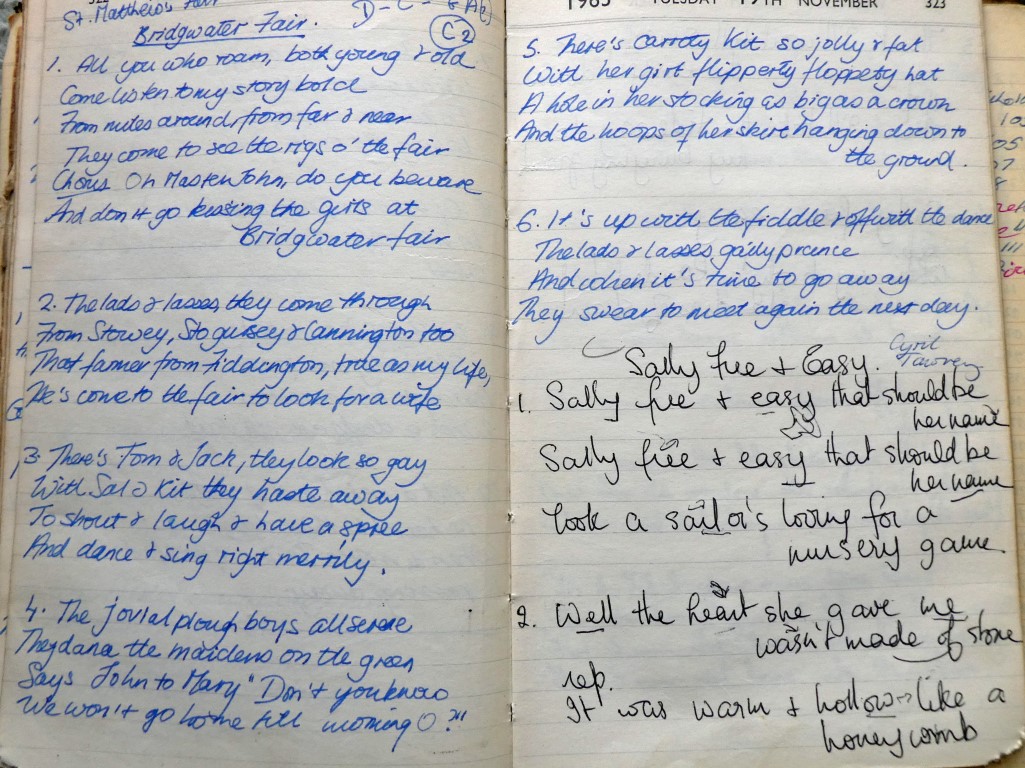
Did this habit have its roots in the jazz culture? A Wikipedia article takes it very seriously: ‘Nicknames are common among jazz musicians…Some of the most notable nicknames and stage names are listed here.’ There follows a list of well over one hundred names, including 16 musicians who chose to call themselves ‘Red’.

Jiving in Soho Square

Group Cafes
The gatherings of the Cabbala Group took place chiefly near Charing Cross, in the ‘2 Gs’ (Gyre and Gimble) in John Adam Street, the Cross, and the Florence in nearby Villiers St, with Lyons Corner House on the Strand playing a part too. It was possible to eat cheaply in some of them as well – getting a filling bowl of stew or pasta was essential. Few members were earning much, if anything. As member Lionel Bowen writes: ‘I spent a lot of time in the ‘Gyre and Gimble’ coffee house on John Adam Street close to Trafalgar Square. We drank espresso, played bad guitar and sang (poorly) folk songs. The elder members of the Group hung out there, I think, on the lookout for likely recruits.
A couple of members even lived on the premises – although rents were cheap at the time, it wasn’t always easy finding affordable accommodation, so keeping body and soul together took ingenuity. Group leader Alan Bain, who sold books, and member Norman Martin, a jeweller, rented an ‘office’ upstairs in the same building as the 2 Gs. However, they also used to sleep there; by day, the bedding was rolled away to hide the evidence of their overnight stays. But, Norman said, the landlord eventually twigged what was going on, and threw them out!

The building which once housed the Gyre & Gimble coffee bar,and the current restaurant in the basement space it occupied.

Micks All-Nighter
Another popular café was ‘Micks’ on Fleet Street. Although this wasn’t so much of a meeting place for the group, it was a welcome resource for all-night cheap eats, and was often frequented by Keith Barnes and Glyn Davies, another of the group’s leaders, after they’d put in long hours on menial jobs, such as washing up in hotels, in order to pay the rent. They weren’t the only ones earning a pound or two where they could. ‘You would often see quite famous musicians bombing along there in Ford vans driving at 70mph delivering newspapers – they took on these jobs because they couldn’t earn enough from their music.’

A former police officer, interviewed for ‘Spitalfields Life’, remembers it well from slightly later, in 1972:
Micks Cafe in Fleet St never had an apostrophe on the sign or acute accent on the ‘e.’ It was a cramped greasy spoon that opened twenty-four hours a day, seven days a week. During the night and early morning it served print-workers, drunks returning from the West End and the occasional vagrant. Generally, we police did not use it. We might have been unwelcome because we would have stood out like a sore thumb. But I did observation in there in plain clothes sometimes. Micks Cafe was a place where virtually anything could be sourced, especially at night when nowhere else was open.’

Recollections of the café also pop up in Fleet Street memoirs:
Working through the night was thirsty work and John recalled how the ink-stained printers would rub shoulders with the ‘toffs’ on their way back from London nightlife, in a “Mick’s Café”, as part of the Fleet Street tradition.

Perhaps one of the few grainy images left of Mick’s Snack Bar, but most likely from a slightly later period. It looks as though an apostrophe has slipped in, in the meantime.

And for messenger boys, a special task awaited them at Micks: ‘First job at 8.00am was to go to Westminster Press and collect the day’s national papers, these were then checked for previous day’s publications, then came the most important job of the day, this was taking a large silver teapot down to Micks Cafe in Fleet Street and getting it filled with tea and also ordering toast for the Darkroom and Bench staff.A Day In The Life Of A Fleet Street Photo Press Agency -1960’s

Micks, though not strictly speaking part of the Soho scene, had the same mix of working people, musicians, eccentrics and high society. It also has a very special claim to fame as the all-night café featured in ‘The Streets of London’, by Ralph McTell. (This YouTube version has a fine set of photos and street scenes accompanying the song.)

The Mix
Other circles with esoteric interests met in the Soho coffee bars. As well as the Cabbala group I’ve come across mentions of a Mithraic order, Druids, and magical groups, and there was also a widespread interest in astrology. ‘Sun sign’ newspaper columns had appeared since the 1930s, and people were keen to know more about their horoscopes. Ernest Page, a homeless, eccentric and very accomplished astrologer, was usually to be found somewhere in Soho, where he read horoscopes for a modest sum, as well as generously instructing those who wanted to learn the art of astrology for themselves. He is recalled by various other Soho seekers of the era, as in this discussion forum:

I well remember Ernest, the elderly astrologer (well, I was early 20s) giving me a reading for the price of a coffee or two!

The astrologer was named Ernie Page an ex postman. Long grey hair, hunched shoulders and carrying a small suitcase with his astrology charts. He used to prefer Sam Widges’ Coffee bar to the 2Gs. He often kept company with a ladyboy prostitute called Angel.

Angel is featured in Pip Granger’s book Up West, as a transexual who braved the general intolerance of the times: ‘We were easygoing. We were an odd society of people, and when you say we were bohemians, in a way we were, and we were very broad-minded, so…Angel came down to my coffee bar a lot.’ (Interview with Soho dweller ‘Gary’.)

In the photo below, extracted from a short video on Soho Coffee Bars, Ernest discusses astrology with other key Cabbala group teachers Glyn Davies and Tony Potter. Their colleague Alan Bain acknowledges what an excellent teacher he was.

Ernest Page, centre, with Tony Potter on his left and Glyn Davies on his right. You can see the whole 8 mn film below, and the scene with the French cafe, Ironfoot Jack and then the astrologers is at around 5.10

By the mid-1960s, the Soho café culture was waning. I was keen to visit it as a teenager, however, on the rare occasions I was allowed to stay in London for a few days, as somehow its reputation had trickled through to Birmingham where I was at school. I remember seeking out ‘Les Cousins’, a famous café and music club. I was a keen folk singer and had brought my guitar, and sang a few songs to a very small cluster of people. Indeed, I wondered where the action was – but was quite glad there wasn’t more of an audience, as I forgot the words to one of my songs!

Soho in the 50s is a world I relish reading and hearing about – perhaps because it was the party that I just missed.

Early days, aged about 16 with guitar

References
The London Coffee Bar of the 1950s – Teenage occupation of an amateur space?, Dr Matthew Partington, (conference paper 2009, available to read or download on line)
Soho in the Fifties – Daniel Farson (Michael Joseph, 1987)
Up West: Voices from the Streets of Post-War London– Pip Granger (Corgi, 2009)
The Surrender of Silence – The Memoirs of Ironfoot Jack, ed. Colin Stanley (Strange Attractor Press, 2018)
A complete and remastered version of ‘Beat Girl‘ (starring Adam Faith, filmed by Walter Lassally) can be found on Prime Video