Baba Yaga and the Borderlands

This article is adapted from my book Russian Magic (first published as The Soul of Russia). It opens Chapter Five, ‘The Secrets of Life and Death’ celebrating the mystique and myths of the Russian witch and crone, Baba Yaga. Although she’s a popular figure of Russian folk lore, yet she’s a shadowy, complex figure, who may have a role in the old pre-Christian rituals of the land of ‘Rus’.

This is the second of four posts celebrating the years I spent going back and forth to Russia, in search of its ancient culture and mythology. I’m flattered that the young conductor Alexander Prior said of my book: ‘It’s the first time any Westerner has understood the Russian soul.’

Baba Yaga’s Kingdom

‘Beyond the thrice-nine lands, in the thrice-ten kingdom there lives Baba-Yaga, the witch. Her house stands in a forest beyond the Flaming River.’ (from the story of Maria Morevna)

Original etching by B. Zaborofin, 1992, collection of Cherry Gilchrist. Baba Yaga holds a book titled ‘Russian Folk Tales’ and her house is built on chicken legs, according to tradition.

Baba Yaga is an ugly, cantankerous old woman, who lives in a hut that stands on chicken’s feet in the middle of the forest, and who flies around the skies by means of a pestle and mortar. She captures small children, tricks young maidens, and kills just about anyone who crosses her. This wicked witch of Russian fairy stories is familiar to every person in the land, and her fame, or notoriety, has spread further afield, so that she is also well-known in Europe and America. She is a stock character in folk tales, and also turns up regularly in other contexts: in modern Russian cartoons and children’s books, as a puppet, and in more high-minded art as a character in Modest Mussorgsky’s suite of music, Pictures from an Exhibition.

Baba Yaga is also a useful weapon for Russian parents to frighten small children who are misbehaving. 

‘Sit down, and finish your supper, otherwise Baba Yaga will come for you!’

Olga, otherwise an extremely patient grandmother, had finally had enough of small Dima’s noisy behaviour at the supper table. On hearing the dreaded name, he subsided instantly; a watchful, fearful look in his eyes as he sat back quietly to eat his meal. A few minutes later, though, after the threat of the witch had worn off, he began to jump up and down again.

Olga was quick to react. She got to her feet and peered out of the window.

‘Baba Yaga’s coming down the lane now,’ she said.

Dima was back in his seat before any of us could blink twice, and we finished our evening meal in peace. Baba Yaga is fond of stealing little children in order to cook them up for her own supper.

But although she has a world-wide reputation, and is a star of wonder tales, woodcuts, comics and animated films, Baba Yaga remains enigmatic and ambivalent, ultimately a mysterious figure whose source is unknown. No one is quite sure of her origins, her function, or of whether she is ultimately a force for good or evil. All studies seem to agree, however, that her role is much more than that of a pantomime-style witch. Baba Yaga stands at the boundaries of life and death, at the borders of darkness and rebirth.

A depiction of Baba Yaga by the famous Russian illustrator, Bilibin, dating from 1900. She flies through the air in a mortar, steering it with a pestle. The forest is her natural habitat.

‘Leg of Stone, Toothless Crone’

Baba Yaga is of grotesque appearance, with lank greasy hair, a long nose, and a leg which is either made of stone in polite renderings, or of faeces in more earthy accounts. Her bulk fills up her hut when she is at home, and, when out of it, she flies around in a mortar made of iron, which she steers with a pestle. Sometimes, as in the story mentioned below, she rides instead on a magic horse chosen from her herd of doughty mares. She lives deep in the forest, and has a fondness for killing and perhaps eating visitors, whose skulls she nails to posts impaled in the ground around her hut. This hut also has the property of revolving at the witch’s command, hiding or concealing its entrance according to her word.

In common parlance, the term Baba Yaga is used in Russian for any cantankerous old woman. There is no common agreement as to where the Yaga (or Iaga, Ega, Egibihk and other variations) part of her name comes from. The ‘Baba’ prefix refers to woman or mother, but Yaga may be connected to the word for snake, for pain, or even for pelican, according to various authorities, or, more likely, to none of these.

Her role in traditional stories is to challenge anyone who strays into her domain, whom she may then attack, kill, advise, help or strike a bargain with, or any combination of these functions. She is fond of both drinking and spilling Russian blood, and can smell it approaching from afar. New arrivals are often greeted with the question, ‘Are you here to do something, or are you running away from something?’ – words that suggest a ritual confrontation, a challenge to test the visitor’s determination.

Her attitude towards children and girls is different to the stance she takes with young men. She may capture and consume small children, she may imprison young girls or choose to let them go unharmed, but she always challenges and tests youths and men. This has led to a theory that Baba Yaga is in origin the ancient goddess of the underworld, who conducts young men through initiation ceremonies at their coming of age. They must show bravery and cunning, avoid the traps and snares that she sets, and perform near-impossible tasks in order to win through and be worthy of manhood.

An episode in the story of Maria Morevna, when Ivan, the young hero, agrees to look after Baba Yaga’s horses in return for her sparing his life (attribution at end)

In the story of Maria Morevna, quoted earlier, Prince Ivan encounters Baba Yaga when he is in search of his abducted wife, the warrior queen Maria Morevna. Baba Yaga’s house is surrounded by twelve poles, all but one crowned with a human head, and Ivan recognises that the last one has been saved for his own head to crown. But Baba Yaga promises to spare him, and grant him his freedom, if he will look after her horses for three days. She has many fine mares, and flies around the world each day on one of them; she is ready to offer Ivan one of these magical steeds if he can care for the whole herd.

The task is more difficult than he thinks, since for two days running, the horses gallop off into the forest as soon as he takes them out to pasture, and he falls into a heavy slumber till the end of the day. But he is then helped by creatures who he has been kind to earlier in his travels, and manages to get the herd back to the house with the mares intact. At midnight, knowing that Baba Yaga will never honour her promise, he decides to escape; he steals a colt and rides off towards the flaming river, where his wife waits for him on the other side.

Going to sleep on the job, as with the story of Prince Ivan and the Firebird, is a mistake for young would-be heroes, and in this case it may correspond with the sleep deprivation that often accompanies initiation rites, where keeping a vigil can be a significant phase of the process. All the old habits of eating, sleeping and bathing must be uprooted, and Baba Yaga’s offer of steam baths and food in some stories may be echoes of new and possibly dangerous experiences in this department. There is a strong tradition of women initiating boys into manhood in various societies: for instance in the early Middle Ages in Western Europe, women would present young men with weapons so that they could become warriors or knights. And in mythology, King Arthur himself is said to have received his magical sword Excalibur from the Lady of the Lake.

Male initiation is often sexual, too. The horrific appearance of Baba Yaga as an ugly old crone, who may be farting and exposing her foaming genitalia, denotes the reverse of everything lovely and maidenly. This may challenge the young man’s unquestioning attachment to the beauty of the female form, and force him to look with different eyes at an adult woman. The witch is also the opposite of the comforting, familiar mother figure, and this may help to break his dependence upon his mother, in order to claim his manhood, and make a new and truer bond with a woman who can become his wife. In the story of Maria Morevna, although Ivan is married to her already, she is abducted on account of his naivety and carelessness, and it is only by showing genuine bravery and effort that he can finally reclaim her, and make her truly his own. 

If the forest ritual was once a cultural event, marking the passage from youth into manhood, then most likely it would have been enacted by a person, male or female, dressed and masked as Baba Yaga, to give a terrifying appearance. Some weight is lent to this by the fact that fairy stories may contain ‘a’ Baba Yaga, or even several of them, suggesting that there could be local Baba Yagas. There may be three sister Baba Yagas, for instance. This may also relate to the symbolism of the triple goddess, an idea which is widespread through various cultures. The three faces or figures of this goddess are maiden, mother and crone, and there is no doubt that in this schema, Baba Yaga would be a manifestation of the crone figure.

Baba Yaga’s hideous appearance here is given full rein by the artist (From ‘Heroes, Monsters and Other Worlds from Russian Mythology, by Elizabeth Warner, illustrations Alexander Koshkin. Eurobook 1985)

The symbolism of the triple goddess is intimately connected with the phases of the moon, so that the maiden can be seen as the crescent moon, who then grows to fullness as mother, and finally declines into the dark phase as the crone, a phase associated with Hecate in Greek myth, for instance. The crone may be frightening, old, smelly and in some ways evil, but she is also the embodiment of wisdom, and no understanding of woman is complete without her. It has also been suggested that Baba Yaga’s hut, which revolves to conceal or reveal its opening, may itself be associated with cycles of the moon, and of feminine sexuality, so that Baba Yaga’s role as crone could also thus embody knowledge about female sexual cycles, about menstruation and the waxing and waning of fertility and desire, knowledge which young men need to acquire as they are about to enter into relationships with the opposite sex. Such an interpretation also goes a long way to explaining the ambivalence of Baba Yaga, and how she can never be finally upheld as totally good or evil.

A sample sketch of Vasilisa the Fair prepared by artist Natalia Danilin for a proposed Russian Oracle by Cherry Gilchrist

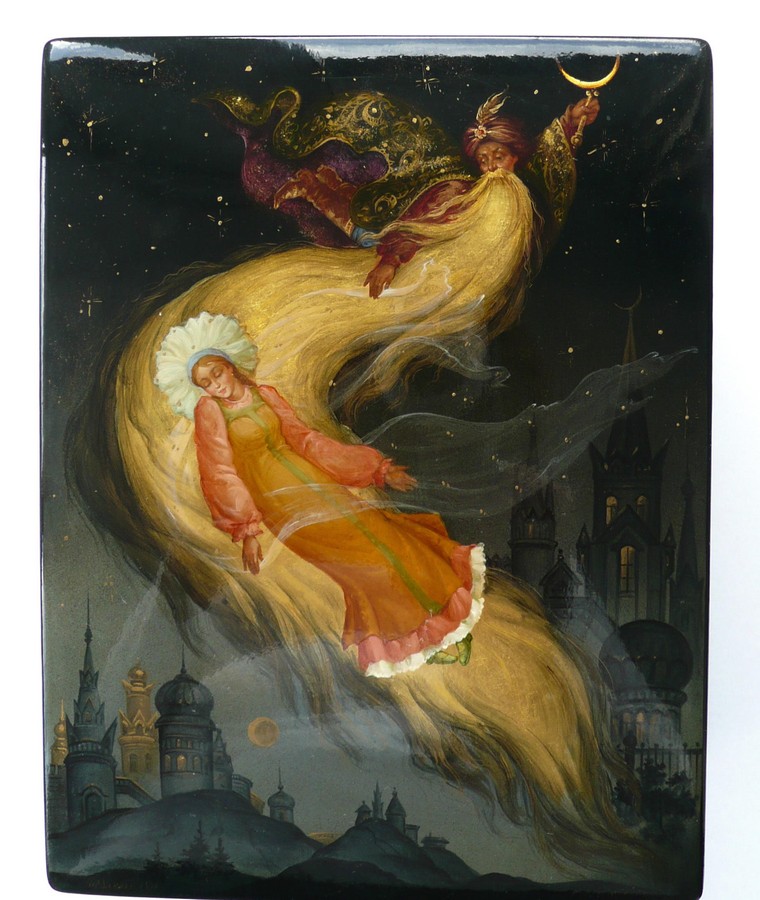
The much-loved tale of Vasilisa the Fair gives us a heroine’s perspective on an encounter with Baba Yaga. Young Vasilisa is sent to the forest by her cruel stepsisters to fetch a light from Baba Yaga’s house in the forest. On approaching the hut, she meets three horsemen, one white, one scarlet and one black; they represent Day, Sun and Night, and they are under Baba Yaga’s command, for she, as many stories about her relate, has power over the winds and weather, sun and moon. Baba Yaga sniffs out Vasilisa’s approach, and offers her a light only on condition that the little girl stays and works for her. The tasks seem impossible, but Vasilisa has an ally – a little magic doll that her mother gave to her as she lay dying. The doll helps her to do the housework, and finally Baba Yaga turns Vasilisa out of the house and gives her the light she requested to take home.

In terms of the lunar cycles and the symbolism of the triple goddess, Vasilisa may be seen as the ‘maiden’ phase of the moon, and her mother as the full moon, who then died to be followed by the black lunar crone. Vasilisa wins the light of her crescent moon back by braving Baba Yaga’s darkness, and earning her respect through hard work and integrity.

Russian lacquer miniature illustrations of Vasilisa the Fair, meeting the Knight of the Sunrise. (Left – Kholui School, Right – Palekh School)

Perhaps Baba Yaga once played a part in coming of age ceremonies for young girls too, and perhaps, too, this is an example of one, although I have not come across any direct mention of this.  

Vasilisa the Fair, using one of the lighted skulls from Baba Yaga’s hut to help her see her way in the dark and make her escape

Baba Yaga is a figure who stands at the borders of life and death, and as both boys and girls have to die to their childhood in order to enter the adult world, she is an appropriate figure to meet them on the threshold of that transition. She is herself a symbol of death in some old folklore customs; at harvest time, for instance, an effigy of Baba Yaga may be created in straw, and subsequently destroyed. This is said to act as a reminder that the day of reaping and death comes to us all.

In many tales, it is made clear that the witch lives close to the borders of the otherworld. One hero finds her abode right at the end of the earth: ‘A little hut stood there, with no road beyond it, but only darkness so deep that the eye could not pierce it,’ as we are told in the story of The Enchanted Princess’.

Baba Yaga’s territory is already considered to be in the world of ‘the living dead’, known as the ‘thrice-nine land’. This lies far beyond the human realm, and from here one must set out to confront the final boundary to the ‘thrice-ten kingdom’, often understood as the realm of the truly dead. This boundary may be described as the ‘flaming river’ or ‘the blue sea’. In one story, it is charmingly defined as the ‘Currant River’, crossed by the ‘Cranberry Bridge’. Indeed, it is not enough just to reach the boundary, for a means must be found or created to pass over it. In the story of Maria Morevna, Ivan calls up a bridge by waving a magic kerchief, a trick sometimes employed to make it passable. In fairy stories such as this, the hero performs the superhuman feat of going to the‘thrice-ten land’ and  returning, perhaps as young men once did symbolically through their ritual ordeals. Baba Yaga has been the catalyst for this.

A ‘lubok’ or wood-cut print of Baba Yaga, probably in battle with a wizard

She also remains a key archetype in Russian mythology, represented not only in stories but in popular rhymes, and in old folk woodcuts, known as lubok. In one famous and often copied lubok, she is depicted as fighting something described as a ‘crocodile’, but which looks more like a furry figure, or a bearded man with a tail. This has been interpreted as representing a political satire on Catherine the Great (the witch) fighting with Peter the Great (the foreigner, and thus the dangerous crocodile). However, as one study points out, both Baba Yaga and the crocodile are designated as guardians of the underworld in traditional lore; the appearance of the so-called crocodile as half human, half furry animal may in fact be a shaman magician. These wizards were real life characters, but were popularly regarded as a combination of beast and man. According to accounts given by the wizards themselves, battles were also traditionally fought between witches and sorcerers, and it may be an old magical battle that we see here.

Whatever the final definition of Baba Yaga, if such a thing is possible, she remains as a figure who can both attract us to the darkness of her mysteries and repel us with her disgusting appearance and unpleasant ways.

Once, I was dreaming by a camp fire in Russia

References – Image of Ivan and Baba Yaga in ‘Maria Morevna’ from ‘Life in Russia’

Suggested reading on Baba Yaga and Russian myth and fairy tales

Forest of the Vampire (1999) (various authors), (Duncan Baird, Amsterdam).

Haney, Jack V. (1999) An Introduction to the Russian Folk Tale, (M. E. Sharpe Inc, Armonk, New York & England)

Haney, Jack V. (2001) Russian Wondertales (two vols), (M. E. Sharpe, New York).

Hubbs, Joanna (1988) Mother Russia: The Feminine Myth in Russian Culture, (Indiana University Press, Bloomington and Indianapolis)

Ivanits, Linda J. (1992) Russian Folk Belief, (M.E. Sharpe Inc., Armonk, New York & England)

Johns, Andreas (1998) Baba Iaga and the Russian Mother in The Slavic and East European Journal, vol. 42, No. 1.

Krasunov, V. K. (ed.) (1996) Russian Traditions, (Kitizdat,Nizhni Novgorod)

Phillips, C. and Kerrigan, M. (1999) Forests of the Vampire, (Duncan Baird Publishers, London)

Ryan, W. F. (1999) The Bathhouse at Midnight: Magic in Russia,(Sutton Publishing Ltd., Stroud)

Related books by Cherry Gilchrist

The Russian Diaries

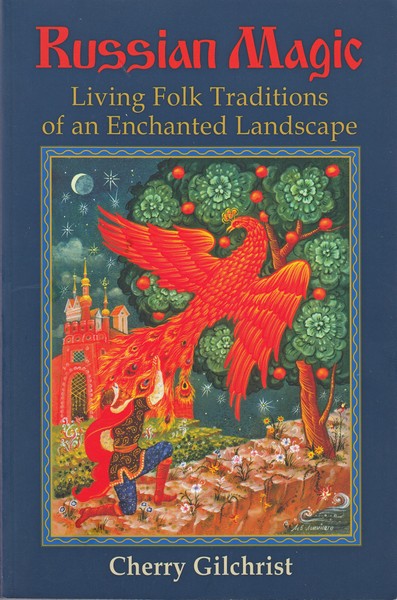
In 1992, I made the first of what was to be fifty-nine journeys to Russia, something I could never have foreseen when I stepped off a plane in St Petersburg. Between then and 2006 I developed Firebird Russian Arts, a business specialising in Russian crafts, and became a lecturer in traditional Russian culture. Somehow, I ran this alongside my other writing projects and activities, although it did take over the course of my life for fifteen years! It also resulted in a book called Russian Magic, first printed as The Soul of Russia, drawing on my experiences in Russia and related research.

Returning to my Russian adventure stirs up plenty of memories, both joyful and sad. It was a unique experience, getting to know the country just after the Iron Curtain had been lifted. And in particular, for me, learning directly from its artists and discovering the charms of Russian rural life had a huge significance. This month, for the next four posts, I’m celebrating that quest through posts based on articles I’ve written, extracts from my book, and diary entries. All have been adapted as necessary for this new output. I hope you enjoy them.

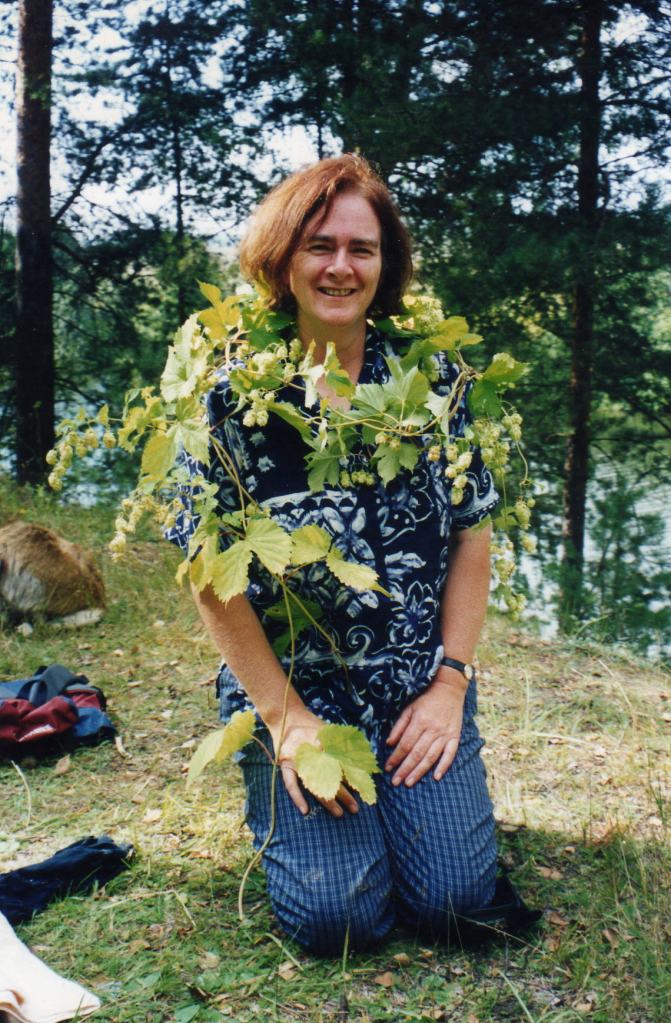
Garlanded with wild hops, on a Russian picnic, of which there were many.

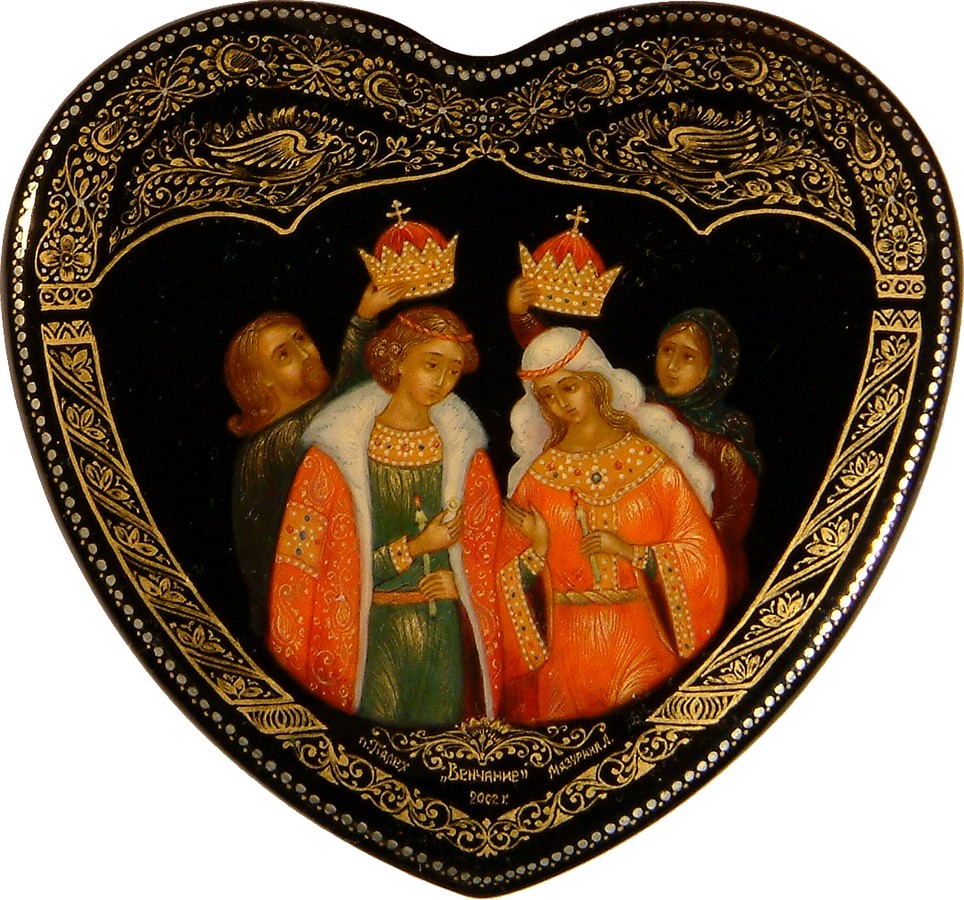
The next-but-one post will explain the art of the Russian lacquer miniature, which was at the core of my visits.

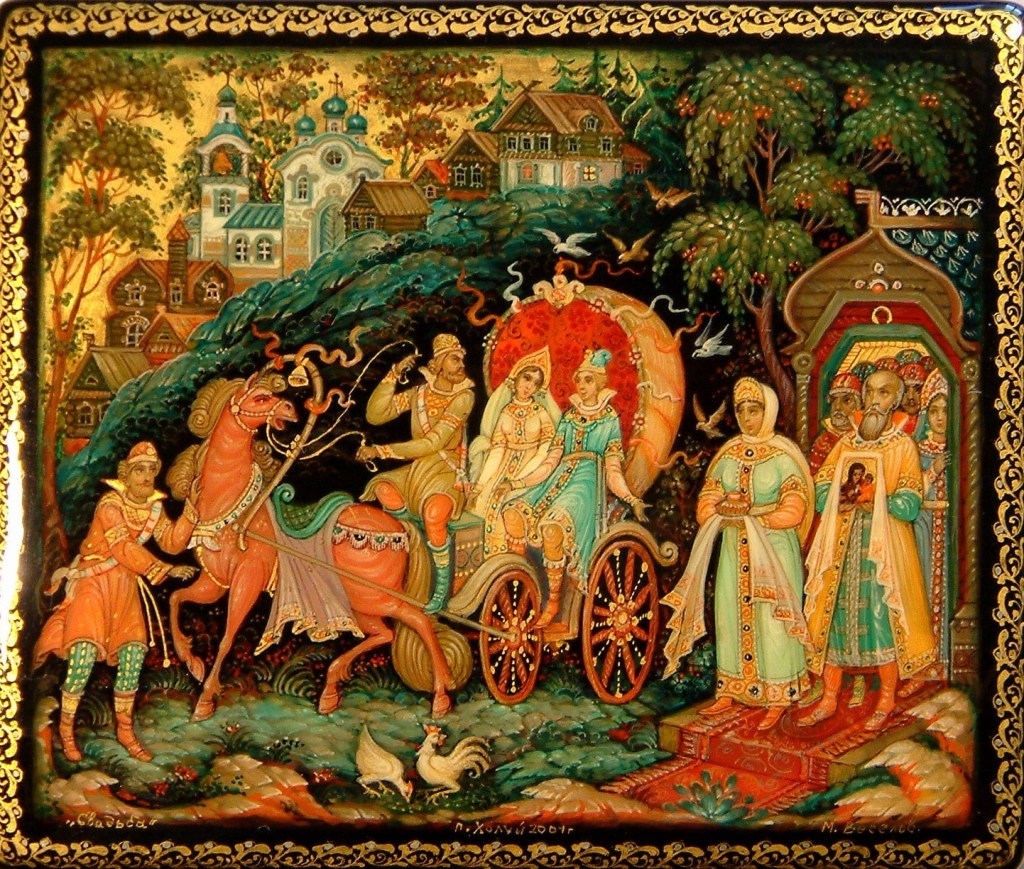
An example of a Russian lacquer miniature: ‘Wedding Day’
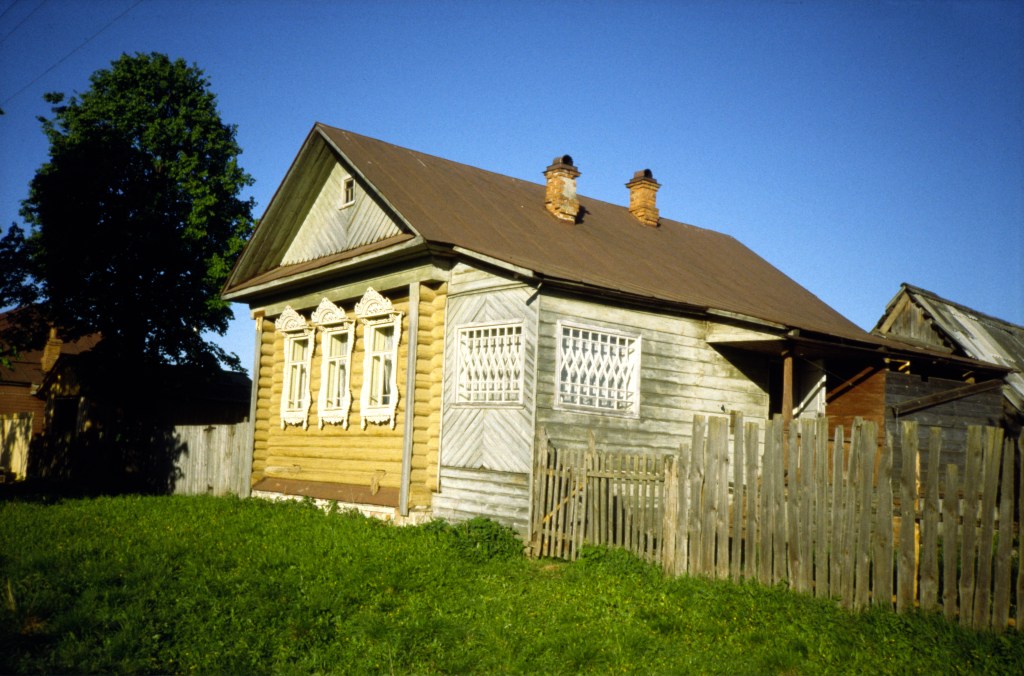
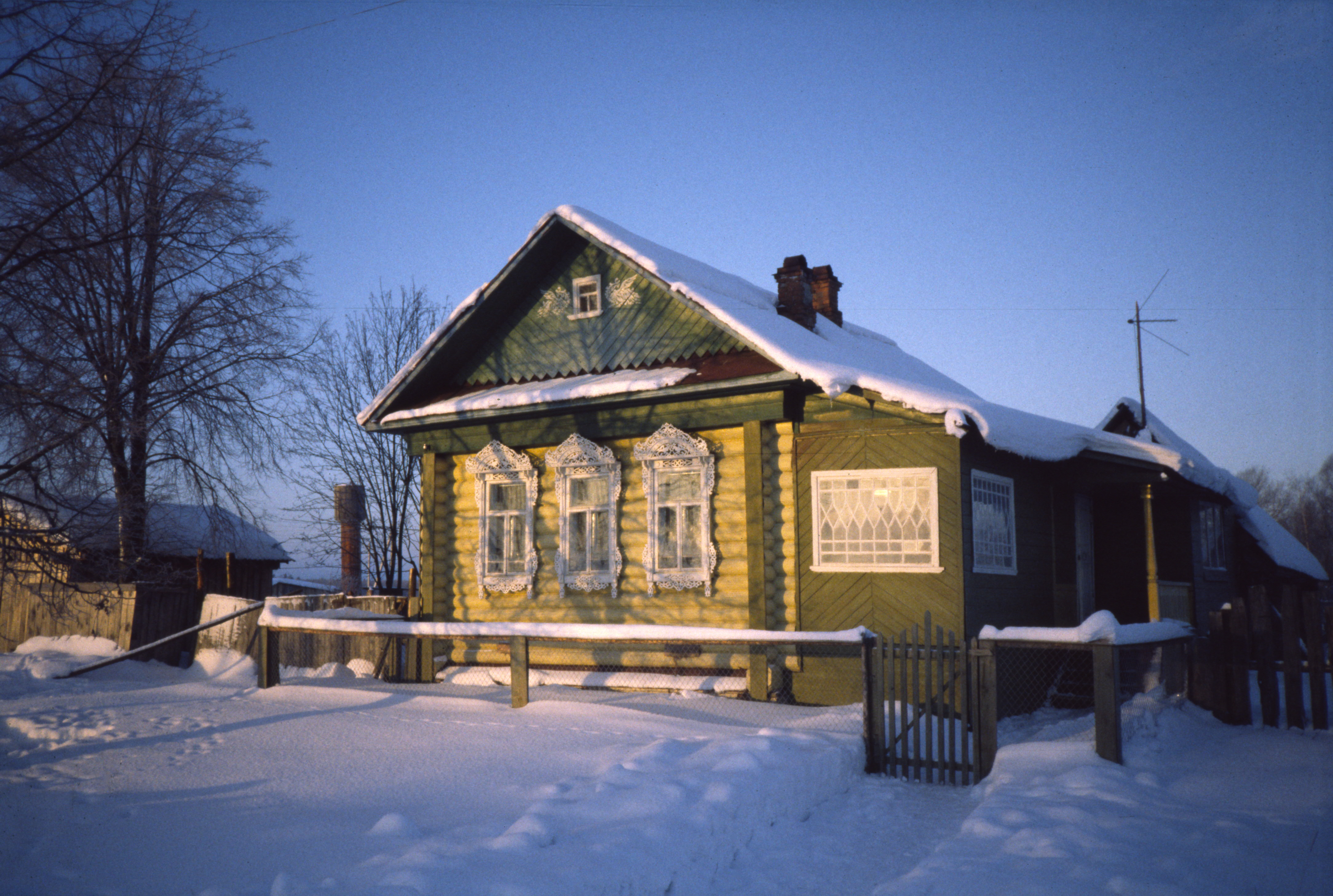
The ‘izba’ which I bought in the village of Kholui in 1995

The Russian Izba

In 1995, I bought a wooden village house in Russia, known as an ‘izba’. It was situated in the village of Kholui in the Ivanovo province, east of Moscow by some 200 miles. I’d started buying and selling Russian lacquer miniatures which are an acclaimed art form in their own right. Kholui is one of the four artists’ villages where these are painted. Although there are about 300 artists in the village, along with an art school, a painting workshop and a museum, it is still very much an unpretentious country village. It sits on the river Teza, and was once a place of annual trading fairs and passing river traffic. I was won over by its charm, the friendliness of the people, and the chance to immerse myself in the life and work of the artists. A later article this month on Cherry’s Cache will say more about this art, but this one is a memoir of that first idyllic summer, when my former husband and I took over a wooden village house, and immersed ourselves in local life.

Even on the threshold of the twenty-first century, the wooden cottage or izba, remains deeply rooted in the Russian psyche as a symbol of simplicity and comfort that also represents an aesthetic, even spiritual, perception of the world. These cottages served to diminish and humanize the vast scale of the Russian landscape, offering a place of comfort in an alien universe.

Russian Houses – E. Gaynor, K Haavisto (D. Goldstein 1994)

Many of the the houses in the village are brightly painted, with delicately carved fretwork windows

I should explain that I had to buy the house through one of my business partners, Ludmilla, as it needed a Russian signature on the deeds. She and her husband Valodya were close friends and colleagues, and Ludmilla helped us in every way with the Kafka-esque process of trying to buy a modest village cottage for about $4000 (American dollars, the unofficial Russian currency).

Extracts from the Russian diaries: What follows are extracts from my diary of our first stay in the house that summer of 1995 in Kholui. We arrived in late May, having travelled there on the overnight bus from Moscow, an experience in itself, and the first major journey that we’d made in Russia by ourselves.

Friday May 26th 1995 – Arrival

Yesterday we arrived at our dacha for the first time since the ten minutes it took to choose and agree to buying it last September.

In Moscow, Vladimir had found out that the arrival time in Uja, the nearest stop to Kholui, was supposed to be at 8am. He told us that the arrival times had been scratched off the notice boards, so that you had to go to the bureau inside and pay 1000 roubles to get the information you needed.

We actually arrived in Uja at about 6.45am. It was a lovely day. My primitive Russian began to seem even more primitive as a few friendly travellers and women travelling with their produce to market questioned us. Finally, our Natasha arrived from Kholui with a car and a driver, and it was lovely to see a familiar face. Her family, the Malkovs have agreed to be our caretakers, and they are going to look after us as well as the house.

We just about got all our cumbersome, hard-shelled suitcases and bulging holdalls into the car. Packing had been a nightmare; I accumulated what I thought were small but essential items for the house, and some useful food, as we didn’t know what provisions might be available. We packed; I weighed. We were 30 kilograms overweight. We unpacked. We repacked. Chris threw out the candles, and I put them back in again. (Wisely, as it turned out, as there were a number of power cuts during the next couple of years.) In the event, when we got to the airport, all the computers were down, and the poor airline staff had enough to do, writing out boarding passes by hand, without worrying about overweight baggage.

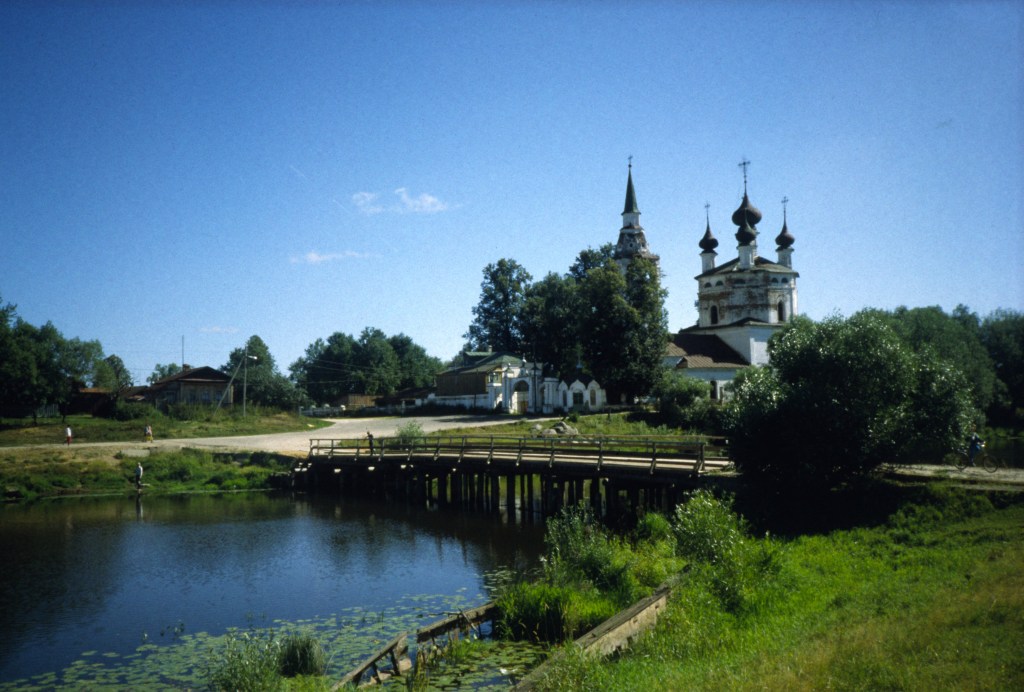
Driving into Kholui from Uja, we both felt a surge of euphoria. Till then, we had been full of joy and confidence in our undertaking one day, the next struck by insecurity and panic. The village looked wonderful in the brilliant sunshine, with dandelions and buttercups in bloom, the grass already rich and deep, and the dignified green and white onion domes of its ancient church crowning the scene. Already men were fishing in the river, women were washing clothes from the banks, and children were splashing in the water. Over the bridge, along the road to the right, a turn to the left, and we were there.

The church at Kholui, which stayed open all through the Soviet era, unlike many others
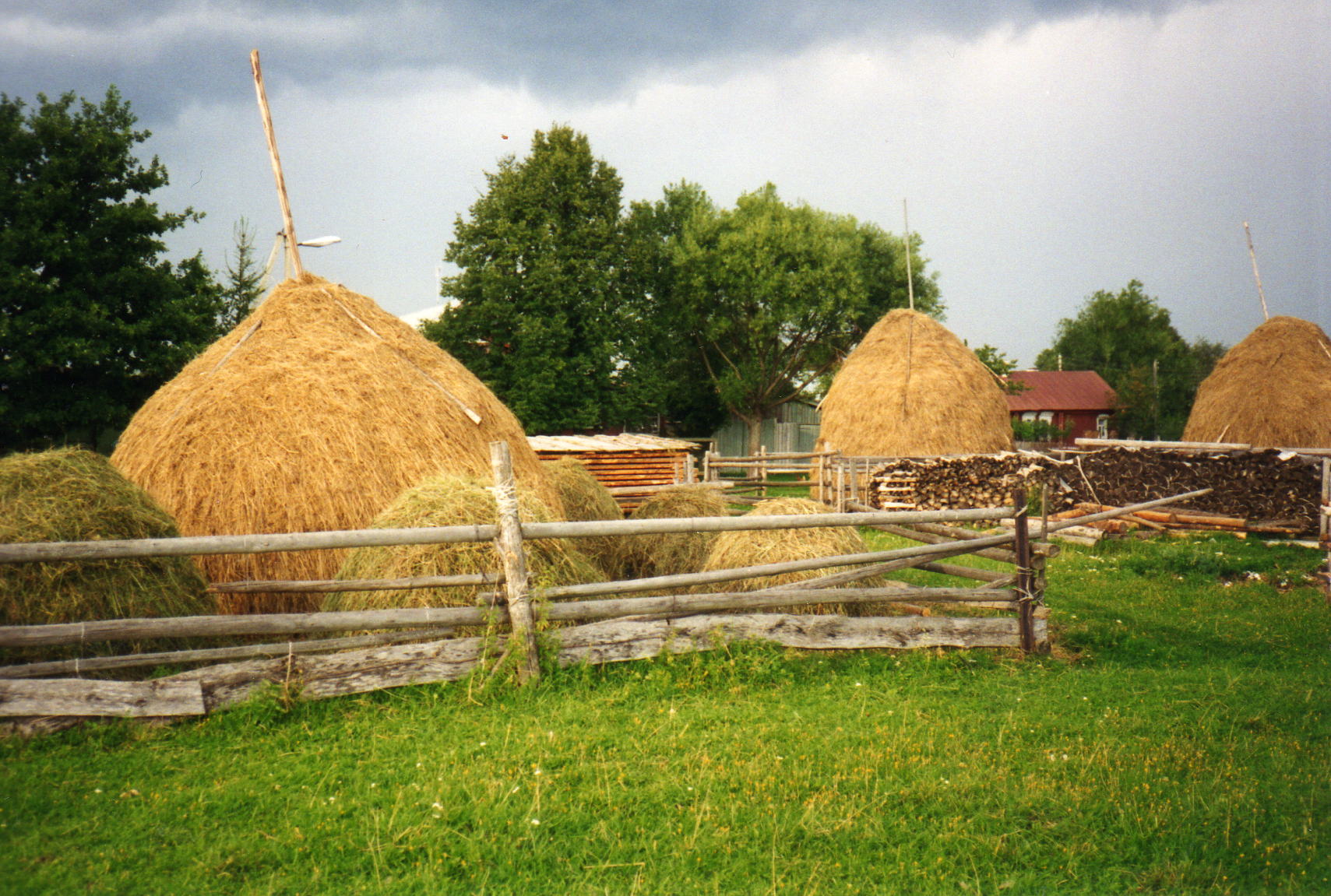
The house itself, that I bought, is built in a typical pattern with just ground-floor living, a summer room (on the right) and wooden steps up to the front door. Sometimes there is a proper attic room, and/or a cellar but not in this case.

Our house

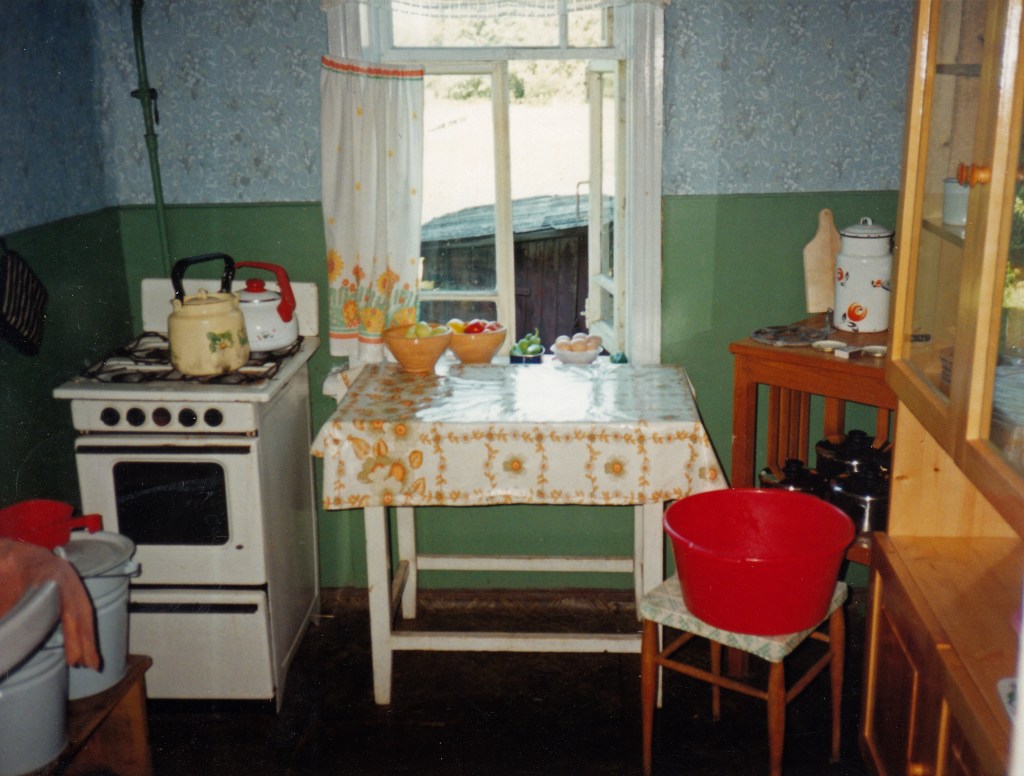
The house is painted in gentle, kindly, faded, blue and brown colours. Like other Russian country houses, it has elegantly carved window frames and looks bigger than it is. Most houses have been constructed to accommodate cows, goats, potatoes, boats, tools and hay as well as people, and plenty of space is given over to this. It has two main rooms: one a large, regularly shaped front room with a traditional Russian stove built up to ceiling height, and the other an L-shape, with the kitchen built into the missing section. It’s sunny, and feels peaceful and settled. The previous owners have left two primitive tables, two wooden benches, two rickety stools, one bed base with old-fashioned metal bed-ends (useful for hanging towels on), a stove that runs off bottled gas, a free standing corner shelf, a small kitchen cupboard, and lots of rusty paint cans and empty beer bottles in the numerous gloomy wooden storage rooms that cluster around the main living space. The toilet is a wooden throne emptying onto an abyss below, with only two ancient and grubby curtains hanging across the entrance to dignify one’s privacy. (We replaced these with a door as soon as we possibly could!)

As with most country village houses, there is no running water. The local well is just around the corner at the bottom of the lane, roofed in a quaint, fairy tale style. A sort of upturned painted biscuit tin over the sink acts as a temporary water tank; we fill it with a bucket and then it comes out of the tap below. This might seem rather pointless, but does mean that you can turn the tap on and get a quick trickle if you need to rinse something or wash your hands. I have instituted a graded water programme, with bowls of good water for rinsing dishes, and less good water for first washes. An ancient fridge rumbles self-importantly, and thank God that we’ve got it, as it’s so hot, and the lovely fresh milk, butter and eggs that we have would go off in no time otherwise. Natasha has kindly filled the cupboard with basics, mainly potatoes, pasta and more pasta, which is a curious grey-brown colour.

The kitchen, much as we inherited it, although we added the cupboard on the right. Bowls and pails for everything! Plus a small milk canteen.

Settling in – We have unpacked as best as we can, but until Ludmilla comes on Monday, we will be a bit limited with cupboards and storage space. Then we hope to go to Uja and buy some cheap Russian furniture. Natasha sent her son over with one of her own soft mattresses for the bed, and she had managed to buy us a folding bed too – just as well, as we wouldn’t have been able to cram two of us into the ancient, indigenous bed.

The old iron-framed bed, plus some of the furniture we managed to acquire

Not long after we arrived that morning, I lay down on it to test it out, and was soon fast asleep after three nights of little rest. The sound of hammers ringing all around became a kind of lullaby. At this time of year, everyone is outside, planting potatoes in the garden, or improving their houses and outhouses. The growing season doesn’t begin until May, and will be over by the end of September. There is an air of ominous necessity about the frenzied activity and industriousness too; it’s been explained to us that if country people didn’t grow their own vegetables and potatoes, they probably wouldn’t eat, since some of the factories in the nearby small towns, which used to provide them with employment, have lain idle for two years.

This morning, Natasha sent round three of her brood in the blistering heat to finish the potato planting. (They’ll be using our back garden to grow vegetables, and they are more than welcome.) The eldest, Misha, knocked at the door, and asked if he could use the electricity socket. I thought he had some kind of a rotavator that he wanted to plug in, but instead he had an enormous ghetto blaster, for very loud music while they worked. The children lined up along the rows: one to open up the trench with a spade, the next to drop the potatoes in, and the third to cover them over with earth.

Enjoying tea – using an electric samovar, as traditional ones require a special technique to light and keep them going! In Russia, ‘chai pit-y’ means not just drinking a cup of tea but eating a cold collation too, plus cake and biscuits

Shopping – a challenge Today we have sorted out the house as best we could, and in the early afternoon, we went for a walk around the village, partly to admire it, and partly to find the food shops. Kholui is peaceful, yet fully alive. It is not noisy in the way that cities full of traffic are, but it is certainly not quiet either. As well as the hammers, you can hear cockerels crowing, goats butting up against the side of the house, wood being chopped, geese honking, the roar of an antiquated motor bike, the voices of neighbours loudly calling out their news to each other. And, as we discovered later, in the evening, you may also hear the plaintive sounds of the garmon, a kind of small accordion, which is often played as people gather on the riverbank, or a party is struck up in someone’s parlour.

We watched hens and cows meandering around contentedly, saw boats being pulled up on the riverbank, and old people sitting on benches outside their homes. When we got to the shops, however, my Russian began to seem useless as we were drawn into conversations and began to make our needs known. I kept asking for sugar, sakher, and was met with incomprehension until someone finally said, ‘Oh, sakher!’ Which sounded to me exactly the same as what I had already been saying.

I also got the words for butter (maslo) and meat (myaso) muddled up, when we were trying to buy groceries. One shop on the far side of the river, the church side, was a mystery to me as it appeared to have nothing in its rather impressive chilled cabinets except for a few biscuits, but was still presided over by several ladies in white overalls and head coverings. In the other establishment on our side of the river, we managed to buy margarine, and a tin of steamed Chinese cow.

Often shopping would take place wherever someone had set up a stall, or parked up a van

Across the dirt road, a man was selling provisions from his porch. At his miniature Upstart’s Emporium, we got butter; a large cardboard box was produced, which contained a gigantic block of butter. He carved some off for us, which wasn’t easy in the heat, as it threatened to slide everywhere. And we got the famous sugar at last, where the request for half a kilo mysteriously turned into a kilo’s worth, but never mind. It’s lovely sugar, only partially refined. Tomorrow I must find out where the bread comes, as it’s Saturday, and we shall need plenty for the weekend. Little quests like that take on a pleasing importance, and present an adventure in themselves.

An unwelcome visitor When we came back from our walk, we had a sleep, as we are still catching up, but our siesta was disturbed just now by a young man with blond hair, sporting an elaborate gold cross on his tanned bare chest. He marched in practically uninvited carrying two very heavy rusty tin cans. We didn’t know whether he had been sent by Natasha our caretaker, so we were cautiously welcoming. He wanted us to guess what was in the tins. He claimed they contained a kind of preservative oil for painting on the house, and he wanted three dollars for them. Since he was trying to have a good look round, and was commenting on our nice big angliski suitcases, (you can see one under the bed in the photo above) I began to feel rather uncomfortable, and decided that I no longer spoke or understood much Russian, so that he would feel he was wasting his time. (This was the only – and rather strange- occurrence – where someone was pushy and out-of-keeping with usual neighbourliness in the village)

Saturday May 27th 1995
Life at the riverside The weekend begins in earnest. Once again, it is very hot, and quite humid too, with some strange cumulus clouds appearing at intervals. It’s a family day, and motorbikes with sidecars have bumped their way into the village complete with husbands, wives and children on board. Some arrived in their faithful Lada cars, and one family was even towed in on a trailer at the back of a tractor. Everyone made for the river, and the bathing area in the centre of the village was soon full of splashing children. The whole scene reminded me of the 1950s: little girls clad only in cotton knickers, women in loose flowered shifts, metal pails, bicycles, and picnics.

You can see the hordes of happy picnickers and bathers in the background, while the goat munches on, unconcerned.
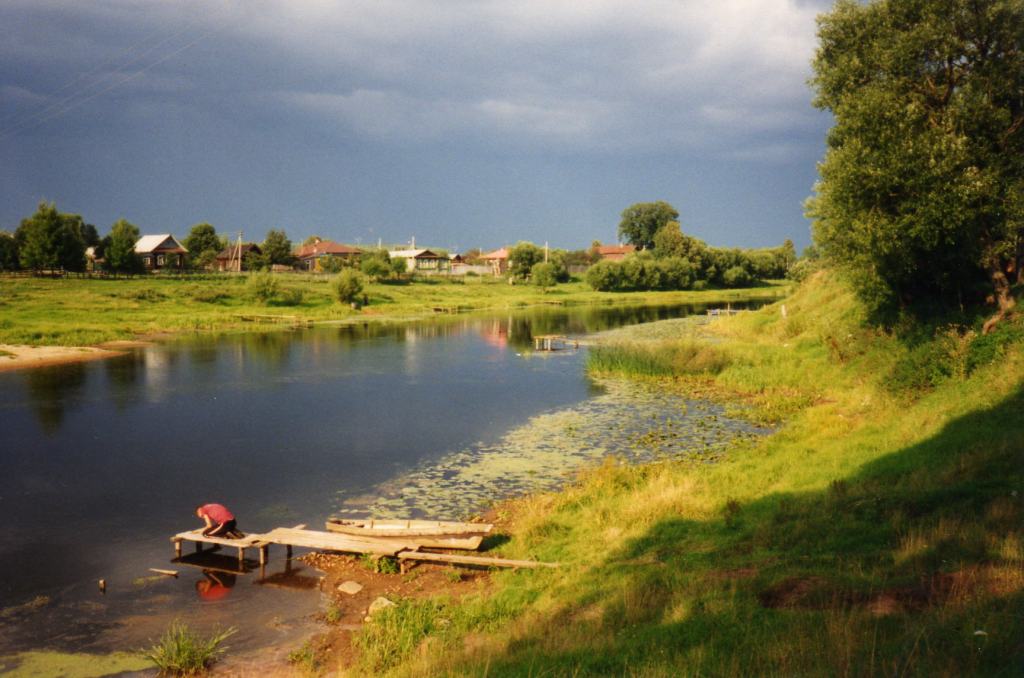
The river Teza, on a quieter day: one of the many washing platforms built along its banks

At our swimming place further down the river, there were fewer families, perhaps because the water is deeper there. You have to wade out, acclimatising slowly in my case, then strike off in a diagonal direction, though this only just about counteracts the effects of the current. Eventually, the current cuts back in with a vengeance, and I drift back downstream again. I usually end up bumping my knees against the rocks under the water where it becomes shallower again.

A younger generation of artists, probably students from the Kholui art school

I love the life of the river. This is what I observed: Terns swooping down, catching the fish out of the water from right under your nose. Swallows and martins flying over the water. Fishermen using round nets, like large shrimping nets, which they allow to rest on the bottom until the shoals of tiddlers are just above them, and then they can draw up a catch. Frogs, croaking and warbling. Water lilies and waterweed. A large herd of cows and calves which come down at about 4pm every day, and stay until they are called by their owner at about 5.30pm. Dogs which stride purposefully into the water to cool themselves down. Boats – plenty of them – narrow, pointed, elegant, and used with paddles or poles. Women washing at the edge of the river on little wooden platforms built out over the water, so that they can rinse the clothes and sheets that they haul out of the tubs, brought on little trolleys to make the load easier. Mosquitoes and more mosquitoes, worse in places where the water is still.

The riverside, with a willow tree and a rather dilapidated washing platform. As I discovered, it’s easy to lose a sock or two downriver if you’re not careful while rinsing!

The bread queue I was truly initiated into Russian life today by joining the bread queue. I decided to try the Co-op shop which we spotted last night, and found myself in line behind fourteen or fifteen women all buying their bread for the weekend – four loaves of chorni khleb (black bread), seemed to be the norm. The girl serving was dressed up in a white overall and a sort of starched white baker’s cap made of material pressed around some cardboard. She was efficient, and the wait wasn’t that long.

In the meantime, the man behind me in the queue found out I was English, and said excitedly to the ladies in front of me, ‘Did you hear that? She’s English!’

They nodded sagely and said, ‘Oh yes, we know. We know all about her.’

So, although the people we meet along the road may only give us a brief formal greeting, most of them probably know exactly who we are and are full of curiosity about these mad foreigners who have taken up residence in Kholui.

We tried to buy matches today, and at last managed to get a cigarette lighter in the Upstart’s Emporium. He has put up a little hand-written notice which says: Kino –ie cinema – and offering showings of Karate Kid for a modest entrance fee. I suppose it’s a video played on his television. We found some Djam in the Sweet Shop, along with two Mars Bars and some cherry soda. The woman who works there wears her hair nicely waved, and watches a portable TV as she works. It’s quite fun seeing what you can get hold of on any given day, but then we’re not struggling to feed a family here on a tiny budget.

The film poster, announcing ‘Karate Kid – Price 400 Roubles – Starts at 9pm’

The Kholui workshop When we went into the workshop yesterday, (the official studio, where a number of mainly female artists painted lacquer miniature boxes) we tried to find Kamorin, (the director) but he was nowhere around. However, we called in on the ‘Brigada’, and the women artists were very welcoming. They downed their paintbrushes, and soon had an impromptu lunch party in full swing. We ate macaroni, as all pasta is called in Russia, and drank to Anglo-Russian friendship with the famous cranberry vodka that I enjoy so much. (If you manage to read to the end of this blog, your reward will be a recipe for making ‘Cranberry Vodka’ – very easy and delicious!)

The ‘Brigada’ – the team of women artists in the Kohlui studio during the 1990s
Choosing lacquer miniatures to order for Firebird Russian Arts. I’m at the front, with my business colleague Ludmilla next to me, and Kamorin, the director, at the far end. What you ordered was not what you eventually got! But anything done with a good will in Russia usually works out in some way at the end.

Partying, village style Today after lunch, Chris went off to do something useful outside, and I lay down today for yet another afternoon snooze (must be the Kholui air), at about 2.30pm. Then I heard some music playing. First of all, I thought it was a recording of some accordion music playing popular Russian tunes. Then a song began, and I realised that the cracked voices raised in joyful unison were in fact coming live from the house over the road, and that a party had started up. I fell asleep while listening to them, and dreamed that they were all singing, ‘Down the Old Kent Road,’ and in my dream marvelled at how well they knew the words in English. When I woke up, the party had moved outside onto the grass verge. The men and women began dancing, doing some old Russian country dances as far as I could tell, then started on some kind of a waltz. Later, when we came back from our swim at about 6pm, the music and dancing had stopped, but quarrels were breaking out, the drink having presumably flowed freely. Now, at 9.30pm, a serious fight has broken out between two men, but a group of women have just sorted them out, and sent them on their separate ways.

Sunday May 28th
At about 10am, eruptions were still happening out of the smouldering ashes of yesterday’s volcano of a party. A young man rushed out of the house pursued by a middle-aged woman, who was dressed only in an elastic girdle and an armour-plated bra. She was holding a frying pan with which she was taking a swipe at the young man’s head every time she got near him. He put his hands over his head to protect himself, as he raced towards his motorbike, which he got to just in time, leaping on it and accelerating up the lane. The dust was billowing up behind, as she ran after him screaming, and waving her frying pan. After that, everything went quiet. They must have all exhausted themselves.

In the late afternoon, I made a cup of tea, took it down to the bottom of the lane, and sat with my book under a willow tree on the riverbank. I thought to myself: I am sitting in a Russian village, by a Russian river, drinking tea and reading Dostoyevsky’s Crime and Punishment. What could be better?

Below are scenes of Kholui village life. Goats, cows, chickens and geese wander where they will, and return home at the end of the day.

Tuesday June 6th
Farewell to Kholui Today was our last full day in Kholui. In the morning, I went back to the studio to see if the ladies of the Brigada had any more lacquer boxes to offer me. They didn’t, and I was glad in a way, as I now have a lot of lacquer miniatures to take home, and my budget is getting tight. So we had a kind of farewell party instead, and although it was only 11am, they began preparing a feast for me. I was given a copy of a magazine to look at called Droog, or ‘Friend’, which was all about pedigree dogs, while they began scurrying around gathering the ingredients together. ‘Big Olga’ leapt up and went to purchase six little fish from one of the other factory women, and made boiled fish and soup on the spot. The soup was called Uxa, pronounced ‘Oo-kha,’ with a kind of owlish hoot. One woman opened her mouth so wide to demonstrate how to say it that I could see every bit of fish currently lodged within.

We had a merry conversation, as best as I could manage. They are curious to know about England – what kind of home do I have? Is it a flat? How many floors has it got? How many rooms? Does it have a garden? Do we have servants? Our Georgian house in Bristol is in fact very large by Russian standards, and I tried to play this down. I promised to bring some photos next time.

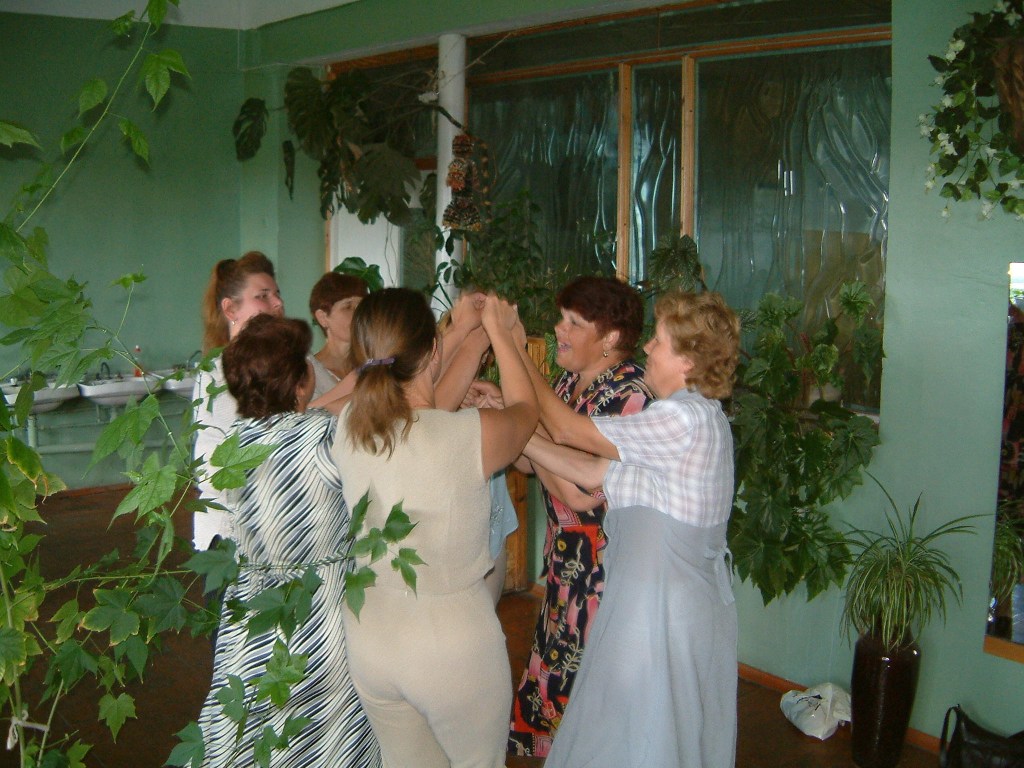
Ladies of the Brigada joining together for a Khorovod, a traditional circle dance. Parties in the studio were frequent!

In the afternoon, Chris and I went for a wonderful walk, our final one for this visit. The sky had cleared to a cloudless blue, and it was warm but fresh. We started to walk along in the direction of the weir, but on the opposite bank of the river to our house. Soon we had to make a detour, as one often does here, to avoid boggy patches. We’ve learnt that it usually pays to follow the path, which circumnavigates the numerous ditches, dikes, quagmires and swamps that dissect this area.

Walks and picnics from other occasions, with the Mityashin family

Reflections on the landscape Past the weir, we eventually arrived on a bank-side path which ran through a beautiful sandy, heath-like stretch of ground. Here the flowers were in full bloom, and even more gorgeous than those we saw the other day. There were magenta flowers like single pinks, buttercups, a kind of mauve campanula like a Canterbury bell, a type of yellow cowslip, scabious, wild flowering chives (good to eat with the loaf of fresh bread we’d just bought), vetches, wild pansies, and an extraordinary yellow and purple flower, the exact colour of heartsease – the flowers themselves are yellow with what seem to be purple bracts. The effect is rather like an exotic bird’s crest. There is also lacy cow parsley, a type of ladies’ bedstraw, occasional orchids, and various other blue and purple flowers, so that the whole ground is carpeted with a delicate mixture of tall grasses and flowers, and full of butterflies. It will probably be short-lived, because the heat and the rain have brought the flowers on rapidly, and during the summer, the profusion will dwindle.

Silver birches, the favourite tree of the Russians. For centuries they have provided sap for birch wine, bark for kindling, or for fashioning into baskets and storage tubs, and wood for carving.

The heathland was dotted with bracken and silver birches, one of my favourite types of landscape. There were large oaks in full leaf too. Eventually, we came to where the wood ended and the ground opened out into a large meadow ahead of us, with a village set above it on a little hill. We tried to get there, then realised that the river lay between. In the meadow on our side of the river was a herd of cows, with two male cowherds in attendance. They carry what I call long whips, and Chris, with his Scottish ancestry, calls ‘knouts’. When I looked up the Russian for whip, it is in fact knoot, so there is obviously some common origin there. Although we think of Russian as an alien language, there are lots of words which are similar to ours, not only those from Latin roots, but some which must relate to old Norse or dialect words in our language. Bruki for trousers, and ‘breeches’, barsuk the badger, and ‘Brock’ as an old nickname for badger, buk and ‘beech’, holm and hill, kot and cat, are just some of the examples that come to mind.

We passed a cemetery; I’ve noticed now that Russians often place their cemeteries in woodlands and forests. I like the idea of being planted among the trees. Finally we came out, as we guessed we would, right by the Detski Dom (children’s home) in the old monastery, and from thence our path back to Kholui lay straight and clear.

Finally…Now it’s 10.30pm, the sun is setting, and tomorrow we leave for Moscow. We’re talking about coming back for three or even four weeks next summer. The river, the walks, the studio, the artists, the museum – it’s a unique combination. We went to the museum once again today, and after ringing the bell and waiting for a long time, one of the young curators appeared.

‘Mozhna?’ I asked. ‘May we?’
‘Mozhna,’ she replied, smiling, and opened the door wide for us.

It only costs about ten pence to get in, and houses as fine a collection of lacquer miniatures as you could see anywhere. The museum employs about four female staff, but what do they do all day? I don’t think they spend their time cleaning, because the dirty footprint on the carpet today was the same as it was last week when we paid a visit. Perhaps they catalogue a bit, and read professional journals; I don’t know. Although they can’t have more than one or two visitors a day, when we looked at the Visitors’ Book today, we were astonished to find that an American from Texas had visited the museum since we came in last week. Who could he be? How did he reach these parts? Where might he be going? I’m beginning to react like a Kholui local!

Later visits included arriving in autumn, or in winter (see below)
This is very popular with friends and family at Christmas!

And afterwards – Posting these diary records tugs at my heart strings…I kept the house until the early 2000s, and visited it about three times a year. It was a colourful time, but over the course of the years became textured with challenges and even tragedy. Accidents, both serious and fatal, occurred to people we knew; wintertime in the village could be beautiful but harsh, and the old innocence of country life began to shift under the rapidly changing influence of unstable economics and the increasing sophistication of the Russian cities. But I’ve never forgotten the beauty and fulfilment of those first few visits to Kholui, or the kindness of the people there. The countryside in Russia still holds the essence of its old traditions and wisdom.

Related books by Cherry Gilchrist

Glimpses of the Tarot – 1

I’ve taken an interest in Tarot cards since I first came across them in the USA, at the age of 19. I was fascinated by their images, and over the following years delved into their meanings and history. When I wrote Tarot Triumphs in 2016, it was a chance at last to put together my research and findings, and to pass on what I had learnt from others too – in particular a unique divination layout called ‘The Fool’s Mirror’.

But it didn’t allow me to share the glorious images of traditional Tarot cards, which range from the opulent gilded cards from the royal courts of Europe, to the crude but vigorous woodcuts sold for popular use. There are many mysteries as to Tarot’s origins, and how it was used – you can find out more in my book – but the images have retained their power through the centuries, and are a colourful set of symbols in their own right.

And so I’m planning a series of occasional posts on Cherry’s Cache, which enables me to share images from my own sets of cards, and from digital resources. Along with this, I’ll post extracts from my book on the individual cards themselves, giving some snippets of their meaning, history and variations of imagery.

‘Cherry reading the cards’, oil painting by Robert Lee-Wade – in this case, not the traditional pack, but the renowned Rider Waite pack with its detailed symbolism. It suited Robert’s art better!

I prefer the traditional packs, which have been handed on down through the centuries, and adapted to different countries and cultures. They have a resonance, like traditional folk songs. Their river of time can carry me on its currents, whisper secrets in my ear, and speak to me of its past and future. The symbolism of the 22 Tarot Trumps, as the pictorial cards are known, echoes down through the centuries, if we do but listen to it, connecting us to an ancient way of knowledge.

Each post will put the spotlight on three individual cards – today’s cards are pictured above, in line drawings produced by my husband Robert Lee-Wade for Tarot Triumphs. I’ve allowed the cards to speak in the time-honoured way, simply by shuffling the pack, and using the order in which the cards appeared in, to define the sets of three, rather using the regular numbering of the 22 cards. These are from what is known as the Major Arcana, or the Tarot Trumps; the remaining 56 cards fall into 4 suits like regular playing cards, with one extra court card in each suit.

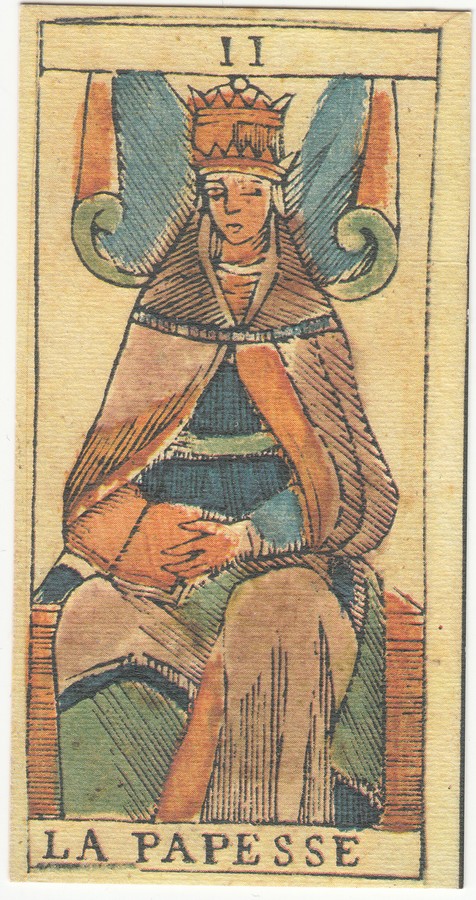
Tarot of Pierre Madenié, card master and engraver Dijon, 1709-1740

THE HIGH PRIESTESS (No. 2)
The image of the High Priestess, otherwise called the ‘Papesse’ or Female Pope, is very simple in one sense. A woman with a tall headdress sits before a curtain hung between two pillars, holding an open book in her lap. But she has aroused great debate and much learned research among Tarot historians. Does she represent Pope Joan, Isis, Sophia, the Virgin Mary, Faith and the Church, a prophetic Sibyl, a Sorceress or Pagan Knowledge? All have been proposed as candidates, along with a specific historical character, the heretical Manfreda who believed in creating female popes. After fighting my way through this thicket of possible allusions, and appraising their possibilities, I have arrived at the view that this card can best be understood not as one particular figure, but as an embodiment of wisdom and ancient knowledge, symbolised in female form.

Tarot from Bologna, 18th c, reproduced by Il Meneghello, Milan

In the early Renaissance, for practitioners of philosophical or Hermetic traditions, such a figure of female wisdom was not only acceptable but essential to their cosmology. The headdress and book of the High Priestess were associated with the spirit of ancient teaching, and from that standpoint, she could quite readily have been equated by different interpreters with Mary, Sophia, Isis or the Kabbalistic Shekinah, each of these a feminine representation of wisdom, current in different strands of teaching and thinking at the time. She is not a historical counterpart of the Pope, or a renegade version of the Pope in female form. There is a case though for associating her with ‘Prudence’, a later personification of Sophia, the spirit of Wisdom; some of her attributes – book and triple crown, for instance – can be found in imagery related to Prudence.

Image of Prudence (top left) with book of wise teachings and disciples. From the illuminated manuscript ‘La Somme le Roy’ (early 14th c.)

So the High Priestess is a teacher of wisdom. And if you go past the trappings, you can also see her as the symbol of contemplation itself. She sits at the entrance to the temple, and is the keeper of its mysteries. In a reading, the card may suggest the need to tap one’s inner resources and to use silence wisely.

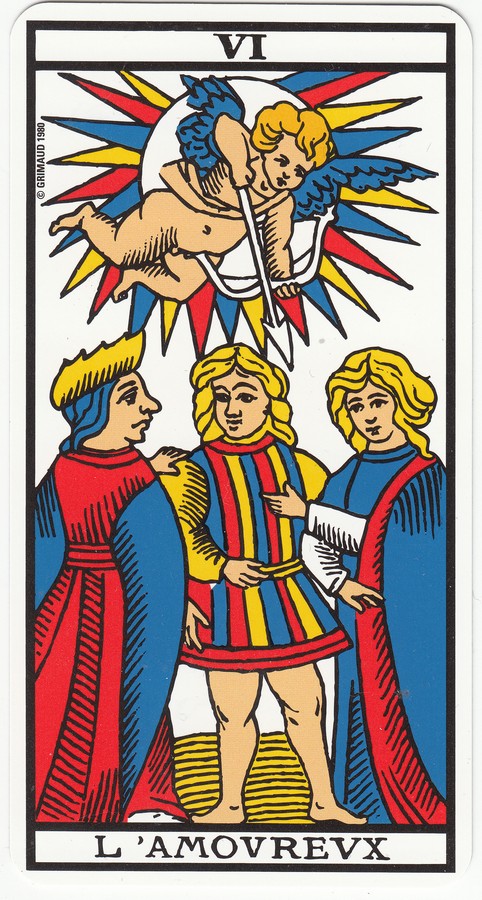
Classic image of ‘The Lover’ or ‘Lovers’ from the Marseilles Tarot. This was indeed produced in the Marseilles area of France around the 18th c., but was more widespread than that. A reproduction of a set in 1930 by Paul Marteau set this pack on course to be the typical ‘traditional’ Tarot for the 20th and 21st centuries.

THE LOVER (No. 6)
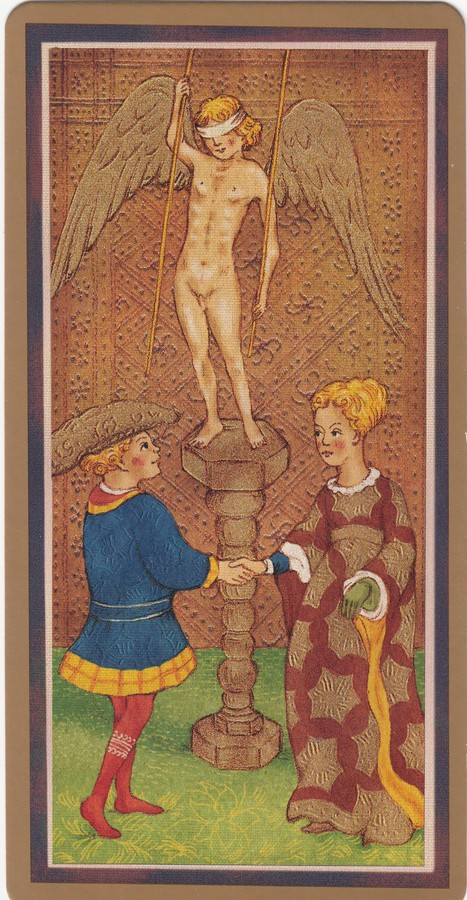
The usual version of The Lover clearly indicates a choice: which woman will the young man decide to marry? However, some earlier versions, notably the 15th century Visconti-Sforza pack, show what appears to be a wedding in progress, and in that particular case, the figures are presumed to be Francesco Sforza and Bianca Maria Visconti. The couple were married in 1441, and the sumptuous set of Tarot cards may have actually been commissioned for their wedding. But the dilemma shown on the prevailing traditional image is not a straightforward, happy union; as with many of the cards, it poses a question for us to fathom.

From The Golden Tarot a historical reproduction of the beautiful 15th c. Visconti-Sforza pack. Here a wedding is taking place, perhaps of the patrons themselves

One common interpretation is that these two ladies represent Vice and Virtue. This is borne out by various emblems independent of Tarot packs, such as the one in Orbis Sensualium Pictus by Comenius (1658), where his illustration no. 109 under “Moral Philosophy” shows much the same picture, with the two women positively tugging the young man in different directions.

Comenius: his emblem ‘Moral Philosophy’ shows a young man being pulled in two different directions by Virtue and Vice.

But if we take this as a choice to be made, rather than purely a decision over love, it opens the way to broader interpretations. The question of a dilemma still remains at the heart of this image. The Marseilles Tarot version of The Lover (seen at the start of this section) is a masterpiece of cross tensions, within this Y-shaped formation, indicating this agony of decision. Here, Cupid’s arrow points towards the man’s left, and to the fair-haired maiden standing there. The Lover, though, looks to the right, towards the laurel-crowned lady with the severe face. She rests a restraining hand on his right shoulder, her left reaching out to him below, while the pretty girl on the left, in some versions crowned with flowers, touches his heart with her fingers. She looks forward, while Miss Laurel Crown looks straight into the Lover’s eyes. Both seem to say, ‘He’s mine!’

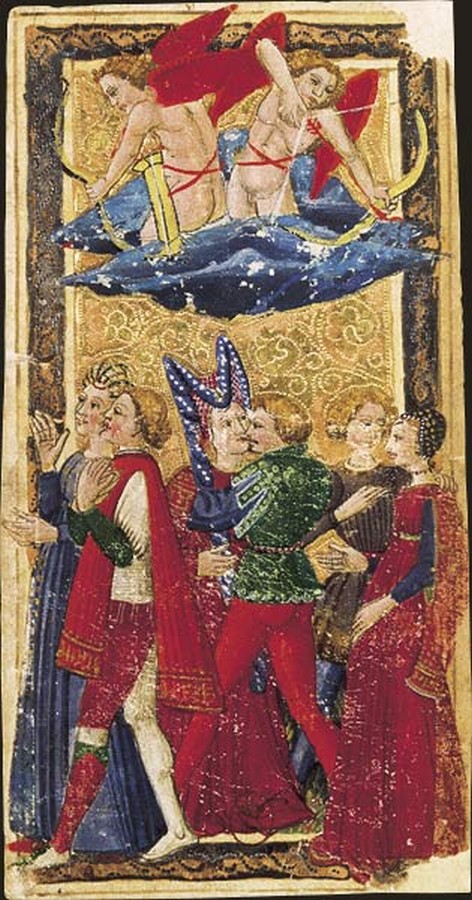
A magnificent emblem from the early French Tarot cards known as the Charles VI pack. This pack is now more reliably designated as Italian, possibly made in Ferrara, in the 15th c.

The card therefore may not always be about a relationship, but can also indicate a decision pending, a choice to be made in another area of life. Likewise, it could indicate a matter of choosing a particular path, and sacrificing another tempting way forward, in order to achieve the desired goal. And sometimes, the best choice is really very simple.

‘La Force’ – Strength: Marseilles Tarot

STRENGTH (No. 11)
The usual Tarot image for ‘Strength’ shows a woman bending over a lion, calmly but firmly opening its jaws. The French name for this this card is ‘La Force’, which means Strength, but not ‘force’ in the English sense of the word. Here, therefore, gentleness triumphs over ‘brute force’, which sets up one of those intriguing Tarot paradoxes: how can a woman tame such a savage creature without using force? Some versions of Tarot cards show this as a woman breaking a pillar in half or a man clubbing a lion, but these are crude allegories by comparison, and, to my mind, miss the point.

A savage version – and probably adrift from the original meaning. Card from the Schaffhouse Swiss Tarot deck. The style is more ornamental, and probably dates from the early 19th c. In the so-called ‘Swiss Tarot’, the High Priestess (Papesse) and the Pope are replaced by the classical gods Juno and Jupiter, so as not to offend Protestant sensibilities.

To understand this better, we can go back to the cult known as the ‘Mistress of the Beasts’ or ‘Lady of the Animals’. This portrays a woman presiding over wild animals, and in particular lions. Images are found as statues and paintings from ancient civilisations such as Crete, Phoenicia and Mesopotamia, where ‘The Lady’ may be seen standing between lions, riding upon a lion’s back, or driving a chariot drawn by lions. There may not be a definite historical link to ‘Strength’ in the Tarot, but it shows that the archetype of woman taming beast resides deep within our culture. It’s also possible that this image derives more directly from the woman jongleurs, the wandering performers who travelled in mixed bands, and whose ‘entertainments’ included showing women taming wild beasts. As I’ve suggested in my book, the troubadours and jongleurs may well have played a part in shaping the Tarot.

Mother goddess flanked by two lionesses on a pithos from Knossos, 625-600 BC. National Archaeological Museum of Athens
A partially-restored Roman bronze statuette of the cult goddess Cybele, on a cart drawn by lions. 2nd c.A.D, Metropolitan Museum of Art

The ‘strength’ shown, therefore, overcomes danger through gentleness, patience and persistence. This type of strength works through anything that is not direct force – through confidence, compassion, understanding, or quietness.

The Tarot of Jean Noblet is the oldest surviving ‘Marseilles’ type pack, produced in Paris in 1650.

Related books by Cherry Gilchrist

Tarot Triumphs can be bought from Amazon UK and Amazon USA as a paperback or Kindle edition

Finding Brummagem

Full twenty years and more are passed Since I left Brummagem. But I set out for home at last To good old Brummagem.

But ev’ry place is altered so Now there’s hardly a place I know Which fills my heart with grief and woe For I can’t find Brummagem.

As I was walking down the street As used to be in Brummagem, I knowed nobody I did meet For they’ve changed their face in Brummagem

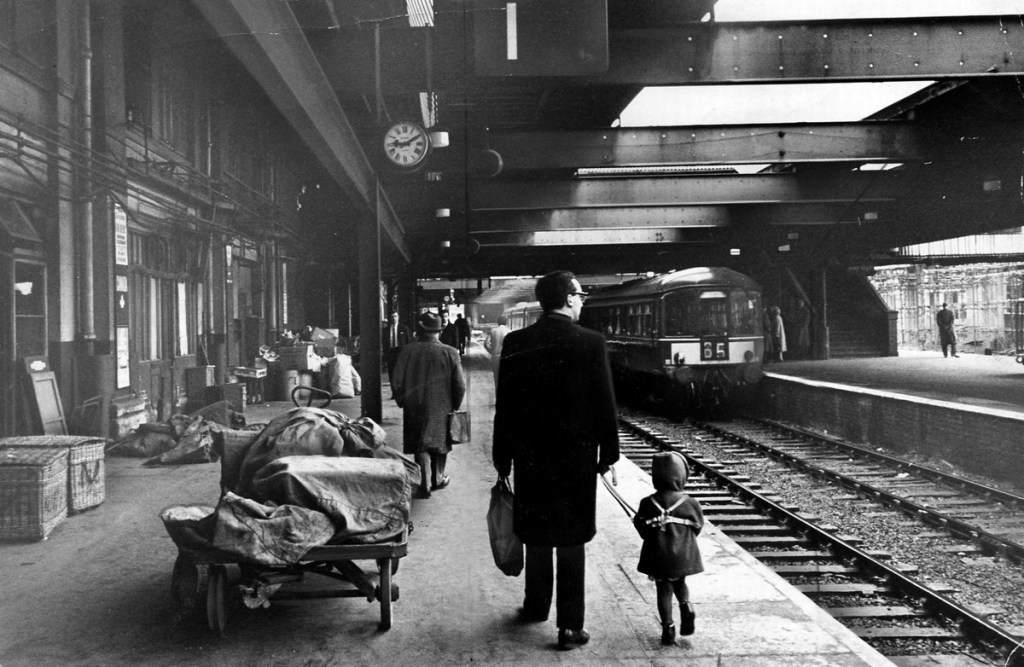
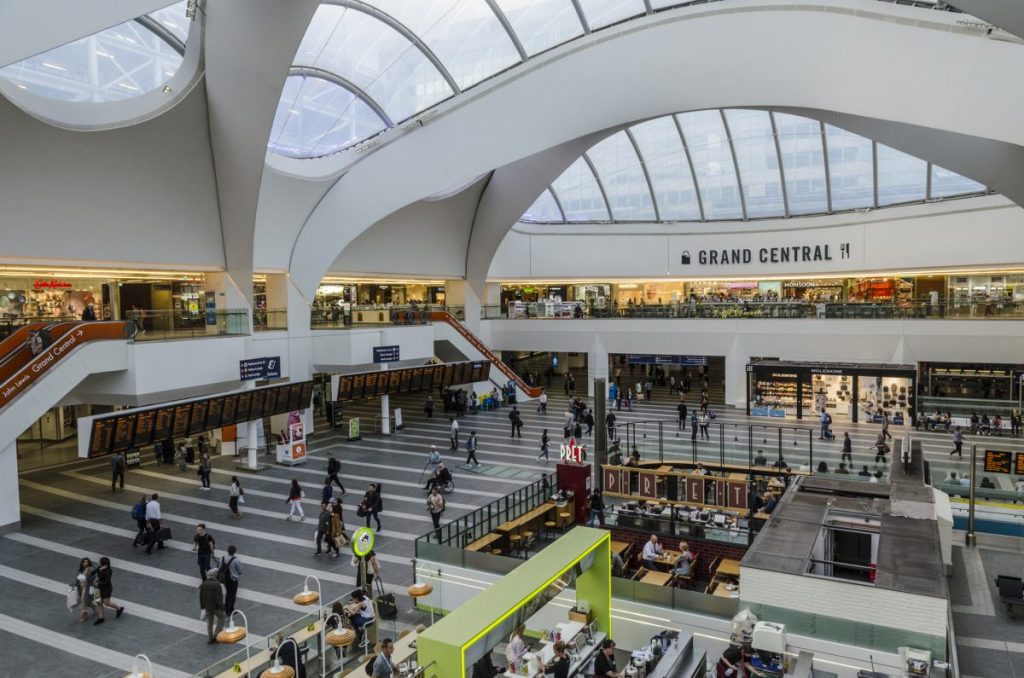
I am here in Birmingham, as bewildered as the poet James Dobbs when he penned this song in the late 18th century. I’ve arrived at New Street Station, and need to find my hotel, which should be only five minutes’ walk from here. But where are the landmarks to guide me? There’s a 1967 map emblazoned in my brain, and in November 2017, this doesn’t serve me well. The station itself has gone through at least two major changes in my time: the first transformation was from the imposing Victorian Temple of the Train, to the brutalist concrete sprawl of the 1960s. And now it is a Temple of Shopping and Bling, titled Grand Central. I emerge from the dingy, low-ceilinged platforms, much as they were in the ‘60s, to acres of glass and chrome, hosting fancy shop fronts and eateries. Here, swarms of cool young people are giving the place a lively vibe. I exit blindly, choosing a way out at random, and emerge into the hustle of rush hour streets and roads.

Birmingham New Street, then and now

So, the Canalside Premier Inn is about quarter of a mile away, but I don’t know how I’m going to get there on foot. I’ve done my homework. I have a printout of the area, a 79p app map of Birmingham, and the phone’s satnav to help me. But I’d be better off with a 3D model as the route involves negotiating underpasses, several floors of the Mailbox shopping development, a pedestrian footway and a couple of canals. It has a weird, dream-like quality. I come unstuck quite early on, and find myself heading the wrong way up the inner Ring Road. A cheerful Brummie lady rescues me (most Brummies are cheerful). ‘You want to go back the way you came,’ she tells me firmly. She knows how to decipher the path through the jungle.

When I get to the sign for Navigation Street, there’s a flash of recognition.

“Oh yes, this is where I used to get off the bus from school.”

A few more steps, though, and the recognition dissolves as I face a meaningless stretch of roadway, shops and buildings. I try to re-impose my original map onto the unknown landscape ahead of me – I want to blot out the acres of chrome and concrete and find the turning that once led to the scruffy Greyhound pub, famous for its dubious cider. I remember small children sitting disconsolately on the pavement, waiting for their parents to emerge.  It would help to orientate me, perhaps? But the new Navigation Street refuses to budge. Then another memory swims to the surface, mythic and incongruous. Here, one hot afternoon after school, I witnessed a man ride down Navigation Street on a small white pony and hitch it up to a newly-installed parking meter, as though this was the most normal thing in the world to do. I never saw a horse in the centre of Birmingham before or since.

The stately heart of Birmingham, where Queen Victoria presides. She used to be surrounded by swirling traffic.

Eventually, I get to the hotel. My room is on the fourth floor, with small windows which squint down onto the tow path of the canal for which the hotel is named. Lights are twinkling in the early evening dusk, as people stroll and jog along the water’s edge.  It looks so inviting. I want to join them. But how do I get from the front door of the hotel onto the tow path at the back? It’s not a simple matter. Water, paths, roads and railways combine in a multi-imensional labyrinth. Wandering lost, I at last solve the mystery when I realise that the road I’m using is actually running under the canal. Oh! Of course, now I remember. The majestic, rather gloomy, iron bridge that stretches above me, carries the waterway itself.

The vibrant mix of old and new around Birmingham city centre canals, which even includes a country pub feel.

When I do manage to access the tow path, it is a delight. Birmingham has reclaimed its city centre canals and they form a charming network of locks, warehouses, pubs, and iron bridges that sometimes lead onto strange little islands. One even has a signpost, as if for a junction of country lanes. There are colourful narrow boats, tubs of flowers and a country feel to some of the old pubs on the waterside. In the 1960s, by contrast, the canals were neglected, having sunk to their nadir after the glory days of commercial water transport. Back then, the Gas Street Canal Basin where I am now walking, was inhabited mostly by a few beatniks living on dilapidated barges. Most of the canals were either drained hollow, or filled with sludge-green, stagnant water. Once, as an over-confident schoolgirl trying to explore alone, I found myself walking through a long, silent tunnel that seemed like the entrance to Hades. I knew that one of the main city streets was passing above, but I could hear or see absolutely nothing of it. Eerie!

Gas Street Basin as it was in 1968. Photos by Martin Tester (Creative Commons)
Martin Tester, who collated these photos, writes: ‘Stepping through the door of the high wall on Gas Street took one into a private & totally different world, completely cut off from the hustle & bustle of Broad Street.’

During the next couple of days, which were interspersed with a school reunion and meet-ups with friends, I explored the new Brummagem. I sifted older memories too. My family arrived in the Birmingham area in the late 1950s. But I was too young to head into town on my own, and had very little experience of being in the centre until 1960, when I had to trek across the city every day to my new school. As I got older, I roamed quite freely with my friends around the city centre –it was our territory, and I prided myself on being at ease there.

A glimpse of a building familiar to me from earlier days – the Birmingham and Midland Institute, originally founded by Act of Parliament in 1854 for the ‘Diffusion and Advancement of Science, Literature and Art amongst all Classes of Persons resident in Birmingham and Midland Counties’
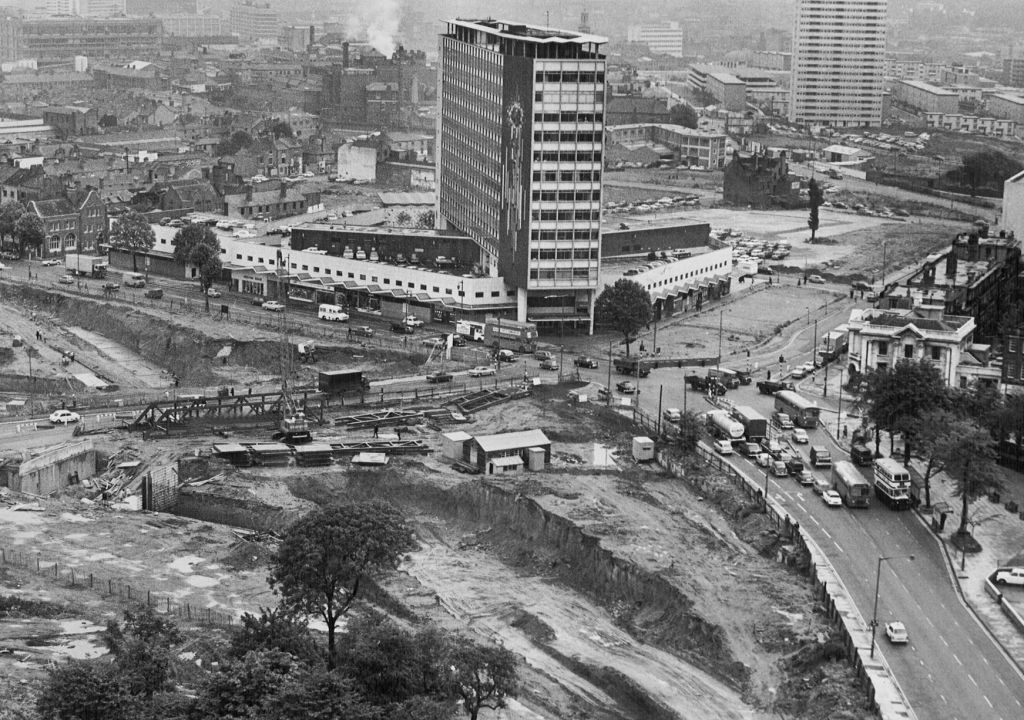
Redevelopment was already starting in the city in the 1960s

Already the city was undergoing major redevelopment. The craze for modernising meant demolishing splendid old municipal buildings, pubs of character and independent shops with ornate tiled frontages. Many Victorian houses and back-to-back terraces also came in for demolition. From the top of the double-decker bus, as I travelled to and from school, I could see newly-razed areas, zones where houses had stood perhaps as recently as the day before, perhaps even that very morning. Half-broken walls thrust up from piles of rubble, whole streets gone in the blink of an eye, the crash of a wrecking ball. Children quickly took over these abandoned sites, turning them into playgrounds with skipping ropes, footballs and home-made go-carts.

Our bus was often diverted down narrow back streets, where houses were still awaiting the moment of execution.  One image imprinted in my memory is the end wall of a house, painted black with the slogan “God Bless Our Boys” in giant white letters. (This, according to internet posts, was in Guildford Street.) It seemed historic to me even then, before my lifetime. For the post-war generation, the war was another country, and we didn’t intend to let it impinge now, when the tide was rising towards the Beatles and miniskirts. We were preparing to surf the wave.

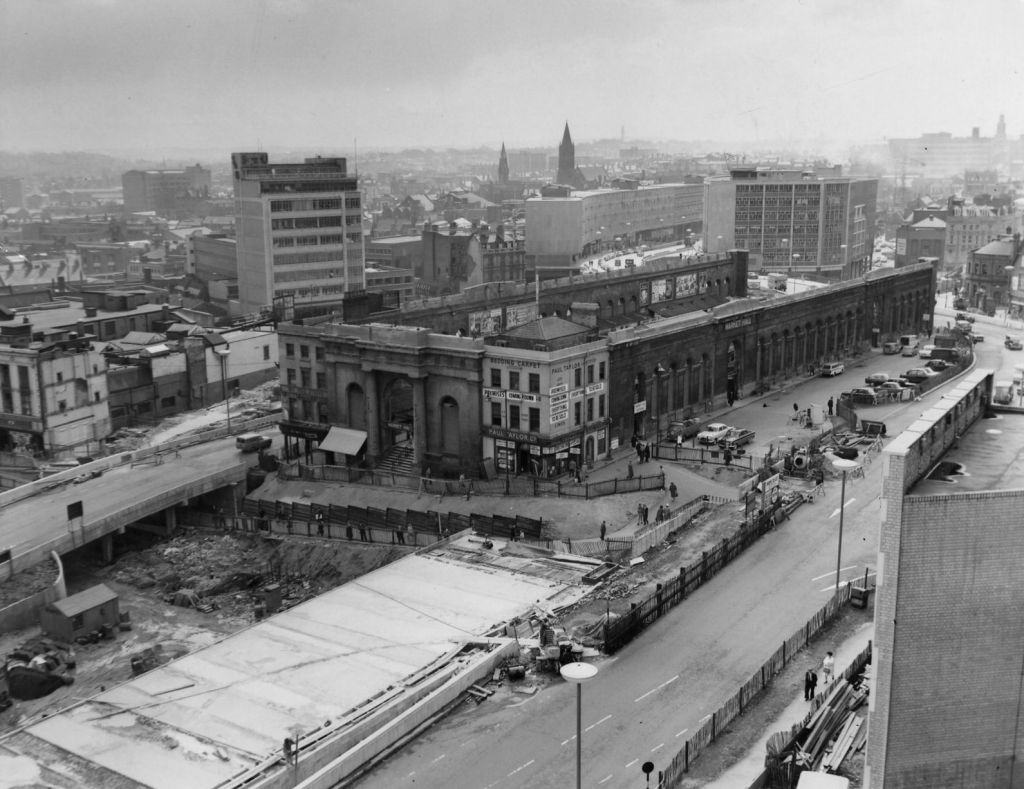
The area around the old Bull Ring Market in the early 1960s (above) and the redevelopment of the old Market Hall below. The sign is just visible above the central archway on the long wall.
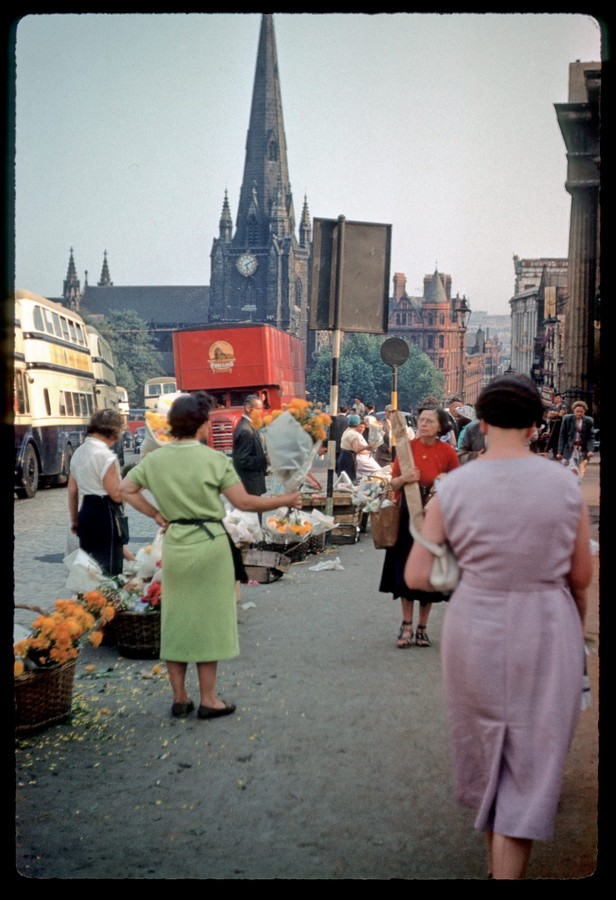
The very last day of trading at the old Bull Ring market, Sep 12th 1959. These colour slides were taken on that day by Phyllis Nicklin, a geography lecturer at the University of Birmingham

Change was also taking place in the very heart of the city. When we first arrived in 1957, the Bull Ring market was just about still in use. I vaguely recall an old-fashioned outdoor market with a wide and sometimes weird variety of stalls. A classmate bought a grass snake there as a pet. The market survived longer than the snake, until about 1962, when it was cleared away for the Bull Ring shopping centre. This brave new world included the most famous Birmingham landmark of the day: the Rotunda, completed in 1965. It was always controversial as a building; some thought its concrete cylinder a marvel of construction, stretching up to giddy heights, whereas others derided it. However, opposition was fierce when the council proposed to demolish it in the 1980s, and it has since been refurbished. The Bull Ring itself was never an exciting destination; drab tunnels, over-priced cafes and mediocre shops held little of interest for my friends and I as teenagers on limited pocket money. One exception was the recording booth.  You sang, spoke or shrieked into the microphone and a few minutes later a 45rpm disk popped out. Was it worth the money? Worth a try – your talent might be ‘discovered’ this way, we thought naively.

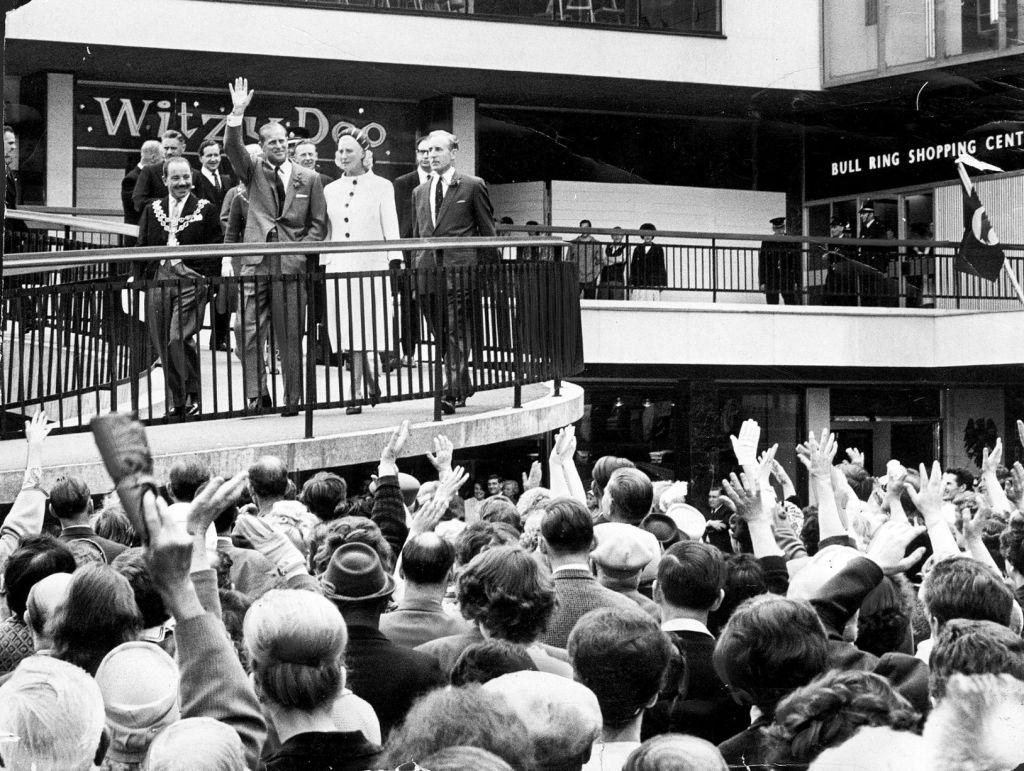
The Rotunda takes shape, and the new shopping centre is already in action in July, 1963. It was officially opened by the Duke of Edinburgh in May 1964. I remember trying out the Witzy Doo restaurant – the name made me shudder – and only being able to afford a badly-cooked fried egg on toast!

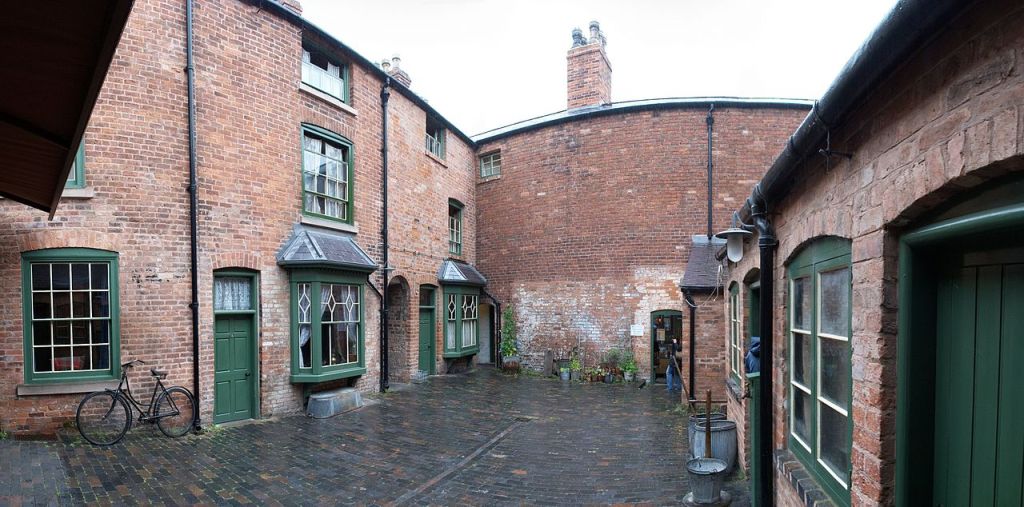
The last courtyard of back-to-backs in central Birmingham has survived thanks to a Jamaican tailor, who didn’t give up his workshop there, and is now restored, and one of the most popular National Trust visitor attractions in the country. On my second day in the city, I took the tour there with a small group of friends. We learned how people had lived in these tiny houses with no indoor toilets or proper washing facilities. Sometimes they slept crammed top-to-toe in beds to save room for a few lodgers, whose rent helped to eke out the tiny family income. Child mortality was high, and general health was poor. But many residents tried to make their homes cosy, and the courtyard at the back was the place for children to play, women to chat, and for neighbours to help each other out.

I briefly saw something of back-to-back life, when I took a job on the Christmas post during my last year at school. My route took me to an area of back-to-back houses where an envelope would be addressed, say, to Mr Dermot O’Leary, care of Mrs Ethel Brown, back of no 15, in something-or-other Court. I would go through the entry, often known as a ‘jitty’ in Birmingham, and try to find the door in question amid a row of unnumbered front doors facing into the courtyard. Often I had to knock and ask. The courtyards had a romantic feel to me, I have to admit. There was an atmosphere of the cottage, of an old way of life that had made its way into the city.

Back-to-back houses, Hurst Street, now restored and run by the National Trust

After leaving school, I lost my sense of orientation during visits to Birmingham. Usually, I didn’t have to figure out where I was going as I was meeting a local friend who shepherded me, or heading to a fixed rendezvous point. But this time, in October 2017, I was spending time on my own during my visit, and my relationship with the city had to be reinvented. And this gave me a chance to see with new eyes.

“What,” I asked one of my old friends, “is that extraordinary building with the golden turban?”

“That,” she said, “is the new library.”

The new library, with its golden ‘turban’

So I visited it later that day. To locals, it’s now a familiar sight, but to me, an uninitiated visitor, the library resembled a Central Asian-style tiered building, covered in patterns of blue and white, enmeshed in a kind of filigree, and topped off with what I will continue to call a golden turban. I found it glorious. Inside, it is still curiously evocative though of the original Birmingham Reference Library, which was much lamented when it was demolished in the late ‘60s. Today’s building is open plan, with gently sloping travellators, but it maintains the quality of a ringed dome, with huge bookcases encircling you as you glide up through the floors through a forest of gently twinkling lights.

The old Birmingham ‘Ref’. A number of us girls from King Edward VI High School hung out in there, ostensibly to revise, but in reality more to look at the ‘talent’. One friend recalls that she acquired a boyfriend with a sports car from her ‘study’ periods there.

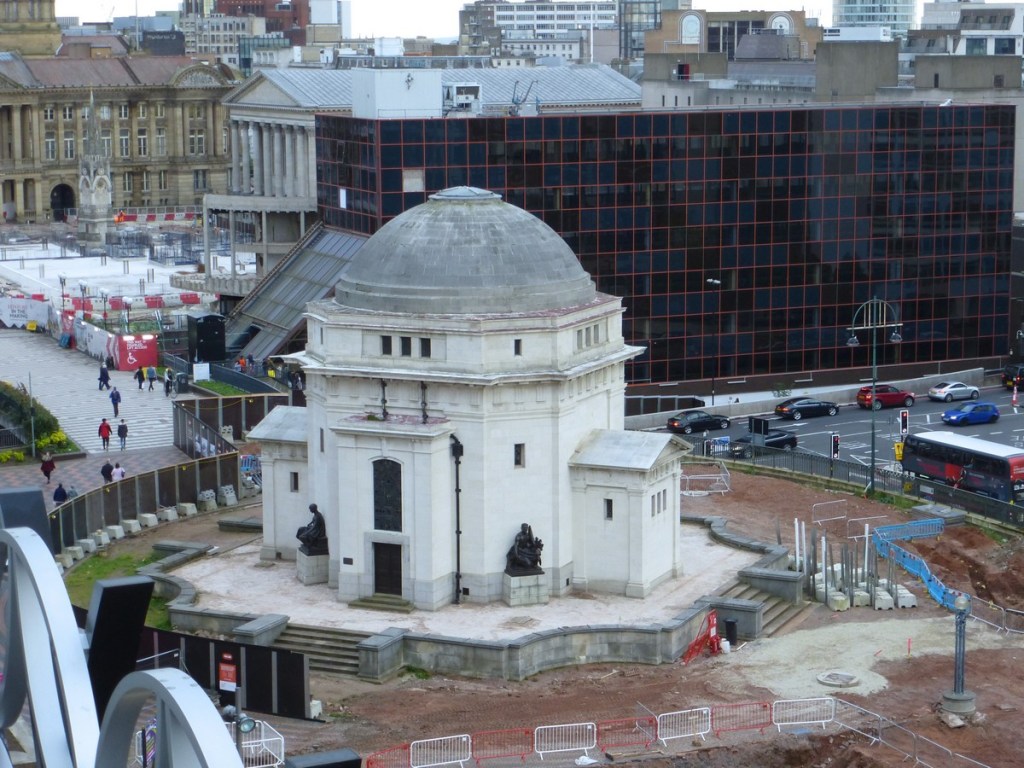
On Level 3 there is a spacious roof garden, planted with fruit bushes and herbs, where you can step out and admire the city centre from on high. Below me, I saw another huge demolition-and-reconstruction project in progress. It had greedily devoured the area where the Hall of Memory, a small, circular, neoclassical building, was still just about standing, and its perimeter stretched to the nearby Town Hall, with its fluted pillars.  Of course these landmarks are preserved – the city is much more careful now about its heritage – but they will now be minor monuments amidst vast edifices.

More reconstruction work in 2017, which I photographed from the roof garden of the new library
The Hall of Memory standing among another onslaught of building work

Coming away from the city and sifting my impressions, I realised that although I recoiled from this large-scale demolition, the energy of the place had grabbed me. To quote from the guide at the back-to-backs, Birmingham has always been a “chuck it up” kind of city. Pile it high, and make it shiny and colourful. It is the city where everyone can have a go, from the kind of trade you follow, to the way you drive your car (‘cowboy country’ as I’ve always called it, trying to navigate through Spaghetti Junction) to the way you – or the city council on your behalf – has a crack at shaping your surroundings. Birmingham, I’d say, is all for individualism.

And something of the ‘chuck it up’ mood still prevails even in the most prestigious new developments, where buildings are thrown up to look like handfuls of coloured dice, and adorned with crazy mirror work, and strangely angled walls. I’m not usually a fan of new cities, but during my three days, I admired what’s going on here. I felt that Birmingham was and is being true to itself. Big, bold, and still full of bling. It gives you new vistas, and unexpected humour too. ‘How come that man is walking upside down halfway up a building?’ It took a few seconds before I realised that I was seeing a reflection in a distorting wall of mirrors, high up above the pavement.

And there is sensitivity too, among the wholescale changes. One example is the little stream that cascades down the hill from the Bull Ring to St Martin’s Church below. It is a rivulet from a river that is now paved-over, but this little flow of water has been brought up to the surface, and a polished granite wall erected beside it, engraved with a poem about the city. And so history is not completely submerged.

A tribute to Birmingham, its people, its history and its waterways

Birmingham is multicultural too on a phenomenal scale. The first wave of immigrants from the Caribbean, India and Pakistan had not long arrived when I came to Birmingham in the late 50s. My parents steered me across the Bull Ring as I marvelled at Indian ladies in gorgeous saris and bare midriffs, shivering in the damp winter air. Now of course there are second and third generations who have been born in Birmingham, and who have made the city their own. It is a youthful place: 40% of Birmingham’s population is under twenty-five, boasts a poster in the city centre.

The new Rag Market in operation
Piccadilly shopping arcade running down from New Street towards the station, still much as I remember it. There was a delicatessen in the 1960s (a rare phenomenon) where you could buy chocolate ants. I never tried them.

Shopping remains a Brummie preoccupation, but the old premier shopping streets have been eclipsed by the smart new complexes such as Mailbox and Grand Central. Though I was happy to see the Rag Market still in full swing, on the far side of the Bull Ring. I recalled Corporation Street in its smarter days, where Marshall and Snelgrove’s department store still used bags and hatboxes patterned in a 1940s style (shown below).

Corporation Street as it is today

Even posher was Rackham’s, where I had a holiday job selling girls’ school knickers. I also had one at Neatawear, where I had to put a hand-written bill and the money into a brass canister that shot up to the cashier’s office in a pneumatic tube. Now Corporation Street and New Street are almost backwaters, and in a way I’m not sorry, because they always seemed stuffy and self-righteous to younger customers. But oh – what happened to the Kardomah, with its chocolate-and-coffee cake? And Yates Wine Lodge, where old ladies tippled their port? (How come I went in there?…memory is blank…)

I ended my astonishing but head-splitting tour of Birmingham back at New Street Station. I had begun there, clutching my luggage in a panic-stricken way, lost in Brummagem just like James Dobbs in the late 18th century. It’s extraordinary to think that I echoed his sentiments nearly 200 years later. But then, perhaps it indicates that Birmingham is still the same. It is still in a state of flux, and ever-expanding to meet the needs of the day. I detect a growing maturity, though, in terms of what is saved and what is lost. The best of the old is now preserved, and the city’s identity celebrated with various sophisticated artistic touches, like the modern sculptures which inhabit Victoria Square, alongside the po-faced statue of Queen Victoria herself, as in the earlier photo. (I once stuck a poster onto her advertising a concert by Ravi Shankar, but that’s another story.) On my journey this time, I couldn’t find exactly what I once knew, but after three days of walking the city, I felt that, yes, I had found Brummagem.

Photos of Birmingham today by Cherry Gilchrist

A version of the song ‘I can’t find Brummagem’ performed by John Wilks can be heard here

Photos of Gas Street Basin in 1968 by Martin Tester.

Photos of the last day of trading in the Bull Ring market by Phyllis Nicklin (1913-1969), who was a University of Birmingham geography teacher. ‘She made these colour slides as lecture aids for her lectures on the geography of Birmingham.’

Photo of Kardomah Café (1965) posted on ‘This is Birmingham’ Facebook page, 20th June 2016

All other 1960s photos of Birmingham from the Birmingham Mail feature ‘This is what Birmingham was like in the 1960s’

Related books by Cherry Gilchrist

Contacts and Comments – I’m delighted to have comments – it may take a little time for these to be checked out and appear on the page. And if you’d like to get in touch with me directly, there is a ‘contact’ link right at the bottom of the page, which will get an email to me promptly. You can also contact me via my author’s website at http://www.cherrygilchrist.co.uk. (This is more reliable than finding me via Messenger).

Strange Signs – a Miscellany from around the World

I’ve decided it’s time for some light relief in the blogs. So here are some of my silly sign collection – I’ve long had a penchant for photographing daft, entertaining, uplifting, creepy or startling signs. Translations from another language offer many creative possibilities, of course. And, oddly enough, so do seaside towns. Let’s start off in the right way.

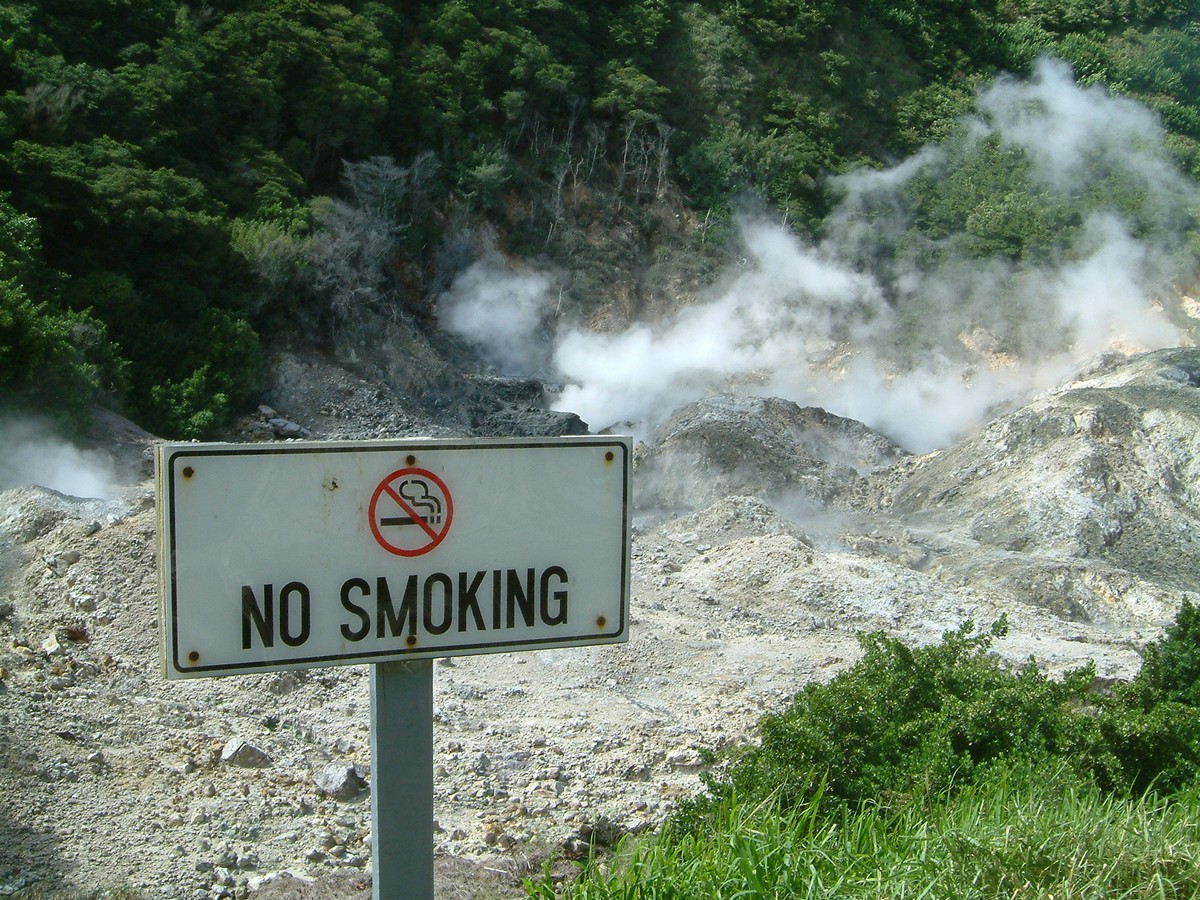
This sign just happens to fit my brief.

One thing you can be sure of in most of your travels, that tipping is allowed. Even when other things are forbidden.

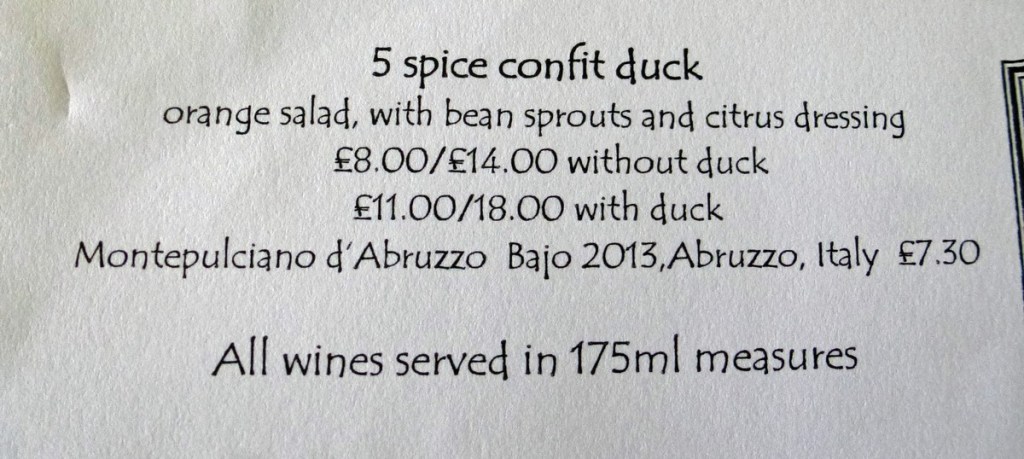
Culinary delights can be dubious or puzzling though.

Even closer to home, it’s the option to order duck without duck that puzzles me.

And I never did work this one out, while visiting the Blue Mountains in Australia, a place where I also found the classic sign which follows.

C’me on now, Aussi pals – you’re putting yourselves down! We Poms love your accent.

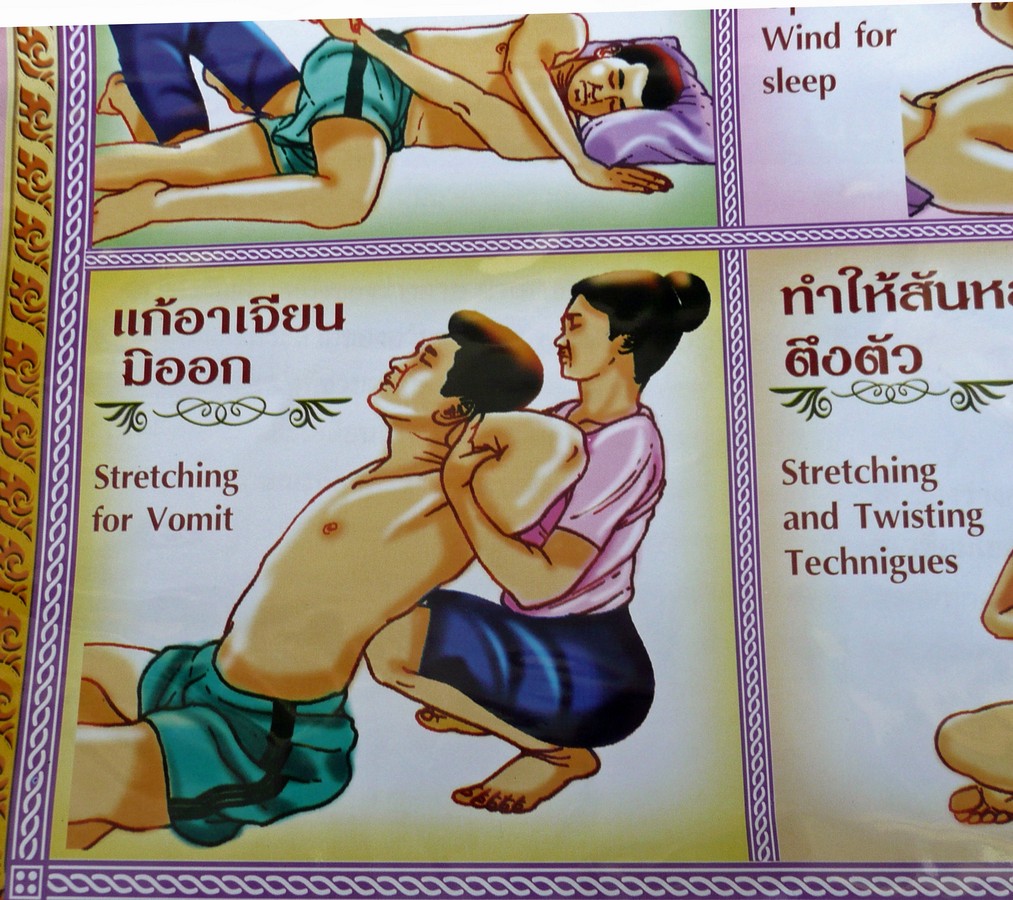
Who’s for this very special form of massage?

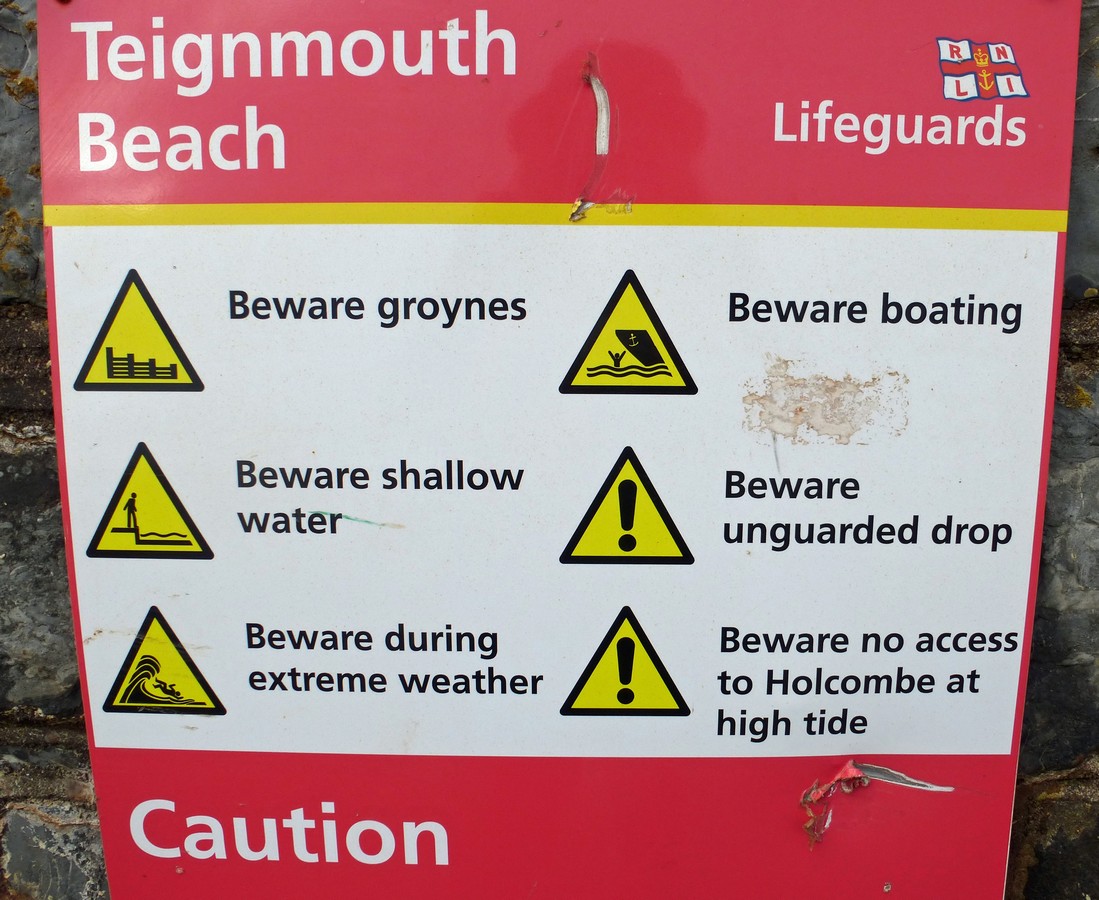
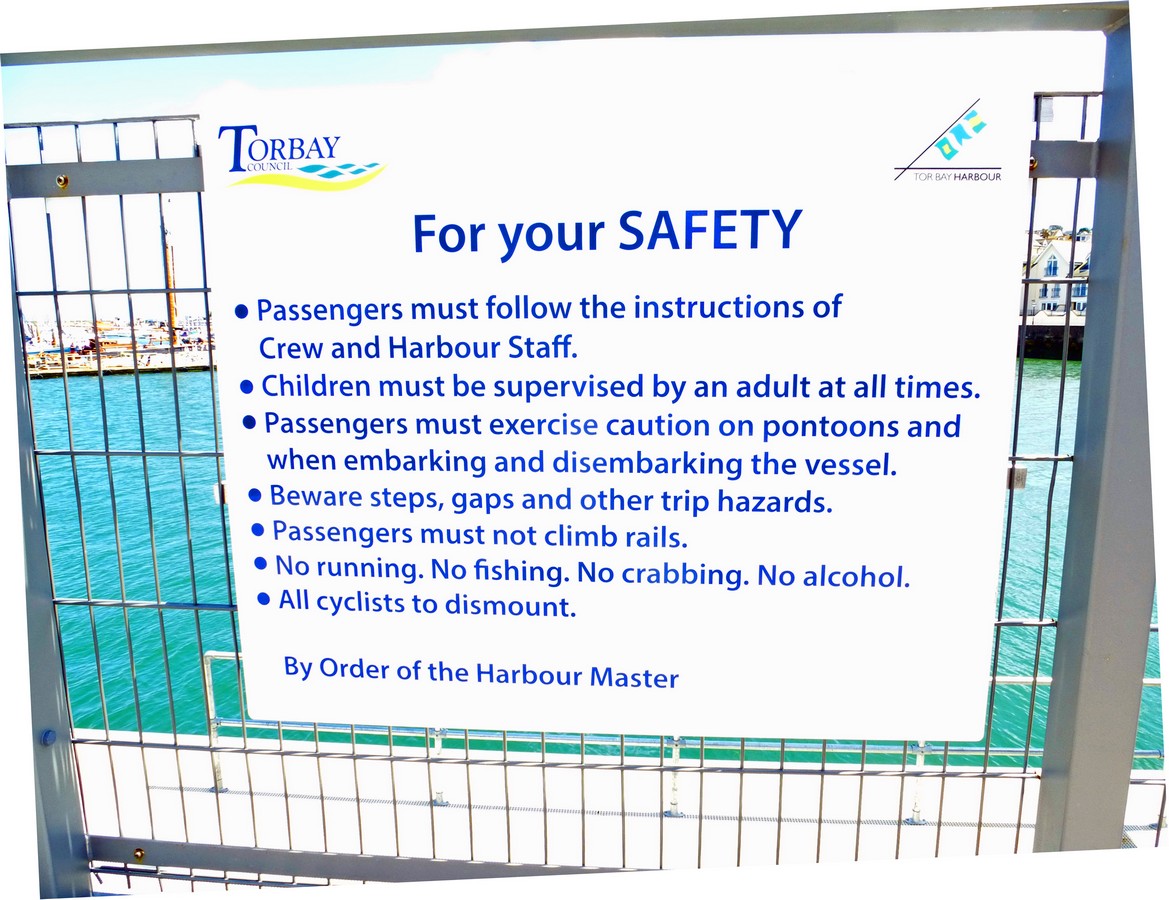
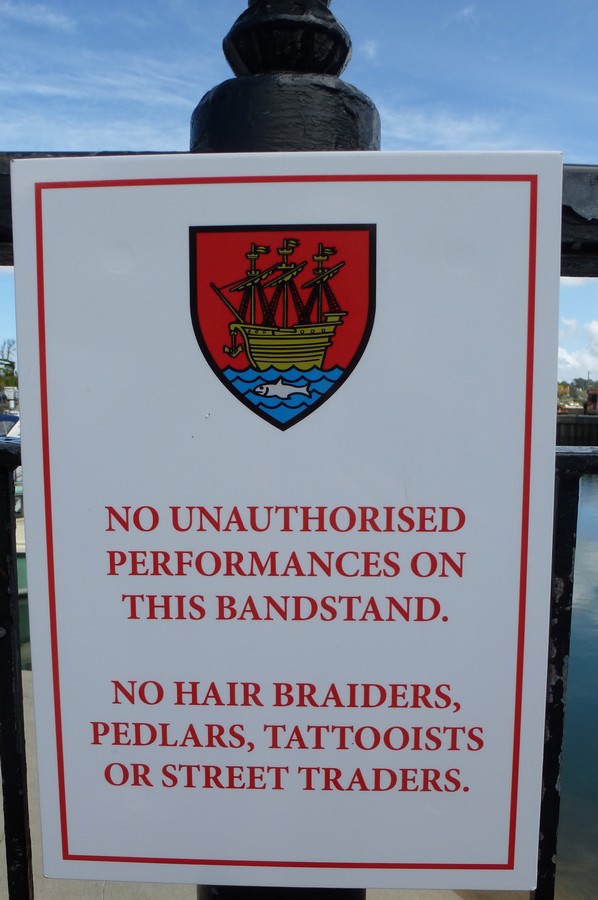
Now for some seaside signs, which seem to specialise in telling you what not to do. Stay away! (from North Devon, Torbay, Padstow, Teignmouth…)

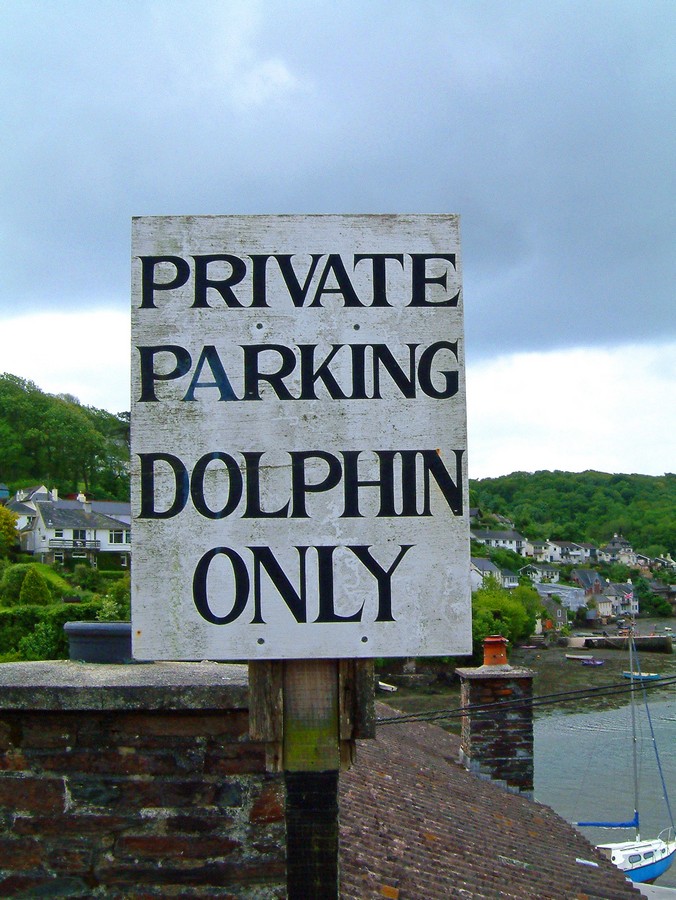
There are a few exceptions though, such as here where parking is reserved for sea mammals, as indeed it should be.

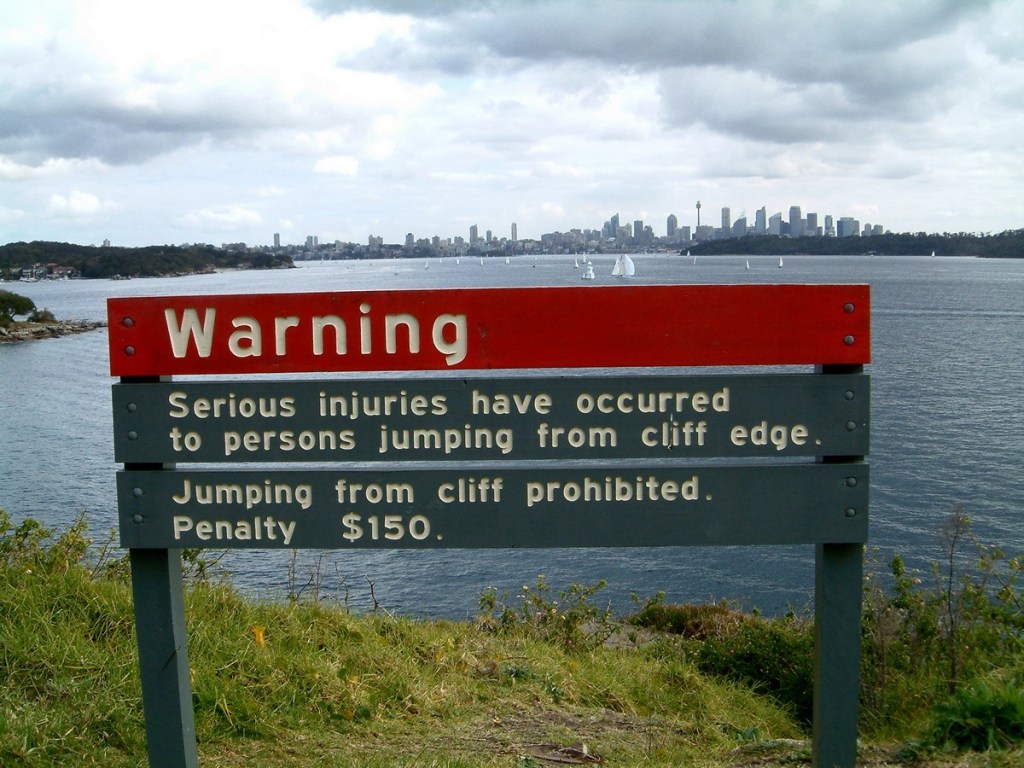
As for the warning below in Sydney, if you did jump with dire consequences, the fine might be the least of your worries.

And this one from Dawlish Warren, I’m afraid, is beyond my comprehension.

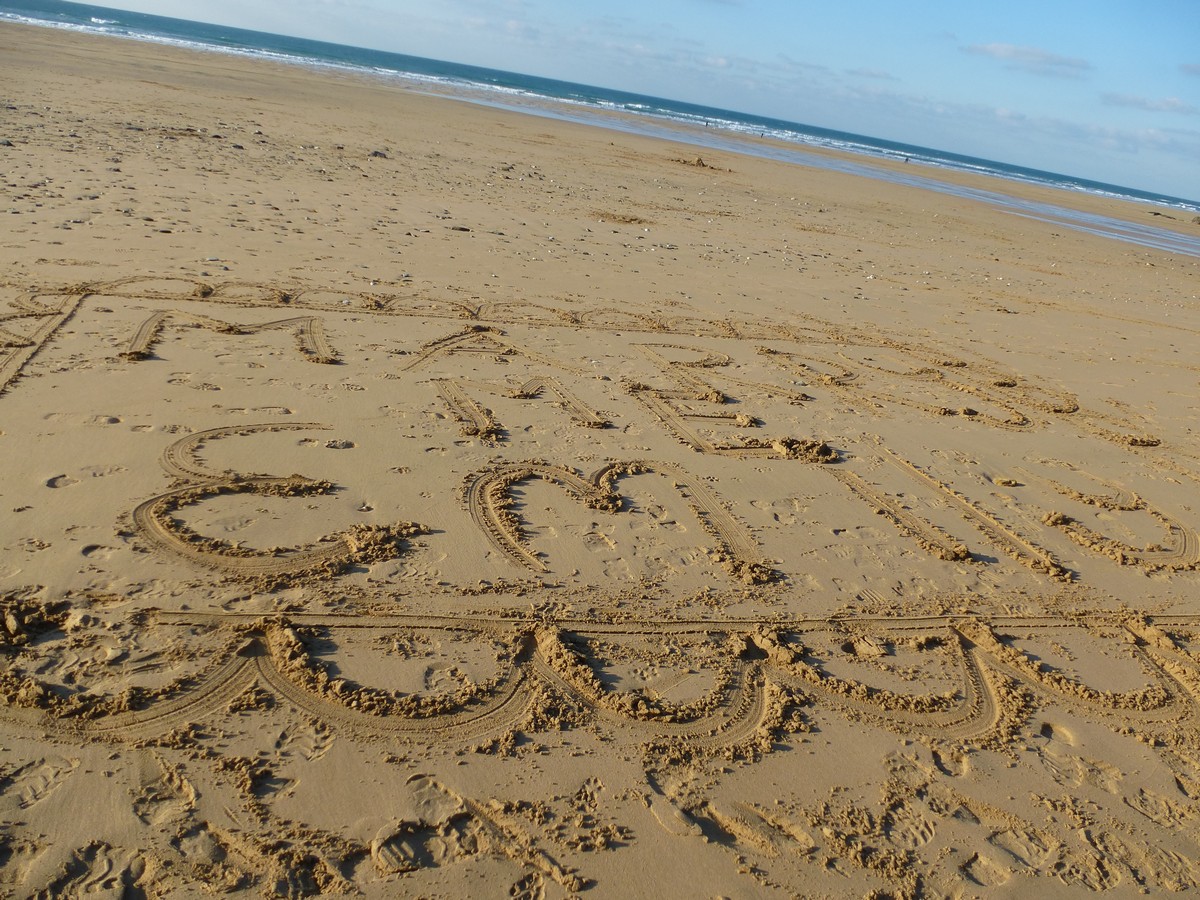
However, it’s not all grim on the beach. This you may not be able to read quite so easily, but it’s a lovely story which we saw unfold on Watergate Beach, Cornwall. The young man led his girlfriend up the rocks to a high point, then dashed down to the sand and wrote in big letters, ‘Marry me Emily!’. After which he climbed back up again, went down on one knee and made the proposal. It looks as though she accepted. And these pictures are followed by a more permanent memento carved into a rock near Sydney.

Changing tack now, though still with the sea in mind, this is indeed the most unusual wedding gift I’ve heard of.

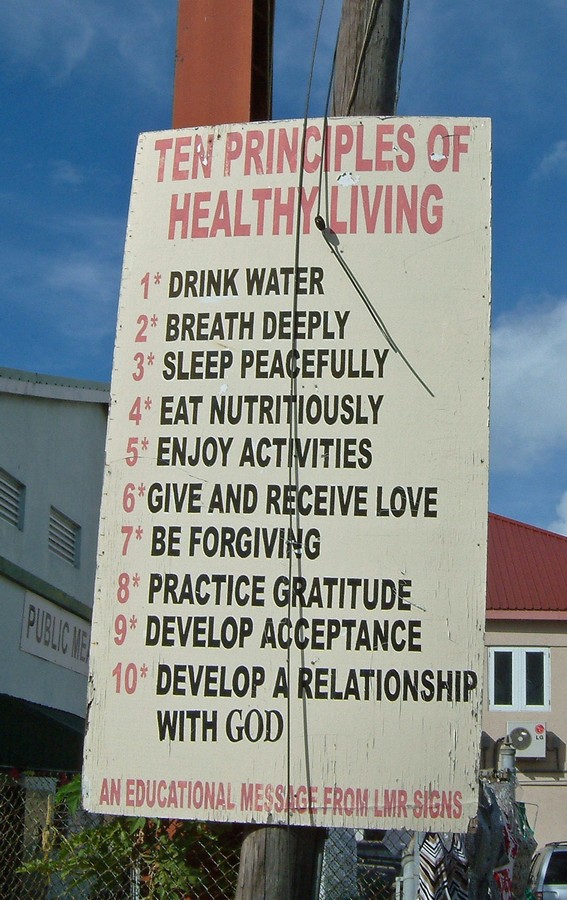
A rather lovely public notice which we saw in Antigua, in the Caribbean.

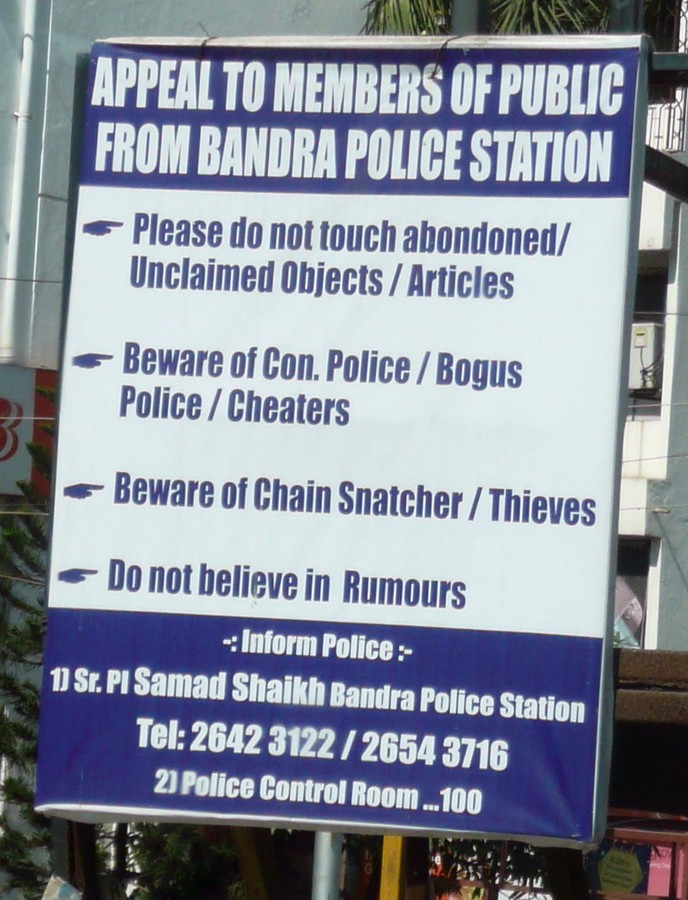
And, on the other hand, keeping you safe on the streets of Mumbai. Well done them for spotting the dangers that rumours can bring! (Actually, I think we should take that one seriously.)

Talking of public safety, I wonder what the outcome of this experiment was in terms of mortality rates? (Seen on a busy London street.) Followed by a questionable sign on a respectable government building in Boston, USA.

Next, some strange aspects of religion – from Good News gas deliveries in my home area of Exeter, to restriction on the length of incense sticks in Penang (4 feet seems rather generous to me) and a re-interpretation of the Bible from Greece.

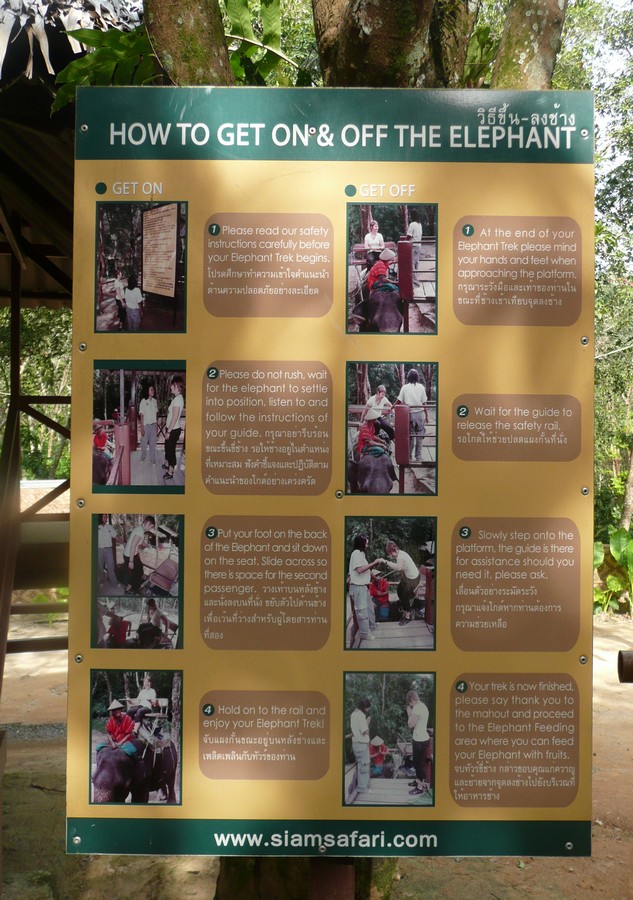
Two ways with an elephant – how to climb up, or use what comes from its rear end. Who knew?

Oh no! Please…I rushed home to shut my cats up when I saw this in Nailsworth one day, close to where we used to live. But there are genuine delights in the area. The Amberley cow hunt takes place in Gloucestershire every year, although visitors might not realise that this sign refers to delightful home-made models of cows. Think scarecrows or ‘cow-crows’.

Onto pubs, restaurants and shops now. Here’s a chorus of dogs banned at one pub, but given high status at another.

Some shop names and signs may have strange associations.

But some, of course, are just right!

And that’s the end of my whistlestop tour of curious signs collected over the last twenty years. It may be another twenty before I manage to find enough to put up a second post.

You might also be interested to read:

Enoch & Eli: Heroes of Black Country Wit

The Unusual Exhibition

A Tale of Two Samplers

I am always curious about people’s lives from earlier times. While other people buy vintage postcards for their pictures, I buy them to read what’s written on the back. And if I come across old books or objects which have names or clues attached to them, I’m tempted to follow the lead further, since with a little research and a dose of luck, it may be possible to bring their stories back to life. When I was writing my book Growing Your Family Tree, I decided I’d like to test this out by taking on a project to illustrate the way that these kinds of inanimate objects can connect us with past lives. I chose two items which I’ve had for years, but which never investigated before.

My mother passed on to me two antique needlework samplers, made by little girls of eight and nine years old. Previously, I had simply admired their neat stitching – the letters of the alphabet, flowers, birds and trees set out in tidy symmetry. But now, perhaps I could learn more: who were these children? What kind of a life did they lead?

The account that follows here is a version of what I included in my book (Chapter Eight – Other Lives, Other Stories) but re-written for Cherry’s Cache, with a little extra research added, and of course the chance to add images.

A sampler from 1733, reproduced in ‘Samplers’ by Rebecca Scott

The background to the samplers

From the seventeenth to the nineteenth centuries, very young girls often created decorative samplers as a way of practising their stitching and embroidery. These were usually cloth panels sewn in silks or wools, often with a mixture of flowers and birds, letters and numbers, and even houses and human figures. Sometimes poems, proverbs and prayers were embroidered too, and the girl’s name and age stitched too, along with a date and place. Sewing this type of sampler, with personal details included, was practised mainly in Britain and America. The samplers were often made at school, as part of the curriculum. They were mostly colourful, but those stitched in orphanages, or by Quakers, for instance, tend to be more sober in appearance.

Samplers worked by orphans. The one on the right by Susannah Carter, 1800, opens with: ‘We are ophans and fatherless/ We have no paretns, but our God’ (Also from Scott’s book ‘Samplers’)

Rebecca Wensor

My first sampler was stitched by Rebecca Wensor, aged eight years, in 1828. To show how I went about tracing her, I’ll include here a few details of the path that I took. Rebecca was born before the start of official registration of births in 1837, but as she would only have been twenty-one at the time of the first census record available (1841), I thought that there would be a good chance that she was still unmarried, and that I might catch her under the same surname. Wensor is an unusual name, which could have given me a head start. But I quickly realised that it could be an alternate spelling of Winsor, a more common name. However, I reckoned that the little girl would most likely have spelled her name in the sampler in the way that the family usually did, as opposed to the census enumerator who might have simply jotted it down as he heard it. A child who spent months labouring over a sampler would want it to be her best work, and would take care to get her name right. But neither version of her surname – Wensor or Winsor – came up with viable results to start with.

Rebecca Wensor’s sampler bought by my mother, which I inherited. As my two samplers are behind glass, they are hard to photograph!

However, by checking the name Wensor on its own, I found a few entries for Lincolnshire, including the Bourne area. My parents had lived for a while in the little town of Bourne after they got married, and that my mother had told me that this was where she had bought the sampler. So, with a sense of the path opening up in front of me, I pursued the Wensors of Lincolnshire. One couple, Samuel and Mary Wensor, farmers of Deeping Fen, looked about the right age to be Rebecca’s parents. Although farmers were not necessarily wealthy in those days, it struck me that a farmer’s daughter might be sent to a modest kind of school, where she would learn her letters and arithmetic, and embroider a sampler. Indeed, in nearby New Sleaford in 1841, a pupil called Eliza Wensor is listed as boarding at a little school run by one Mary Smith; at age twelve, she could perhaps have been a younger sister or cousin of Rebecca.

But then came an unwelcome discovery. I couldn’t find any records in the official registry for the marriage or a death of a Rebecca Wensor or Winsor, born around 1820. But in a collection of parish records posted on the internet, I did find the death of a Rebecca Winsor, aged 11 in 1831. She was buried at Deeping St James in Lincolnshire.

A historic photo of Deeping St James, probably late 19th century.

The age and the location fitted, and judging by the scarcity of anyone else bearing the same name, I think my little embroiderer probably died three years after sewing her sampler. So although the trail didn’t lead far, I now surmise that Rebecca was most probably the daughter of a Lincolnshire farming family, living in the flat fenland country, and that she received some sort of basic education. I have also found a Wensor Farm on the map, (listed too as Wensor Castle Farm) close to Deeping St James, which could well be that of her family or her relatives. This is a poignant conclusion to her story, but she is not forgotten, and her sampler is still treasured nearly two hundred years later.

The town of Deeping St James, the area in which Rebecca Wensor is thought to have lived.
Amey Ross left us a useful clue as to her identity by including the place she lived in

Amey Ross

My second sampler announces proudly that it was stitched by Amey Ross, Boston, aged nine years, in 1833. Amey made her sampler square and bold, with two handsome trees flanking flowers and baskets of fruit, setting out her letters and numbers at the top, and her name carefully stitched in a slightly wobbly octagonal frame at the bottom. It’s fortunate for my search that she left such a valuable clue by including the name of the place in which she lived. Boston, Lincolnshire is also within the area where my mother bought some of her first antiques, so probably both samplers found their way on to the local market stalls after house clearances.

Once again, the issues of trying to photograph through glass for Amey Ross’s sampler!

Amey was born a little later than Rebecca, in 1824, and the closer dates creep towards 1837 and the first official BMD records, and towards 1841 for the first full census, the more likely we are to find results. Again, it might have seemed at first that she didn’t know how to spell the name Amy correctly but, for the same reasons that I researched Wensor rather than Winsor, I decided to give her the benefit of the doubt. Although neither the 1841 nor the 1851census gave any sign of an Amey or an Amy Ross of the right age, both showed an Amey Ross who was born in about 1801. Obviously, this was not Amey herself, but the unusual spelling suggested that it could be a family name, perhaps Amey’s mother or aunt. And this Amey, a widow, is recorded as living in Skirbeck with her daughter Hannah in the Boston area of Lincolnshire, which is the right location for ‘my’ Amey. In 1851, she is described as a laundress, and her birthplace as Ely in Cambridgeshire.

Boston was an important port from medieval times onwards. It lent its name to what is now the city of Boston in the USA. The famous Boston ‘Stump’ is the tower of the church on the banks of the River Witham, which can be seen for miles around in the flat Lincolnshire landscape.

As for young Amey in 1841, the most likely entry which I found, was for an Anne or Anna Ross, working as a servant in the rectory at Wyberton, close to Boston. But in 1848 there was a fully accurate name for the marriage record of an Amey Ross in Boston. I sent off for it and waited eagerly to see what it would say.

The search was at a crossroads; without travelling to Lincolnshire to look at old parish registers for myself, which weren’t at that time on line, it would have been difficult to go further.

But the certificate arrived, and the information it contained launched my little embroiderer into the next stage of her life. On 9 November 1848, Amey Ross married Allen Reynolds in the parish church of Skirbeck, Lincolnshire. Witnesses were Hannah Ross and Daniel Lote, thus making it even more likely that the Hannah from the census is Amey’s sister. Amey’s father was cited as William Ross, a gardener. Allen’s father was named as Charles Reynolds, farmer.

This made things a little spooky: Charles Reynolds was also the name of my 2 x great-grandfather who came from East Yorkshire, just across the mouth of the Humber from Lincolnshire. I experienced a strange sense of connection, though logically I knew it was very unlikely that they were one and the same. Better, I decided, not to get too side-tracked by the Reynolds issue.

Broad Street, Spalding, probably about 60 years after Allen and Amey set up home there.

Allen Reynolds was born about 1820 in Frithville, Lincolnshire, and his occupation was that of a miller. He and Amey set up home in Spalding, where they lived for the whole of their married life. I traced them through the census from 1851 to 1881, as they moved only from Deeping Road to Holbeach Road. Spalding is known as ‘the Heart of the Fens’, and is in the South Holland district which is famous for its flowers and produce, grown in its flat, silty soil. There were also plenty of windmills, which would have provided the power to grind the grain, as was Allen’s trade.

Locks Mill, Spalding. It looks as though the horse and cart are bringing sacks of grain to be ground into flour there.

Over time, Allen became a master baker too, and took on apprentices. In 1871, Amey’s mother, the older Amey Ross, came to live with them, but had almost certainly died by 1881, by which time there was a niece called Amy Rogers (no ‘e’ in her name) living with them as ‘servant to uncle’! What is significant is that there are no signs on any of the census records of children born to Amey and Allen.

Then came one of those extraordinary moments when the view shifts from official listings to a first-hand, eye-witness account of the Reynolds couple. Through an internet search I found an extract taken from a nineteenth-century memoir called The Jottings of Isaac Elsom, which says:

On July, 1856, death first entered the family of the Elsoms of Spalding, for on that day, Eliza, the eldest child, who was eighteen days short of eight years of age, passed into the Spirit World like a ripe old Christian! Her body was carried in its coffin to the cemetery in the spring cart of Mr. Allen Reynolds, miller and baker of Holbeach Road, Spalding, a dear friend of the family; in whose cart, one time or another, all the members of the Elsom family had many a happy ride! Mr. & Mrs. Reynolds had no children of their own, but seemed to find pleasure in numerous and various acts to members of our family, as long as they lived. The writer has much satisfaction in recording this fact.

This caused my heart to leap! Here is Amey Reynolds as a real person, as a neighbourly woman, friendly to children, and happy to offer them rides in her husband’s delivery cart. Perhaps she loved children all the more, having none of her own. And we can imagine her grief at seeing the cart take away the sad little coffin holding the almost eight-year-old Eliza, whom she may have known since birth. A family history website adds the detail about Eliza that ‘Her mother believed that her death was hastened by having been allowed to walk home from Surfleet during a downpour of rain.’

Allen died in 1886, aged sixty-six, and Amey in 1890, at the same age. I wonder if she had kept her childhood sampler, or if it had already strayed into someone else’s possession? At any rate, I will pass on her story to my own children and grandchildren, and hope that they will keep it with her sampler.

Spalding has been famous for its tulip fields

I did my research in 2010, a little ahead of the Fitzwilliam Museum in Cambridge, which in 2017 put on a special exhibition of ‘Sampled Lives’, showing samplers and the history of the girls who made them.

‘Showcasing over 100 samplers from the Museum’s excellent but often unseen collection, this display highlights the importance of samplers as documentary evidence of past lives (and)…the individuality of each sampler, which in some cases is the only surviving document to record the existence of an ordinary young woman.’

A sampler from the Fitzilliam Museum, Cambridge

Other objects awaiting the same story-telling are my christening mugs, a collection I picked up cheaply at an auction house, plus one that has come down through my father’s family. I’ve discovered a fair amount already – one little boy became a highly respectable, philanthropic brewer – but there’s work still to be done, finding out who they were.

My collection of Christening mugs; finding their stories is a work in progress

Related books by Cherry Gilchrist

You may also be interested in a previous blog

Suzani from the Silk Road

Other references:

Samplers, Rebecca Scott (Shire Publications 2009) – An illustrated history and description of embroidered samplers

Hidden Topsham – Part Two

This is the second part of my search for obscure nooks and crannies of Topsham, and its hidden stories.

White Street

Dare you walk down White Street? The crooked entrance to the street looks inviting, but also a little spooky.

Head around the corner, however, and you’ll see charming rows of cottages, with little stirring except perhaps a neighbourhood cat. But in the 19th and early 20th century, this was the Red Light district of Topsham – crowded, noisy and disreputable.  Even as late as the 1950s, young girls from other parts of town were forbidden to go there on their own. Fishing families had grown poor, and a mix of sailors of different nationalities coming ashore helped to fuel the frequent drunken fights, especially on Saturday nights.

You can still see the remains of the sign for the Malt Scoop pub, which finally closed in 1982 after complaints of rowdy motorbike gangs. It was also famous for its late night drinking sessions, since in about 1800 a secret door was installed leading into the neighbouring cottage. If the pub was raided, after-hours customers could then make their escape, and this seems to have continued as a very successful ruse for nearly 200 years.

All is changed now: today White Street is calm and quaint, and offers a very pleasant stroll through the historic heart of the town.

Topsham residents avoided walking up White Street, unless they had to pay their gas bill at the offices there, now a quiet residential enclave.
A current resident, enjoying the peaceful street.

Topsham Pubs

As a port, Topsham was naturally renowned for its pubs, and there were once over forty in the town. Only seven pubs remain now. Route Two Cafe was The Steam Packet pub within recent memory, which in earlier days was nicknamed ‘The Bucket of Blood’, since it had a reputation for fights and rowdiness! Trouble often broke out between sailors from different parts of the world and the locals – even those from Wales were considered ‘foreign’.

The memory of lost pubs sometimes lingers on in the house names, as here, with the King’s Head in Higher Shapter Street

But the Bridge, below, is still very much up and running today.

The Bridge is Topsham’s best-known and most historic pub. No one is exactly sure of its age; the current building incorporates 16th century elements, but an Inn has stood here since at least early medieval times, close to the important bridge over the Clyst River. This may have been where cargo loads of Beer Stone were landed by boat, for onward transport into Exeter, for the building of the Cathedral.

Did the stone for the fireplace in our house ‘fall off the back of a boat’ at The Bridge? The house is in Fore Street and was once the central section of a medieval hall house. It has one of only two Beer stone hearths in Topsham, according to the archaeologists, and dates probably from the late 16th century. Here it’s decked for Christmas.

The Bridge’s exterior hides a warren of charming snugs and a delightful old Malthouse, where folk concerts and story-telling sessions are often held.

A Royal Visit

Perhaps its proudest story in modern times is that of the Queen’s visit in 1998. It’s reputed to be the only pub HRH has ever stepped inside.

As this news report tells us: ‘Landlady Caroline Cheffers-Heard received a very confidential phone call from Buckingham Palace… “We were asked not to change anything so that was lovely because she wanted to see the inn as it was. Why she chose here will be a mystery forever…” The Queen was pictured at the 16th century Bridge Inn holding a bottle of special anniversary ale with Caroline and her father, Norman, in the background.

“She didn’t have a drink, but she did take away a case of out 101 celebratory ale.”’ I am proud to say that beer produced by my daughter and son-in-law’s brewery Powderkeg has also been on the Bridge bar list in recent times.

Come back, your Majesty, and sample it!

The hidden closet at the Salutation

Some Topsham pubs have particular features which only the keen-eyed may spot. The Salutation, for instance, which is now an upmarket hotel and restaurant, was once a coaching inn, hence the superb wooden doors which were big enough to throw open and admit the coach and its passengers. This in itself is not a surprise; however, the little white grill on the left may pose a puzzle. In fact, this was ventilation for a small mortuary, at the side of the coaching entrance. A body could be stored here in its coffin, and loaded discreetly onto a departing coach for burial elsewhere.

The Town Fields

After this time spent in pubs, it’s time for a breather in the beautiful community fields, six acres purchased in 2015 on behalf of the town by the Goat Walk Land Trust. These two fields, at the corner where the Goat Walk meets Bowling Green Lane, provide a secluded sanctuary for wildlife and indeed for visitors. Great care is going into the land management, which includes creating two seasonal ‘scrapes’ to help ‘improve drainage and habitat diversity’, as you can see here. Do consider supporting this excellent scheme!

It’s what I hope is the happy final chapter in the efforts to forestall unnecessary development in that area of Topsham. This tussle was around even when the Goat Walk was built in 1909 (see The Tidal Town of Topsham). Topsham developer Richard Cridland opposed its construction as he wanted to build over the whole foreshore of the river. In a pompous letter to the Board of Trade, he claimed that it was a ‘pettyfogging scheme’ which would be ‘a laughing stock for all visitors to the town’. Really?

I will have more to say about the Cridland family in a later blog, as they were also responsible for dividing up the house we live in, and for building Samoa Terrace.

During lockdown walks, I’ve sat in the Trust’s fields listening to birdsong, and marvelling at the early morning light on tall grasses, young trees freshly planted, and emerging wild flowers in the hedges.

Reka Dom

Take a walk back into town along the Strand, and marvel at Reka Dom, the white house with its intriguing towers (one of them built for water storage by an eccentric wine importer), and which at the end of May is adorned with elegant white wisteria. What are its other secrets?

Possibly, Peter the Great, who founded St Petersburg, stayed here when he came over to Britain from Russia to study boatbuilding from 1697-8. (He and his pals trashed their lodgings in Greenwich, so I pity their landlord in Topsham if he did park himself and his entourage on the Strand.) ‘Reka’ means river in Russian, and ‘Dom’ means house. As a somewhat lapsed Russian speaker, I checked with a Russian friend to see if the words did work this way to signify ‘River House’. (The language has complicated rules regarding adjectives placed with nouns.) She assured me that it’s fine.

So we are in with a chance for Peter the Great’s lodgings, and although this is an unproven story, the current owner told me that documents relating to Russian tenants in the house have been unearthed, although she doesn’t have the details. The house has been in her family for 80 years, and it was purchased when derelict in 1939 by her late father-in-law, architect Rex Gardner. As the war swiftly followed, he had to make do with whatever materials were to hand, in the fine old Topsham tradition of ‘making do’, including getting sand from the ’beach’ at the end of the Strand.

The Old Gaol, seen end on, with the former Steam Packet pub on the left. The quayside lies just to the right.

The Old Gaol
At the town end of the Strand, there is an attractive wedge-shaped building made of brick, now a home decor showroom. This has a hidden past however – it was once the town Gaol. One of its functions was to house prisoners who had been sentenced to transportation, keeping them locked up until they boarded the steamer which would take them to the convict ships that would then transport them to Australia or Tasmania.

The Seven Women Convicts – In a newspaper report of 1837, I found the story of seven women who were sentenced at the Devon Assizes to be transported from Topsham to Tasmania. They would probably have been lodged in the town gaol until the ship was ready to sail.

On Saturday last, Mary Dolbear, and Sarah Bartlett, each transported for 14 years; Elizabeth Ware, Jane Duffy, Susan Featherstone, Ann Rawlings, and Elizabeth Jones, transported for 7 years each, were removed from the Devon County Gaol to the Zephyr steamer at Topsham, order to be conveyed to the Platina, in the Thames, bound for Van Diemen’s Land. (The Western Times, Saturday 15 April,1837)

What were the shocking crimes of these women, that they should be sent into exile? Another newspaper reports further on three of them:
Susan Featherstone stole a shawl from Henry Liscombe of Stoke Damarel
Mary Dolbear stole a pair of boots from Peggy Hawkins
Jane Duffy (sic) a blanket and coverlet from John Greve at East Stonehouse
(North Devon Journal, Thursday 12 January 1837)

The Zephyr steam ship, pictured off Topsham by local artist Edward Henry Hurdle, from around the same period as the transportation of the seven women

It is shocking indeed that these women, aged 18 – 56, who were perhaps living in poverty, should be transported for such petty offences. The first part of their journey was by the regular steamer to London: ‘The Zephyr steam packet sailed every Saturday from Topsham to London, a journey that took three days, with stops in Cowes and Portsmouth’, according to Route Two Café, which was formerly the Steam Packet Inn which stood just across the street from the gaol.

Then the women were moved to the Platina convict ship . The ship’s records do indeed list the names of our seven women, among 113 female convicts, whose journey lasted from 22nd April, 1837, to 22nd October, 1837 when they arrived at Van Diemen’s Land, now known as Tasmania.

We know a little more about them from the medical records kept by the ship’s doctor on the Platina.
Jane Duffy (18) accidentally swallowed a pin which lodged in her gullet, and later suffered from dysentery.
Mary Dolbear (56) had dysentery twice, and also complained of rheumatism Elizabeth Rawlings (47) was another victim of dysentery

At least the doctor was conscientious and took trouble to write detailed case notes for some of the afflictions. On arrival, ‘female convicts arriving in Tasmania were housed at the Cascades Female Factory in Hobart where conditions were grim to say the least’. (note from Gill McLean of Topsham Museum)

The Old Gaol must hide many tragic and largely forgotten stories, ranging from drunken brawls to the last shivering hours spent before being sent away to the other side of the world.

Hidden Gardens

But I’d like to end on a more pleasant note. Topsham is a town of surprises, with hidden gardens and even small fields concealed behind town houses and up small lanes. Check out Topsham on Google Earth, and you will see how green it is. There are tempting gardens to be spied through gateways too as you walk around the town. Some lie directly by the river, often across the Strand from the houses they belong to.

Gardens along the Strand, often across the road from the houses.

And every two years, the Topsham Museum puts on a ‘Secret Gardens’ event, which is hugely popular as generous residents open up their plots for visitors to admire. Everyone wants to see what lies behind those garden doors, gates and archways! The next one will be in 2021.

Admiring the wildflower meadow at Eleanor’s Bower, during the 2018 Secret Gardens event. My granddaughter Martha wonders what she might find in the pond.

Below: Glimpses of the magical gardens at Wixels, a former coal store and now a beautifully styled home which extends into the river. (Visits courtesy of Mary Lambert). The mirrored view is from another ‘Secret Garden’

References: Topsham Inns Past and Present, Colin Piper (Topsham Museum publications, 2010) The Story of the Manor and Port of Topsham, D. M. Bradbeer, (Town & Country Press 1968) Topsham Past and Present, Chips Barber, (Obelisk, 2004)

A note from Cherry: I’m planning a ‘Hidden Topsham – Part Three’ for later in the summer. I hope that these intermittent blogs about Topsham will be of interest for our townspeople, for our sister town across the sea in Topsham Maine (who’ve expressed enthusiasm!) and for anyone else with a fondness for this unique place. Please subscribe to the blog, to receive notifications about the upcoming posts.

You might also be interested in:

Hidden Topsham – Part One

The Tidal Town of Topsham

The Cosmic Zero – ‘Getting Something from Nothing’

I am not known for my skill in mathematics. Although my father was a maths teacher, it seems I didn’t inherit the gene. I struggled as far as O Level Maths (with remedial input from Dad) and then abandoned it with relief. Later, however, when I came into contact with the idea of sacred geometry, I did make my reluctant brain face up to certain mathematical challenges. The effort made me realise that grappling with number can help to stimulate deep layers of thinking, and has come in useful both for my own understanding, and for some of the books that I’ve written.

But the story here is more light-hearted – my own experience of encountering the powers of zero. Although zero itself is not such a light-hearted topic, I discovered, when looking into its history: ‘Within zero there is the power to shatter the framework of logic.’ More on that shortly, but I’ll start the memoir first.

The road in Bath which became the scene of the crime

There are no zeros in the world of the gods. That’s what I’ve been told, anyway. Vida, a friend of mine with a strong interest in the supernatural, pointed out that the number nought doesn’t register on the psychic plane.

‘It just doesn’t work,’ she said. ‘I proved it, with the Premium Bonds. I asked for £50,000, and visualised the number as powerfully as I could. I know that I shouldn’t really ask for money. But my daughter needed things for the baby. Thought I’d give it a go.’

‘And? What happened? Like the rest of us, you didn’t win, I suppose?’

‘Oh, I did. In the very next draw. But I only got £50. The powers-that-be didn’t recognise the noughts, you see.’

‘There’s a zero in fifty,’ I pointed out.

‘Well, they don’t do £5 wins any more,’ she said tartly.

However, as I discovered, it works both ways. The way in which the gods may disregard zeros can sometimes work in our favour. This is the tale of how I lost £200 through no fault of my own, but gained justice through the casual handling of these cosmic zeros. Or maybe it was deliberate? I’ve done my research, and have learnt that the gods sometimes take zeros into their own hands, not so much to retain their jealous power over them, but out of love, to soften the blows of fate, or to allow a little bit of cosmic luck to come our way. Although whatever the outcome, there’s usually a lesson in that too, for us mortals concerned.

Zero may be a relatively modern toy of the gods. The number zero is an invention, not an obvious concept from day one of human civilisation. ‘The origin of the symbol zero has long been one of the world’s greatest mathematical mysteries’, as the Bodleian library states boldly.

The manuscript carbon-dated to prove that this Indian text including the symbol for zero comes from the 3rd-4thc AD. (Bodleian Library)

Although it is primarily a mathematical tool, it most definitely has a magical side too, and many cultures have considered it as having ‘darkly magical connotations’, as one reputable article proclaimed. Zero’s history is one ‘of the paradoxes posed by an innocent-looking number, rattling even this century’s brightest minds and threatening to unravel the whole framework of scientific thought…The clashes over zero were the battles that shook the foundations of philosophy, of science, of mathematics, and of religion.’ (Zero: The Biography of a Dangerous Idea, Charles Seife).


Zero arose independently in different parts of the world, but the version we have today probably began in Babylonia around 300BC, as part of the system for notating numbers. It was developed further in India from the 3rd or 4th century AD, as recent carbon dating of a manuscript proves.
It then spread both East and West – the Silk Road must have played a part in its transmission – and finally arrived in Europe in about 1200 AD, championed by the Italian mathematician Fibonacci.

Leonardo Fibonacci, champion of the zero

As for the symbol we use today, it began as a dot, and then a hollow centre was added, turning it into the 0 symbol that we have today. Perhaps someone thought that a dot is a ‘something’ and that we really need some empty space in it to fulfil the underlying concept. (Could the creation of doughnuts, bagels and Polo mints have followed a similar philosophical evolution, I wonder?)


You can watch a delightful video by the Royal Institution about the origins of Zero: What is Zero? Getting Something from Nothing.

Image from Royal Institution’s video: ‘What is Zero?’

But back to the story – I’ll tell you what happened to me one summer, and you can decide for yourself whether zeros have a cosmic significance.

It was an August Bank holiday weekend, in the city of Bath. I’d been at a lunch party in the country on the Sunday, and drove home to a deserted street. I lived on a short Victorian terrace running up a hill. As you can see in the photo at the start of this post, the houses are set up high, and the road running below is bounded by a high retaining wall. It was conveniently close to the city centre, and thus usually choc-a-bloc with commuter cars on weekdays, and with residents, shoppers and visitors at weekends. But today it looked as if almost everyone had gone on holiday, so I had the luxury of gliding, rather than squeezing, into a parking space.

On that Bank Holiday Monday, my friend Erica came over from Bristol for the day, and when she left, I walked with her to her car. I could see immediately that something was up. Her car was parked safely at the top of the hill, but my red Golf was now skewed sideways along the wall, with a grimy white Toyota sitting too close to its bonnet. It didn’t take long to figure out that the Toyota had reversed with considerable force into the Golf, shunting it back into the wall, then rebounding a few inches forwards. The tow bar on the rear of Toyota showed traces of paint, and it had clearly left a corresponding dent on the front end of the Golf. I was flabbergasted.

‘Why on earth did someone do this? There was plenty of room to park.’

‘Looks as if he was drunk,’ said Erica. ‘You’ll have to report it. Would you like me to be a witness?’

I was grateful. Over the next few days I contacted the insurance company, and waited to hear from the owner. I even put a letter on the windscreen of the offending vehicle, inviting the driver to contact me. At once. Forthwith. Politely, so far – after all, it could have been stolen and returned after a joy ride.

One morning later that week, I drew open my bedroom curtains to see someone taking my letter off the windscreen. I recognised him as the man who lived further down the terracey: fiftyish, with a beaky nose and a loose-fitting fawn mac. A widower, someone had said. Ah, well if it was a neighbour, he would be round, once he’d had a chance to read the note.

I waited for another day, but nothing happened. Was he the type to get drunk, then crash his car? I’d heard he was fond of the cricket club bar, but he didn’t look quite that irresponsible. But you never know, do you?

By the end of the week, I’d put a note through his door, and contacted the police. Why didn’t I go round to see him? Why indeed – I ask myself that now, and the only answer – or excuse – I’ve come up with is that I had recently begun to live on my own, and that divorce can make you timid, and want to avoid further confrontations for a while.

‘How could he have done that and walked away?’ I fumed, as time slipped by, with no word from him. ‘He couldn’t have done it without noticing.’

The policeman who called at my house was sympathetic, but he’d seen evidence in the form of train tickets, proving that the widower had been in Cornwall at the time. The said widower also denied both lending his car to anyone, or having it stolen. Nothing to do with him, or his car, he maintained. This was plainly nonsense, but the same pleasant police officer said that without initiating a private forensic test to prove that the paint on the front of my car came from the back of his, there was no firm proof. 

By now, my ex had heard of the mishap and offered to pay a visit to the perpetrator along with a friend. They planned to wear black balaclavas and brandish baseball bats. Just to frighten him, he said. Just to get an admission of guilt. It wasn’t his normal style at all, and I can only assume he and the friend had had a fun time the evening before, fuelled with a bottle of wine, planning this heroic rescue mission.

‘What if it gives him a heart attack?’ I said, declining the offer.

For a long and tedious time, it seemed as though my insurance company would triumph over his. Then they said as Erica was a friend, her witness statement was not evidence. Huh? Since therefore I couldn’t prove the other party’s guilt, they would charge me the £200 excess. I was left with a hole in my bank balance, and also in my understanding of this event. My best guess was that he’d offered a mate the use of his car while he was away – there was no disproving his story of visiting the son in Cornwall – and that the mate had gone on a binge, rammed the car, and left it without a backwards glance. The owner had probably thus invalidated his insurance, and in order to escape trouble was prepared to alienate a close neighbour. It was a bitter result, but I had to swallow it, unless I was to launch an independent court case. But there was more to come.

Scene of The Encounter:
The allotments in Bath, surely one of the most beautifully-situated plots in the country. Mine is just visible at the forefront of the picture, with the apple tree on the right

Sometimes cosmic justice takes a while to pan out. The following summer, I bumped into the widower on the allotments which ran behind my garden. By the time I spotted him, we were so close that acknowledging each other was inevitable.  

‘I’ve lost my cat,’ he said. ‘She might have gone away to die.’

‘I’m sorry to hear that,’ I said. ‘I’ll look out for her.’

Why were we being polite, as if nothing had happened? Why was I being such a coward? The moment had come to change that.

‘I was very upset,’ I said, ‘when you didn’t respond to my letter. I think you’re aware that your car hit mine, but you wouldn’t own up to it.’

He looked sheepish. ‘I was going through a lot at the time. My wife had died.’

‘And I had just been divorced. I didn’t need the stress either. I lost my no claims bonus, £200.’

He played another hard luck card. ‘Well, maybe it was stolen. When I came to get the MOT, they found that the chassis was completely bent. Had to scrap the car. It was worth £2000 and I had to write it off.’

Hah! I knew then for sure that there was no thief. ‘If there had been, he’d have told the police. He lent or illegally hired out the car, and couldn’t claim on the insurance,’ I triumphed, inwardly.

And so the gods had been kind with their cosmic zeros, at least in terms of the overall balance sheet. The widower had paid three noughts for his misdemeanour. I had lost only two, and perhaps learned a lesson about cowardice.   

References

Zero: The Biography of a Dangerous Idea, Charles Seife (Souvenir Press – new edition 2019) ‘The Babylonians invented it, the Greeks banned it, the Hindus worshipped it, and the Christian Church used it to fend off heretics. Today it’s a timebomb ticking in the heart of astrophysics. For zero, infinity’s twin, is not like other numbers. It is both nothing and everything.’

Related books by Cherry Gilchrist

Enoch and Eli – the heroes of Black Country Wit

‘A Long Long While’
I first heard this story delivered with great relish in a folk club in Birmingham, back in the 1960s. The story-teller was Alan Bishop, a bearded native of Blackheath in the Black Country. It wasn’t the last time I heard it either, as it was one of Alan’s favourites, and he would end it with a gleeful grin, while he waited for the punch line to sink in. Alan was in fact so fond of this story that his family made sure it was recited it at his memorial service in 2017.

It’s bin a long, long while since fust this tale was told
You’ll laugh your eyes out when you hear it, as Eynuck did of old

Two men went sanking down the street
When soon two fighting dogs they hied
They stuck ‘em in an empty butt, lid on
To fight it quietly out inside

Now yow con fight to your heart’s content
And both stood nigh to listen
Bist gonna have a bet? said one
Now tell me, bist or bissen?

They placed their bets the while
And the clamour in the butt was chronic
What thrills they got from that there fight
It was better than a doctor’s tonic

But soon alas, dead silence reigned
And each mon looked at t’other
They raised the lid – an empty butt
Them dogs – they’d etten one another!

I think the title would be better as ‘Them two dogs had etten one another’ – but then that would give the game away. But isn’t there more to this story than just making you laugh? True, it’s yet another comic tale in the traditional Black Country fashion, with a preposterous ‘double take’ conclusion, but I think there’s something of the metaphysical in it too. After all, when cosmologists and theologians struggle with the question, ‘How did Something come out of Nothing?’, then surely, a convincing answer to the even more difficult question of ‘How does Something return to Nothing’, deserves serious consideration. Yes, ‘them two dogs had etten one another’, and that settles it.

Folk singing duo Pam and Alan Bishop, at the Grey Cock Folk Club, Birmingham, in 1969.

And this is just one of a multitude of Black Country jokes and stories. Why is it such a ‘funny’ place? Why do people still tell jokes the whole time, especially, it seems, in pubs? When writer and actor George Fouracres, returned to his native Black Country to research an article on Black Country humour , the first person he asked was his father. “Everyone round here thinks they’m a comedian,” reflected his father. Black Country folk, he reckoned, will always find a way to “av a loff abaat” whatever situation they find themselves in.

Enoch and Eli
These are the mythical duo who drive the juggernaut of Black Country jokes. They are very often the narrators of the stories, tripping each other up in dialogue, scoring points and laughing at the ways of the world. In the tale above, only ‘Eynuck’ (Enoch) appears, but his pal Eli is always just around the corner. The pair, often referred to in Black Country dialect as Aynuck and Ayli, have become the stock characters , often of stories where one of them makes the other the butt of the joke. Aynuck and Ayli have weaseled their way into cartoons and comedy clubs, and have even had a reading room named after them. More on their origins later.

Black Country humour
Black Country and Brummie humour is dry, sharp and mostly delivered dead pan. The inhabitants love to send themselves up, as well as everyone else. Given that ‘meat’ and ‘mate’ are pronounced the same, along with ‘bison’ and ‘basin’, and ‘whale’ and ‘while’, there’s a fund of jokes to be had about these potential misunderstandings.

Aynuk: What’s the difference between a buffalo and a bison?
Ayli: I doh know, I’ve never washed me hands in a buffalo.

Aynuk and Ayli were fishing in the canal:
‘Me mate’s fell in the canal !’
‘Owd it appen?’
‘I just took a bite ov me sanwich an me mate fell out.’

Ayli, Aynuk and their mate Noddy Holder go into a clothes shop and Noddy says to one of the assistants, ‘I’m re-forming Slade, I want to buy some new stage clothes. I need a pair of flared trousers, a wide collar shirt, platform boots and a mirrored top hat.’
‘Kipper Tie?’ asks the assistant.
‘Oh thanks,’ says Ayli and Aynuk ‘Two sugars and milk
please.‘

Even ducks don’t get off lightly in the Black Country

Leaving the puns hastily behind – there’s plenty more in that vein- it’s worth digging deeper into the nature of Black Country wit. The jokes are often about people being daft or stupid, at least on the face of it. But there’s usually a wry twist, a double take, a lightning quick reversal of expectations which kickstarts a guffaw. This kind of wit tickles your brain. It’s a type of humour in the tradition of the Wise Fool, similar to the Turkish and Middle Eastern stories about their folk hero, known as ‘Nasr Eddin’ or ‘The Hodja’. It appears to be ridiculous but is often rather clever.

Aynuk: People always say as Black Country folk is thick, doh ‘em?
Ayli: They do, mate.
Aynuk: Well I read in the paper as ‘ow the population of London is the densest in the whole country.

Yes, right! Insult them, and they’ll find a crafty way of turning it back on you. Indeed, the Black Country has long celebrated its own wit. T. H. Gough’s cheap-and-cheerful collections of Black Country Stories were a popular seller and ran to five volumes in the 1930s. I have one on my shelf now.

I’ve been around Brummie and Black Country humour since I was about ten – although I’m not completely a native, I spent my formative years in the Birmingham area. I am told I still break into a Brummie accent when excited. Strictly speaking, Birmingham and the Black Country are not exactly the same thing, but for many of those years, we lived on the edge of the Black Country itself, near Aldridge and Walsall. The two areas – Black Country and Birmingham – have much in common, but as Birmingham was industrialised earlier, its local customs and language were diluted to a greater extent, as it grew into a city and had a influx of workers. The Black Country – an area covering the boroughs of Dudley, Sandwell, Walsall and Wolverhampton – is said to have retained its distinctive outlook and language for much longer. However, the name ‘ Black Country’ has been in use for a while, at least as early as the 1840s, referring to the seams of coal prevalent in the area, or the soot which began to cover everything .

Another page from Douglas Parker’s ‘Aynuk and Ayli’s Black Country Joke Book’

Black Country dialect is a rich heritage which is valuable to the English language as a whole, as it’s apparently the closest one we have to Middle English. It’s Germanic speech – note the ‘bis and ‘bissen’ in the dog story at the start, similar to German ‘Du bist’, meaning ‘you are’.

When I gave a talk once at the British Council in Florence, Italy, I was put up for the night by the director of and his wife. They were a highly educated, well-spoken couple who you might assume had come from the Home Counties. But no, they were proud natives of the Black Country, and completely bilingual. They loved to speak ‘Black Country’ together, impossible for an outsider to understand and very useful, they told me, when they didn’t want their children to understand what they were saying! Sadly, I also learnt from them that schools had in their day tried to drum Black Country speech out of the children, and the ‘nippers’ ended up with one language for the classroom, and another for the playground.

Black Country words describing what children (nippers, babbies) might be doing
Riling is fidgeting or rolling about
Slummocking is standing or walking in a slouching, slovenly way
Chobbling is chomping or munching loudly, especially on your rocks (hard sweets).
Blarting is crying or sobbing.
Clarting about is messing around.
Wagging it means playing truant

Note how the author, T. H. Gough, despite making collections of ‘Black Country Stories’, still refers to the dialect as ‘vulgar’ and of ‘the uneducated class’.
This volume was published in 1935

Language coach
If you’re concerned that you might not be able to master the accent, then there are guides to help you. I have in my possession Aerbut Paerks of Baernegum: Six Dialect Monologues by Graham Squiers, published in 1923. Fork out one shilling, and you could be speaking like a native – even if it wouldn’t perhaps be considered quite culturally appropriate today. But in the grand old days of the monologue (think Stanley Holloway and ‘Albert and the Lion’) it would indeed ‘be a loff’.

Here’s Aerbut (Herbert) getting married:

‘Ah kid. I’m sorry as yo couldn’t get orf from ther waerks and cum to ther weddin’. We daint ‘arf ‘ave a tim I tell yer. I took Gaertie t’ave ther banns put up faerst. Ther bloke wanted ter know ther date of me baerth, and wot I waerked at and ‘oo my old mon wos, and ‘edaint ‘arf get shearty when I told ‘im I’d got a strorberry mark under me left ear’ole. Then he arksed Gaertie if ‘er wos a spinster. ‘Er says, “Gar off, I’m a baernisher of caertin ‘ooks.”’

Could this be the script for a star turn at a dinner party today? Probably not.

But the double act of Herbert and Gertie Parksis trumped by that of Aynuk and Ayli, the favourites in all the stories and jokes, the duo with the innate shrewdness of the Black Country folk. How did these names come to be chosen? After all, Eli was a High Priest of Shiloh in the Bible, and Enoch an ancestor of Noah who ‘walked with God and was not’. Not much to laugh about there, surely? Such resonant and robust Biblical names were popular in the 19th century, though, especially in non-conformist families. Black Country expert Jon Raven confirms that ‘Methodism had a particularly strong foothold in the Black Country amongst all strata of society.’ (Although he goes on to explain that the Methodists and the similarly numerous Wesleyans were often at each other’s throats!) According to one source, the pairing of the two names Enoch and Eli originated in the late 19th century music hall, as used by comedian Ernie Garner. (Little Book of the Black Country – Michael Pearson, History Press 2013). Somehow, they passed into local culture and became a permanent fixture. Aynuk and Ayli was the name of a much-loved comedy duo (John Plant and Alan Smith), well-known in the Midlands from 1984 to 2006.

Joke Themes

The pub has remained a prime source of material for jokes, as well as a venue where people are still eager to listen to them:
Aynuck and Ayli in the pub.
Ayli: Doh drink no more, mate, yo’ve ‘ad enough.
Aynuk: ‘Ow do yer mek that out, I ay drunk.
Ayli: You must be, yer face is gerrin’ blurred already.

The Dog
Dogs are popular in other A & A jokes too:

After seeing the sign in the big store, ‘Dogs must be carried up the escalator,’ Aynuk spent three hours trying to find a dog.

Aynuk went round to see Ayli’s new dog which kept barking and leaping up at him as he walked up the path.
‘My word ‘e doh ‘erf bark some,’ said Aynuk,
‘Yes’, said Ayli, ‘but you know the saying ‘a barking dog never bites?’
‘Ar,’ said Aynuk, ‘I know the saying and yo know the saying but does you’r dog know it?’

The ‘Ooman
The wife and mother-in-law as tyrant, nuisance and millstone was often the butt of old Black Country jokes – maybe this has changed a little now, with the advent of sharp-witted Black Country female comedians such as Josie Lawrence and Meera Syal? So I shall ignore those sorts of joke, except for this one, which I reckon helps to level up the playing field.

A little lad went home feeling really excited that he’d been chosen for the school play. He told his father, ‘I’ve got the role of an old married man’ His father patted him on the head sympathetically. ‘Never mind son,’ he said, ‘maybe next year you’ll get a speaking part.’

Daft Jokes
And then there are the plain daft ones, which nevertheless make you giggle:

Aynuk: How do yo stop moles diggin’ in the garden?
Ayli: Hide all the shovels.

Aynuk: How many hundredths are there in an inch?
Ayli: Cor, there must be thousands, mate.

Grandiose ideas
Black Country folk like to dream big:
Aynock thought Ayli was in need of a little further education so decided he would take him to the big city, Birmingham.
Aynock led him round the city explaining what building was what, and the local history attached to them. Eventually they arrived at Victoria Square, and by this time Ayli’s brain was in a right spin. Suddenly, Ayli turned and saw the large building and said to Aynock, ‘Is thet a palace our kid?’
‘Naa’, says Aynock, ‘that’s the Council House.’
‘Bloody hell,’ says Ayli, ‘I’ve got me name down for one of them.’

From Jon Raven’s ‘Tales from Aynuk’s Black Country’
‘E is for ‘Ere-ya-go’ – jig along to this delightful Black Country Alphabet Song

More Black Country words
I’ll finish off with a few more delightful dialect words and expressions:
Scrage means to scratch, scrape or graze the skin.
Fittle is food, and ‘bostin’ fittle’ is ‘great food’
Yampy means daft, or someone who’s losing the plot.
Never in a rain of pigs pudding means something will never happen.
Clarting about is messing around.
Noggy means old-fashioned or outdated.
Fizzog is a face (from the word physiognomy); tell someone to stop sulking with, ‘Put yer fizzog straight.’
Oil tot means feeling satisfied and happy, from the days when working men would have a tot of olive oil before drinking beer, in the belief that it would stop them getting very drunk.
Go to the foot of our stairs! is a local exclamation of shock or surprise.
This ain’t gettin the babby a frock and pinny means ‘We’re wasting time’.

So, for now, Keep out th’ossroad! (Mind how you go!)
Ta-ra-a bit! (See you!)

Contribute to the post – If you’ve any Black Country jokes or words that you’d like to share (keep them clean, please!) just submit them via the Comments/Leave a Reply box. They’ll appear on site as soon as I’ve had a chance to ‘approve’ them.

Update! My good friend and former Archers’ scriptwriter Mary Cutler has contributed a few, from her lifelong association with Birmingham and the Black Country:

‘It’s looking very black over Bill’s mother’s ’ – It’s likely to rain soon.’

‘Outdoor’ – Off-licence

‘Yam yams’ – affectionate (local) appellation for people with a strong Black Country accent

‘Go and wash your ickle donnies’ – to a child

References

Black Country words in this piece are contained in an article in the Birmingham Mail

Tales from Aynuck’s Black Country, Jon Raven, Broadside 1978.

Acknowledgements

Many thanks to my old folk singing buddy, Pam Bishop, who supplied photos and a copy of ‘It’s been a long, long while’. View her website here.

Thanks to renowned singer Peggy Seeger, who helped me with general queries about folk music in the 1960s. This is a link to the description of the Radio Ballads (see below) on her website.

And to another folk buddy, collector Doc Rowe, who re-discovered the photo below and sent it to me. Find Doc’s website here.

How I became interested – My interest in folk song, stories and language grew strong through my connection with BBC Radio producer Charles Parker, who with Ewan McColl was responsible for the iconic Radio Ballads. In Birmingham, in the mid 1960s, I was a member of the regular folk workshop run by Charles, along with Pam and Alan Bishop, (who are featured at the start of this post) I dedicated my book Your Life, Your Story: Writing your life story for family and friends, to Charles Parker.

Here I’m sitting with Charles Parker while he records the folk singer Cecilia Costello in the Jewellery Quarter of Birmingham. I was 18 at the time. Cecilia is best remembered for her haunting ballad, ‘The Grey Cock’, which gave its name to the longstanding Birmingham folk club.

Hidden Topsham

Hidden Topsham – Part One

‘If you walk’… This is the first part of a look at ‘Hidden Topsham’, and it’s a series of invitations for you to explore certain nooks and crannies of the town, both here through my post, or perhaps in person. One of the delights I’ve experienced from living in Topsham is the continual discovery of features and stories which are hidden from normal view, perhaps by the obscurity of their position, or their concealed history. Topsham is a town of unexpected twists and turns, as I’ll reveal later. But I’m going to start with two stories from the edge of the town.

The Mourne Lass in her current position on the River Clyst, near its meeting point with the River Exe on the edge of Topsham

The Mourne Lass

If you come from Darts Farm, just outside Topsham, and take the footpath a short way further towards the town on the left, it will take you through a little-known part of the Topsham area, passing some charming cottages, and then running along the back of Odhams Wharf and Tremletts Quay. Here, if you look towards the River Clyst, you’ll spy a dilapidated blue boat called ‘The Mourne Lass’. I had long wondered what her story was, and how she had got there, so I did some digging.

Mourne Lass in her sailing days

She has in fact a venerable history as one of the oldest fishing vessels in Brixham. It seems that she is probably about seventy years old; in an undated post, her owners in recent times ask for advice on restoring her, saying that  ‘The ‘Lass’ is a an ex-MFV, which we are working on in an attempt to give her a new lease of life in her retirement. We need to replace the 60 year old deck, but we can’t afford (time and money) to do this for a few years.’

Berthed at Topsham Quay a few years ago

For a spell, she was berthed at Topsham Quay, but now appears to be slumbering in the waters and mud of the Clyst. In her glory days, she continued to sail in Brixham even after she was decommissioned, and to take part in the famous Brixham Trawler Race. Watch her overtaking the competition in this YouTube clip from 1993! (NB – if your device doesn’t show the correct clip, please refresh the page, as there was a slight glitch earlier)

Tryphena Gale (‘Thomas Hardy stood here’)

If you stroll to the back edge of the Topsham cemetery, you will find the memorial to Tryphena Gale, 1851-1890. Tryphena was the wife of Charles Gale, the landlord of the South Western Tavern in Fore St (now the Co-Op, and formerly Drakes Inn). But she was born Tryphena Sparks, and was the beloved of Thomas Hardy, one of England’s most famous writers. They were probably engaged for a while, though the evidence isn’t clear. She was also a relation of his – the usual version is ‘cousin’, but some sources hint that she may in fact have been a niece, which would have meant that any relationship would have been forbidden. In the photo below, Hardy is aged sixteen, and Tryphena looks to be in her twenties.

Both went on to marry other people, though Tryphena first trained as a teacher and became headmistress of the Plymouth Day School before her wedding to Charles Gale. The couple must have been comfortably off, as they ran an antiques business next door to their tavern, and also owned The Steam Packet pub (now Route Two Café).

Thomas remained close to his former love, and was apparently devastated by her early death, caused by childbirth just before her thirty-ninth birthday. In a poem to mark her passing, he refers to her as ‘my lost prize’, and laments that:


Not a line of her writing have I,
Not a thread of her hair,
No mark of her late time as dame in her dwelling, whereby
I may picture her there.

(Thoughts Of Phena – At News Of Her Death)

She had become a woman of the town. As ‘Exeter Memories’ records: ‘Tryphena was well known in Topsham for working to improve the lot of local fishermen – at her funeral, her coffin was carried by some local fishermen to the graveside. Sometime after the funeral, Hardy cycled to Topsham with his brother Henry and visited the grave – he left a note on the grave saying “In loving memory – Tom Hardy”. He was not given a warm welcome when he called on Charlie Gale to pay his respects’

If you stand by her grave, you may like to remember: ‘Thomas Hardy was here too.’

The listed telegraph pole. How did they get it into place?

Twists and Turns

As a Topsham guide, I love to lead visitors into some of the little alleyways. Even locals aren’t always aware of their existence. If you enter the one known as Trees Court, which leads up the side of Lily Neal’s bookshop on Fore St, your sharp eyes might spot a date over the side door, and one of the various old pumps which are studded around the town, in the cobbled yard behind. But perhaps you wouldn’t immediately remark on the huge telegraph pole in the middle of this open yard, or realise that it’s a Grade Two listed monument. This was in fact the first telegraph pole in the town and through the little window seen on the bottom left, the post master or mistress used to deal with the business of sending telegrams from the town. No one is quite sure how they managed to bring such a tall pole into position, especially as it has an extra 8 meters sunk below ground!

The date above the side door of the bookshop, and a selection of Topsham pumps

If you follow the alley further, you will see two spic and span examples of old workers cottages, with their privies across the yard.

Workers’ cottages…and their outdoor toilets on the other side of the yard!

And then you come to what I call ‘the All and Everything’ wall on the lefthand side. If you look closely, you’ll see that it’s composed of Dartmoor granite, volcanic rock, Heavitree sandstone (frequently used in local buildings), and ‘buns’, the rounded boulders found on the Jurassic beaches of Budleigh Salterton and Sidmouth. Not to mention the old grindstone, as I assume it was. Topsham has always been a place of ‘make-do-and-mend’ which sometimes descends into ‘cobbled together’ tactics. When we renovated our house further down Fore St, although the original medieval walls were sturdy, the more recent bathroom wall turned out to be made of flimsy wooden packing cases! Times were hard in the town, when the fishing industry and market gardening declined in the late 19th and early 20th centuries.

Along this alleyway from Trees Court, you’ll also see examples of Dutch bricks. These are small, narrow bricks which were brought back as cargo or even ballast after Topsham merchant ships exported goods to Holland in the 17th and 18th centuries.
Less picturesque – Dissenters’ graves among the rubbish bins

Finally, just as you emerge on Victoria St, if you peer over the tall wall on the left hand side belonging to the Masonic Hall, you might be surprised. Here, among the dustbins, are the old Dissenter graves, where members of non-Conformist sects were buried at their old chapel.

Glimpses

If you walk a little downhill from the place of entry to Trees Court, you will come across Chapel Place on the left hand side of the road. The cobbled path ends with a glimpse of a pleasant-looking, substantial house facing you. The house to the right however, which is even more tucked away, was once a chapel, and later the ‘Cosy Cinema’. Then it became a Glove Factory, as the old sign commemorates. A few years ago, I met a builder in Exeter who was the son of the last glove manufacturers there; he remembered coming home after school to sit among the employees sewing, and play with the scraps of material on the workroom floor.

The Seven Stars

And if you look on the opposite side of the road, you will spy an almost hidden entrance to yet another passageway. Walk up here (it emerges in the churchyard), and see where the mysterious old sign of the Seven Stars Cider House still hangs. What is its story? The author of the excellent Topsham Inns does not know. But someone else has plumbed its secrets. Ray Girvan gives a fascinating – if tongue-in-cheek – account in his own blog ‘Ray’s Secret Topsham’.

Here’s what Ray has to say:

‘The churchyard of St Margaret’s has an intriguing feature, the Hamilton Tomb. This is the tomb of Alexander Edward (‘Ned’) Kelso Hamilton, the young archaeologist on whom Bram Stoker based the hero of his story, The Jewel of the Seven Stars [an archaeological horror story about Egyptian mummies]. Stoker’s title was inspired by the Seven Stars Cider House which can be seen in the small close at the other side of the churchyard (the same location was used in the filming of Cider House Rules).

OK, perhaps this might be stretching a point? But to end the first part of my ‘Hidden Topsham’ posts, I’d like to offer Ray’s solution to another mystery. If you listen to people talking around the town, why is it that some say Tops-ham, and others Top-sham? This has long been a contentious issue in the town, and no one seems to have a definitive or convincing answer. Once again, Ray puts us to rights, speaking first of the King’s Beam, which I featured in my post ‘The Tidal Town of Topsham’:

‘In the late 19th to early 20th century, a stylised depiction of the beam was used as a religious symbol by the Topsamite Reformed Brethren, a non-conformist sect who preached that Joseph of Arimathea had visited Topsham with the young Jesus. The sect is still technically banned by an emergency law passed in 1915 when its leader spoke out in favour of the Kaiser, but it still exists and members can be identified by their secret pronunciation of the town’s name as “Topsam”. It’s of related interest that Oscar Wilde stayed incognito at the quay, “posing as a Topsamite”, before sailing to exile in France.’

So, are you a member of this secret sect?

Next time, I plan to take you up the once wicked White Street, into some Secret Gardens, and to follow in the Queen’s footsteps, among other delights of Hidden Topsham. ‘If you want to…’ of course.

Hiding in the ‘special tree’ in St Margaret’s churchyard with my granddaughters

To finish with, here are a few Topsham Fancies – these are the kind of things you may spot if you let your eye wander to the rooftops, the walls, and the porches of the houses of Topsham.

References

Topsham Inns Past and Present, Colin Piper (Topsham Museum 2010)

Secret Topsham, a blog by the late Ray Girvan at jsbookreader.blogspot.com/2014/04/secret-topsham.html  

The Story of the Manor and Port of Topsham, D. M. Bradbeer, (Town & Country Press 1968)

Topsham Past and Present, Chips Barber, (Obelisk, 2004)

Topsham: An Account of its Streets and Buildings, Caroline Obussier (Chevron Press, 1986 revised edition)

Previous blogs you may also be interested in – The Tidal Town of Topsham

Related books by Cherry Gilchrist
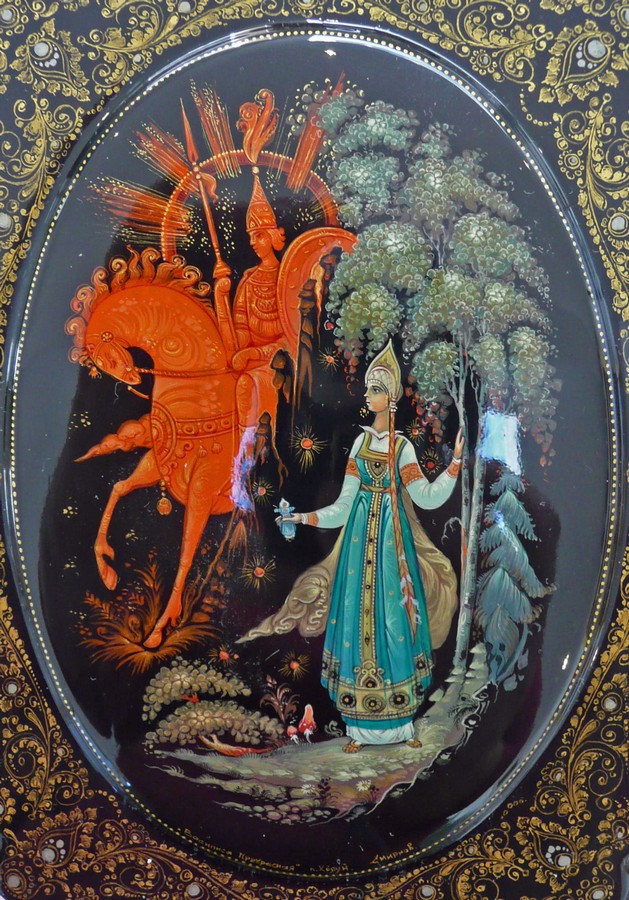
These titles were written for schools use. Although they are not directly related to Topsham, they paint a picture of social history and life in Britain from World War One up to World War Two. See also: People at Work 1930s-1980s and Shops by Cherry Gilchrist, also published by Batsford Educational.