Enoch and Eli – the heroes of Black Country Wit

‘A Long Long While’
I first heard this story delivered with great relish in a folk club in Birmingham, back in the 1960s. The story-teller was Alan Bishop, a bearded native of Blackheath in the Black Country. It wasn’t the last time I heard it either, as it was one of Alan’s favourites, and he would end it with a gleeful grin, while he waited for the punch line to sink in. Alan was in fact so fond of this story that his family made sure it was recited it at his memorial service in 2017.

It’s bin a long, long while since fust this tale was told
You’ll laugh your eyes out when you hear it, as Eynuck did of old

Two men went sanking down the street
When soon two fighting dogs they hied
They stuck ‘em in an empty butt, lid on
To fight it quietly out inside

Now yow con fight to your heart’s content
And both stood nigh to listen
Bist gonna have a bet? said one
Now tell me, bist or bissen?

They placed their bets the while
And the clamour in the butt was chronic
What thrills they got from that there fight
It was better than a doctor’s tonic

But soon alas, dead silence reigned
And each mon looked at t’other
They raised the lid – an empty butt
Them dogs – they’d etten one another!

I think the title would be better as ‘Them two dogs had etten one another’ – but then that would give the game away. But isn’t there more to this story than just making you laugh? True, it’s yet another comic tale in the traditional Black Country fashion, with a preposterous ‘double take’ conclusion, but I think there’s something of the metaphysical in it too. After all, when cosmologists and theologians struggle with the question, ‘How did Something come out of Nothing?’, then surely, a convincing answer to the even more difficult question of ‘How does Something return to Nothing’, deserves serious consideration. Yes, ‘them two dogs had etten one another’, and that settles it.

Folk singing duo Pam and Alan Bishop, at the Grey Cock Folk Club, Birmingham, in 1969.

And this is just one of a multitude of Black Country jokes and stories. Why is it such a ‘funny’ place? Why do people still tell jokes the whole time, especially, it seems, in pubs? When writer and actor George Fouracres, returned to his native Black Country to research an article on Black Country humour , the first person he asked was his father. “Everyone round here thinks they’m a comedian,” reflected his father. Black Country folk, he reckoned, will always find a way to “av a loff abaat” whatever situation they find themselves in.

Enoch and Eli
These are the mythical duo who drive the juggernaut of Black Country jokes. They are very often the narrators of the stories, tripping each other up in dialogue, scoring points and laughing at the ways of the world. In the tale above, only ‘Eynuck’ (Enoch) appears, but his pal Eli is always just around the corner. The pair, often referred to in Black Country dialect as Aynuck and Ayli, have become the stock characters , often of stories where one of them makes the other the butt of the joke. Aynuck and Ayli have weaseled their way into cartoons and comedy clubs, and have even had a reading room named after them. More on their origins later.

Black Country humour
Black Country and Brummie humour is dry, sharp and mostly delivered dead pan. The inhabitants love to send themselves up, as well as everyone else. Given that ‘meat’ and ‘mate’ are pronounced the same, along with ‘bison’ and ‘basin’, and ‘whale’ and ‘while’, there’s a fund of jokes to be had about these potential misunderstandings.

Aynuk: What’s the difference between a buffalo and a bison?
Ayli: I doh know, I’ve never washed me hands in a buffalo.

Aynuk and Ayli were fishing in the canal:
‘Me mate’s fell in the canal !’
‘Owd it appen?’
‘I just took a bite ov me sanwich an me mate fell out.’

Ayli, Aynuk and their mate Noddy Holder go into a clothes shop and Noddy says to one of the assistants, ‘I’m re-forming Slade, I want to buy some new stage clothes. I need a pair of flared trousers, a wide collar shirt, platform boots and a mirrored top hat.’
‘Kipper Tie?’ asks the assistant.
‘Oh thanks,’ says Ayli and Aynuk ‘Two sugars and milk
please.

Even ducks don’t get off lightly in the Black Country

Leaving the puns hastily behind – there’s plenty more in that vein- it’s worth digging deeper into the nature of Black Country wit. The jokes are often about people being daft or stupid, at least on the face of it. But there’s usually a wry twist, a double take, a lightning quick reversal of expectations which kickstarts a guffaw. This kind of wit tickles your brain. It’s a type of humour in the tradition of the Wise Fool, similar to the Turkish and Middle Eastern stories about their folk hero, known as ‘Nasr Eddin’ or ‘The Hodja’. It appears to be ridiculous but is often rather clever.

Aynuk: People always say as Black Country folk is thick, doh ‘em?
Ayli: They do, mate.
Aynuk: Well I read in the paper as ‘ow the population of London is the densest in the whole country.

Yes, right! Insult them, and they’ll find a crafty way of turning it back on you. Indeed, the Black Country has long celebrated its own wit. T. H. Gough’s cheap-and-cheerful collections of Black Country Stories were a popular seller and ran to five volumes in the 1930s. I have one on my shelf now.

I’ve been around Brummie and Black Country humour since I was about ten – although I’m not completely a native, I spent my formative years in the Birmingham area. I am told I still break into a Brummie accent when excited. Strictly speaking, Birmingham and the Black Country are not exactly the same thing, but for many of those years, we lived on the edge of the Black Country itself, near Aldridge and Walsall. The two areas – Black Country and Birmingham – have much in common, but as Birmingham was industrialised earlier, its local customs and language were diluted to a greater extent, as it grew into a city and had a influx of workers. The Black Country – an area covering the boroughs of Dudley, Sandwell, Walsall and Wolverhampton – is said to have retained its distinctive outlook and language for much longer. However, the name ‘ Black Country’ has been in use for a while, at least as early as the 1840s, referring to the seams of coal prevalent in the area, or the soot which began to cover everything .

Another page from Douglas Parker’s ‘Aynuk and Ayli’s Black Country Joke Book’

Black Country dialect is a rich heritage which is valuable to the English language as a whole, as it’s apparently the closest one we have to Middle English. It’s Germanic speech – note the ‘bis and ‘bissen’ in the dog story at the start, similar to German ‘Du bist’, meaning ‘you are’.

When I gave a talk once at the British Council in Florence, Italy, I was put up for the night by the director of and his wife. They were a highly educated, well-spoken couple who you might assume had come from the Home Counties. But no, they were proud natives of the Black Country, and completely bilingual. They loved to speak ‘Black Country’ together, impossible for an outsider to understand and very useful, they told me, when they didn’t want their children to understand what they were saying! Sadly, I also learnt from them that schools had in their day tried to drum Black Country speech out of the children, and the ‘nippers’ ended up with one language for the classroom, and another for the playground.

Black Country words describing what children (nippers, babbies) might be doing
Riling is fidgeting or rolling about
Slummocking is standing or walking in a slouching, slovenly way
Chobbling is chomping or munching loudly, especially on your rocks (hard sweets).
Blarting is crying or sobbing.
Clarting about is messing around.
Wagging it means playing truant

Note how the author, T. H. Gough, despite making collections of ‘Black Country Stories’, still refers to the dialect as ‘vulgar’ and of ‘the uneducated class’.
This volume was published in 1935

Language coach
If you’re concerned that you might not be able to master the accent, then there are guides to help you. I have in my possession Aerbut Paerks of Baernegum: Six Dialect Monologues by Graham Squiers, published in 1923. Fork out one shilling, and you could be speaking like a native – even if it wouldn’t perhaps be considered quite culturally appropriate today. But in the grand old days of the monologue (think Stanley Holloway and ‘Albert and the Lion’) it would indeed ‘be a loff’.

Here’s Aerbut (Herbert) getting married:

‘Ah kid. I’m sorry as yo couldn’t get orf from ther waerks and cum to ther weddin’. We daint ‘arf ‘ave a tim I tell yer. I took Gaertie t’ave ther banns put up faerst. Ther bloke wanted ter know ther date of me baerth, and wot I waerked at and ‘oo my old mon wos, and ‘edaint ‘arf get shearty when I told ‘im I’d got a strorberry mark under me left ear’ole. Then he arksed Gaertie if ‘er wos a spinster. ‘Er says, “Gar off, I’m a baernisher of caertin ‘ooks.”’
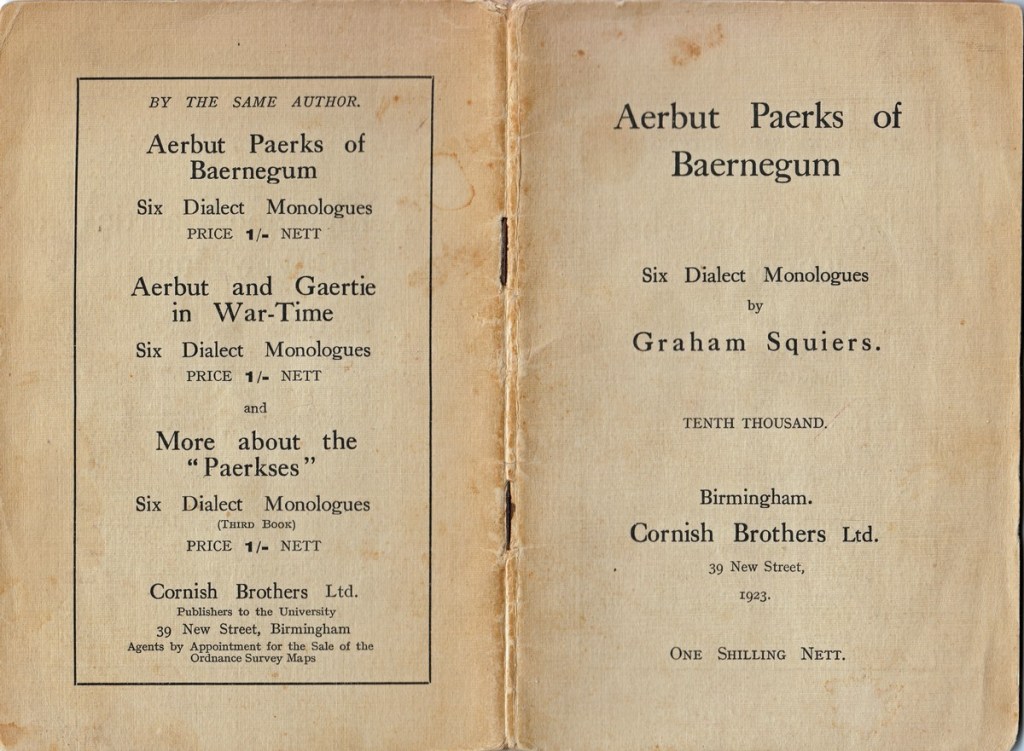
Could this be the script for a star turn at a dinner party today? Probably not.

But the double act of Herbert and Gertie Parksis trumped by that of Aynuk and Ayli, the favourites in all the stories and jokes, the duo with the innate shrewdness of the Black Country folk. How did these names come to be chosen? After all, Eli was a High Priest of Shiloh in the Bible, and Enoch an ancestor of Noah who ‘walked with God and was not’. Not much to laugh about there, surely? Such resonant and robust Biblical names were popular in the 19th century, though, especially in non-conformist families. Black Country expert Jon Raven confirms that ‘Methodism had a particularly strong foothold in the Black Country amongst all strata of society.’ (Although he goes on to explain that the Methodists and the similarly numerous Wesleyans were often at each other’s throats!) According to one source, the pairing of the two names Enoch and Eli originated in the late 19th century music hall, as used by comedian Ernie Garner. (Little Book of the Black Country – Michael Pearson, History Press 2013). Somehow, they passed into local culture and became a permanent fixture. Aynuk and Ayli was the name of a much-loved comedy duo (John Plant and Alan Smith), well-known in the Midlands from 1984 to 2006.

Joke Themes

The pub has remained a prime source of material for jokes, as well as a venue where people are still eager to listen to them:
Aynuck and Ayli in the pub.
Ayli: Doh drink no more, mate, yo’ve ‘ad enough.
Aynuk: ‘Ow do yer mek that out, I ay drunk.
Ayli: You must be, yer face is gerrin’ blurred already.

The Dog
Dogs are popular in other A & A jokes too:

After seeing the sign in the big store, ‘Dogs must be carried up the escalator,’ Aynuk spent three hours trying to find a dog.

Aynuk went round to see Ayli’s new dog which kept barking and leaping up at him as he walked up the path.
‘My word ‘e doh ‘erf bark some,’ said Aynuk,
‘Yes’, said Ayli, ‘but you know the saying ‘a barking dog never bites?’
‘Ar,’ said Aynuk, ‘I know the saying and yo know the saying but does you’r dog know it?’

The ‘Ooman
The wife and mother-in-law as tyrant, nuisance and millstone was often the butt of old Black Country jokes – maybe this has changed a little now, with the advent of sharp-witted Black Country female comedians such as Josie Lawrence and Meera Syal? So I shall ignore those sorts of joke, except for this one, which I reckon helps to level up the playing field.

A little lad went home feeling really excited that he’d been chosen for the school play. He told his father, ‘I’ve got the role of an old married man’ His father patted him on the head sympathetically. ‘Never mind son,’ he said, ‘maybe next year you’ll get a speaking part.’

Daft Jokes
And then there are the plain daft ones, which nevertheless make you giggle:

Aynuk: How do yo stop moles diggin’ in the garden?
Ayli: Hide all the shovels.

Aynuk: How many hundredths are there in an inch?
Ayli: Cor, there must be thousands, mate.

Grandiose ideas
Black Country folk like to dream big:
Aynock thought Ayli was in need of a little further education so decided he would take him to the big city, Birmingham.
Aynock led him round the city explaining what building was what, and the local history attached to them. Eventually they arrived at Victoria Square, and by this time Ayli’s brain was in a right spin. Suddenly, Ayli turned and saw the large building and said to Aynock, ‘Is thet a palace our kid?’
‘Naa’, says Aynock, ‘that’s the Council House.’
‘Bloody hell,’ says Ayli, ‘I’ve got me name down for one of them.’

From Jon Raven’s ‘Tales from Aynuk’s Black Country’
‘E is for ‘Ere-ya-go’ – jig along to this delightful Black Country Alphabet Song

More Black Country words
I’ll finish off with a few more delightful dialect words and expressions:
Scrage means to scratch, scrape or graze the skin.
Fittle is food, and ‘bostin’ fittle’ is ‘great food’
Yampy means daft, or someone who’s losing the plot.
Never in a rain of pigs pudding means something will never happen.
Clarting about is messing around.
Noggy means old-fashioned or outdated.
Fizzog is a face (from the word physiognomy); tell someone to stop sulking with, ‘Put yer fizzog straight.’
Oil tot means feeling satisfied and happy, from the days when working men would have a tot of olive oil before drinking beer, in the belief that it would stop them getting very drunk.
Go to the foot of our stairs! is a local exclamation of shock or surprise.
This ain’t gettin the babby a frock and pinny means ‘We’re wasting time’.

So, for now, Keep out th’ossroad! (Mind how you go!)
Ta-ra-a bit! (See you!)

Contribute to the post – If you’ve any Black Country jokes or words that you’d like to share (keep them clean, please!) just submit them via the Comments/Leave a Reply box. They’ll appear on site as soon as I’ve had a chance to ‘approve’ them.

Update! My good friend and former Archers’ scriptwriter Mary Cutler has contributed a few, from her lifelong association with Birmingham and the Black Country:

‘It’s looking very black over Bill’s mother’s ’ – It’s likely to rain soon.’

‘Outdoor’ – Off-licence

Yam yams’ – affectionate (local) appellation for people with a strong Black Country accent

‘Go and wash your ickle donnies’ – to a child

References

Black Country words in this piece are contained in an article in the Birmingham Mail

Tales from Aynuck’s Black Country, Jon Raven, Broadside 1978.

Acknowledgements

Many thanks to my old folk singing buddy, Pam Bishop, who supplied photos and a copy of ‘It’s been a long, long while’. View her website here.

Thanks to renowned singer Peggy Seeger, who helped me with general queries about folk music in the 1960s. This is a link to the description of the Radio Ballads (see below) on her website.

And to another folk buddy, collector Doc Rowe, who re-discovered the photo below and sent it to me. Find Doc’s website here.

How I became interested – My interest in folk song, stories and language grew strong through my connection with BBC Radio producer Charles Parker, who with Ewan McColl was responsible for the iconic Radio Ballads. In Birmingham, in the mid 1960s, I was a member of the regular folk workshop run by Charles, along with Pam and Alan Bishop, (who are featured at the start of this post) I dedicated my book Your Life, Your Story: Writing your life story for family and friends, to Charles Parker.
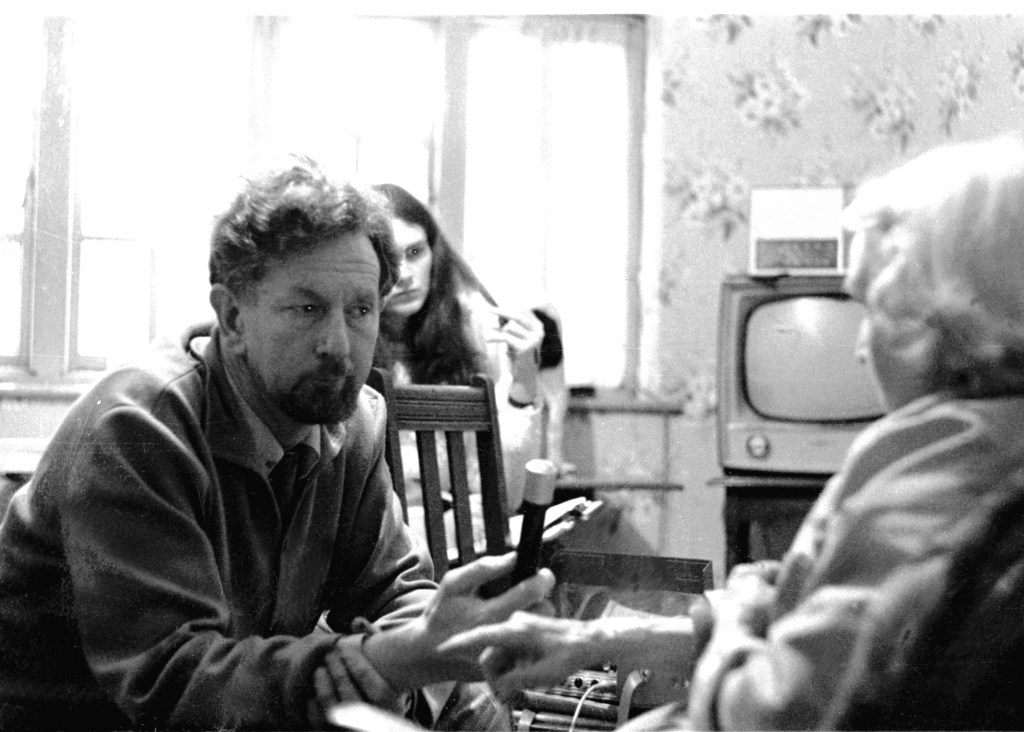
Here I’m sitting with Charles Parker while he records the folk singer Cecilia Costello in the Jewellery Quarter of Birmingham. I was 18 at the time. Cecilia is best remembered for her haunting ballad, ‘The Grey Cock’, which gave its name to the longstanding Birmingham folk club.

Hidden Topsham

Hidden Topsham – Part One

‘If you walk’… This is the first part of a look at ‘Hidden Topsham’, and it’s a series of invitations for you to explore certain nooks and crannies of the town, both here through my post, or perhaps in person. One of the delights I’ve experienced from living in Topsham is the continual discovery of features and stories which are hidden from normal view, perhaps by the obscurity of their position, or their concealed history. Topsham is a town of unexpected twists and turns, as I’ll reveal later. But I’m going to start with two stories from the edge of the town.

The Mourne Lass in her current position on the River Clyst, near its meeting point with the River Exe on the edge of Topsham

The Mourne Lass

If you come from Darts Farm, just outside Topsham, and take the footpath a short way further towards the town on the left, it will take you through a little-known part of the Topsham area, passing some charming cottages, and then running along the back of Odhams Wharf and Tremletts Quay. Here, if you look towards the River Clyst, you’ll spy a dilapidated blue boat called ‘The Mourne Lass’. I had long wondered what her story was, and how she had got there, so I did some digging.

Mourne Lass in her sailing days

She has in fact a venerable history as one of the oldest fishing vessels in Brixham. It seems that she is probably about seventy years old; in an undated post, her owners in recent times ask for advice on restoring her, saying that  ‘The ‘Lass’ is a an ex-MFV, which we are working on in an attempt to give her a new lease of life in her retirement. We need to replace the 60 year old deck, but we can’t afford (time and money) to do this for a few years.’

Berthed at Topsham Quay a few years ago

For a spell, she was berthed at Topsham Quay, but now appears to be slumbering in the waters and mud of the Clyst. In her glory days, she continued to sail in Brixham even after she was decommissioned, and to take part in the famous Brixham Trawler Race. Watch her overtaking the competition in this YouTube clip from 1993! (NB – if your device doesn’t show the correct clip, please refresh the page, as there was a slight glitch earlier)

Tryphena Gale (‘Thomas Hardy stood here’)

If you stroll to the back edge of the Topsham cemetery, you will find the memorial to Tryphena Gale, 1851-1890. Tryphena was the wife of Charles Gale, the landlord of the South Western Tavern in Fore St (now the Co-Op, and formerly Drakes Inn). But she was born Tryphena Sparks, and was the beloved of Thomas Hardy, one of England’s most famous writers. They were probably engaged for a while, though the evidence isn’t clear. She was also a relation of his – the usual version is ‘cousin’, but some sources hint that she may in fact have been a niece, which would have meant that any relationship would have been forbidden. In the photo below, Hardy is aged sixteen, and Tryphena looks to be in her twenties.

Both went on to marry other people, though Tryphena first trained as a teacher and became headmistress of the Plymouth Day School before her wedding to Charles Gale. The couple must have been comfortably off, as they ran an antiques business next door to their tavern, and also owned The Steam Packet pub (now Route Two Café).

Thomas remained close to his former love, and was apparently devastated by her early death, caused by childbirth just before her thirty-ninth birthday. In a poem to mark her passing, he refers to her as ‘my lost prize’, and laments that:


Not a line of her writing have I,
Not a thread of her hair,
No mark of her late time as dame in her dwelling, whereby
I may picture her there.

(Thoughts Of Phena – At News Of Her Death)

She had become a woman of the town. As ‘Exeter Memories’ records: ‘Tryphena was well known in Topsham for working to improve the lot of local fishermen – at her funeral, her coffin was carried by some local fishermen to the graveside. Sometime after the funeral, Hardy cycled to Topsham with his brother Henry and visited the grave – he left a note on the grave saying “In loving memory – Tom Hardy”. He was not given a warm welcome when he called on Charlie Gale to pay his respects’

If you stand by her grave, you may like to remember: ‘Thomas Hardy was here too.’

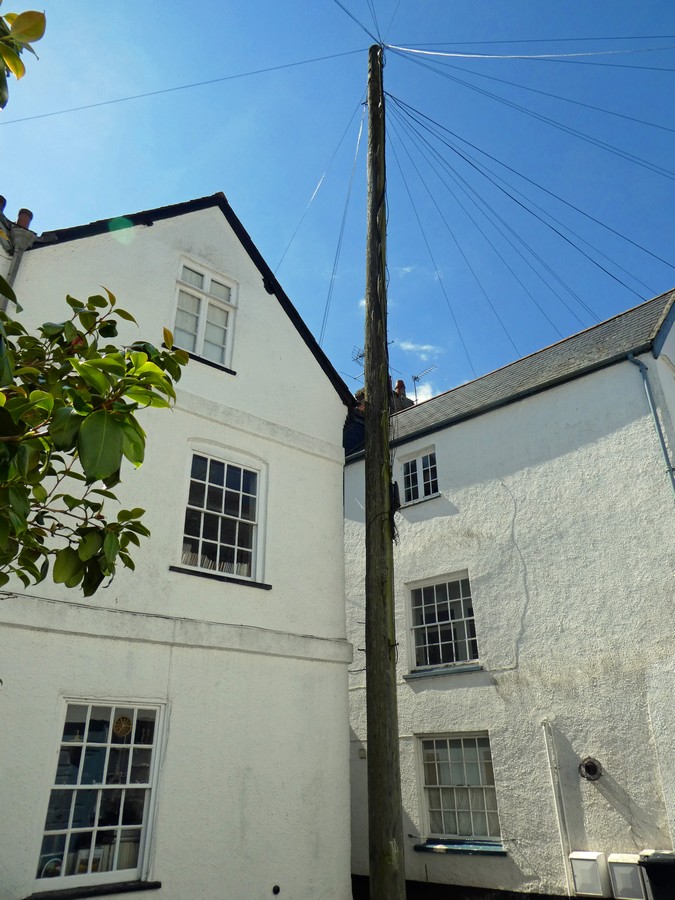
The listed telegraph pole. How did they get it into place?

Twists and Turns

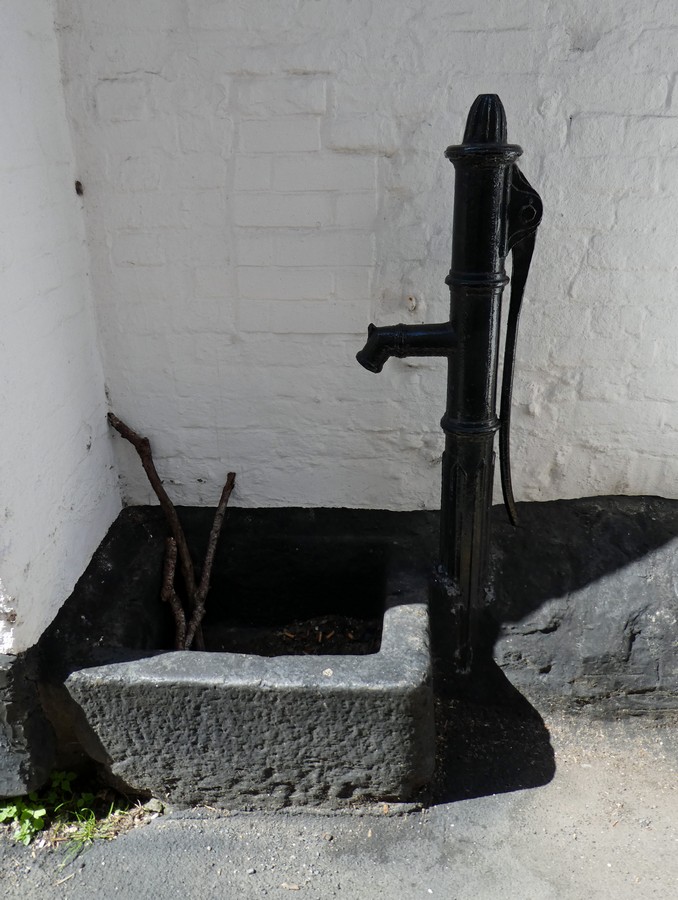
As a Topsham guide, I love to lead visitors into some of the little alleyways. Even locals aren’t always aware of their existence. If you enter the one known as Trees Court, which leads up the side of Lily Neal’s bookshop on Fore St, your sharp eyes might spot a date over the side door, and one of the various old pumps which are studded around the town, in the cobbled yard behind. But perhaps you wouldn’t immediately remark on the huge telegraph pole in the middle of this open yard, or realise that it’s a Grade Two listed monument. This was in fact the first telegraph pole in the town and through the little window seen on the bottom left, the post master or mistress used to deal with the business of sending telegrams from the town. No one is quite sure how they managed to bring such a tall pole into position, especially as it has an extra 8 meters sunk below ground!

The date above the side door of the bookshop, and a selection of Topsham pumps

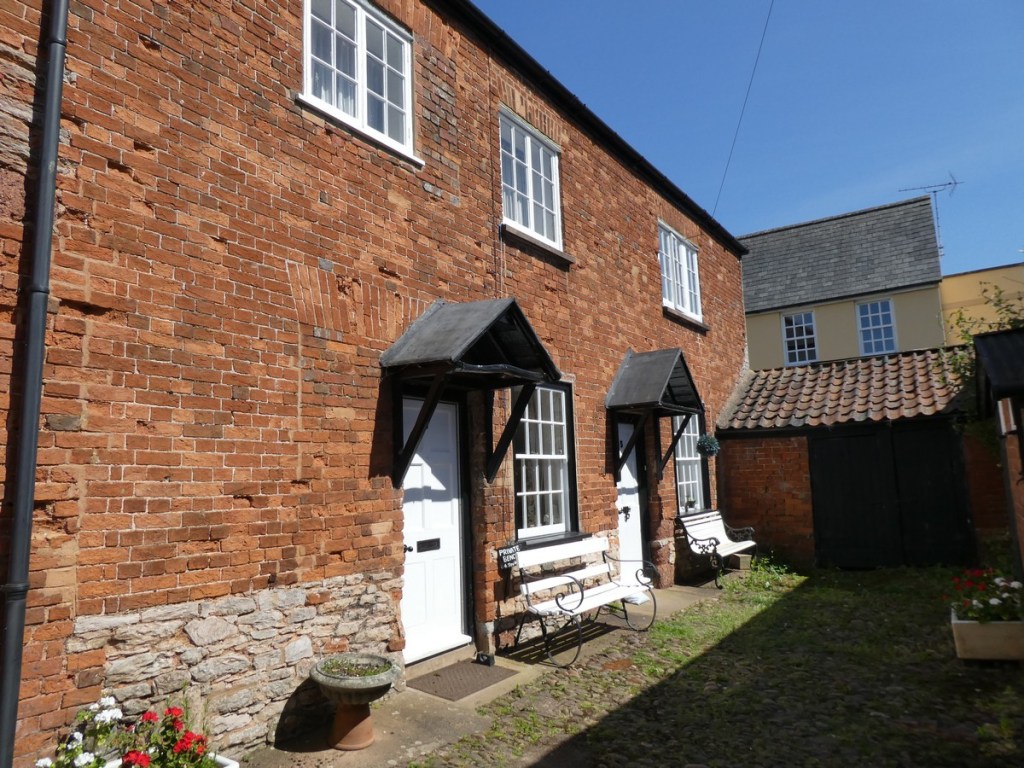
If you follow the alley further, you will see two spic and span examples of old workers cottages, with their privies across the yard.

Workers’ cottages…and their outdoor toilets on the other side of the yard!

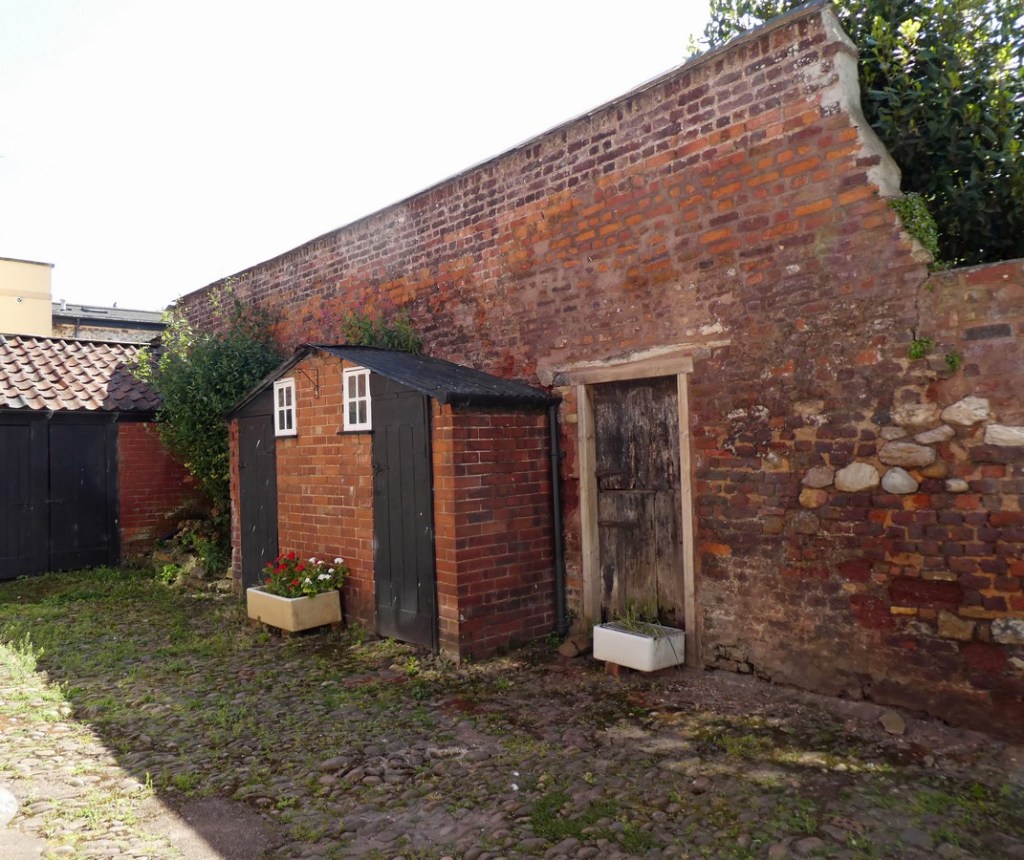
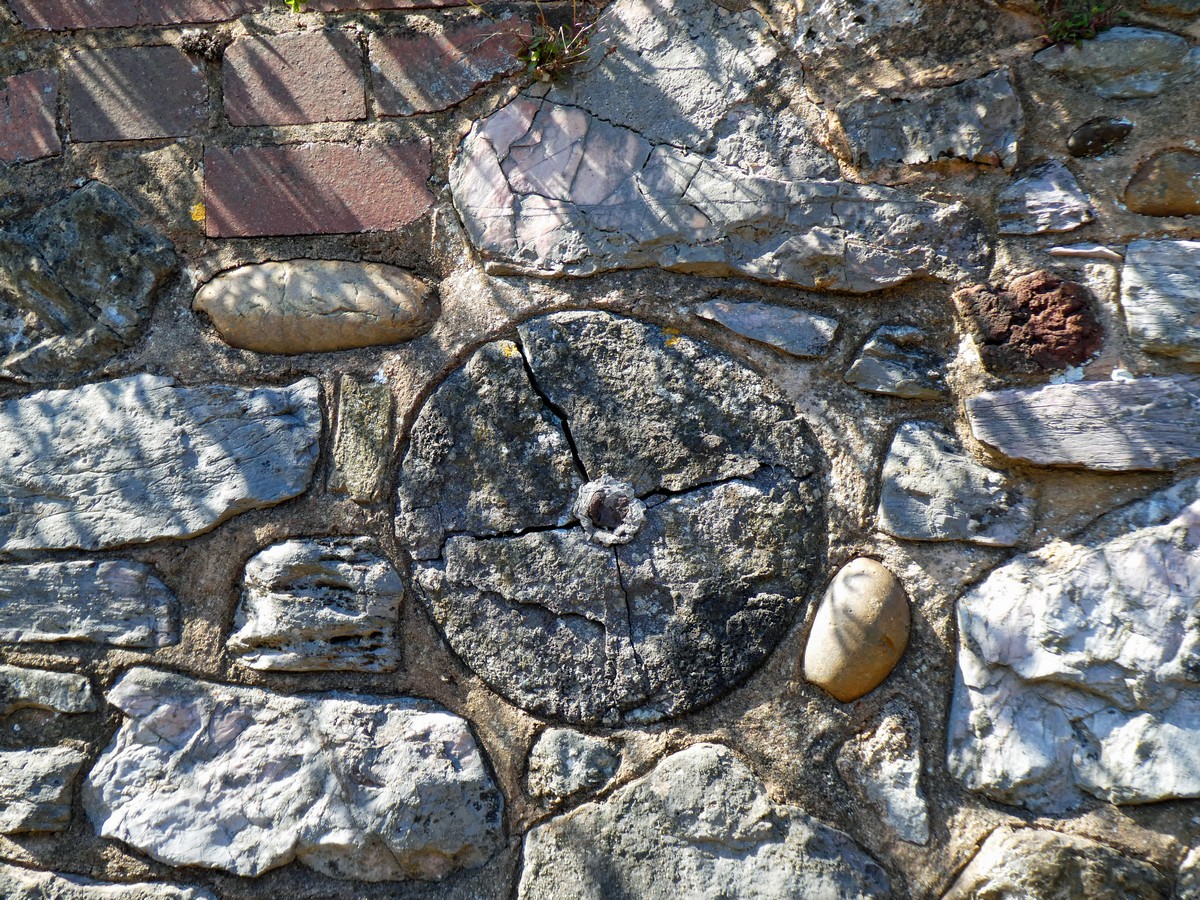
And then you come to what I call ‘the All and Everything’ wall on the lefthand side. If you look closely, you’ll see that it’s composed of Dartmoor granite, volcanic rock, Heavitree sandstone (frequently used in local buildings), and ‘buns’, the rounded boulders found on the Jurassic beaches of Budleigh Salterton and Sidmouth. Not to mention the old grindstone, as I assume it was. Topsham has always been a place of ‘make-do-and-mend’ which sometimes descends into ‘cobbled together’ tactics. When we renovated our house further down Fore St, although the original medieval walls were sturdy, the more recent bathroom wall turned out to be made of flimsy wooden packing cases! Times were hard in the town, when the fishing industry and market gardening declined in the late 19th and early 20th centuries.

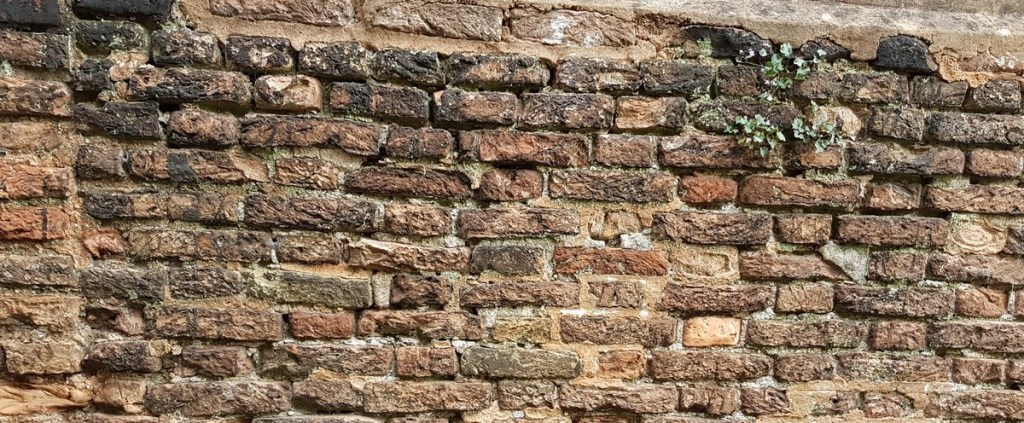
Along this alleyway from Trees Court, you’ll also see examples of Dutch bricks. These are small, narrow bricks which were brought back as cargo or even ballast after Topsham merchant ships exported goods to Holland in the 17th and 18th centuries.
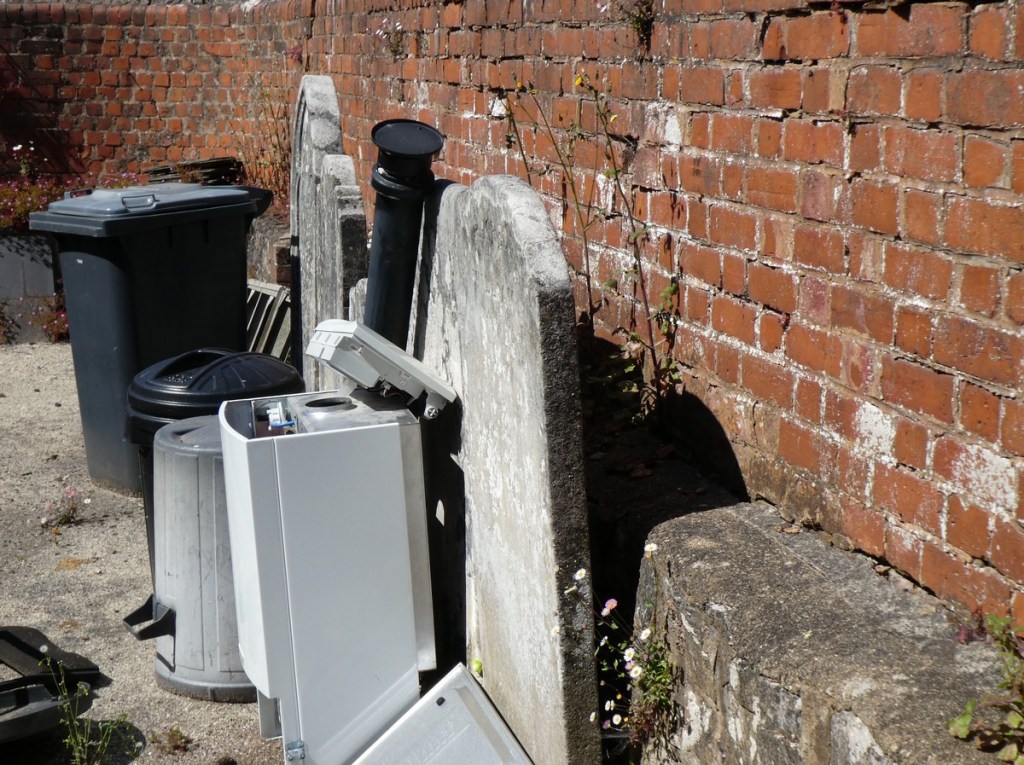
Less picturesque – Dissenters’ graves among the rubbish bins

Finally, just as you emerge on Victoria St, if you peer over the tall wall on the left hand side belonging to the Masonic Hall, you might be surprised. Here, among the dustbins, are the old Dissenter graves, where members of non-Conformist sects were buried at their old chapel.

Glimpses

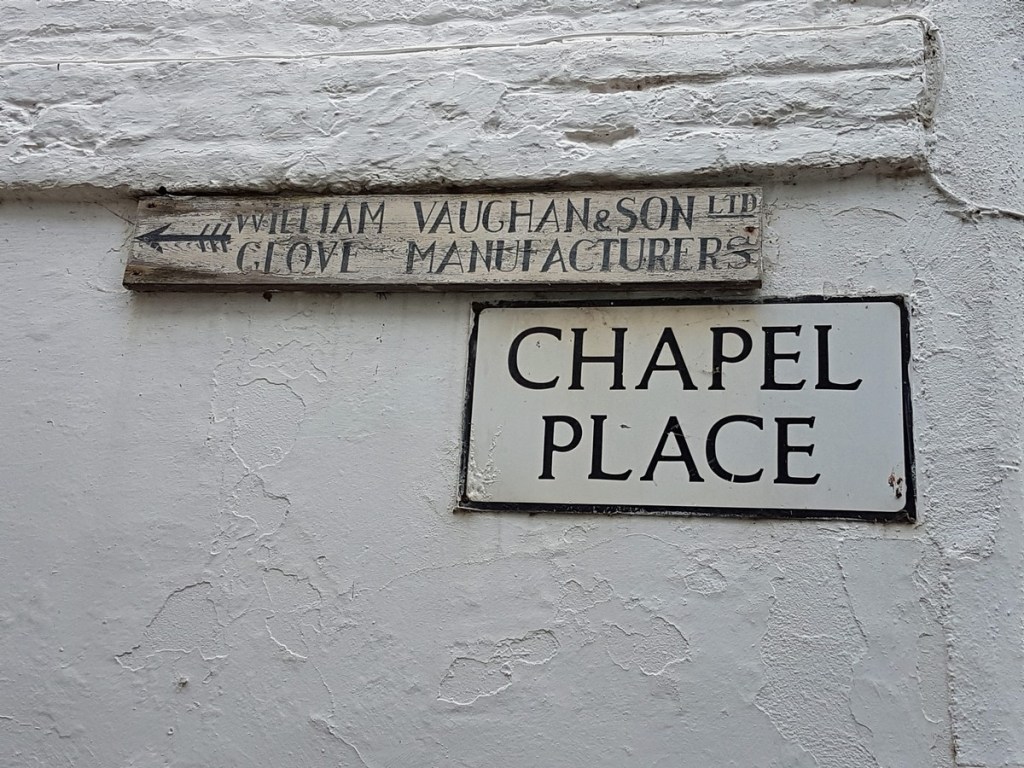
If you walk a little downhill from the place of entry to Trees Court, you will come across Chapel Place on the left hand side of the road. The cobbled path ends with a glimpse of a pleasant-looking, substantial house facing you. The house to the right however, which is even more tucked away, was once a chapel, and later the ‘Cosy Cinema’. Then it became a Glove Factory, as the old sign commemorates. A few years ago, I met a builder in Exeter who was the son of the last glove manufacturers there; he remembered coming home after school to sit among the employees sewing, and play with the scraps of material on the workroom floor.

The Seven Stars

And if you look on the opposite side of the road, you will spy an almost hidden entrance to yet another passageway. Walk up here (it emerges in the churchyard), and see where the mysterious old sign of the Seven Stars Cider House still hangs. What is its story? The author of the excellent Topsham Inns does not know. But someone else has plumbed its secrets. Ray Girvan gives a fascinating – if tongue-in-cheek – account in his own blog ‘Ray’s Secret Topsham’.

Here’s what Ray has to say:

‘The churchyard of St Margaret’s has an intriguing feature, the Hamilton Tomb. This is the tomb of Alexander Edward (‘Ned’) Kelso Hamilton, the young archaeologist on whom Bram Stoker based the hero of his story, The Jewel of the Seven Stars [an archaeological horror story about Egyptian mummies]. Stoker’s title was inspired by the Seven Stars Cider House which can be seen in the small close at the other side of the churchyard (the same location was used in the filming of Cider House Rules).

OK, perhaps this might be stretching a point? But to end the first part of my ‘Hidden Topsham’ posts, I’d like to offer Ray’s solution to another mystery. If you listen to people talking around the town, why is it that some say Tops-ham, and others Top-sham? This has long been a contentious issue in the town, and no one seems to have a definitive or convincing answer. Once again, Ray puts us to rights, speaking first of the King’s Beam, which I featured in my post ‘The Tidal Town of Topsham’:

‘In the late 19th to early 20th century, a stylised depiction of the beam was used as a religious symbol by the Topsamite Reformed Brethren, a non-conformist sect who preached that Joseph of Arimathea had visited Topsham with the young Jesus. The sect is still technically banned by an emergency law passed in 1915 when its leader spoke out in favour of the Kaiser, but it still exists and members can be identified by their secret pronunciation of the town’s name as “Topsam”. It’s of related interest that Oscar Wilde stayed incognito at the quay, “posing as a Topsamite”, before sailing to exile in France.’

So, are you a member of this secret sect?

Next time, I plan to take you up the once wicked White Street, into some Secret Gardens, and to follow in the Queen’s footsteps, among other delights of Hidden Topsham. ‘If you want to…’ of course.

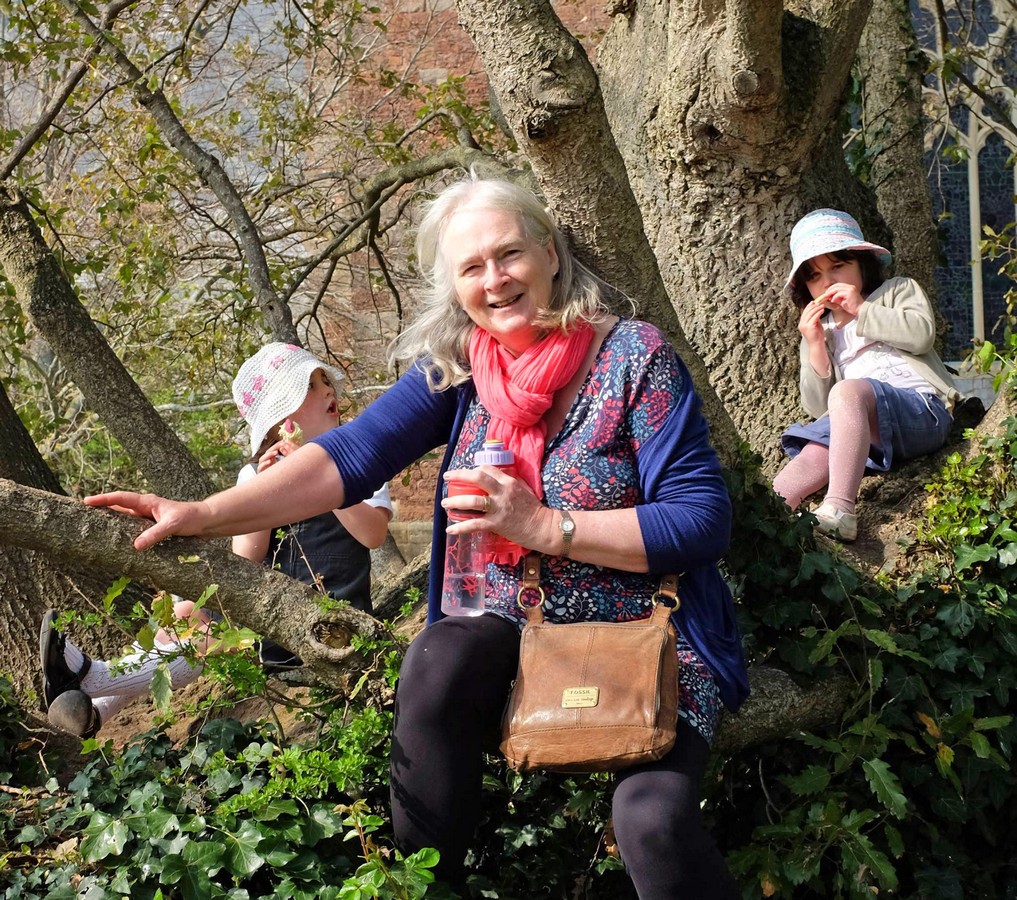
Hiding in the ‘special tree’ in St Margaret’s churchyard with my granddaughters

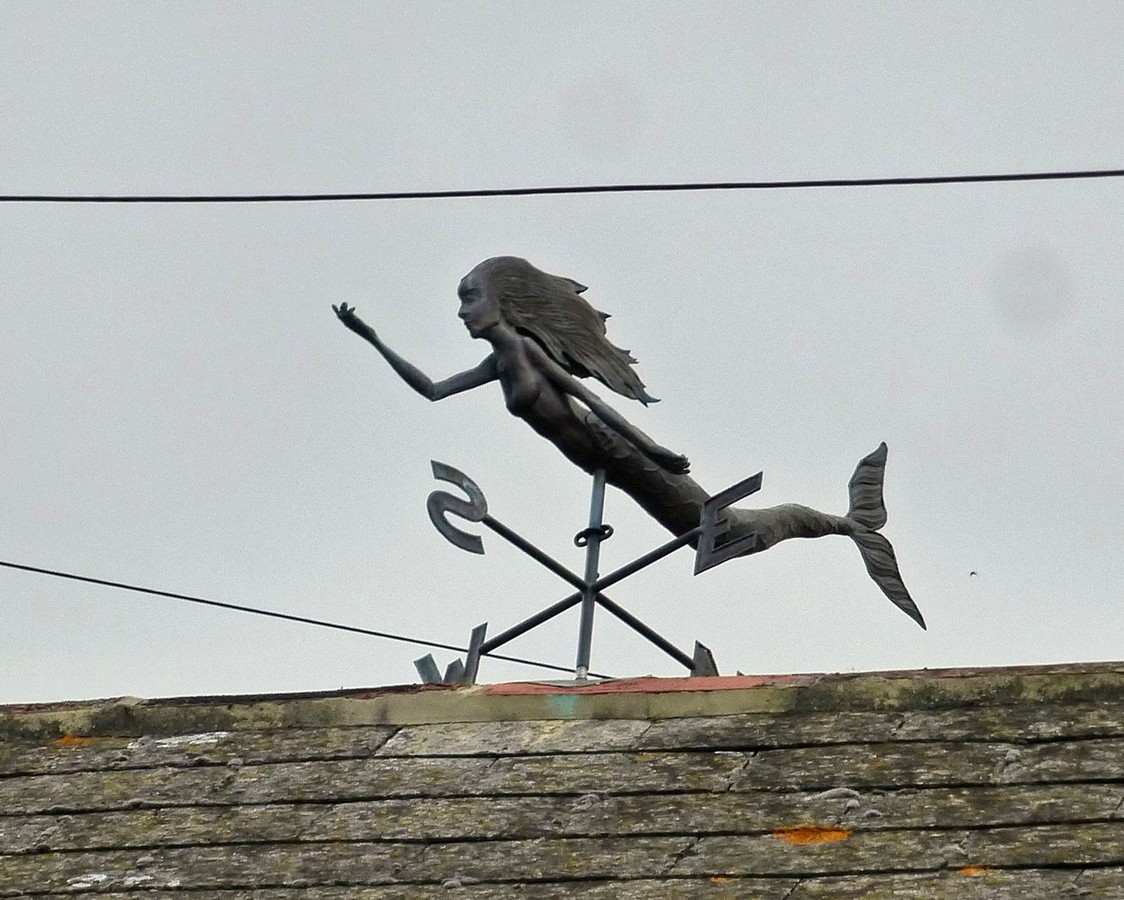
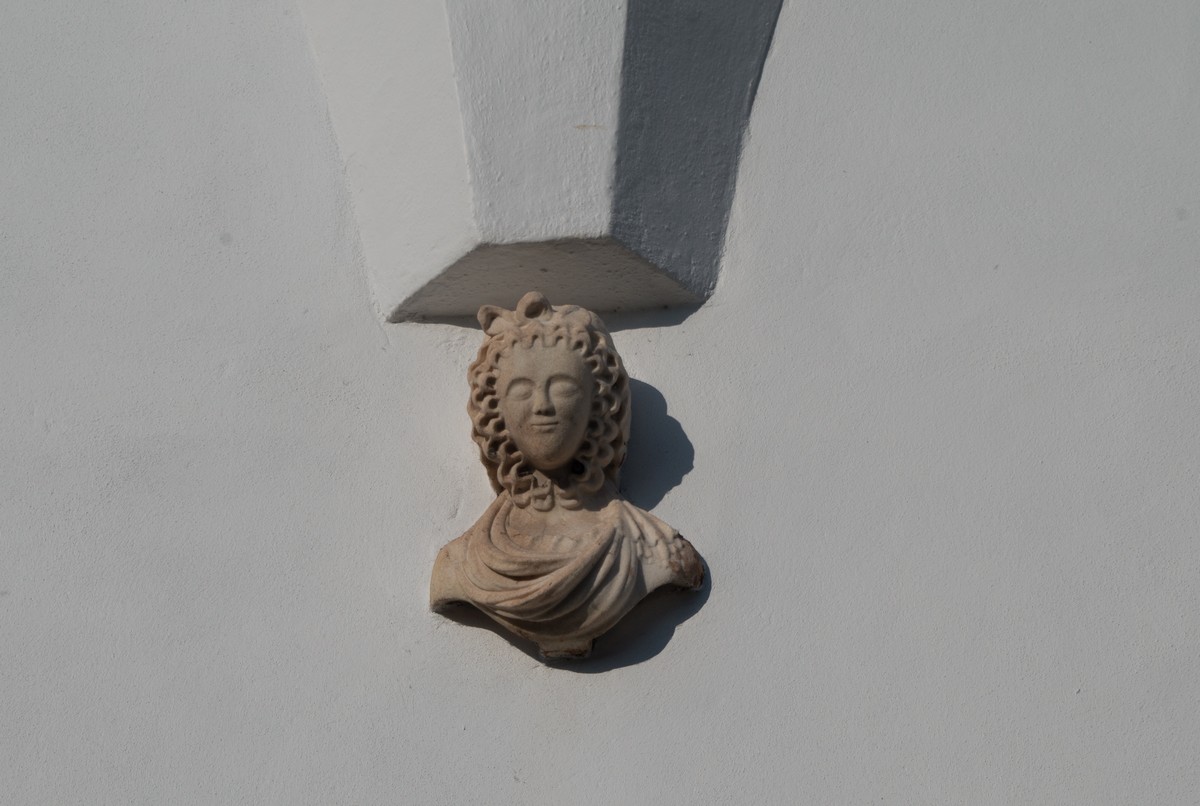
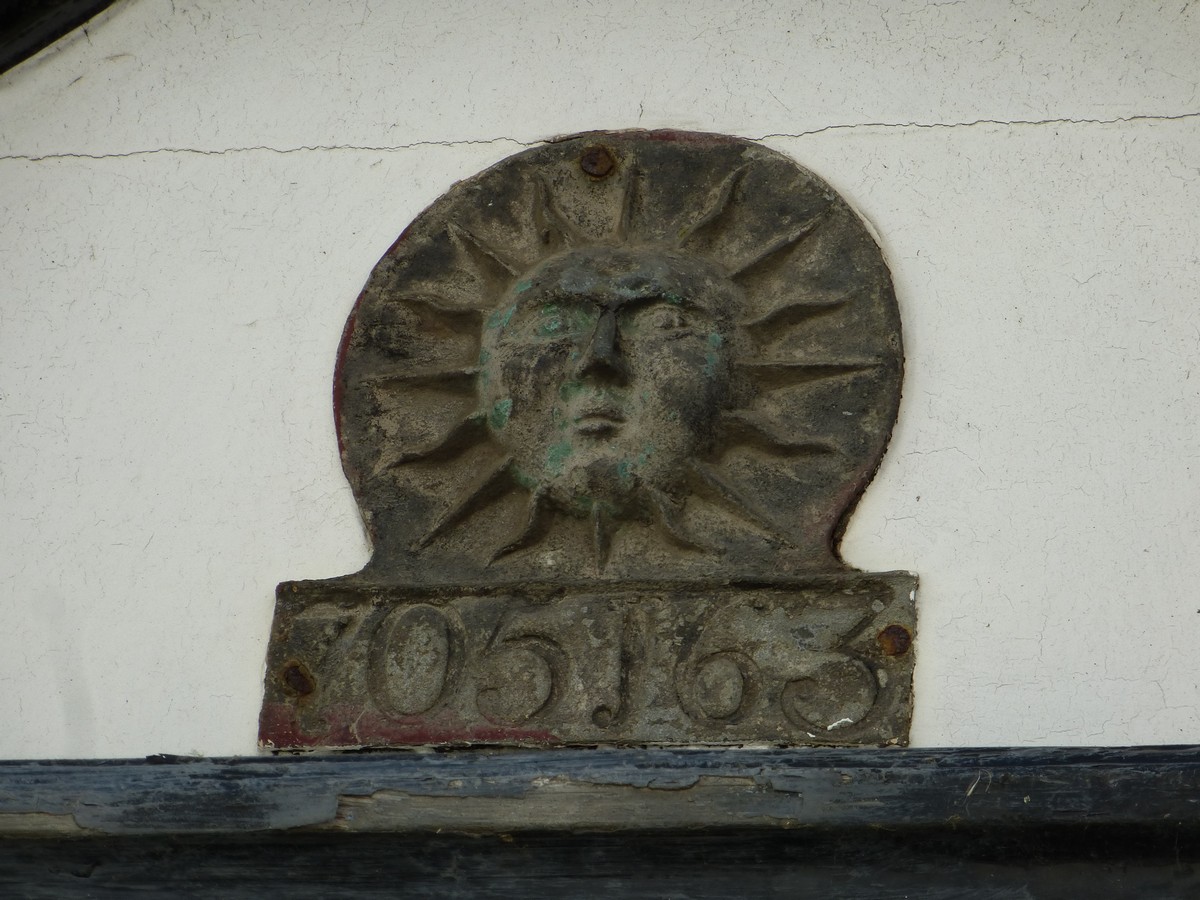
To finish with, here are a few Topsham Fancies – these are the kind of things you may spot if you let your eye wander to the rooftops, the walls, and the porches of the houses of Topsham.

References

Topsham Inns Past and Present, Colin Piper (Topsham Museum 2010)

Secret Topsham, a blog by the late Ray Girvan at jsbookreader.blogspot.com/2014/04/secret-topsham.html  

The Story of the Manor and Port of Topsham, D. M. Bradbeer, (Town & Country Press 1968)

Topsham Past and Present, Chips Barber, (Obelisk, 2004)

Topsham: An Account of its Streets and Buildings, Caroline Obussier (Chevron Press, 1986 revised edition)

Previous blogs you may also be interested in – The Tidal Town of Topsham

Related books by Cherry Gilchrist

These titles were written for schools use. Although they are not directly related to Topsham, they paint a picture of social history and life in Britain from World War One up to World War Two. See also: People at Work 1930s-1980s and Shops by Cherry Gilchrist, also published by Batsford Educational.

Meeting Walter Lassally – Cinematographer and Kabbalist

Walter Lassally shooting ‘We are the Lambeth Boys’ (1959), a Free Cinema documentary
Credit BFI (British Film Institute)

The Meeting – January 2014
As our train pulled into Diss station in Norfolk, Walter was on the platform to meet us. My colleague Rod Thorn and I had seen photos of him, but were unprepared for the sheer energy of this 87-year-old, striding forward energetically to greet us with a long mac flapping behind him. We shook hands with a rugged-faced man, with exuberant wavy white hair, and a ready smile. We piled into his car, which as I recall was on the rough and ready side, and he drove us to ‘The Abbey’ at Eye, his current home just over the border in Suffolk. As the name suggests, this was a former medieval Benedictine Monastery, which had evolved into a large and impressive house. Its permanent resident at the time was Walter’s partner, Kate Campbell. Walter himself was not long back from his second home on Crete, close to where he had filmed Zorba the Greek, his most famous cinematic feat. For a few hours that day, my colleague Rod Thorn and I were able to enjoy Walter’s company, listening to his philosophical ideas and sharing impressions of the Kabbalah group he had studied in, to which we also had connections.

Career

Walter had long been renowned as a cinematographer, in a career that spanned half a century.  He began his career as a lowly clapper boy at Riverside Studios, frequently sent off by the crew to collect cups of tea on his clapperboard, but swiftly moved on to greater things. His career as a cinematographer blossomed at the start of the 1960s, when he made three films with director Tony Richardson – A Taste of Honey, The Loneliness of the Long-Distance Runner and Tom Jones. These titles became key films in the British cinema of that decade.

But the film for which he was most highly acclaimed worldwide came straight after these British triumphs. For his work on Zorba the Greek (1964), Walter won an Academy Award for cinematography.

Yet despite his status as an Oscar winner, which gave him the freedom to work wherever he wished, he largely stayed rooted to Britain and its film industry. He was a leading light in Lindsay Anderson’s radical Free Cinema movement, which favoured realistic, heavy-hitting narratives, shot with flair and imagination. Critics dismissed some of these works as ‘kitchen sink dramas,’ but they effectively portrayed the spirit of those times.

Walter remained a firm favourite with leading British-based film-makers, notably Merchant Ivory, who hired him as cinematographer on three of their major titles: Savages (1972), Heat and Dust (1983) and The Bostonians (1984). Thereafter he continued working on smaller films in various countries until the turn of the century.

This section has been augmented with the kind assistance of film critic David Gritten, best known for his writing in the Daily Telegraph and Saga Magazine. (David@Gritten.co.uk)

Walter in Crete, probably just a few years before we interviewed him

The Soho Group
Our own interest in Walter’s story began when a few colleagues and I started to research the roots of an organisation known as Saros, which we had been involved with for many years. This had started as a series of groups studying the Kabbalah, in its Tree of Life form, as a framework for peronsal and spiritual exploration. (Read more about these groups, their practices and Kabbalah at our ‘Soho Tree’ website ).

But our study groups, which began in the 1970s, were preceded by one simply known as ‘The Group’, which met in the coffee bars of Soho in the late 1950s. Our small band of researchers was keen to explore the connection, and see where our tradition had come from. As we began locating contacts who had themselves been in that Soho group, the name of Walter Lassally kept cropping up. Some former members were even still in touch with him, sporadically. Fired up by the fascinating interviews we were recording, and the intriguing world of 1950s Soho, we were keen to trace this man.

Walter’s Quest

‘My career as world-famous Director of Photography is well known and has been written about ad infinitum. On the other hand my other activities in the realm of philosophy and esotericism are not so well known but have in my estimation been even more important and significant to me than my main occupation.’

So Walter wrote in his later years, for a talk entitled ‘The Universe and the Individual: The Cosmos and the Microcosmos.

Walter’s chief interests were in Tree of Life Kabbalah, especially through the writings of Dion Fortune (her book The Mystical Qabalah was the one most readily available in the mid-20th century), and in the I Ching. He was also a keen and proficient astrologer. As he said to us at our meeting:

‘You have an aim, which can broadly be described as self-knowledge. The saying ‘Know Thyself’ – inscribed over the temple of Apollo at Delphi – is very important. …And now I firmly adhere to the idea that that is the only point of being on earth as a human being. Everything else is peripheral.’

Watkins Bookshop, just off the Charing Cross Road, as it was in 1960. This was about the only place where books on esoteric and mystical subjects were on sale, and was much-frequented by members of the group which Walter joined.

Walter’s Early Life
As we tried to get in touch with Walter Lassally – he had gone off radar, even to his close friends from ‘the Group’ – we started to look into his background. In a series of YouTube interviews, he gives an account of his challenging early years, a remarkable story of persecution and escape.

Walter was born in Berlin in 1926, growing up there during Hitler’s ascent to power. His father worked as an animator of industrial films, and the family seems to have been cultured and comfortably-off financially. However, although the family were Lutheran Protestants, they had Jewish roots in earlier generations, which led to them being classified as ‘non-Aryan’, even though they weren’t technically Jewish. Hitler’s regime clamped down on them. His father was prevented from working after 1933, and Walter excluded from school from 1938. At this point, his father was put in a concentration camp and would only be able leave if the family could prove they had permission to emigrate.

Walter’s mother tried every avenue, nearly securing a job in Canada for her husband, but finally obtaining a Peruvian visa with a transit visa for the UK. Armed with this, she was able to secure the release of her husband, and the family set out on a stressful and risky journey to Dover. Walter clutched his ‘Kinderpass’, stamped with the red J for Jew. They arrived in the UK with virtually nothing, since all their possessions were bombed while awaiting shipping in Bremen, and their valuables had in any case been confiscated automatically by the Nazis. On top of that, Walter spoke no English, a source of anxiety to him at first, but soon overcome by studying so hard that he came second in the English exams at school!

Walter showing the Kinderpass which he kept, stamped with the red ‘J’ for Jew.

In the UK, his father was at first interned as an alien on the Isle of Man, but set free after a tribunal assessment. The family then settled in Richmond, near London, and Walter left school at the age of sixteen with the firm conviction that he wanted to be a film cameraman. He ascribes his interest in film not so much to his father’s involvement, as to his passion for visiting the cinema as often as possible during those war years.

A teenage Walter, perhaps dreaming of his future life in the cinema.
(from his own collection, posted by the BFI)

Finding Walter
We were about to give up our search when a stroke or two of luck enabled us to trace him. It seemed he was probably in Greece. When our Greek friend Byron, another member of Saros, returned to his native country for a while, he agreed to help in the search. Contact was made. He wrote to me later, on Sat, 5 Oct 2013:

When I finally decided to post the letter to Walter to an address I accidentally found from an interview that he had given on the net, I went to my local post office to ask whether there was in fact a post office in that little village in Crete where I was sending my letter to. By sheer ‘coincidence’ the employee at my local post office hailed from Stavros Acroteriou, the very same place where Walter now resides. He didn’t know Walter himself, but described the place to me and also told me that there was no post office there and that the nearest one was in Chania. So anyway thank you all for your ‘intent’ it must have helped in this search!

However, at that point, it was only a distant possibility that one of us would be able to go out to Crete to meet him. But once again, luck was on our side, as he suddenly decided to return to the UK for a while. And so it was that two of us had the pleasure of getting off that train and meeting Walter for the first time in the East Anglian countryside.

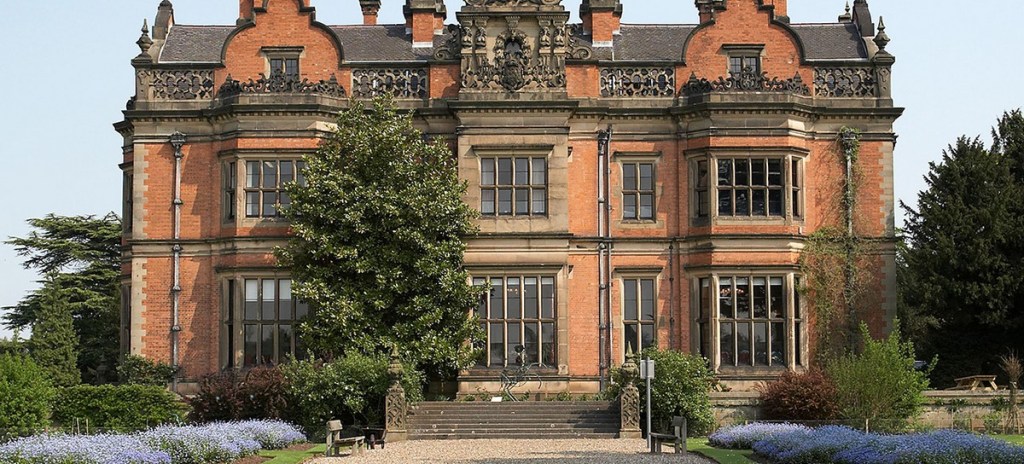
The Abbey at Eye, where we spent the day with Walter Lassally
(This and photo below credit website of the Abbey )
The large living room where we sat with Walter to talk about his memories of ‘The Group’.

Conversation at the Abbey
Walter led us into the main drawing room, an impressive room where we began our talk. Later he showed us his equally impressive study which doubled as a projection room, its shelves lined with reels of the films he had made.

How did he come across ‘the Group’? What aroused his interest? We were eager to hear more about how his search began.

It was probably triggered by an unhappy love affair in the early 1950s, he said. ‘And that led to what I would call the search for the self. Which is still going on…First of all, I turned towards Yoga – I read Paul Brunton’s book, a classic book about Indian yoga, and then I became interested in Gurdjieff and Ouspensky.’

One day in 1956 when he was in Soho, perhaps on film business – it was a hub for the film industry at that time -Walter entered a café where an energetic discussion was taking place. As a person of keen intellect, with a friendly nature and an enquiring mind, I imagine he wasn’t shy about joining in. He hadn’t retained an exact memory of the occasion – the Group met in various coffee bars, but he thought it was probably ‘the “Nucleus” [which] was the centre of it all, the coffee bar in Monmouth Street. And someone was always in there holding forth.’

The cafes were the place where most members of ‘the Group’ first encountered ‘the Work’. They were a magnet for young people, who flocked to London seeking something different and inspiring after the war years. The open gatherings acted as a hub for anyone who might be interested in following up ideas on Kabbalah and its associated practices – primarily meditation and astrology. But it wasn’t about putting pressure on people to join; indeed, the waifs and strays who ended up in Soho were often encouraged to go back home, sometimes with a donation of cash towards food or a train ticket. The ‘Work’, as it was known, was only for those who actively wanted to pursue the aims of knowledge.

Nor was it for guru worship. At the core of the Soho gatherings were three key figures. Alan Bain was the overt leader, and the man who became Walter’s teacher. He was a former merchant seaman, and an accordion player who busked for a crust in the early days after he arrived in London. He was far from being a typical sailor, however, and his life had taken a different turn after a transformative spiritual experience. A second figure who tended to observe from the sidelines, even though he was a teacher in his own right, was former RAF Radar Fitter Glyn Davies, originally from South Wales. Glyn became my own mentor, and later initiated Kabbalah groups which evolved into the organisation known as Saros. The third key person was Tony Potter; he too later founded his own line of groups in London. The talkative one of the three, remarked Walter, was ‘mainly Potter. Potter was great at holding forth, whereas Alan was really quite reticent, a shadowy figure in the background’.


Remarkably, a film clip has survived which shows Glyn Davies, Tony Potter, and astrologer Ernest Page discussing a horoscope in a Soho café. It was filmed for the ‘Look at Life’ series. View it here.

The clip of the three astrologers meeting – Ernest Page, Glyn Davies and Tony Potter – is about 5m 45s into the video

The encounter was an eye-opener for Walter, and what he discovered there became his lifeline. He described this type of Kabbalah as ‘such a wonderful system. It’s both simple and complicated. It covers all the areas…the Tree is a terribly dense, but a relatively simple diagram. It’s not hard to understand, although you can study, and study and study …the Tree in all its aspects, the paths on it, its connections with astrology.’

Group Meetings

At this point, so as not to overburden the narrative of Walter’s story, I’ll refer you again to the ‘Soho Tree’ site we have created, which explains the various teachings that these and subsequent groups practised. It also paints a portrait of Soho life at that time, as a fascinating mix of people and ideas. But here we can track Walter’s progress into a ‘closed’ group, and how he later started to hold private group sessions himself.

These closed groups were where the real focus lay, rather than in the casual gatherings and discussions in the coffee bars.  Anyone who showed a real interest would be invited – discreetly – to a private group meeting. As Keith Barnes, another early member and life-long friend of Walter’s told me: ‘Even the existence of the group was hidden. Everything was kept very quiet, and it was very hard to find out anything.’ But then Keith was handed a piece of paper, an invitation to visit a certain address at a certain date and time. This address turned out to be Walter Lassally’s flat. (Walter was becoming successful in his film career, and able to afford a very nice flat in Holland Park.) ‘There were 20-30 people gathered there, many of whom I’d seen around the West End, plus Glyn and Alan’.

Walter had joined a little earlier than Keith, and was still a regular member on the night that Keith turned up, but a few years later he started running a group. It was common practice in this particular tradition to ‘learn and pass it on’, and to set up groups that could offer a useful starting point for beginners. During our visit, he brought down old notebooks to show us, inscribed with ‘Society of the Common Life 1962’, listing attendance of members and their subscriptions (strictly for expenses only, as no one took a fee for their teaching). Two sample pages are displayed below, which he invited us to photograph.

But it became a tricky matter to balance initiatives related to ‘the Work’ with his own professional work, and his financial affairs. One of the most difficult crises he ever had to deal with came about because of conflict of interests, as we’ll see shortly.

Clip of the famous dance sequence, in Zorba the Greek, released in 1964. Walter Lassally won an Academy Award for best cinematography.
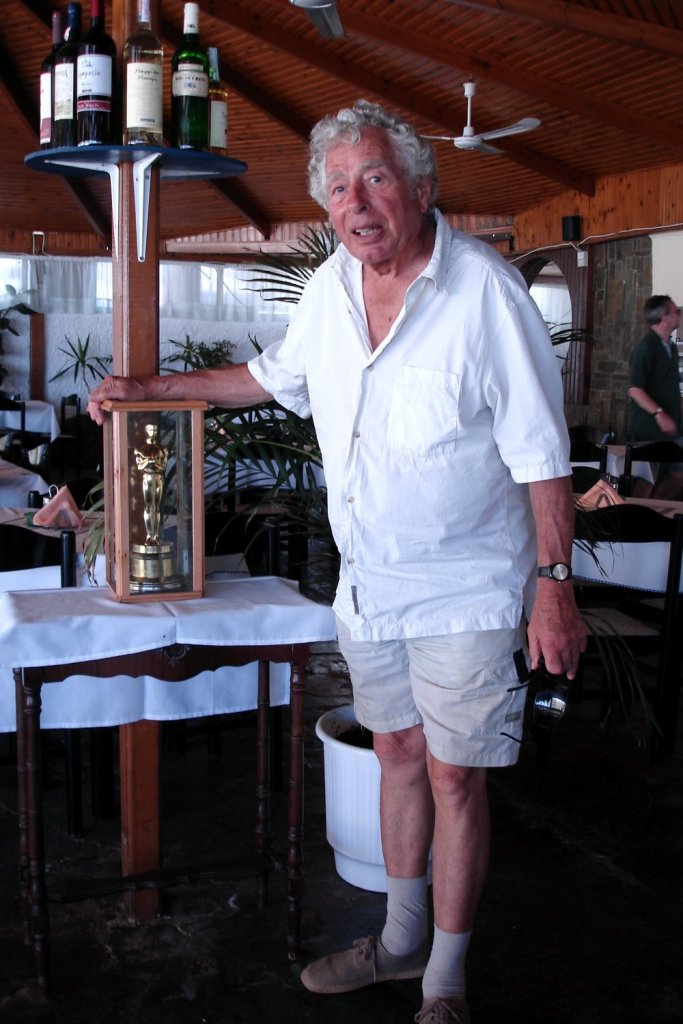
He allowed the award to be displayed in a local taverna in Crete, close by where the filming had taken place. Unfortunately, the place burnt down in 2012, and destroyed the statue.

Meeting Kate
At some point in our talk at the Abbey, we were summoned to lunch, where we joined Kate Campbell, Walter’s partner, and Kate’s son Adam. Kate was the widow of artist Peter Campbell – they had been childhood sweethearts, according to one source – and the Abbey had been their home until Peter’s sudden death in 1989. But Walter and Kate had a relationship which stretched back to the 1960s, during decades of her marriage to Peter, and sometimes the three adults had shared a home, both in London and Suffolk. Kate was also Walter’s business partner for a number of years. There seems to have been a kind of accepted arrangement between the three of them. But even so, Kate’s and Walter’s relationship wasn’t plain sailing – both were strong-minded, and Kate was a feisty person, who did not care for Walter’s more esoteric interests. Rod Thorn and I were treated politely by Kate and Adam, but very much kept at a distance.

Kate and Walter at the National Film Theatre in the early 1960s (Credit BFI)

It’s clear that Walter was very loyal to Kate over the years, but their modus operandi allowed for a part-time relationship. Perhaps ‘the Itinerant Cameraman’ (as he entitled his autobiography) preferred the freedom to travel for work and savour life in Greece. Just after I’d finished writing this section, I watched the film ‘Before Midnight’ (2013) in which Walter actually took on an acting role, playing the part of an elderly English writer (based on Patrick Leigh Fermor) living in Greece. At the dinner table one evening with assorted writers who are staying in his house, the conversation focuses on the nature of romantic love. Patrick, aka Walter, speaks the following lines about his marriage: ‘We were never one person, always two. We preferred it that way. But at the end of the day, it’s not the love of one other person that matters, it’s the love of life.’ Were these words, even if scripted, ones which Walter had produced and which reflected his own long-term relationship with Kate Campbell? I think it’s very likely. ‘Patrick’ also proclaims the inscription at Delphi, ‘Know thyself’, which we know was one of Walter’s favourite sayings.

Kate in her study at the Abbey in her later years

The I Ching

Walter had a great passion for the ancient Chinese oracle known as the I Ching. ‘The advice that you get – I did one yesterday – is absolutely to the point. It’s unbelievably practical,’ he told us.

Although the I Ching is well-known today, it was far less so when Walter began to use it around 1960. Remarkably, Walter kept a record of nearly all of his readings, which he later turned into a book called Thirty Years with the I Ching. (He probably practised it for over fifty years, although the book stops short of recent readings for discretion’s sake.) In the event, he failed to find a publisher but left a legacy of a photographic copy on his website.

The opening to the book states: ‘Some of my questions will be seen to refer to something I call the Work. This was the general term I used to denote the ongoing process of the ‘search for the self’ referred to earlier, and which for some years I conducted as a member of the Society of the Common Life, a small group dedicated to this search.’.

Every reading that he includes in the book quotes sections of the relevant I Ching text, with his interpretations of these, both at the time and retrospectively. He uses the classic translation by Richard Wilhelm, which has an introduction by Carl Jung.

Walter’s questions centre chiefly on a trio of concerns: ‘the Work’, his professional film work, and his relationship with Kate Campbell, referred to as ‘K’. On one occasion Walter asked the I Ching whether he should try and keep Kate in the group – the answer was that it would do no good to try and force her! She attended just once or twice, and remained suspicious of it thereafter.

Some questions were less about problems than to seek a balanced view of a situation. On Sep 2nd, 1961, Walter asked a question about the Kabbalah group he was running: ‘What is the present state of the group?’ The I Ching offered two hexagrams – no. 11 Peace turning into no. 55 Abundance. These are plainly favourable situations, and Walter reflects in hindsight: ‘The period in question turned out to be one of the best periods in the life of the group; the traumas connected with the over-ambitious purchase of the lease of the house [more on this below] were by now forgotten, and the group could get on with some productive work.’

Conflict and acceptance
But there were also tricky issues that kept cropping up, and one in particular related to Walter’s teacher Alan Bain. Alan was someone that I knew quite well in later years, and I can vouch for the fact that he was not a straightforward character. Although he didn’t seek to profit personally from his teaching, he had a weakness where money was concerned. As Walter put it: ‘He lived a very easy-going life.’ He looked for just enough money to get by, and if he hadn’t got it, he’d look around for a way to get it.’

That ‘way’ was often to solicit it from those who were in funds. Walter was doing well financially, and he wanted to further the Work as best he could. With the best of intentions, he bought a lease on a building in Bath Street, near Old Street in London, to set up a bookshop, provide premises for group meetings and accommodation for both him and Alan. His record of his I Ching readings tells the story, and I’ve inserted additional comments based on what Walter told us in person.

These grainy images are the only record of the place where this ill-fated bookshop was set up.

Page 4/5:
[In March 1960] ‘I had just taken on the lease of a building in London to serve as HQ for the group, as well as to provide accommodation for myself and A.B. [Alan Bain], the leader of the group and a small bookshop.’

But Walter couldn’t be there much of the time, as he was away a great deal filming on location.

Page 7:
I had left some members of the group in charge of the bookshop I had opened before leaving for Greece, and now K. [Kate, Walter’s partner in business as well as in his personal life] brought me the news that they had proved to be less than reliable, to say the least. The whole thing was a complete disaster.

Even if ‘stole’ is too harsh a word, they certainly ‘borrowed’ and lost most of the stock.

This prompted the question:
3/6/60: Will the bookshop prosper?…the I Ching’s answer indicated that the bookshop had no future, and that immediate steps were needed to prevent a rapid deterioration of the situation. K. sorted out the mess, which was considerable, when she returned to England, closing the bookshop and managing to dispose of the lease of the whole building which I had foolishly taken on.

It was plain, as Walter recounted this sorry story to us, that it had caused him much grief and stress, although he found some consolation in hindsight that the lease was sold to Eduardo Paolozzi, who became a leading sculptor and artist.

It also threw into question his relationship with his teacher, Alan Bain. Perhaps it served to make him more guarded in future dealings.

Page 12:
‘After my return home to England I was faced with a number of problems. As result of closing the bookshop and disposing of the lease, my relationship with the group, and in particular with A.B. were rather strained.

Page 13:
He concluded that the I Ching counselled him ‘to proceed gently with the group, distancing myself a little, and taking care not to repeat the weakness that had led to my pandering too much to fulfilling the material needs of the group leader.’

Alan Bain, Walter’s teacher of Kabbalah, photographed later in life.

This wasn’t the only time that Alan attempted to get money from Walter.

Page 66:
‘A.B. was once more in financial difficulties, and asked for a loan to help him move to Glastonbury.
27/3/63 Question: Should I give him a loan?
Hindsight: Here is one of several occasions when I was asked to help A.B. financially, and the advice here is – don
’t!’

Further records refer to ‘the danger of pouring it [money] down a bottomless well.’

However, Walter showed great maturity and wisdom in the way he resolved the complexities of the situation. ‘But the I Ching also speaks of loyalty, so I had to balance my loyalty to him as the leader of the group against my misgivings about his abilities as a businessman. I made a series of loans to him over the period of our association, and whilst not regretting this, I was not surprised when all his business ventures failed.’

As far as Alan’s tendency to sponge off him went, he told us: ‘To some extent I saw that, and as far as Alan was concerned, I was prepared to go along with it as the sums concerned were never anything other than minor. And I think I was getting value for money. He was telling me things I wanted to know about.’

His admiration for Alan as a teacher remained, but he was now able to accept him as a mixture of weakness as well as strength:
‘As a teacher, he was patient; there was a lot of wisdom in what he said, which was never presented as ‘a word from ‘The Man’, it was just something he thought you might like to consider. And I was always very convinced….Alan talked to people who were willing to listen. Quite a lot of them sought him out…He never advertised himself…He was a person who you would pass in the street, and you wouldn’t give him a second look in his dirty mackintosh. And yet he was a very unusual person’

A mosaic of images from his long and illustrious career

The end of the connection

Fri, 14 Mar 2014
Dear Cherry,
I have some very sad news for you. My beloved Kate died peacefully in her sleep last Tuesday and will be buried here tomorrow… I shall therefore return to Crete permanently just after Easter as there is nothing to retain me here…

It goes without saying that you are very welcome to visit me in Crete at any time and I will keep you up to date as to my whereabouts.

Tomorrow evening I will embark on a short trip to Norway, which had been planned since before Xmas. I will be back here on March 26th.

All good wishes,

Walter

We didn’t manage to see Walter again, and he died in Crete at the age of 90 in 2017. His death was reported in the papers, and various obituaries were written, such as that in The Guardian.

But none, as far as I’m aware, mention Walter’s deep and abiding interests in Kabbalah, astrology and the I Ching. I hope that this account will add this dimension for those who are interested in the life of this unusual and talented cinematographer.

Walter celebrating what was probably his only acting role in a movie – as an elderly English writer in ‘Before Midnight’. Credit Cristophe Dupin

Material Videos

Playlist for Walter Lassally life story clips (266 clips)
Although most of these are about his work in film, and specific projects, it’s easy to see from the titles which are about his life story.

Walter reads the Free Cinema Manifesto

Full free and authorised access to We are the Lambeth Boys and Every Day Except Christmas, two short documentary films produced for the Free Cinema movement, with Walter Lassally as director of photography.

A collection of video clips from a Masterclass with Walter Lassally which mentions his interest in Kabbalah and the I Ching.

Websites
An excellent selection of photos of Walter at work, from all stages of his career, published by the British Film Institute.

Photos and descriptions of The Abbey, Eye, Suffolk, where we met Walter and his partner Kate Campbell. This is a memorial site to her husband, artist Peter Campbell

A traveller gives an account of meeting Walter Lassally in Crete in 2011

Books and Articles
Itinerant cameraman by Walter Lassally (John Murray 1987), is an account of his work in cinema. (Out-of-print but sometimes available second-hand)
Uploaded articles and essays by Walter Lassally
Among these articles is access to a photographic version of Thirty Years with the I Ching by Walter Lassally. Scroll down from the article ‘Big Screens’ on the opening page to see this.

Background research
This article has been written from research done on behalf of the Saros Roots Group, which for several years has been investigating the origins of a particular teaching line of Kabbalah and how it links through to present day activities. The members of this group have all been involved in this line themselves, and as well as myself and Rod Thorn, mentioned here, they include Jack Dawson and Michael Frenda. Thanks for our collaborative efforts!

Thanks also to Byron Zeliotis, who helped us to track Walter down. Byron’s website is at https://www.meditator.org

To expand references in this post, please visit The Soho Tree, a website created by Rod Thorn and myself, with collaboration from present and former members of Saros and ‘The Soho Group’.

Related books by Cherry Gilchrist

Mick Jagger and the Cigarette Butt

Mick and Brian on stage, c. 1964, with trademark maracas

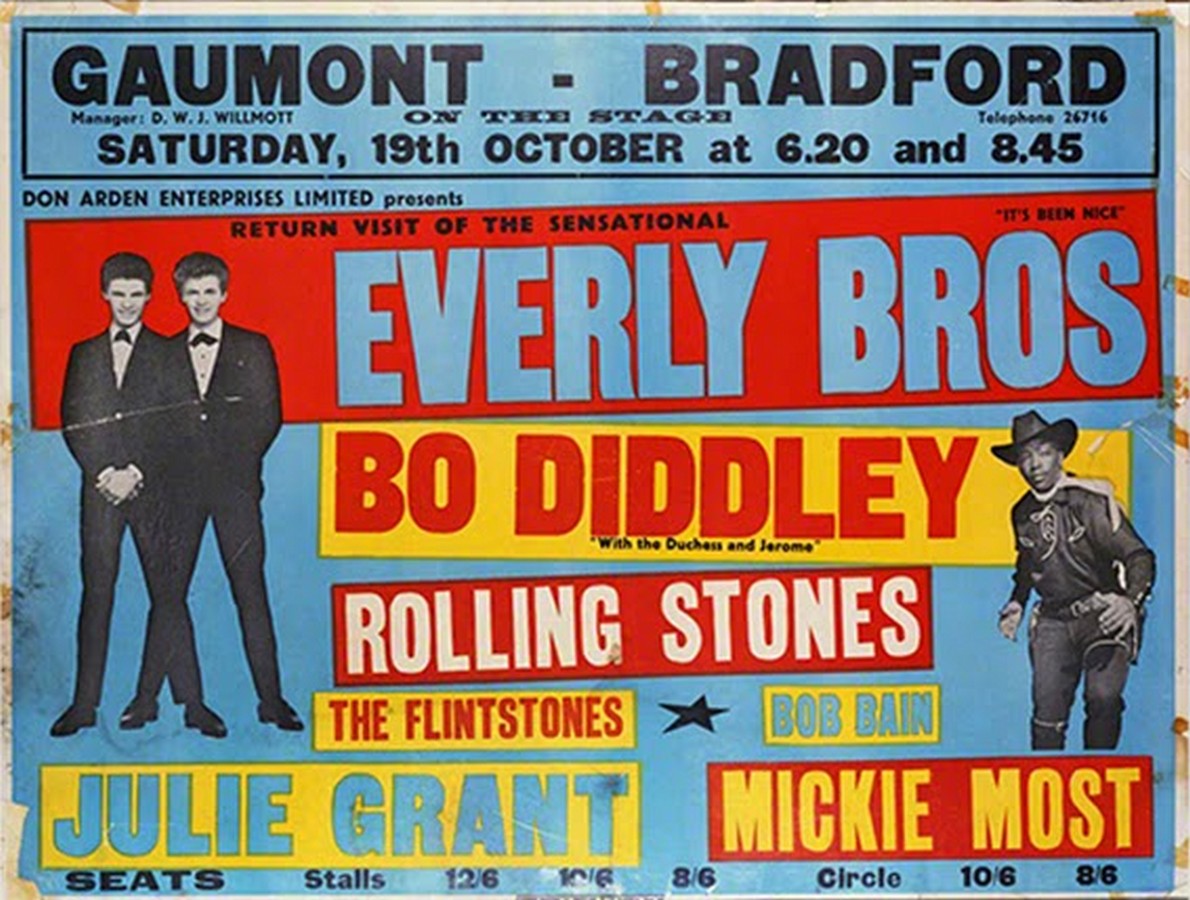
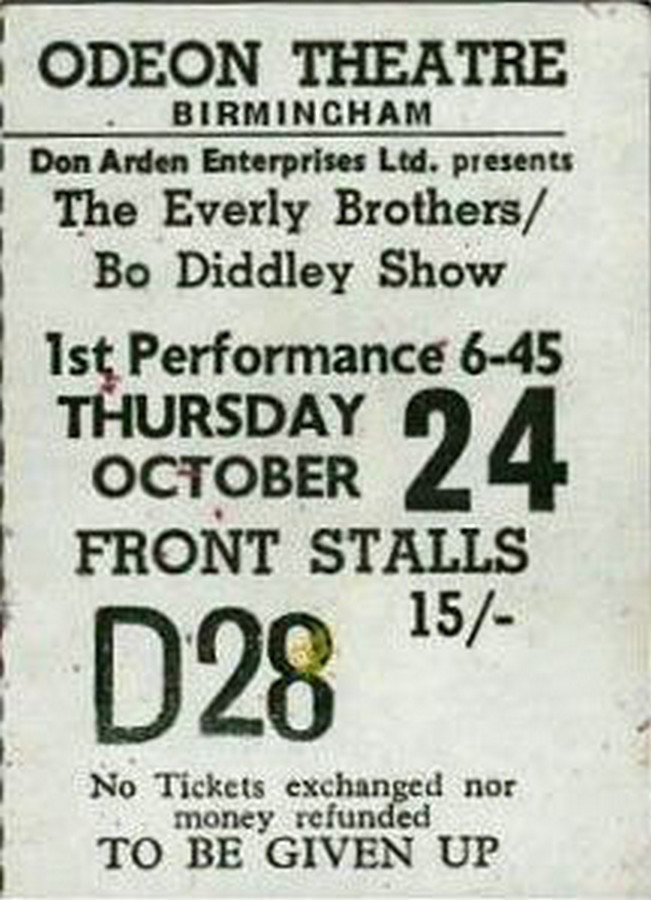
In 1963, I discovered the Rolling Stones, outside a concert venue in Birmingham. With a couple of friends I raced off to the Odeon Cinema after school, and waited for the stars to emerge from their rehearsal. We were engaged in our best new pursuit – autograph-hunting. Being only 14, I couldn’t have afforded a ticket for the actual concert, and wouldn’t in any case have been allowed to go. It was the era of screaming fans and disapproving newspaper reports about long-haired pop stars. But on the day when I simultaneously fell in love with both Mick Jagger and Brian Jones, I do think it shows some discernment – the Stones were almost unknowns, on their first tour of Britain as a support band.

What follows is a memoir that I’ve written for a new anthology of ‘flash’ stories from Exeter Writers, of which I’m a member. I can’t quite believe I’m exposing my youthful folly so openly here, so be gentle with me, dear reader.

Their first major concert tour of the UK in 1963 – they appeared at Birmingham Odeon on Oct 24th. This was the breakthrough that shot them to stardom, even thought they were only a supporting band

Meeting the Stones

‘You kept one of Mick Jagger’s butts,’ she said. ‘And a tin of Coke they’d drunk.’
‘No – no, not me,’ I replied. What a sleazy idea. I had chased the Rolling Stones, I admit, but I wouldn’t have stooped to that.
‘Oh well, must have been someone else,’ Marion conceded graciously. We were old acquaintances, meeting again at a funeral and reminiscing on being teenagers back in 1963.


My friend Helen and I did pick them out, the Rolling Stones, and that’s something to be proud of. They were just a supporting band on the bill in Birmingham when we discovered them. But we recognised their talent, befriended them, wrote them dozens of letters, and followed their trail as best we could. Fourteen-year old schoolgirls with watchful parents and little pocket money didn’t get too much chance to roam, although it’s amazing what we managed. We took trains and buses to places like Coventry and Worcester, and devised ingenious tricks to get in backstage, such as announcing confidently, ‘I’ve been asked to take a message to the band.’ (That one did work, occasionally.)


The Stones drove around in an old Commer van, which we learnt to recognise half a mile away. They recognised us, too, frenetically waving and ready to be their willing slaves.
‘Get us a cup of tea, Cherry,’ said Keith Richards in the greasy spoon café, and my world was complete.

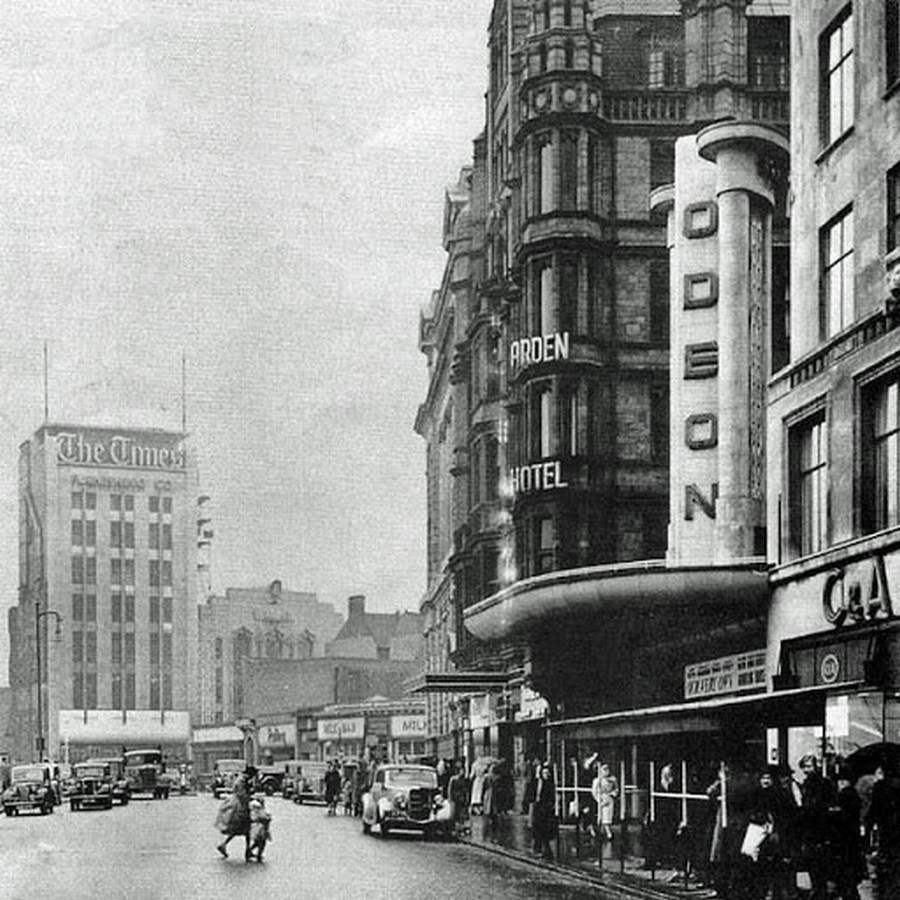
The Odeon Cinema, New St, Birmingham
Scene of my first encounter with the Stones, down a side alley at the Stage Door. This photo seems to date from an earlier period, but the scene is very similar. I can see the bus shelter where I waited every day, changing buses after school.

At one concert, forbidden to enter backstage, we pushed ourselves up on the window ledge outside, trying to get a glimpse into their dressing room. Inside was a memorable scene – Mick and Charlie were reading a letter from Helen, and laughing fit to bust. She had a talent for humour – later, she wrote radio scripts for a living.

Helen and I divided the Stones up between us. She was to have Mick, and I would have Brian Jones. The shaggy blonde hair, the slow sexy smile….It’s all there, in my diary, which is covered with embarrassing scrawls: ‘Brian! Brian!’

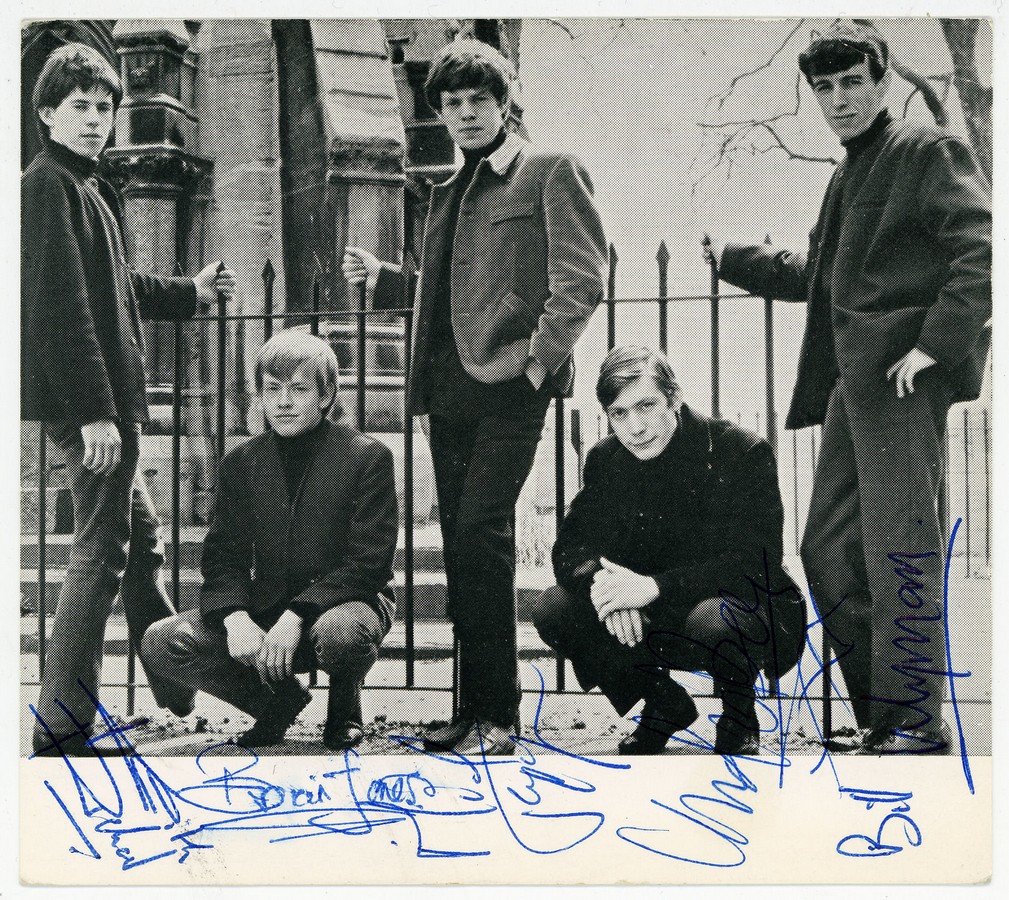
I don’t think Brian ever replied to my outpourings, though Bill Wyman did when I asked him to clarify their song lyrics. ‘It’s “Where’s it at?” not “Where’s my hat,”’ he wrote back in patient amusement. Such letters and signed records from various Stones were tossed out with scorn in my later teenage years. They would have been worth something now.

I too had autographed photos, letters (better than a ticket!) and this EP record signed by all the band. I wonder where they are now?

But I do have my diaries to check up on all those touching details of our meetings.
Here’s one account: ‘At about 6.30 we saw a van coming and Brian waving to us! Wow! Introduced him to our policeman friend, and Brian sort of backed away nervously.’
I can’t think why.

And now I turn back to the entry for that first, life-changing encounter in Birmingham – and what’s this? ‘Mick is quite nice and he gave me a fag to keep and we got some fag ends and souvenirs and things off the others and then we walked down to the hotel with fair-haired Brian and we thought umm yes we like him then we thought….’


The diary is a ruthless reporter. Memory is a fickle thing, our hold on it ephemeral. It charts our journey of passion, even though the feelings inscribed there may be ephemeral too. When Brian died in 1969, the year I turned twenty, I’m afraid I just didn’t care any more.

The incriminating evidence

This story will be published in the Exeter Writers Flash Fiction anthology on June 6th through Amazon Kindle. (Click to pre-order your copy for just 99p!) Here’s the description: Welcome to Flashlight: a lucky dip of flash fiction from the members of Exeter Writers. It’s a varied collection, much like its authors. We hope you’ll find plenty to amuse, move, intrigue and entertain you. Sample at your pleasure! I’ve been a member of this writers’ group for about five years now, and can vouch for the lively mix of offerings which it contains.

Related books by Cherry Gilchrist

The Unusual Exhibition

‘Vines and olives groves, Fressac’ – All paintings on this page are by Robert Lee-Wade, RUA

Robert is sweeping out the dust and straw from the long, covered alley where the horses come to be groomed and fed. Bill, the chief horseman around here, removes the last saddles and bridles from their pegs, while the dogs sniff around eagerly, aware that something unusual is happening. It’s the day of the art exhibition. My husband, Robert Lee-Wade, is a painter in the impressionist style, a member of the Royal Ulster Academy and widely exhibited in various countries abroad. But never before in a stable block in the South of France.

Robert cleaning the alleyway ready for the exhibition.

Robert and I have been at Mas la Chevalerie for several weeks now. We’re staying in a gite on a ranch owned by retired actors Bill Homewood and Estelle Kohler on an extended stay to paint (Robert), write (Cherry) and enjoy the landscape of the Languedoc and the Camargue. It’s September in the South of France, and the grape harvest is coming along, in this idyllic spot. And so is Robert’s art – Bill has helped him to set up a makeshift studio in his capacious office, where he (Bill) also records audio books for Naxos.

Estelle, I should say, was my heroine when I was sixteen and she was a very young actress with the Royal Shakespeare Company at Stratford. At that time, newly arrived from South Africa, she was playing Ophelia to David Warner’s Hamlet. The innovative production by Peter Hall captured my teenage imagination, and with friends from school in Birmingham, we saw the play several times, usually on cheap stand-by tickets. I never imagined that I might become friends with Estelle so many years later.

Robert Lee-Wade, Estelle Kohler and Bill Homewood
Bill organising the logistics. Camargue pony arrived for schooling. Interested bystanders.

‘Let’s have an exhibition!’ said Bill, after Robert had been painting for several weeks. He and Estelle have been here for decades, and know practically everyone in the Fressac area. They count up who they might invite – the mayor (of course), the baker, the restaurant owner, the dressage specialist, the Danish sculptor, the ex-rock drummer and a whole long list of others. We are to provide the refreshments; being France this must be wine, and being near the Camargue, this must include brandade, a paste made of salted cod. And definitely some baguettes. So be it.

The alleyway is nearly clear now, except that another friend of Bill’s has chosen to bring his exquisite white Camargue stallion for some extra training in Bill’s manège. We’ve had our own exciting encounter with Camargue horses on this trip, taking a three day break down in the marshes to ‘ride the white horses to the sea’.

‘The White Horses of the Carmargue’

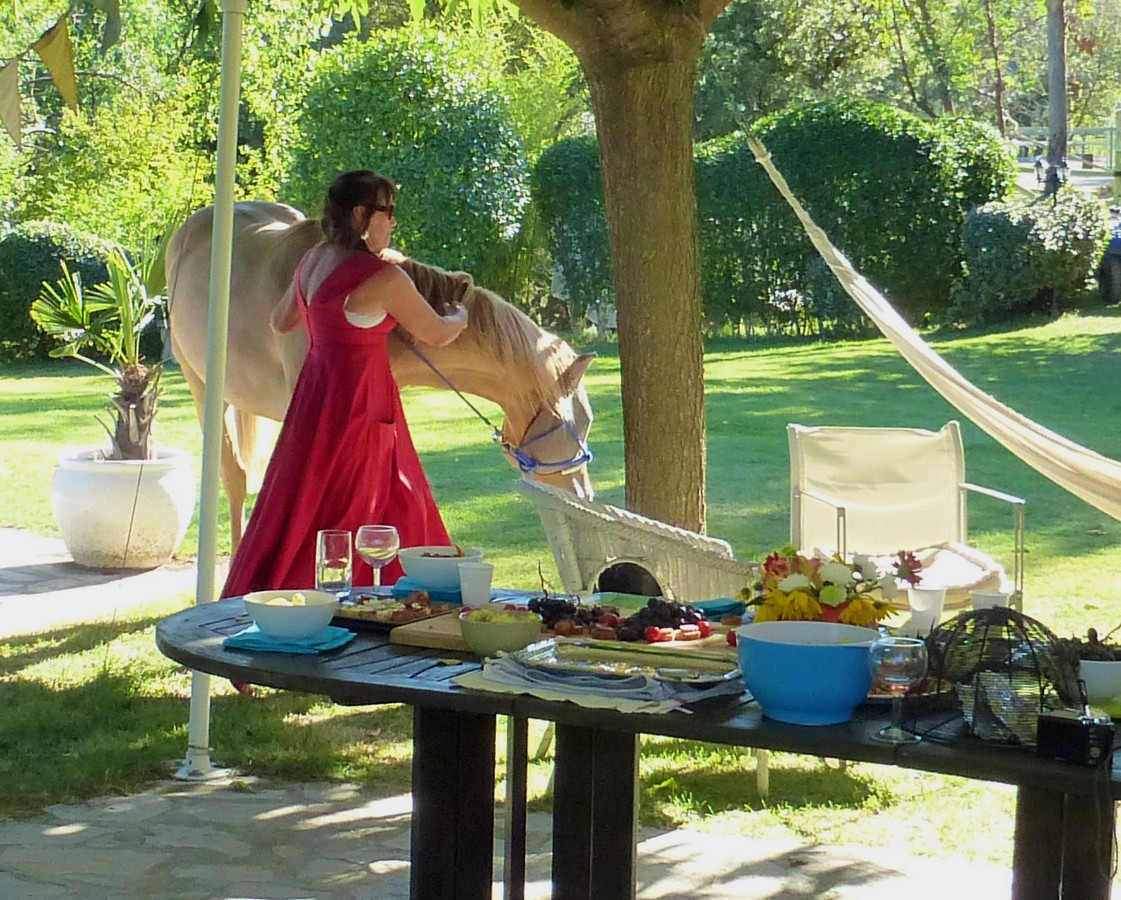
The pictures are up, the guests arrive. ‘Everyone will come,’ we’re told. ‘They love a chance to socialise and have an apéro.’ They do, and they mingle, looking carefully at the paintings first– some sales are made – and then it’s time to get down to the serious business of eating and drinking. The party grows merry – why not let the horses join in the fun?

The horses on the lawn, in art and real life

Several hours later, it’s quiet again. Bill and Estelle choose a painting as a gift for their help – it’s ‘Where the Nightingales Sing’, which captures the essence of this magical place. We have also seen golden orioles here, and once, a bee-eater in technicolour glory.

We’ll soon be packing our hatchback car and making the long drive back to the UK. We all talk of doing the same thing another year, but although Robert and I will come back for shorter visits, this exhibition is one of those delightful comings-together that can only happen once. And it’s probably all the more memorable for that reason.

The castle from the horse manege at Mas La Chevalerie

Paintings from the Camargue, by Robert Lee-Wade RUA

You can see more of Robert’s artwork here

‘Just Ordinary Girls’ – Noel Leadbeater and the Secret Army

This post is being published a couple of days earlier than the usual Sunday morning slot, to celebrate VE Day. I’m proud to be sharing Noel’s story with you to mark the occasion.

Many ordinary lives conceal extraordinary stories. I’ve had the opportunity to listen to some of these stories, sometimes when researching for a book, sometimes just out of a strong personal interest. This is the first of an occasional series of posts about such lives, Noel Leadbeater’s story of what she did in World War Two. In the current state of the coronavirus crisis, many of us may be thinking about how the challenges and restrictions compare with wartime, and wondering about the efforts that people made to try and keep their country safe. Some of these were never revealed until many years later.

Noel Leadbeater (née Davies) would never tell us what she did in the war. Her daughter Helen was one of my closest friends, since after my parents moved house as I was about to go into the Sixth Form, I lived with the Leadbeater family in term time. Noel was one of the liveliest, most amusing and kind-hearted people I have ever met. She was also a natural raconteur. However, ask her about wartime, and she clammed up. She might mention the Land Army and the ATS in passing. ‘My lips are sealed. I signed the Official Secrets Act,’ she’d say dramatically, when pressed for more detail.

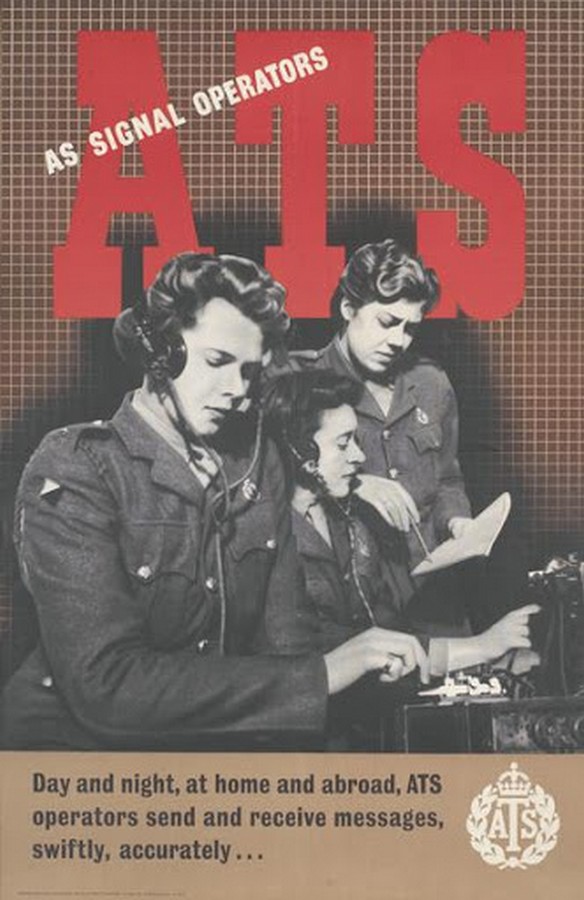
Finally, the secrecy around the operations evaporated, and she was free to tell her story. She had become a member of a hidden army of Morse Code operators, trained to record German signals. The coded messages they took down were then sent to be deciphered at Bletchley Park. Which, as you may be aware, was the place that broke the highly-encrypted messages sent by the Germans via the Enigma Machine.

I visited Noel in 2010, just before her 90th birthday, so that I could record this story in full, and preserve it not just for her family but for a wider audience too. It’s presented here in a slightly shortened narrative version. On my visit, she was full of life and fun as usual, and as bright and sharp as ever. But it was the last time I was to see her, since she died just over a year later.

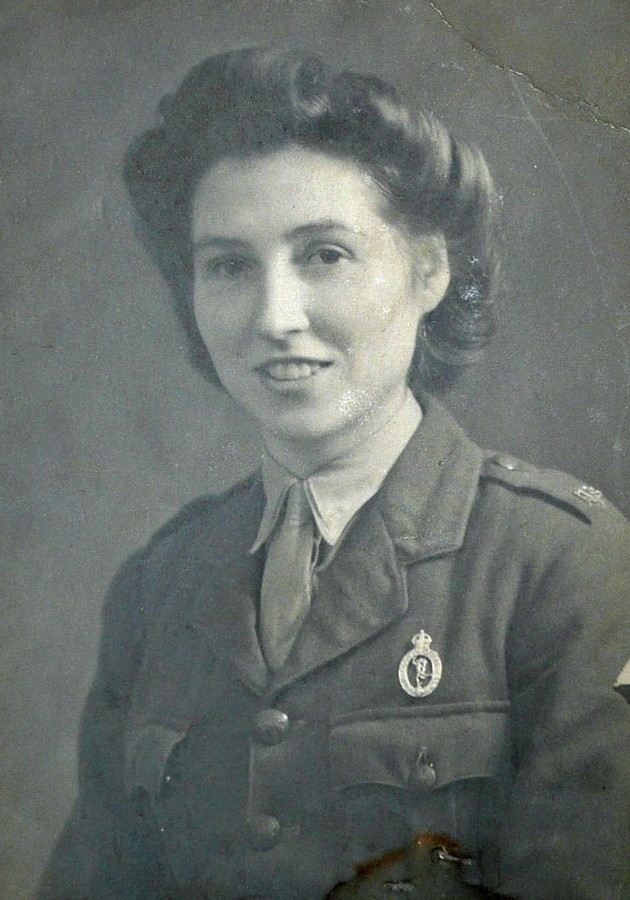
A treasured, and somewhat battered photo of Noel in her ATS uniform

Noel at the start of World War Two
Noel, née Davies, was born and brought up in Birmingham, where she was one of a large working-class family. Although intelligent and keen to learn, any proper education was out of the question as she was expected to to help at home with her siblings, and to go out to work as soon as legally possible. Nevertheless, as the story will show, her abilities were clearly recognised in wartime, and in later life she educated herself in literature, worked as a teaching assistant, and completed an Open University degree.

Early on in the War, Noel joined the Land Army: ‘Not because I loved the land, or anything else, but I just loved the uniform!’ However, she became ill after the very strenuous work, and switched to factory work instead, working with a company called Avery’s who made weighing scales. ‘There was quite a lot of bombing in Birmingham, so I never knew when I went into work whether the office would be still standing, but it was all right.’ Luckily for Noel, she didn’t stay there too long, since a history of W. & T. Avery records: ‘During the second world war the company also produced various types of heavy guns. At that time the site underwent severe damage from parachute mines and incendiary bombs.’

Call-Up, and the ATS
Then came the compulsory call-up for women, and Noel joined the ATS (Auxilliary Territorial Services) :
‘I had to report to a little town called Droitwich which is near Birmingham, in Worcestershire, and I went on the train with several other girls from Birmingham. We were met at the station by a corporal and a sergeant.’ There, they were put into threes, and told to march into the town. ‘But one unfortunate girl called Janice, her mother had insisted on coming with her! And this woman, she couldn’t march in the road because the sergeant wouldn’t let her, so she was hopping on and off the pavement, into the road and back again. And the poor girl was saying, “Our Mum, our Mum! Do go ‘ome again, our Mum!” But the mother said, “I promised your Dad I’m going to see you into those barracks, and that’s what I’m going to do.”’

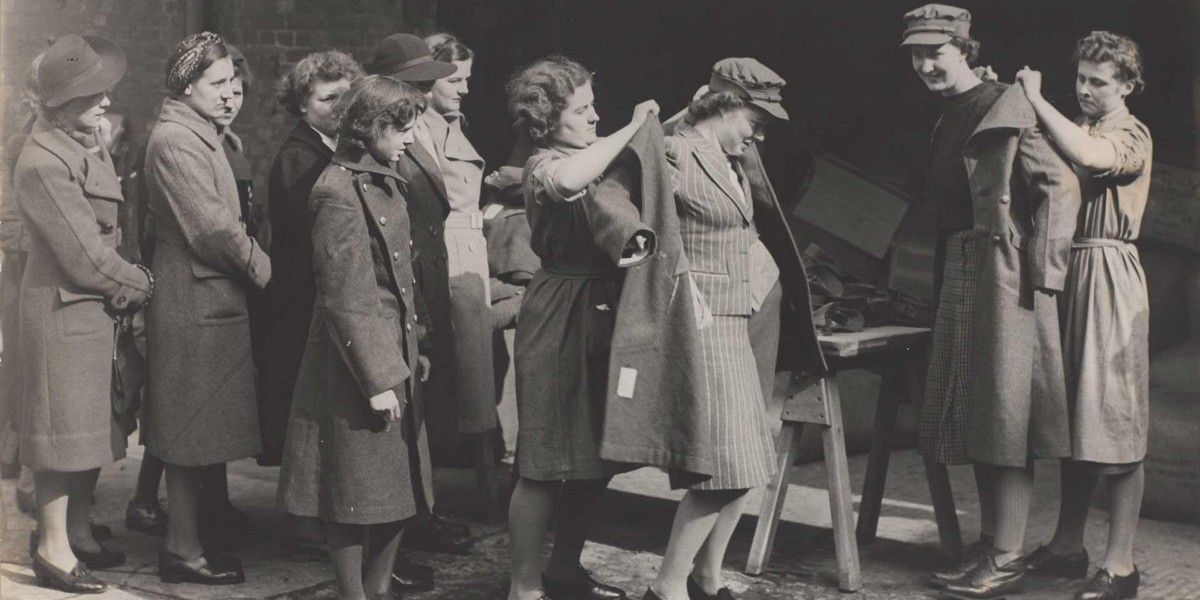
At their destination, a hotel that had been commandeered, Janice’s mother was speedily sent home, and the girls were kitted out. ‘We had to go into what must have been the garage earlier on, and we were issued with our kit. Well, we lined up and marched into the garage, and there was a sergeant there – she didn’t bother with things like measuring tapes, she just looked us up and down and said, “Tall – thin – skinny – number three!” Or, “Short -fat – number one!” And we processed along a counter where we were issued clothing. Two skirts, two tunics, shirts and collars and blue stripe pyjamas, and then it came to the greatcoats. The girl behind the counter looked me up and down and said, “Haven’t got your size.” She spoke to the sergeant who said, “There’s some men’s greatcoats in there. Give her one of those!” So I was issued with a man’s six-foot greatcoat.’

ATS recruits struggling to fit into their uniforms (National Army Museum)

In their allocated huts, the new recruits got ready to transform their status: “We all proceeded to put on our uniform, because we were very proud of it. But we were all different sizes, and some of the skirts came nearly down to the ground, and some were – oh, we did look a mess! And when I put my great coat on there were hoots of laughter, because it was nearly on the floor, and the sleeves covered my hands. But when I grumbled to the sergeant about it she said, “Oh you don’t have to wear it dear! As long as you’ve got it. When you get to your next posting, just go to the stores, and they’ll change it for you.” Which really was very typical of the army, I thought.’

First training with ‘Ack, ack’ or anti-aircraft guns. Officially, women were not allowed to actually fire these guns. (National Army Museum)

The first day ended with the ‘Lights Out’ bugle call at 9pm. ‘Which to me was wonderful because I thought, “Well, now you know you’re in the army!”’ Their training was general to start with – learning about the ranks of the army and taking various tests. Then they were asked what section they would like to be in. Noel’s first choice was to be a driver, but as she couldn’t drive already, that was refused. ‘So then I said I would try “Ack-Ack”, which was anti-aircraft guns. We had to do various tests for that, lying on our backs and looking through binoculars – all sorts of things. And I thought, “Oh well, I shall enjoy this.” But then one day, one of the officers called me in to speak to her, and we had quite a long conversation. And she said, “I think I’ve got a job which would be better for you, and that you’d like, but you mustn’t tell anybody about it. It’s very hush hush, and you’ll have to go up to London for some more tests.”’

This was the start of her transition into the Signallers, and her Morse Code training. To begin with, she was posted to London, staying in a hostel in Gower Street which had previously been accommodation for shop workers – it was usual at the time for the bigger London stores like Heal’s or Gorringe’s to house their female workers ‘safely’ in hostels. ‘The main test was to see if we would be suitable to take down Morse. They didn’t send Morse as such, but they sent sounds.’ She recited a string of ‘da-dee-da’ syllables in varied pitch and rhythm. ‘You had to put a tick or a cross whether it was the same sound or not. Then we had to write an essay – there were all sorts of tests, and in the end, some people went back to their unit. But some of us were then held in Gower Street until there was a place for us at the training centre, which was at Trowbridge in Wiltshire. There were thirty girls, and we were going to be known as 37 Squad.’

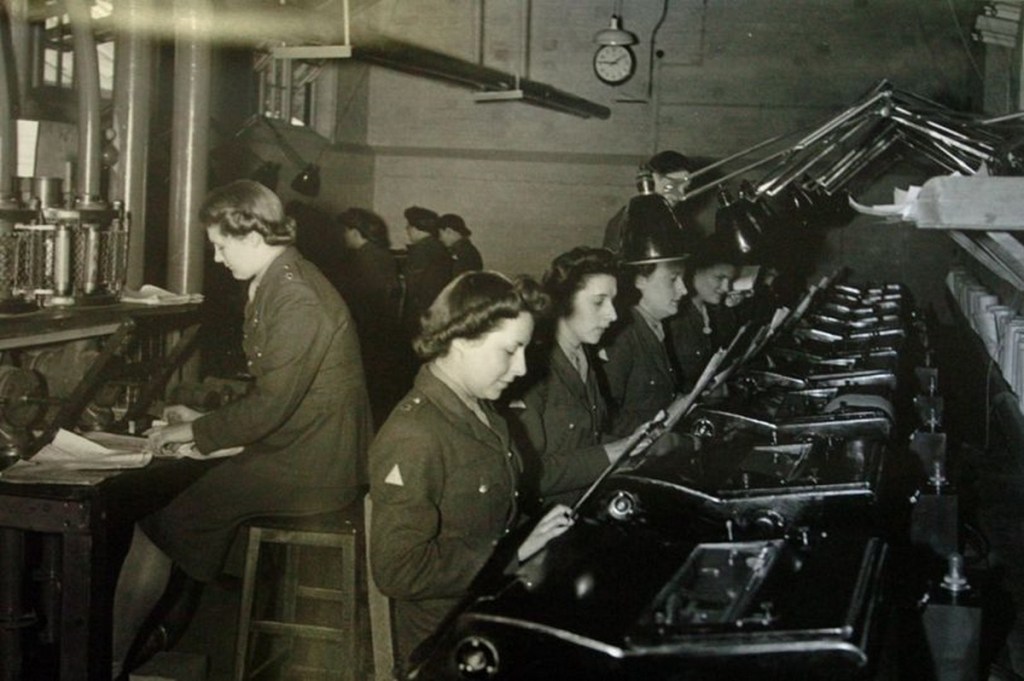
ATS wireless operators learning Morse code at Trowbridge in Wiltshire, 1941 (Imperial War Museum)

ATS in the Film Studio

One day, as they lined up to be assigned their daily chores, like washing the windows or cleaning the dining room, the officer in charge said, ‘I want six girls who can play table tennis.’  Noel hesitated: ‘I couldn’t play table tennis, and my father, who had been in the First World War, had said to me, “Never volunteer for anything! Keep your head down.” But I thought, “Oo- table tennis – that’ll be nice!”’

She stepped forward, and she and five others were then given travel warrants. Much to their astonishment, they were sent off to a film studio. ‘And for that day, we were ATS in a film called The Gentle Sex.’ The film was made as propaganda, showing a somewhat romanticised but detailed version of life in the ATS. The set for Noel’s scene was designed to look like an ATS recreation room in an ATS centre. ‘Then a chap called Lesley Howard, who was a film star and also a director, came in and said, “Now, you are supposed to be playing table tennis in this scene, so come along to the table.” I’m afraid that not one of us could actually play table tennis! And he was really, really cross. So in the end, they got one of the cameramen to play at one end, and one of the stars at the other. But of course you only saw his hand, and the bat – you never saw him. And we were all in disgrace. So we stood there, and he suddenly pointed at me, and said, “You!” I almost fainted and just managed to say “Ye-es?” Then he said, “You’re too tall! Stoop down or something.” I did what he told me, and made like Quasimodo, and crouched there. And this went on practically all morning – this poor cameraman, sending the ball, and the film star sending it back.’

She and her ATS comrades were told to stand around, admire the game and clap. But they were just a backdrop to the ATS actresses. ‘They didn’t wear the same uniforms as we did. Their uniforms were all carefully tailored, in a different material, and they looked super in them! And there was us in our rough tweed and serge, looking terrible.’

But it wasn’t all bad news. They dined in the canteen with the stars: ‘We sat where we could observe them. Oh, and they all smelt lovely! Their lovely perfume…and our Lifebuoy and Wright’s Coal Tar soap faded into the background.’ And after a further brief stint of filming after lunch, they were actually paid – a welcome surprise: ‘I think we were given something like seven shillings, or eight shillings. I’ve seen the film, of course, many times, and honestly – that day’s work is condensed into about three minutes. You just see my head bobbing up and down! But we did enjoy it, and of course when we got back the other girls were furious.’ The next day, when the officers asked for seven recruits, plenty of the girls who’d missed out stepped forward eagerly, but they were only signed up for domestic tasks rather than the glamour of a film studio!

Images for The Gentle Sex, a propaganda film, showing a factual though somewhat romanticised version of life in the ATS.

The next stage
‘Well, then, as I said, thirty of us formed this 37 Squad and went down to Trowbridge in Wiltshire.’ This is where the Morse training began, going at a very slow pace. It was a long process to accustom fresh ears to distinguish the different Morse signals, some nine months in all. ‘Longer than an air crew, because it had got to be perfect. We were told we could not make mistakes’ If they weren’t sure of a letter, then they had to leave a blank and not put it down. Otherwise: ‘It could cause such a lot of trouble. This was dinned into us, and of course the need for secrecy. We had to sign the Official Secrets Act.’

‘We did our training in Nissen huts in a sea of mud.’ That was a disaster for Noel’s new shoes. ‘They couldn’t fit me with two pairs of shoes, so I had one ordinary pair and one officer’s pair. Oh, the lovely pair! I used to polish them every day. But of course with this mud, they didn’t look so good.’ (On reading this transcript, Noel’s daughter Helen said: ‘She was still talking about those officers’ shoes, years later. I don’t think she ever had a pair of shoes she liked as much.’)

The huts and the sea of mud caused other problems too. Once, Noel was sent off to see a major in his hut for a review, and when she left, she couldn’t work out which direction she’d come from! ‘I stood in the mud and thought: “Which hut did I come out of?” I hadn’t got a clue, because they all looked the same! So I went across to the nearest hut and opened the door, and they were all men, signallers, and they wolf whistled and shouted, and their sergeant said, “Shut up!” I backed out quickly, and went to another hut. These were girls, but not any girls that I knew. So after visiting about four huts, I said to the sergeant in charge, “I’m in 37 Squad, and I don’t know where it is!” She said, “Try that one.” Much to Noel’s horror, when she entered the door pointed out, she found herself back in the major’s hut again. ‘I could have died! And he said, “You’ve just been in here! And your shoes are dirty.” And I, forgetting where I was, said, “Yours would be dirty if you’d just walked through all this mud!” So that wasn’t very successful. I’ve never made up into corporal or anything, and I think it was that interview that did it.’

Noelene Muriel Davies married Raymond Leadbeater in 1943. The wedding dress was apparently a communal dress to be shared amongst the ATS brides! We think it may have had an adjustable hemline, as Noel was very tall but nevertheless, it hangs rather well.

Marriage and the Isle of Man
The training began in the autumn 1942, and the following January Noel was given an extra week off, known as Marriage Leave, for her wedding with Raymond Leadbeater. In her absence, the rest of the squad was told that they were leaving Trowbridge, to finish their training in Douglas on the Isle of Man. ‘It was very hush hush.’ Noel had to follow later, after her honeymoon, catching a boat alone and suffering terrible sea sickness en route.

‘I kept thinking, “Oh please let a submarine come and shoot us down, and we can go to the bottom of the sea!” But the minute my feet were on the ground, I was OK.’ OK enough to go off with her friends who were waiting on the quayside, for a free meal of egg and chips.

Squad 37 was billeted in boarding houses, where apparently Italian internees had been living. ‘I didn’t understand what they’d written on the walls, but the powers-that-be sent soldiers with whitewash to cover it up!’ Every day, the squad members marched up the hill to ‘quite a nice hotel’ for their Morse sessions. The two male drill instructors, one short and squat, the other tall and thin, sent the girls into fits of uncontrollable giggles when they gave out orders for the drill. ‘They used to get so mad, and scream at us, “Stop that!”’ Although the girls liked their instructors, they couldn’t curb those giggles. ‘We just couldn’t – we just couldn’t.’

But it was becoming a serious business. ‘We now became aware that we were going to listen in on German messages.’ They were trained to get used to background noise, and to pick out the individual ‘voice’ of their operator. ‘And this was quite difficult. But in the end, we all passed, and we then really became Signallers.’

The return crossing to England was smooth, and Noel travelled back to her home town of Birmingham by train on April 30th, 1943. She remembers what a delight it was to see the countryside again. ‘There are not many trees in Douglas – it was so lovely to see all the trees, so green and fresh. And I had a week’s leave at home – of course I was married by then.’

Beaumanor Hall, Woodford Eaves, Leicestershire. A secret intercept centre in World War Two

Final training
After this, the ‘girls’ were sent to Loughborough, in Leicestershire. ‘There we did the final training for the job we were going to do. It really was quite traumatic because we had all this noise and interference, and you had to learn – in the way that you recognise a friend’s writing on an envelope – we had to learn our Jo’s method of sending the Morse. They were all different – it was amazing!’

The skill was not just in notating the Morse, but in finding their individual ‘Jo’ (probably a term for a Jerry or a German) on the wavebands. The transmitters often changed frequency. ‘So we had to carefully track them down and be sure that it was ‘our’ chap.’ Noel thought it was likely that each ‘Jo’ they followed was also being followed by another trained operator in the UK, as a double-check.

Beaumanor – a ‘Y’ Intercept Listening Centre
In Leicestershire, the squad was stationed in the village of Woodhouse Eaves, once again in huts in a field. However, the actual work was carried out at Beaumanor house, a grand stately home, to which they were transported by troop carriers. As a recent article about the centre says:

Beaumanor was a highly strategic “Intercept Station”, concerned with monitoring the enemy’s main channels of wireless traffic and communications. The “Y” Intercept Listening Service operated from 1941 to 1945 and its wartime activities were as top secret as those at the Code and Cypher School at Bletchley Park. By the end of the war, there were more than 1,200 ATS women operators and 300 male civilians working at Beaumanor.
Much of the monitoring took place in specially built huts in the grounds of Beaumanor, many disguised as cricket pavilions and greenhouses to confuse spies and nosey neighbours. Civilians and girls of the Auxiliary Training Service were the main members of staff, each having their own allocated part of a radio waveband to monitor for Morse-coded messages.
Leicester Mercury, 7 Feb 2020

Morse code operators at Beaumanor (Imperial War Museum)

Despite the seriousness of the work, the recruits learned to unwind and enjoy each other’s company.

‘Oh, it was quite fun really! We did have a lot of fun, in spite of the work. I mean, we all knew it was absolutely vital, but at the same time, we were only girls. And we did have our fun.’

The job itself was so strenuous, requiring such extended concentration, that they weren’t asked to do any extra chores. Once they were qualified to join these ‘ops’, they worked in four watches throughout the 24 hours. ‘So the Set Room, as they called it, where all the wireless sets were, was never ever empty.’ Transitions from one shift to another went as seamlessly as possible. The other girl would just get up and say, “He’s here,” and show us where on the dial.’ But even that didn’t hold, since the frequency could move, and the signal would have to be tracked down all over again. ‘We really, really did work so hard. But, as I say, we did have a lot of fun. Sometimes the girls would get a tin of condensed milk, and we’d make toffee over the stove in our hut. We got to know the girls we were with very well, of course, and I was friendly with so many of them. It was a lovely, lovely time – I mean, it wasn’t a lovely time! It was terrible with everything that was going on – but the companionship was so wonderful. I’ve never really found that since. And we all felt that we were really doing a very good job in the work that we did.’

More Morse operators at Beaumanor. Could Noel be the one on the right?
(Source Leicester Mercury)

‘All our messages went to Bletchley, either by motorbike or on the tele-printer. The work we were doing was monitoring the German army. Sometimes it was Gestapo.’ (The operators could tell this by the way the letters were sent.) ‘And oh God, it really upset us, that did.’

The messages were taken down in ordinary English letters in blocks of five, which in themselves were strings of meaningless letters. ‘But it was interesting in as much as we knew that we’d got to get it right. As I say, if we weren’t sure, we didn’t guess, we put a blank. And then these were sent to Bletchley, who then had to decode them. They were so clever, those people, really, really clever.’

A filled-in W/T Red Form, similar to the one Noel and her colleagues would send to Bletchley Park for de-encrypting

By the time Noel was a qualified operator, the team at Bletchley Park had cracked the Enigma Code. She recalls the Enigma machine: ‘It was like a typewriter. But in addition to the Qwerty things, there was above that another keyboard with lights. At the beginning of the war, the Poles got hold of an Enigma Machine and passed it to our people. Otherwise I don’t think we could have done it. Also, one of our ships intercepted a submarine, and they were able to lift an Enigma machine, and a code book from the submarine’

Just Ordinary Girls…
‘We were so keen, and just ordinary girls. And yet, this secret never got out. It was wonderful. I’m really proud of the fact that we did that work, and that we kept the secret. And all through the years, I’ve kept in touch with people that were with me then, and there are still a few of us left. You really felt you had done something towards the war effort. What you had done, mattered.’

Noel Leadbeater, just before her 90th birthday in 2010

Further information:

Links to other accounts by other women who trained as WW2 Morse operators

Linda Battle and Margaret Crook

‘The Gentle Sex’ (1943) can be viewed on Amazon Prime Video. It’s surprisingly interesting and entertaining, following the fictional progress of seven recruits, but showing different sides of genuine training in the ATS. The table tennis clip comes about 21m 30s into the film – and lasts for about 3 seconds!

Other links to aspects of women’s war work:

Trowbridge Training Centre

Women’s place in the War -ATS

Women in the work force WW2

Female conscription WW2

Related Books by Cherry Gilchrist

Seduction, Sin and Sidmouth An Ancestor’s Scandal

The historic village of Hemyock, in the Blackdown Hills

I was idly browsing the online newspaper archive one evening, looking for entries about my respectable great-grandmother, Mary Masey Walker and her staunchly Baptist family from the Devon village of Hemyock. They may have been pious, but they were also entrepreneurs. Mary’s mother Catherine had begun making butter, and soon expanded the business into a sizeable and successful dairy. Becoming ultra-respectable and prosperous, they then moved over the Blackdown Hills into the nearby town of Wellington, becoming pillars of the community there. The last thing I was expecting was scandal – until I hit upon a startling court case from 1869 headed:

Walker versus Salter – An action for seduction

The defendant, one Edwin Masey Walker (and as it happens, my 2 x great uncle), was accused of deflowering a young girl called Jane Salter, getting her pregnant, trying to persuade her to have an abortion, and eventually abandoning her. Jane had kept the baby, and now her own mother was suing Edwin for ‘loss of her daughter’s services’.

I’m probably the first member of the family since that generation to come across these newspaper reports – I’m sure that it was swiftly hushed up after the event. There are several accounts of the two trials, delivering the sordid details with gleeful relish. Edwin was the son of Catherine nee Masey and Thomas Walker. Both the Maseys and the Walkers had been in Hemyock since at least as early as the 17th century, two of prominent and close-knit tribes of the village.

Hemyock lying at the foot of the Blackdown Hills; dairy herds do well in this area

At the time of the scandal, the dairy was doing well. My formidable 2 x gt grandmother Catherine had twelve children, and she and her husband roped many of them in to help out both with the dairy and their local shop. Catherine’s reputation lived on after her; according to family memory, certain visiting reps would always try to make an appointment to visit on a day when she was not in charge! The dairy certainly took off as a business, and Catherine and Thomas decided to expand it by moving to Wellington. Here they also acquired a comfortable new brick-built villa, something now more suited to dairy owners, the Walkers of Wellington.  And Edwin was told to change his ideas – his father had found a new candidate for him to marry, someone more suitable than a country cousin such as Jane.

The formidable Catherine Walker, nee Masey, who sales representatives feared to deal with.

But Jane Salter, back in the village of Hemyock, now wrote to him Edwin to tell him she was pregnant. The statements read out in court declared that not only had he reneged on his promise to marry her, but he had instead committed the unpardonable sin of offering her money to go to Sidmouth for an abortion. (From the tone of the report, it seems that in those days, Sidmouth had a reputation as the Devonian den of vice.) And at that point, Mrs Salter decided to bring the whole matter to court.

‘Up the Steps’ – probably a former shop run by the Walker family in Hemyock

Now the counter accusations flared up. Edwin had primed his defence, Mr Prideaux QC, to interrogate Mrs Salter about the nature of the house she kept in Hemyock. Was it not, in fact, a bawdy house? Was young Jane no better than she ought to be, coming from such a home? He had a witness: John Pursey, confirmed that he and another friend had had sexual relations many times with both Jane and her sister Sarah – and while the girls slept in one bed. Was Jane then really an innocent deflowered maiden? According to Pursey, she shared her favours generously around the neighbourhood.

The judge hovered, almost ready to throw the case out, but Mr Collins, Mrs Salter’s attorney, leapt heatedly to Jane’s defence, and protested that the ‘abominable insinuations’ would be refuted by the ‘minister of the parish’ who would testify to the family’s ‘irreproachable characters’. If this was the Baptist minister, then the temperature was getting hot indeed, with Edwin’s family also prominent in Baptist circles. The Baptist Church abhorred any sex outside marriage at the time; people were often excluded from the church for less.

And so the jury found in favour of Mrs Salter, with Edwin ordered to pay £50 damages, just over £2000 by today’s values.

Wellington High Street, a grander place to live than Hemyock for the ambitious Walker family
The solid villa in Waterloo Road which Thomas and Catherine Walker moved to

But that was not the end of the matter. John Pursey was brought back to court on Wed August 3rd, 1870, accused of perjury. The ‘friend’, Robert Wright, who said he had slept with both girls, hastened to back off from his testimony. John now maintained that he had plainly fallen into a kind of trance, and that he had found himself by the girls’ bedside one day with no idea of how he had got there. Of one thing he was no sure – there had been no intimacy. Edith Salter likewise denied that her house ‘was frequented by young men who played cards and drank to a late hour.’ The colourful accusations were hurled backwards and forwards in court that day, which finally resulted in a bemused verdict by the jury that ‘there was a doubt in the case’, and so Pursey was released.

After I’d investigated this scandal, I was contacted by two new descendants. One was descended from Edwin’s legitimate heirs – his father Thomas Walker had indeed persuaded Edwin to marry into a better family – and the other was the grandson of the illegitimate daughter with Jane Salter. Jane had defiantly named her daughter Emily Masey Walker Salter, and sadly, my new contact confirmed that Emily had carried a sense of betrayal and resentment all her life. Both of these men, who didn’t know each other, were curious to know anything I could tell them about their ancestor Edwin. I pondered this – one of the ethical dilemmas of family history can be whether to tell the whole truth. My solution was this: to both of them I replied that I could certainly do so, but I should warn them that nobody came out of this very well. Did they still want me to go ahead? Oh yes, they each replied enthusiastically – please dish the dirt!

A rather faded but telling photo of Edwin Masey Walker – note the rather flashy tie pin. The census reveals that he was born with a club foot.

There was some rough justice, as Edwin didn’t make a success of his life. He became a failed and bankrupt businessman several times over, and his socially desirable marriage ended in separation. Meanwhile, others in the family prospered. Two other sons, Clifford and Eustace Walker took over the dairy business and became pillars of society. Eustace served as a Justice of the Peace and Portreeve of Wellington, while Clifford built a classy mansion known as the Gables, where the cream of the town gathered for tennis parties on the lawn. They died well-established and wealthy, and the dairy was not forgotten even after various take-overs and its final demolition in the 1980s. ‘Walkers Gate’, a small development of executive-style houses, is built on the site. I think formidable Catherine would have approved.

The housing development standing on the site of the old Walker’s Dairy, run very successfully by Eustace and Clifford Walker, Edwin’s brothers
The dairy as it used to be in its closing days of business. It was the principal employer in the town. The Walker family had sold it on some decades beforehand.
A more flattering newspaper story than the reports of Edwin’s court case

As for my great grandmother Mary, family memory relates that she resented acting as a nursemaid to her six younger brothers and sisters, and was only too pleased to an offer of marriage from the Rev David Owen. Great-grandfather David arrived in his first pastorate in Hemyock as a newly-qualified Baptist Minister from mid-Wales. The story also relates how he found the Devon mindset too closed for his liking, (he was a highly-educated scholar of Hebrew and Greek, even though he came from humble beginnings), which is why he whisked his bride off to a new life in Ohio, USA. They returned later to England, but never a word was breathed about the scandal of the wicked great uncle Edwin.

In the 1980s, I used to live on Exmoor and would drive over to Wellington to buy feed for my horse and chickens. The dairy was still operating then as a sizeable factory, and under a different name. I had no idea that it had a family connection. Since then, I’ve moved away, and then back again to Exeter, from where I’ve explored Hemyock and Wellington more thoroughly, seeking out the family stories. What has struck me is the comparative remoteness of Hemyock as a historic but quiet village, reached by a maze of lanes, whereas Wellington has what must once have been Victorian sophistication, and was well-connected to places further afield. Although there are only five miles between them, they are two different worlds. I have pity for the girl that Edwin abandoned, but am also proud of the 2 x great grandmother who set the scene for family success. Family history can certainly be a cause of conflicting emotions.

Moving over the hill, from Hemyock to Wellington, certainly brought about a new era of family life for the Walker family, but was also the cause of a scandal long hidden out of sight.

If you’re interested in viewing another blog which focuses on discovering lost ancestors, try:

A London Family

Huguenot Jo

Related books by Cherry Gilchrist: