

Oh dear! The Victorians had a very strange attitude to Christmas cards. No one seems to know why. Poor old Cock Robin – he won’t be having a very ‘joyful’ Christmas.
As you’ll perhaps have seen, I wrote a blog on Vintage Christmas cards a couple of years ago. https://cherrycache.org/2023/12/24/vintage-christmas-card-special/ In this, I gave the background to their history, starting with Henry Cole, director of the Victoria & Albert Museum, in December 1843. He printed a thousand cards with a specially-created artist’s image of his family sitting round having a jolly time during the festive season, imbibing wine. As well as taking the effort out of writing Christmas greetings to his kith and kin, he’d also hoped to make a bit of money out of the venture. However, the commercial side didn’t go well – one reason was public disapproval of the image. If you look closely, you may be able to see that the baby is also imbibing wine.
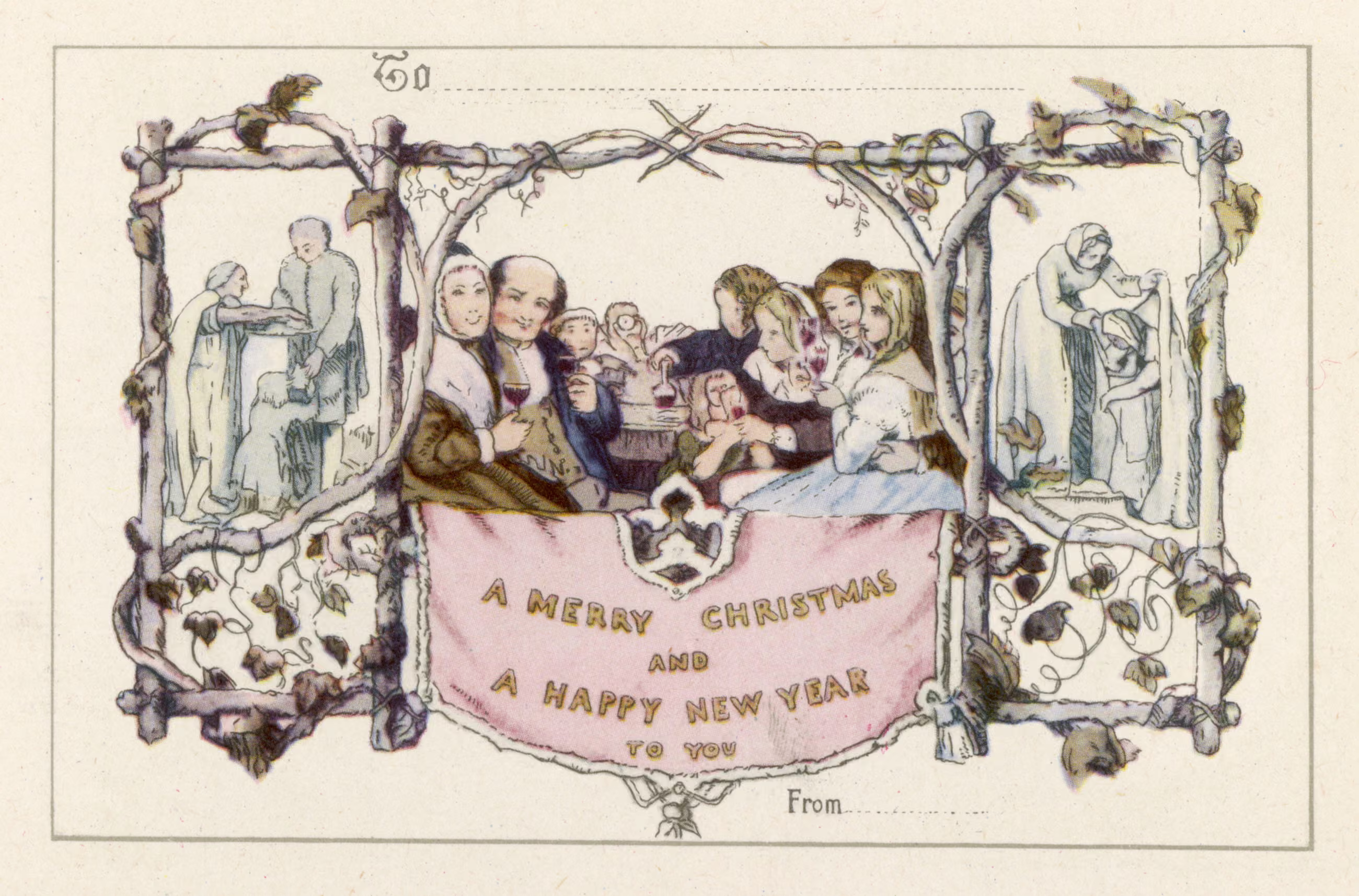

However, Christmas was on the up as a family festival.1843 was also the year that Dickens published ‘A Christmas Carol’, and it was the period when Queen Victoria’s consort Prince Albert was doing his best to introduce German Christmas customs into to Britain. (Experts still disagree as to how much of a part he played in making us buy a Christmas tree each year.) And Christmas cards themselves came more into favour from this point on. Other talented artists were commissioned to print designs, and exhibitions of Christmas cards were even held.
But whereas you might expect saccharine pictures of cute cherubs and jolly Santa Claus(es) from the sentimental taste of the time, the most prominent themes were very different. In the years which followed, the Victorians began to favour grotesque images, the like of which might shock us today. The death of Cock Robin was apparently hilarious – and what are these children doing flying on bats? Playing some kind of ghoulish lacrosse? Quite frankly, I don’t want them all turning me up to wish me a ‘bright New Year’, as the message suggests!
……

And presumably a naughty child won’t even enjoy flying on a bat, because Father Christmas regularly stuffs ungrateful children into his sack. Perhaps the card below is based on the figure of Krampus? In certain parts of Europe, Krampus (meaning ‘claw’) accompanies St Nicholas on his gift-giving Christmas visits to children, and punishes the badly-behaved ones.
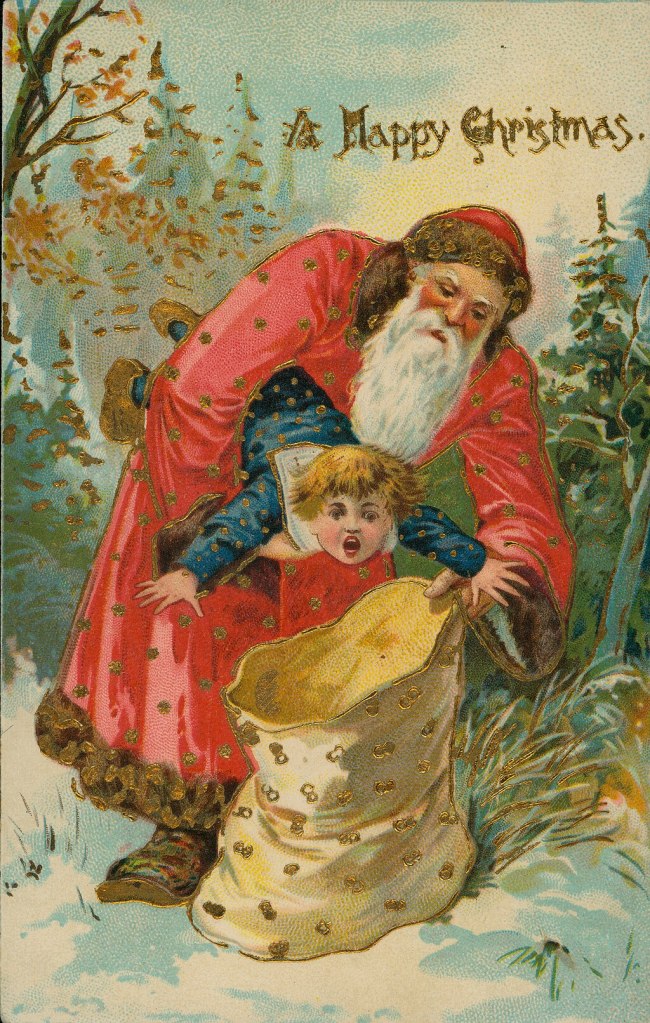
The Victoria & Albert Museum has a collection of old Christmas cards, and the listings show plenty of those with a more macabre slant. Here’s a tally of some which I’ve come across:
Man emptying a chamber pot onto carol singers’ heads
A wasp attacking two children
A bloody battle between two opposing varieties of ants
A snowman ghost mugging an innocent gentleman stroller.
One frog mugging another – and a duck eating a tangle of frogs
And then, the Museum tells us it has a whole collection of cards illustrating policemen being run over! I wish I could find one to show you.
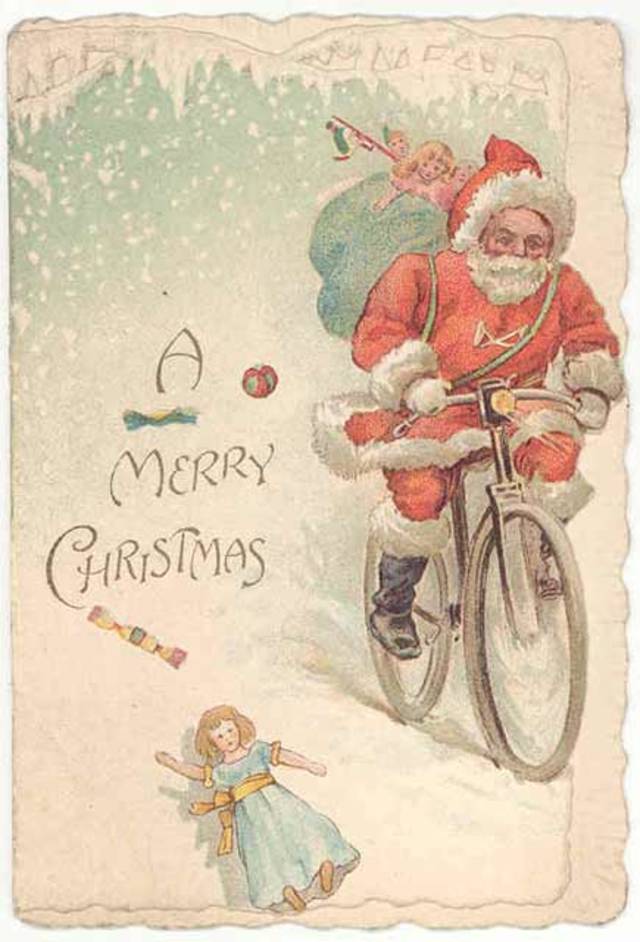
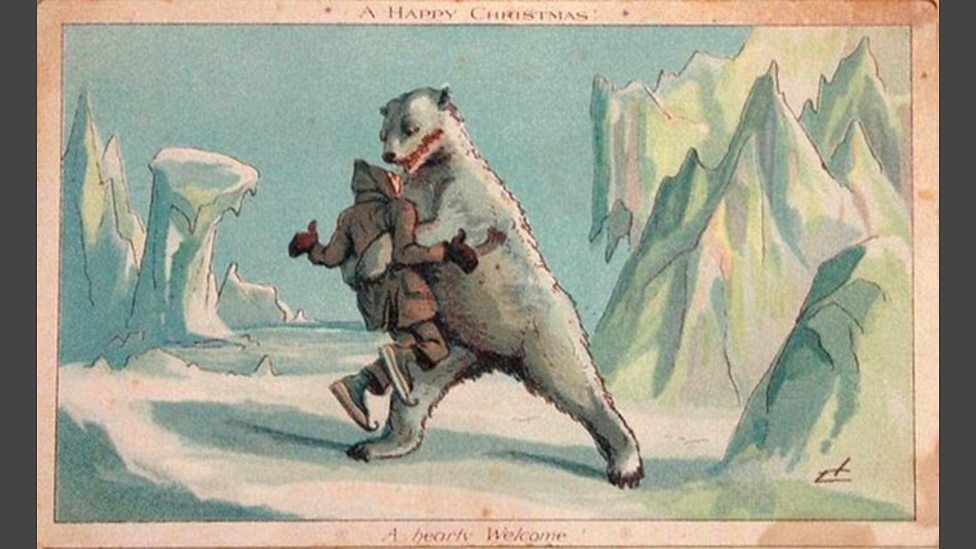
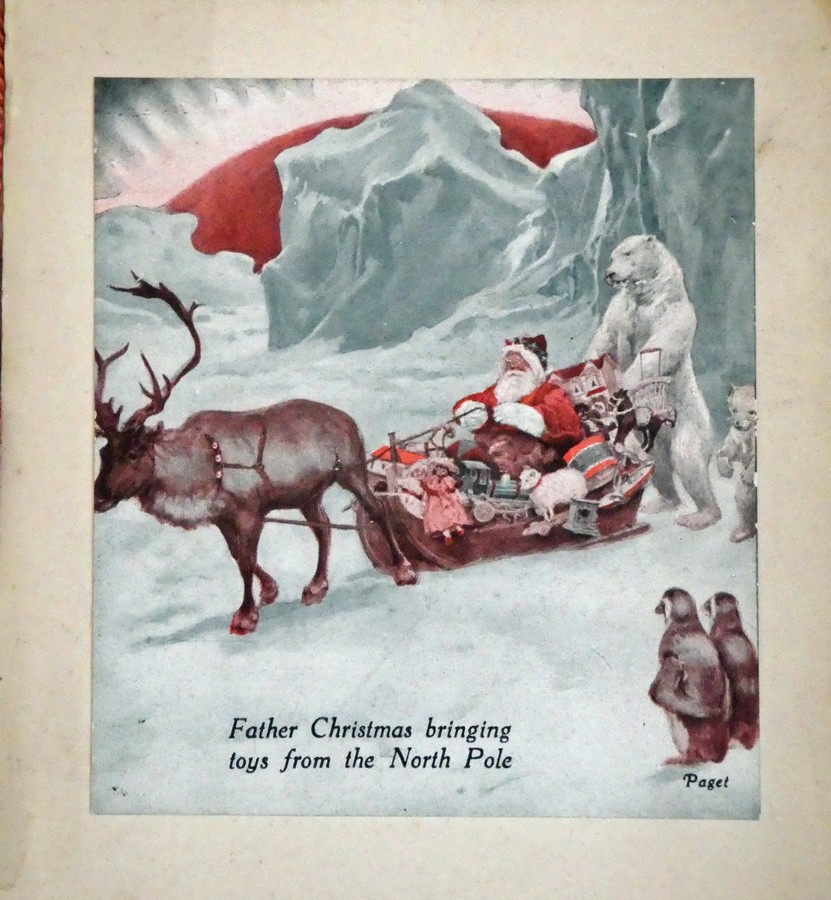
The picture above might seem a more innocent and conventional Father Christmas, albeit on a bicycle – but is he chucking his toys out of the bag in a fit of pique? And if Father Christmas doesn’t get you, a polar bear might.
Although the images on Christmas cards may have been grim, in contrast the messages were usually quite sweet. Valentine’s cards had already got under way as an early form of greetings card by the first part of the 19th century, and it seems that however fearsome the picture, you were at least expected to send good wishes to the recipient. Perhaps the whole thing was really meant to be an extension of Christmas merriment? I’ll come back to that! In the meantime, here’s a delightful video from the V&A about the history of Valentine’s cards.
But coming back to the strange nature of early Christmas cards, even among my own later collection, dating from the end of the 19th century to the 1920s and 30s, there are some extremely odd images. Take this one, of Boy Scouts ready to kill their Christmas dinner.

And a friend said she’d discovered something similar:
‘When we moved into our house we found many pieces of Victorian childhood memorabilia underneath the floorboards of the top floor bedroom, presumably posted there through the gaps by the incumbents. Amongst them was a gruesome picture of a very small boy dragging a very large dead bird home along the road by its leg for Xmas dinner…. !‘
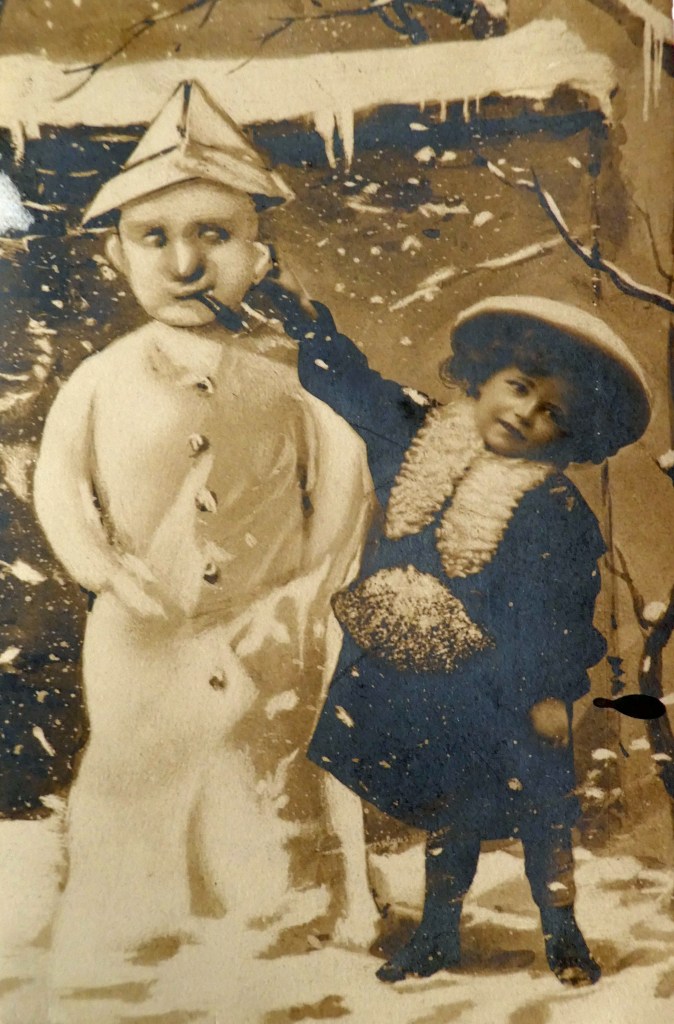
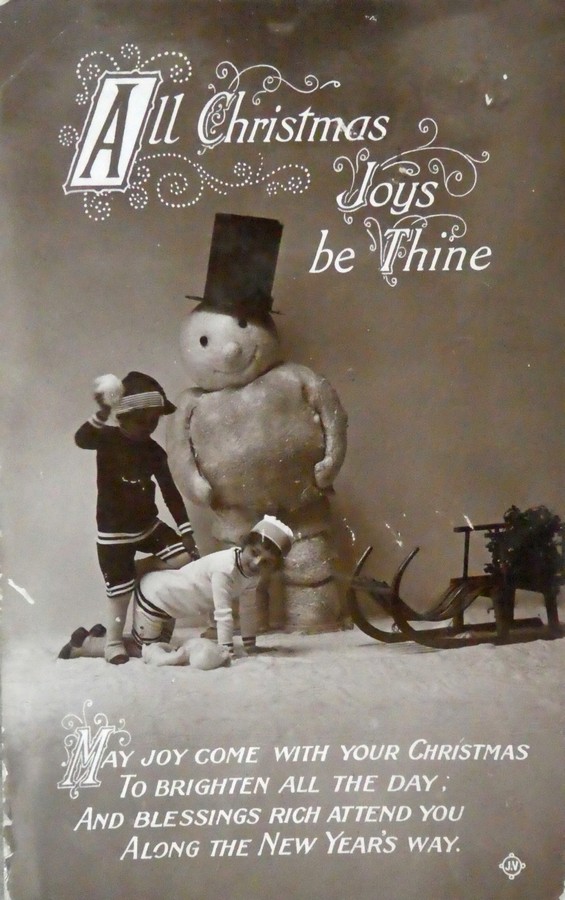
Some cards in my collection, perhaps inadvertently, are very odd – not to say dubious – in their tone. I wouldn’t trust a small child with this snowman – would you?
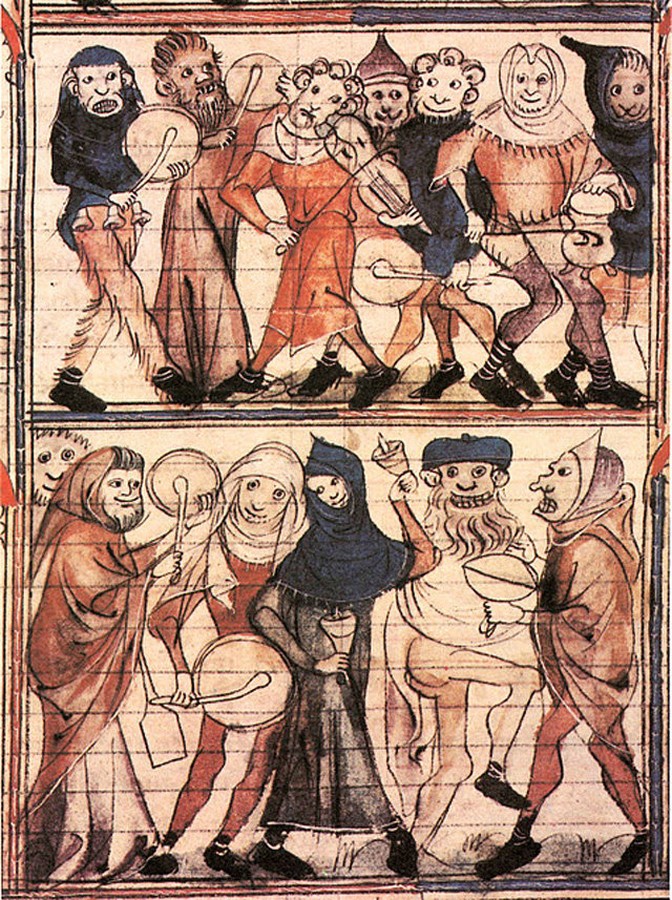
The Feast of Fools
Is the Victorian love of bizarre Christmas cards a continuation of the old tradition of the Feast of Fools? I was trying to make sense of their taste, and finding no help from more authoritative sources, when it occurred to me that this might be Saturnalia resurfacing again. Check out the above link to my earlier blog on this subject, which I quote from below:
‘So as well as the religious and domestic celebrations of the Christmas period, primarily associated with the birth of the baby Jesus and the coming of the Three Kings, this is also the domain of the Lord of Misrule. In customs found all over Europe, during the period when the sun ‘stands still’ and seems to halt in its cycle, at the period of greatest darkness, the usual hierarchy could be turned upside down. This was ‘time out’ – time out of the calendar, time out of work, and time out of the normal rules and regulations. Society could throw off its shackles and reverse the general order. Thus a servant could play master or mistress for a night; a Knave could become a King at the Twelfth Night Feast. Games normally forbidden, such as ball games in Tudor England, could now be played. Priests played practical jokes, and got tipsy, while mock sermons were preached by ‘boy bishops’ or perhaps anyone not too drunk to stand up and spout a few words.’
Perhaps the Victorians liked the rumbustious side of Christmas and New Year traditions, and to laugh merrily over less than politically correct jokes? And are we missing a trick by designing more tasteful cards today? Probably not; I can’t see flying bats, murderous Santas and bear attacks being quite so popular nowadays. When I was at school, some of my elderly teachers (or so they seemed to me at the time!) complained that the meaning was being taken out of Christmas as not all the cards were showing Nativity-related themes. Had they dug into the matter further, they might have been shocked and surprised by what the Victorians thought was acceptable!
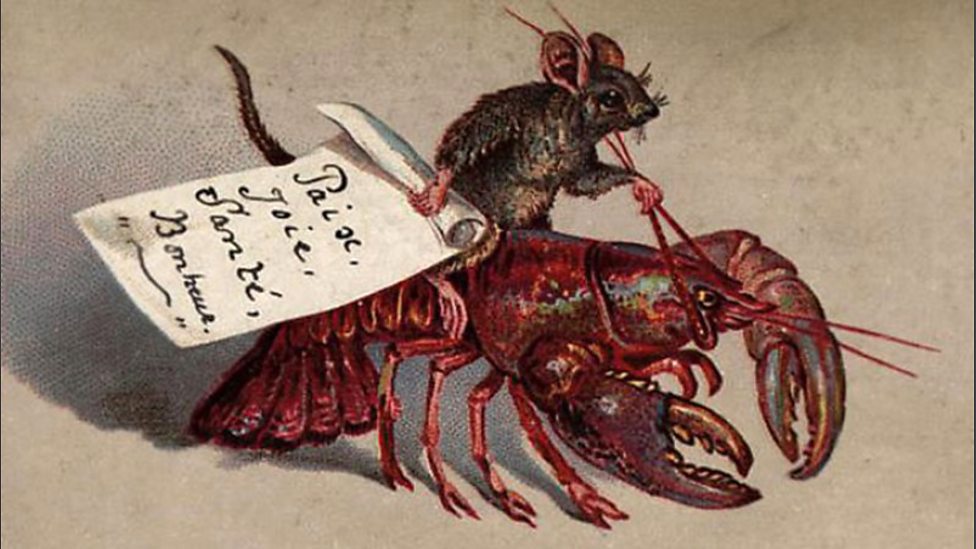
Ho, ho, ho….here’s my final jolly offering. Now where’s that mouse – or possibly rat – going on that sinister-looking lobster?













 Cherry's Cache